


Table of Contents Show
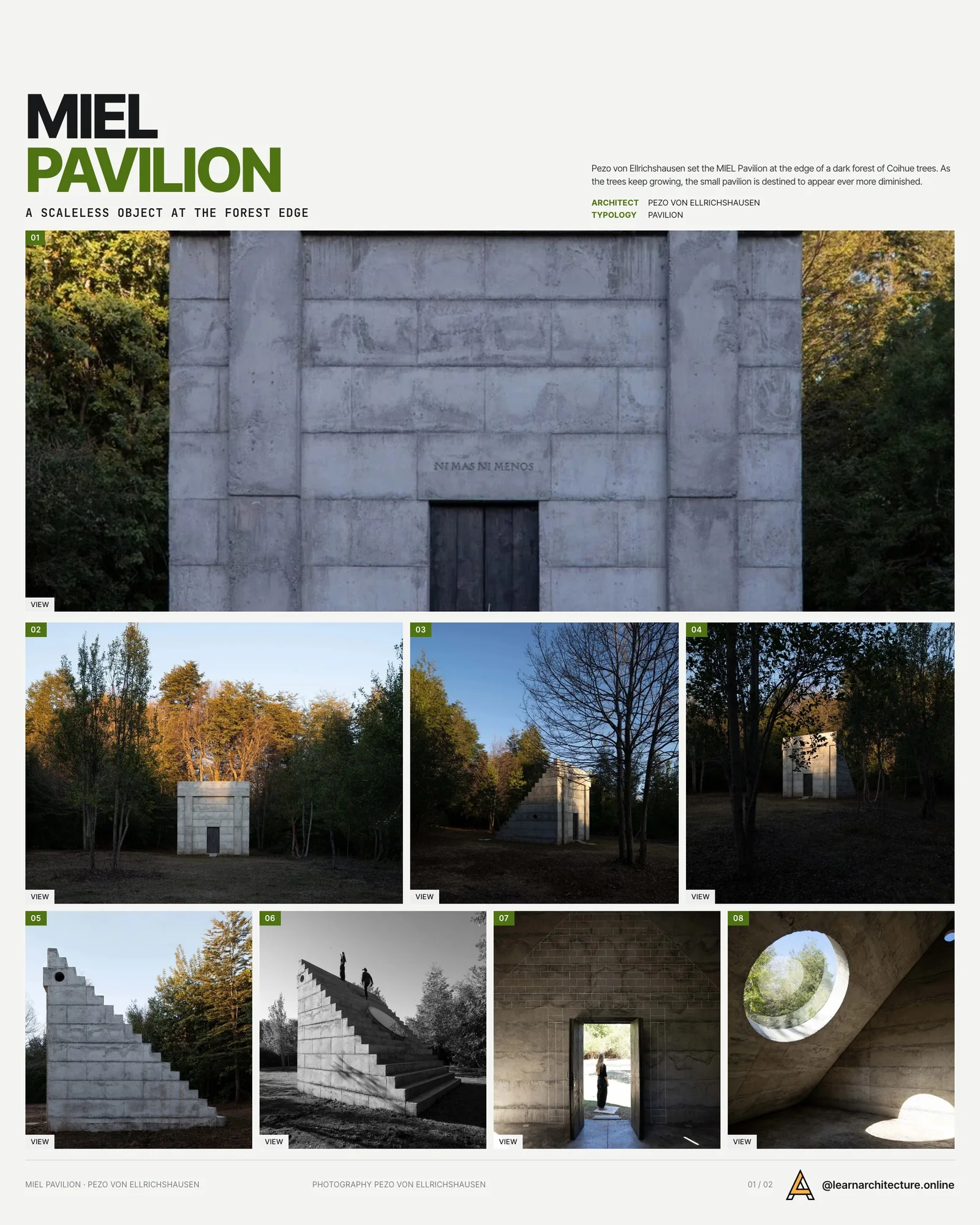
The MIEL Pavilion by Pezo von Ellrichshausen is a small yet conceptually dense architectural object set at the edge of a dark forest of Coihue trees (Nothofagus dombeyi). As these trees continue to grow, slowly and indifferently, the pavilion is destined to appear increasingly diminished, reinforcing its condition as a scaleless and quietly resistant structure. Neither fully monumental nor entirely subordinate to its surroundings, the pavilion exists in a state of deliberate ambiguity, where form, function, and symbolism converge.

An Asymmetrical Figure Anchored to the Forest
Placed tightly against the forest edge, the pavilion’s footprint is compact, concentrated, and deliberately directionless, yet it acquires a subtle axial reading through its pronounced asymmetry. One side rises sharply, suggesting the completion of an imaginary cube, while the opposite side dissolves almost entirely, refusing elevation and hierarchy. This imbalance generates a peculiar spatial tension, one that resists frontal interpretation while still asserting presence.
The pavilion does not seek harmony through symmetry. Instead, it accepts imbalance as a condition of its existence, echoing the irregularity of the surrounding landscape. The nearby topography, though artificially shaped, remains intentionally meaningless: reaching the top offers no reward in terms of view or dominance. Elevation here is not about control, but about gesture without consequence.

The Wall as Altarpiece and Threshold
One façade assumes an unexpected frontality, transforming the concrete wall into something resembling an altarpiece. This mute plane is reinforced by two buttress-like supports that hold an apparently unnecessary beam, an act that feels ritualistic rather than structural. Set into the lintel is an engraving, “NI MAS NI MENOS” (“no more, no less”), a statement that contradicts the wall’s silence while reinforcing the pavilion’s philosophical stance of exactness and restraint.
Crossing this opaque threshold marks a decisive spatial shift. An oversized circular oculus cuts abruptly through the boundary, cropping the foliage beyond and severing the continuity of the forest canopy. Once inside, the distinction between wall and ceiling dissolves entirely. Spatial orientation softens, and enclosure becomes abstract rather than literal.

Interior Diagonals and Diluted Forces
Inside the pavilion, what the architects describe as the opposing forces of spirit and gravity (borrowing Georg Simmel’s terms) are no longer clearly legible. These vectors disperse along a diagonal equilibrium, producing a space that feels neither fully intentional nor purely dictated by necessity. The room resists a single reading; it must be experienced through occupation rather than observation.
This interior ambiguity contrasts sharply with the exterior, where mass, slope, and geometry assert themselves more clearly. The pavilion’s form suggests effort and weight from the outside, while inside it becomes surprisingly light, almost diagrammatic, emphasizing perception over structure.

A Relative Object Seen From All Sides
The pavilion’s identity shifts depending on the observer’s position. From a distance, it registers as a discreet monument, restrained and nearly anonymous. From within the forest, it reads as an interrupted plinth, something unfinished or embedded. Viewed obliquely from inside, the materiality dissolves into delicate white traces (subtle marks left by the formwork) that soften the heaviness of concrete.
This relativity is central to the project. The wall, seemingly flat and almost without thickness, becomes irreversible: a one-way condition rather than a reversible surface. Outside, it suggests the engaged frame of a temple for six queens; inside, it transforms into the pale, almost ghostly drawing of an archetypal wooden cabin. Architecture here is not fixed but interpretive, oscillating between references without settling on one.

Craft, Concrete, and Productive Silence
Constructed from artisanal concrete, the pavilion carries the weight of manual labor and time. Its surface is not polished into abstraction but retains imperfections that register human involvement. These traces reinforce the project’s resistance to spectacle: it is not meant to be admired as an image, but inhabited as a tool.
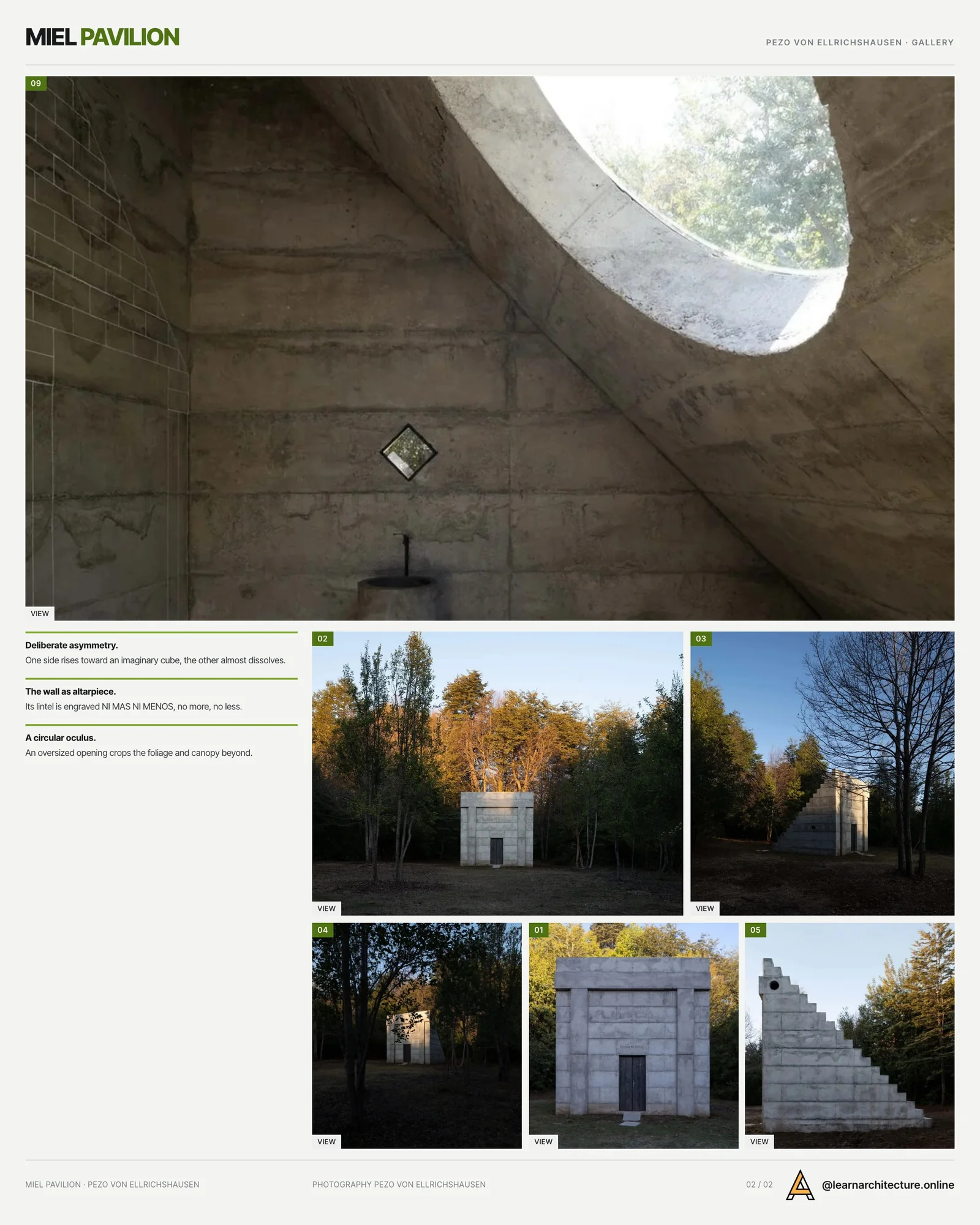
This becomes evident in its function. Despite its symbolic overtones, the pavilion serves a very modest and specific purpose: it is a workspace for the organic production of honey. Within these walls, a small-scale cycle of labor unfolds, centered around beekeeping and the care of six queen bees. The architectural drama is thus deliberately disproportionate to the task it shelters.

Architecture as Instrument Rather Than Object
The true generosity of the MIEL Pavilion lies in this contradiction. It appears monumental yet supports an everyday, almost invisible activity. It is not an object meant to be looked at, but an environment meant to be occupied, worked in, and slowly worn by use. Its symbolic gestures (altarpiece wall, temple references, ritual inscriptions) exist in tension with its humble productivity.
By allowing architecture to frame labor rather than replace it, Pezo von Ellrichshausen position the pavilion as an instrument of work and contemplation, rather than a finished statement. Over time, as the forest thickens and the pavilion recedes further into shade, this small concrete structure will continue to do precisely what its inscription declares: no more, no less.
Photography: Pezo von Ellrichshausen
- Architecture and landscape
- Architecture and nature dialogue
- Architecture for production
- Artisanal concrete design
- Beekeeping architecture
- Chilean architecture
- Conceptual pavilion design
- Concrete pavilion architecture
- Contemporary pavilion projects
- Experimental architectural practice
- Experimental concrete structures
- MIEL Pavilion
- Minimal architecture pavilion
- Minimalist pavilion design
- Monolithic concrete architecture
- Pavilion in forest setting
- Pezo von Ellrichshausen
- Poetic architecture
- Ritual space architecture
- Small-scale architecture












Leave a comment