


Table of Contents Show
Deconstructivist buildings are structures that deliberately reject conventional architectural order, symmetry, and harmony in favor of fragmented forms, tilted planes, and disjointed geometry. The movement emerged in the 1980s and was formally introduced to a broad audience through the 1988 Deconstructivist Architecture exhibition at New York’s Museum of Modern Art, curated by Philip Johnson and Mark Wigley. Its defining architects include Frank Gehry, Zaha Hadid, Daniel Libeskind, Rem Koolhaas, Peter Eisenman, Bernard Tschumi, and Coop Himmelb(l)au.
What Is Deconstructivist Architecture?
Deconstructivist architecture is a late-20th-century movement that challenges traditional relationships between form, structure, and function. Rather than treating a building as a unified composition with clear hierarchies, deconstructivist design treats architecture as a collision of elements that can be pulled apart, shifted, and reassembled in unexpected ways. The term itself is a portmanteau of “deconstruction” (the philosophical method developed by Jacques Derrida) and “constructivism” (the Soviet modernist movement of the 1920s).
In deconstructivist architecture, buildings are designed to appear fragmented or in motion. Surfaces intersect at unexpected angles, load-bearing elements are hidden or disguised, and the visual logic of the facade often works against the building’s structural logic. None of this is accidental: the intent is to destabilize the viewer’s assumptions about what a building should look like and how it should behave.
⚠️ Common Mistake to Avoid
Many people use “deconstructivist” and “postmodern” architecture interchangeably, but they are distinct. Postmodern architecture plays with historical references and ornament, often ironically. Deconstructivist architecture, by contrast, has no interest in historical quotation. It attacks the very idea of coherent architectural form, regardless of which historical period that form comes from. The two movements overlap in time but differ sharply in method and intent.
How Deconstructivism Became a Movement
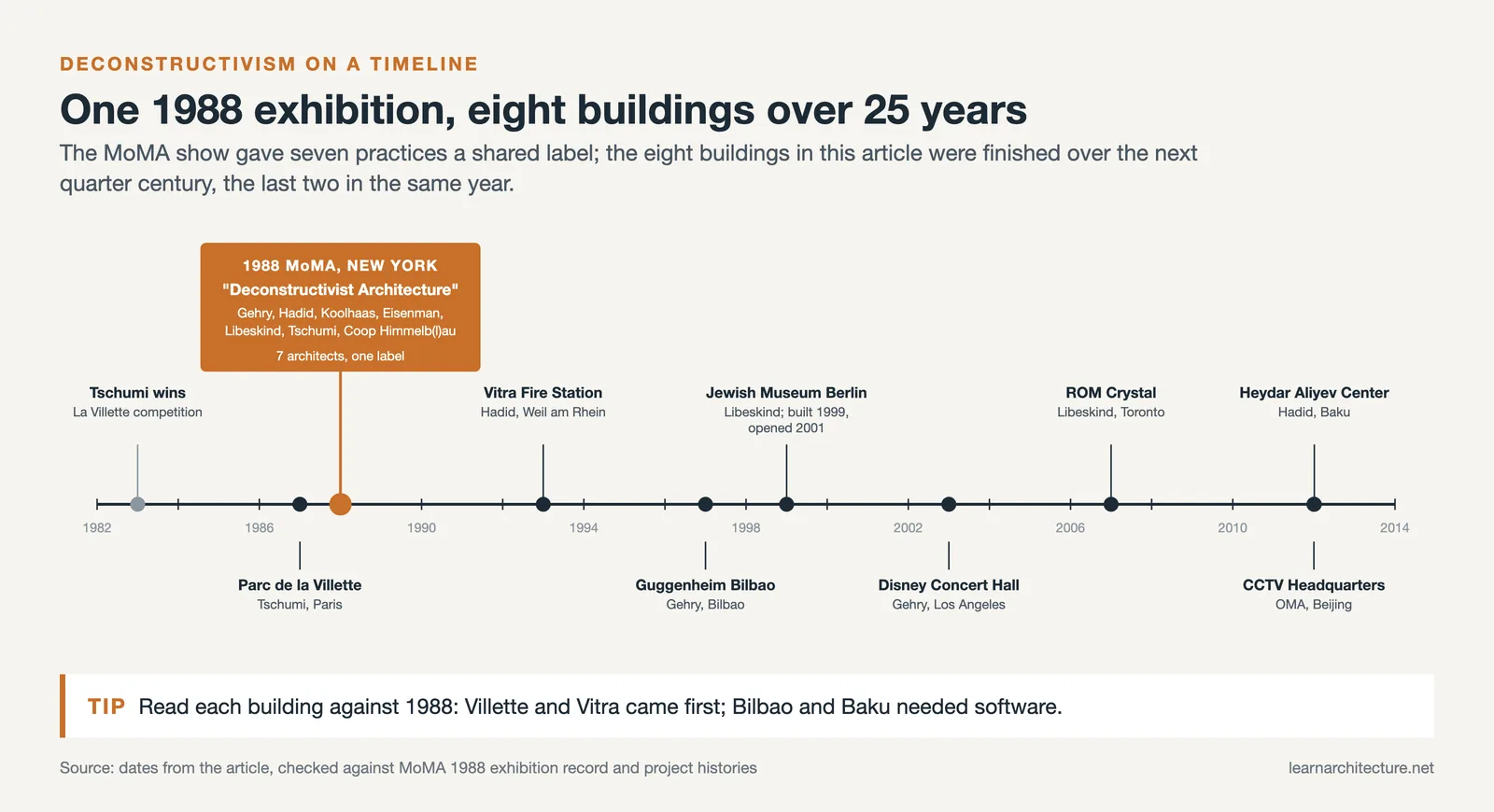
The movement did not emerge from a single manifesto or school. It crystallized around three converging forces. First, Jacques Derrida’s philosophical writing on deconstruction in the late 1960s gave theorists a framework for questioning stable meaning in built form. Second, the Russian Constructivist movement of the early 20th century had already demonstrated that angular, colliding geometries could be structurally viable. Third, the 1988 MoMA exhibition brought together seven architects whose independent experiments suddenly looked like a coherent movement.
Notably, several architects associated with the style rejected the label. Frank Gehry said he never considered himself a deconstructivist, and Derrida reportedly confirmed that Gehry’s work was not, strictly speaking, deconstructivist. Daniel Libeskind has similarly distanced himself from the term in later interviews. This resistance is itself telling: deconstructivism was always more a critical designation than a self-declared style.
📌 Did You Know?
The 1988 MoMA exhibition “Deconstructivist Architecture” was organized by Philip Johnson and Mark Wigley. Wigley’s catalogue essay tried to find a common thread among seven architects (Gehry, Hadid, Koolhaas, Eisenman, Libeskind, Tschumi, and Coop Himmelb(l)au) whose work was better known for its differences, and described the projects as marking “a different sensibility, one in which the dream of pure form has been disturbed.”
8 Iconic Deconstructivist Buildings You Should Know
The buildings below span four decades and four continents. Each represents a distinct approach to the core deconstructivist impulse: using architecture as a medium for disorientation, critique, and formal experimentation. For students and practitioners studying deconstructivist architecture, these are the essential reference points.
1. Guggenheim Museum Bilbao (1997): Frank Gehry
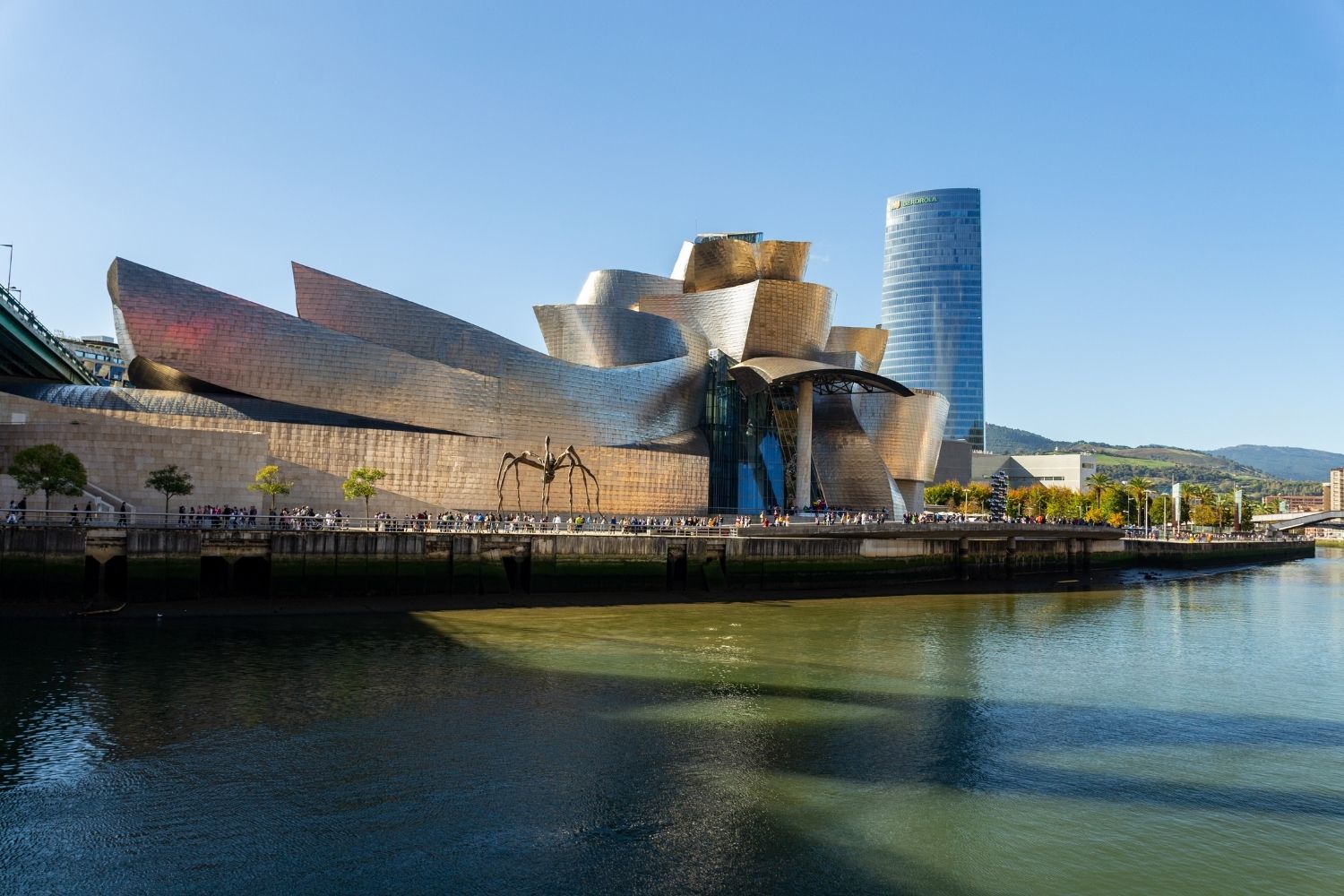
The Guggenheim Bilbao is the building that brought deconstructivist architecture into mainstream cultural consciousness. Located on the Nervion River in Bilbao, Spain, the museum is clad in approximately 33,000 titanium panels, each custom-shaped to produce its rippling, fish-scale surface. The form reads differently from every angle: at times like crumpled metalwork, at others like a ship docked against the waterfront.
Gehry designed the building using CATIA software, a 3D modeling tool originally developed for the aerospace industry, one of the first major architectural projects to rely on it for both design and fabrication. The building’s cultural impact was immediate: tourism to Bilbao increased dramatically in the years following its opening, a phenomenon now widely referred to as the “Bilbao Effect.” The museum houses a permanent collection of modern and contemporary art alongside temporary exhibitions, and its atrium is one of the most photographed interior spaces in 20th-century architecture.
💡 Pro Tip
When studying the Guggenheim Bilbao as a design student, pay attention to how Gehry handled the relationship between the building’s irregular exterior and its functional interior galleries. The main challenge of deconstructivist architecture is not the formal experimentation itself but maintaining usable, well-lit interior spaces beneath an exterior that appears to refuse all rational geometry. Gehry’s solution was to keep the gallery spaces relatively conventional while concentrating the deconstructive energy in the circulation areas and the building’s skin.
2. Jewish Museum Berlin (2001): Daniel Libeskind
The Jewish Museum Berlin was Libeskind’s first major built work, and it remains one of the most emotionally charged buildings of the 20th century. The zinc-clad building zigzags across its Berlin site in a form that, viewed from above, suggests a fragmented Star of David. Libeskind described the building as a “between the lines” composition: two lines, one straight but broken, one tortuous but continuing, represent the relationship between Jewish history and German history.
The building contains a series of “voids”: empty, inaccessible concrete shafts that cut through the building vertically and can only be glimpsed through narrow slots in the walls. One of these, the Holocaust Tower, is an unheated, unlit space accessible only through a heavy door. The interior temperature is whatever the outside temperature happens to be. Libeskind’s deconstructivist approach here is not purely formal: every angular collision and disorienting circulation path carries deliberate symbolic weight. Visitors consistently describe a physical sense of unease that the architecture induces before they encounter a single exhibit.
The museum is part of the wider postmodern and late 20th-century architectural movements that sought to reconnect building form with meaning and cultural memory, though Libeskind’s method is considerably more radical than most postmodern strategies.
3. Walt Disney Concert Hall (2003): Frank Gehry
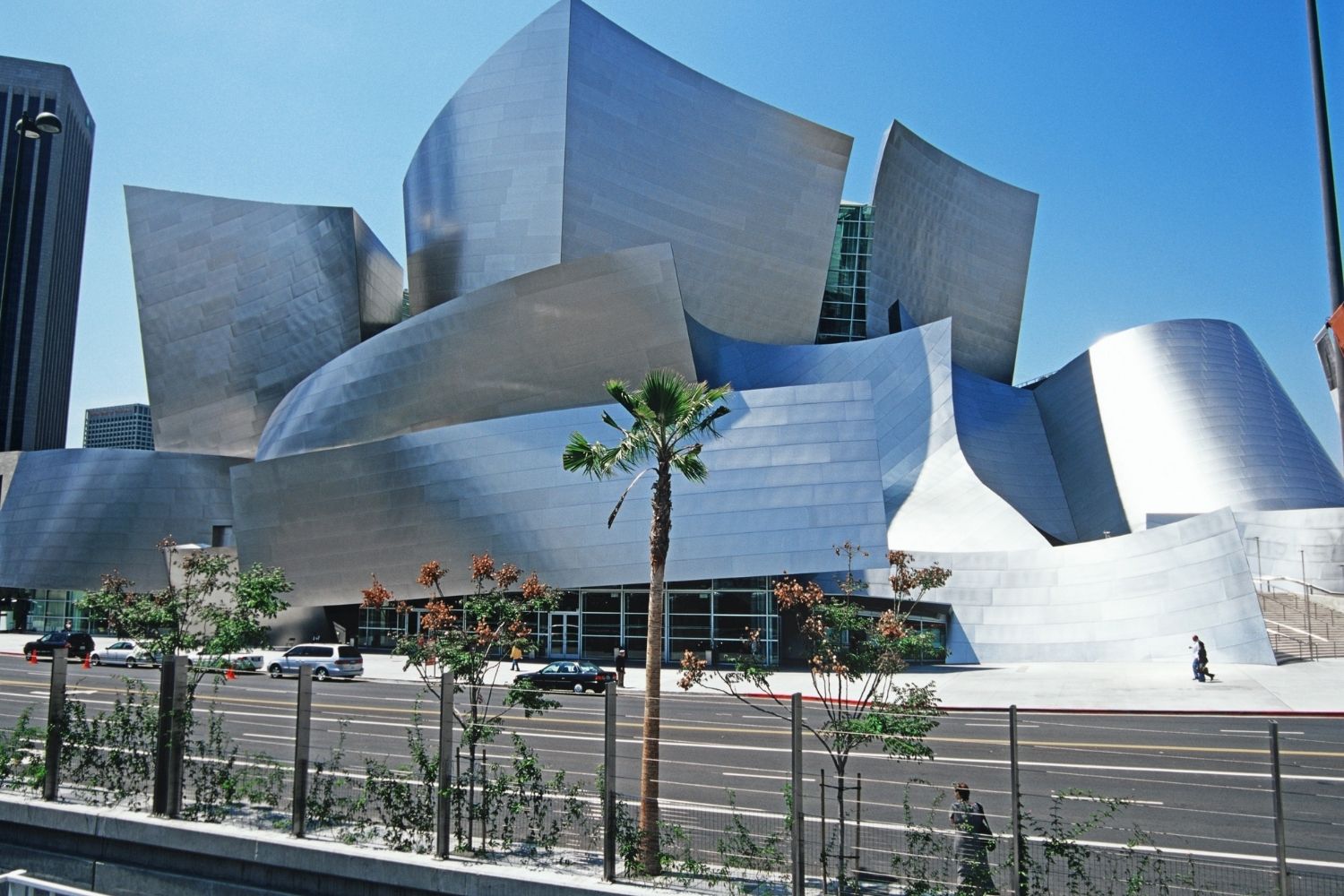
Located in downtown Los Angeles, the Walt Disney Concert Hall is Gehry’s most celebrated work in the United States. Its stainless-steel exterior consists of curved and folded panels that catch Southern California light differently across the day. The building was commissioned in 1987 and opened sixteen years later, delayed significantly by funding and structural complications. The exterior you see today differs from the original design: Gehry initially intended polished stainless steel, but residents of nearby apartments complained about intense solar reflections, and sections of the surface were sanded to reduce glare.
Inside, the hall is acoustically exceptional. The main auditorium seats 2,265 people and was designed in close collaboration with acoustician Yasuhisa Toyota. The interior walls of Douglas fir panels curve organically, responding to sound distribution requirements rather than to any formal architectural logic. The result is a rare case in deconstructivist architecture where the interior spatial complexity is driven by performance requirements as much as by aesthetic intent.
🎓 Expert Insight
“The building is not about trying to be difficult. The building is about trying to be accessible.”
Frank Gehry, architect
Gehry made this observation in response to criticism that deconstructivist architecture is willfully obscure. His point is that the formal complexity of Walt Disney Concert Hall was always in service of the building’s civic role: drawing people into the cultural life of Los Angeles through a building that is impossible to overlook.
4. CCTV Headquarters (2012): Rem Koolhaas / OMA
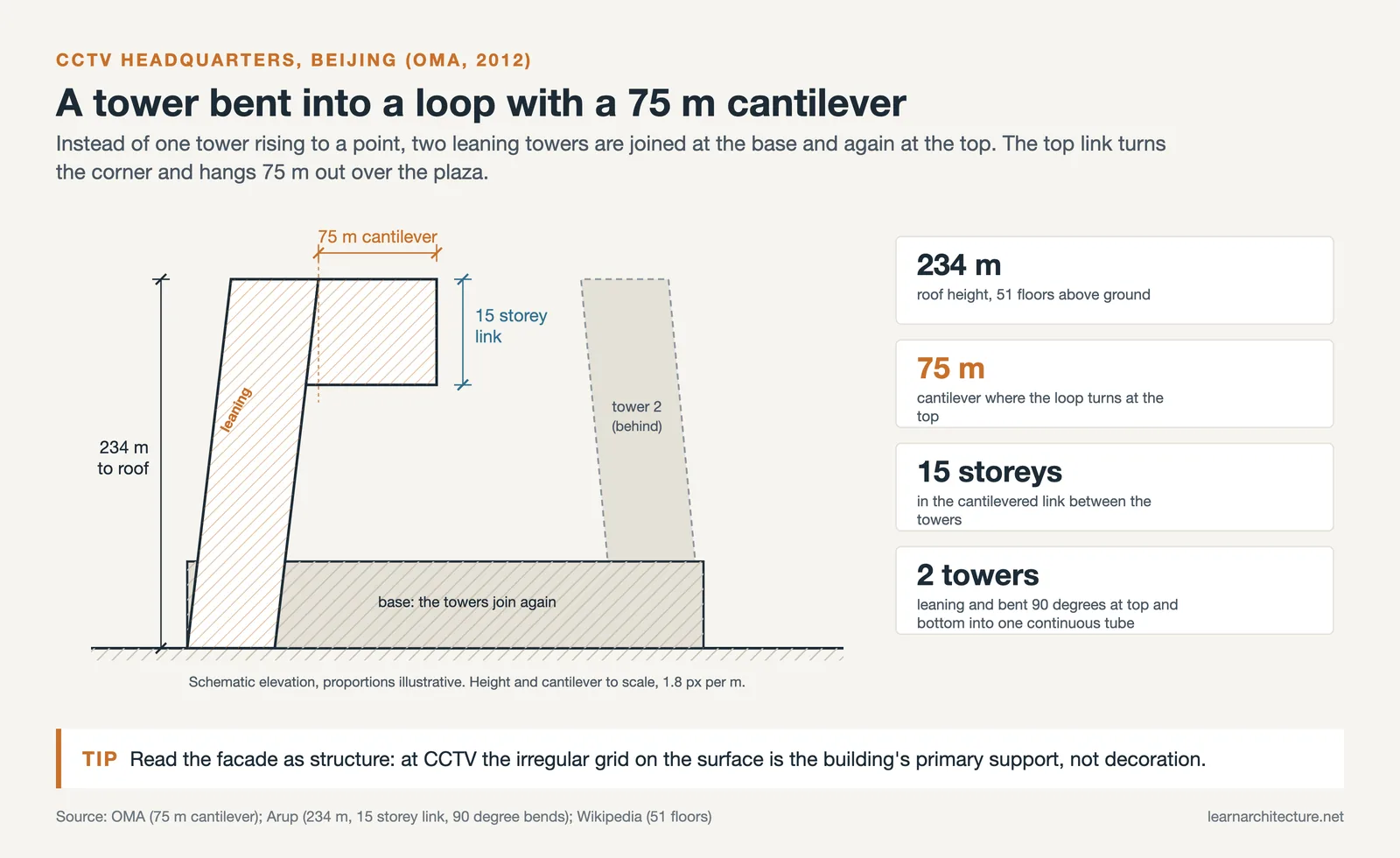
The China Central Television headquarters in Beijing is one of the most structurally ambitious buildings of the 21st century. Designed by Rem Koolhaas and Ole Scheeren of OMA, the building consists of two leaning towers that arch at the top and bottom to form a continuous loop. The result is a single building that reads as a closed loop in space, with no clear front, back, top, or bottom.
The structural engineering required to build it was extraordinary. The two towers lean toward each other at six degrees from vertical, and the overhanging sections at the top, which project roughly 75 meters from the tower faces, had to be assembled using a precise sequence of steel connections to control stress distribution as the structure settled. The building is a canonical example of how deconstructivist formal ideas can now be realized through computational structural engineering that was simply not available to earlier generations of architects.
Understanding how structure and form interact in buildings like this connects directly to wider studies of how shapes in architecture influence both structural behavior and user experience.
5. Heydar Aliyev Center (2012): Zaha Hadid
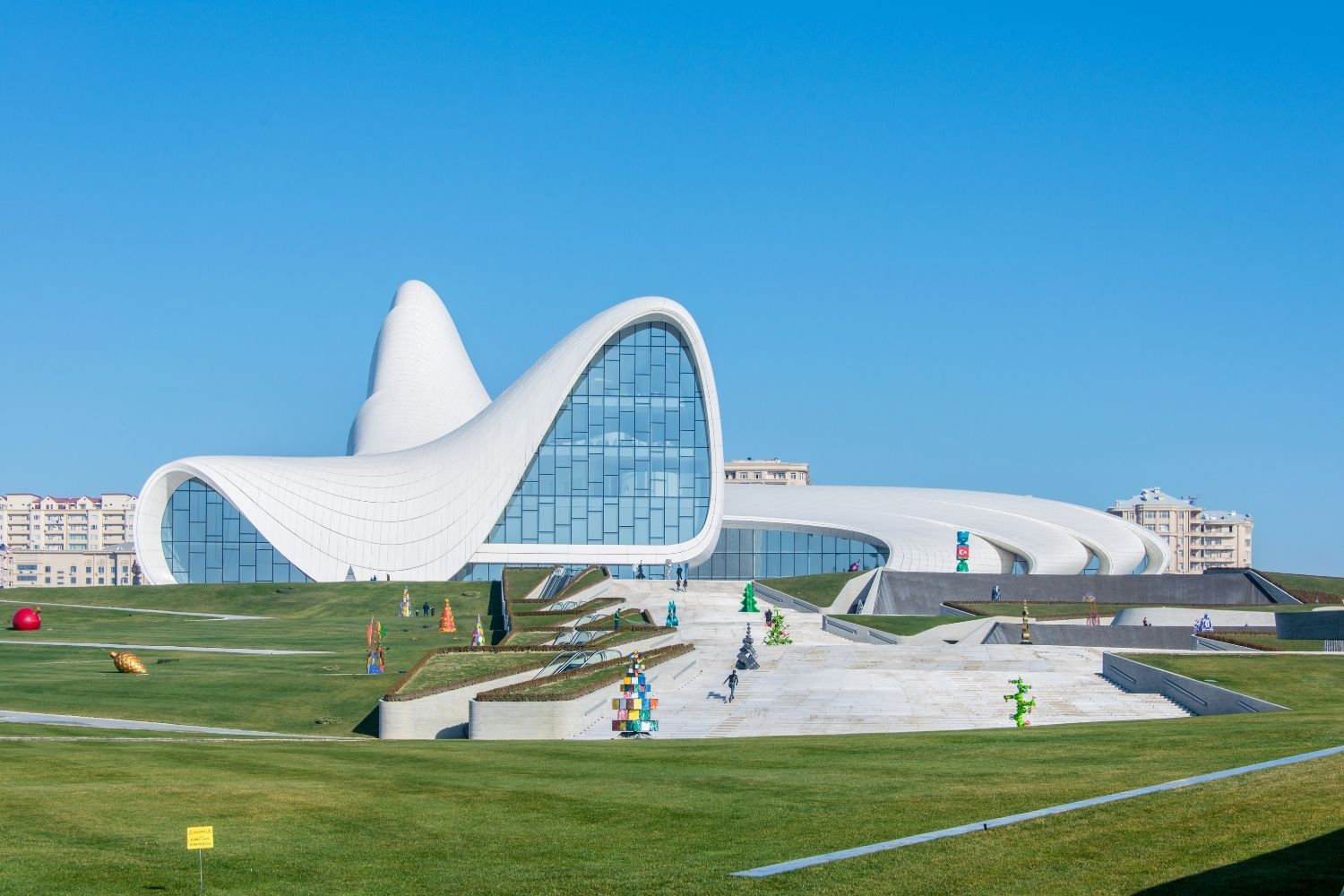
The Heydar Aliyev Center in Baku, Azerbaijan is among the purest expressions of Zaha Hadid’s mature design language, and one of the most widely recognized Zaha Hadid deconstructivist buildings. The building’s exterior is a single continuous white surface that folds upward from the landscape, forming the ground plane, walls, roof, and canopy in one uninterrupted gesture. There are no right angles anywhere in the building’s envelope.
Hadid combined a concrete structural body with a lattice-frame system clad in glass-fiber-reinforced concrete panels. The panels were prefabricated off-site and assembled to tolerances measured in millimeters. The interior continues the exterior geometry: floors curve into walls, stairs become ramps, and the ceiling of one space transitions without interruption into the wall of the next. The building won the Design of the Year award from the London Design Museum in 2014.
6. Vitra Fire Station (1993): Zaha Hadid
The Vitra Fire Station in Weil am Rhein, Germany was Hadid’s first completed building, and it established the formal vocabulary she would develop for the next two decades. The building’s concrete planes tilt and stack at sharp angles, the horizontal lines of the facade broken by jutting slabs that convey tension and speed. Hadid described the building as a “frozen movement,” a structure that embodies the urgency of fire response in its very geometry.
The fire station is no longer in use for emergency response and now functions as an exhibition space on the Vitra Campus, which also contains buildings by Frank Gehry, Tadao Ando, and Alvaro Siza. Visiting the campus gives a rare opportunity to experience early deconstructivist design at human scale, without the contextual noise of an urban setting. For students of deconstructivist design, the Vitra Fire Station is worth studying closely: it is small enough that you can read every formal decision from a single viewpoint.
7. Parc de la Villette (1987): Bernard Tschumi
The Parc de la Villette in Paris is deconstructivism at the scale of a landscape. Tschumi won the 1982 to 1983 competition for the park’s design with a scheme that distributes 26 red steel “follies” across the site in a regular grid, regardless of the program each contains. The follies are identical in their basic cubic armature but differ in their secondary additions, ramps, stairs, covered walkways. The park’s three organizational systems, namely points (the follies), lines (covered walkways), and surfaces (open lawns), are deliberately superimposed without one taking priority over the others.
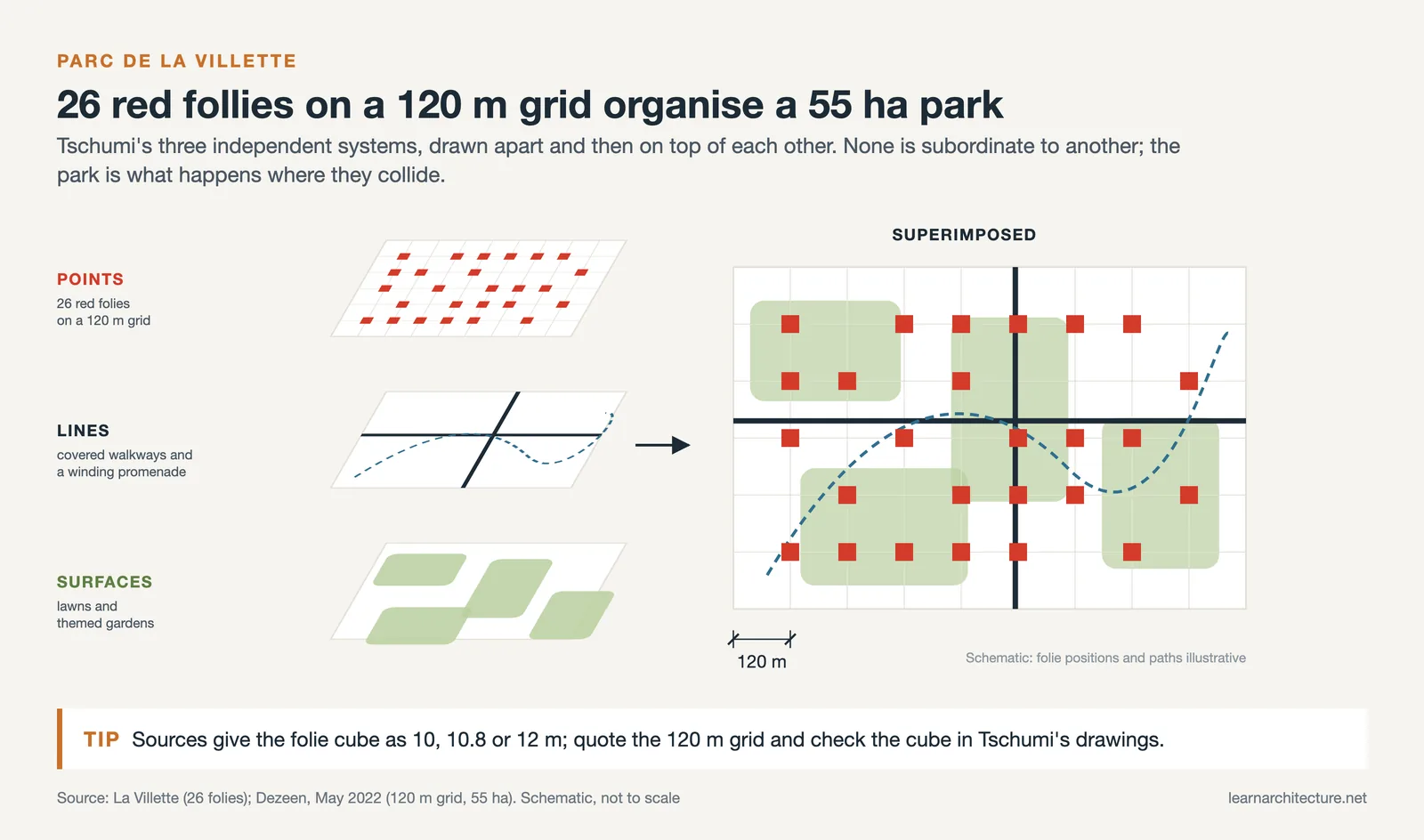
Tschumi’s theoretical argument was that architecture does not need a hierarchy of program and form. The follies demonstrate that a building can be composed from a formal system applied consistently, without requiring that the system “make sense” in relation to what happens inside. The park remains one of the most used public spaces in Paris, which is itself an argument that architectural disorientation does not prevent a space from being genuinely inhabited.
💡 Pro Tip
When analyzing Tschumi’s Parc de la Villette in a design studio or academic context, focus on the distinction between his “points, lines, and surfaces” organizational system and the more familiar hierarchy of primary and secondary circulation in conventional park design. The conceptual move Tschumi makes is to treat all three systems as equally weighted, which produces a landscape that reads as designed but cannot be decoded through conventional spatial logic. This is a useful framework for thinking about how organizational systems can generate formal results that exceed the rules that produced them.
8. Royal Ontario Museum Extension (2007): Daniel Libeskind
The Michael Lee-Chin Crystal, Libeskind’s extension to the Royal Ontario Museum in Toronto, is one of the clearest examples of a deconstructivist building in an urban context, and one of the few significant deconstructivist buildings in North America outside the United States. Five intersecting crystalline volumes clad in aluminum and glass are joined into a single structure with no parallel walls, no right angles, and no flat ceilings anywhere in the addition. The building pushes against its historic Edwardian host with an aggressive collision of geometries.
The project generated considerable public controversy in Toronto, where opinions divided sharply between those who found it an energizing addition to the museum’s civic presence and those who found the geometry fundamentally hostile to the display of art and artifacts. Libeskind’s response was characteristically blunt: the building’s job was not to be neutral but to honor the complexity of the museum’s collections by refusing to reduce them to a simple container. The extension added approximately 8,000 square meters of gallery and public space to the existing museum.
This approach to expanding historic buildings raises broader questions about how an architecture concept can be developed in direct tension with its surrounding context rather than in harmony with it.
What Makes a Building Deconstructivist?
Across these eight buildings, several consistent formal and theoretical strategies recur. Fragmentation is the most visible: walls, roofs, and facades appear to be coming apart rather than holding together. Asymmetry replaces any compositional balance, and the viewer cannot resolve the building into a stable overall image from any single viewpoint. Industrial materials like steel, glass, and exposed concrete are used without applied surface finish, which keeps the building’s tectonic honesty visible even as its form becomes increasingly abstract.
The deeper commonality is intellectual. Deconstructivist architects treat the building as a critical instrument, a way of questioning the assumptions embedded in conventional architectural form. This connects to broader architectural debates about form and function in architecture and whether a building’s visual language must correspond to its programmatic use.
Why Deconstructivist Architecture Still Matters
Deconstructivism as a formal movement peaked in the 1990s and early 2000s. Most of the architects associated with it have either moved into different formal territory (Koolhaas’s later work, for instance, is more interested in programmatic research than formal fragmentation) or are no longer practicing (Hadid died in 2016; Gehry, born in 1929, died in December 2025, and his late work was more restrained). The raw formal provocations of the movement’s founding generation are rarely replicated today.
What persists is the conceptual toolkit deconstructivism introduced. The idea that a building can be designed as a field of competing systems rather than a resolved composition, that form and function need not correspond, that architecture can carry theoretical and philosophical argument in its structure, these ideas have become part of mainstream architectural education and practice. Parametric design, which dominates contemporary avant-garde practice, would not exist in its current form without the formal experiments deconstructivism made physically credible.
For students examining architectural styles across history, deconstructivism occupies a specific and irreplaceable position: it was the moment when architecture most directly engaged with contemporary philosophy, and when the formal possibilities of the computer first began to be tested at full scale.
✅ Key Takeaways
- Deconstructivist buildings reject symmetry, harmony, and conventional compositional logic in favor of fragmented, colliding forms.
- The movement was formally defined by the 1988 MoMA exhibition, which grouped seven architects (Gehry, Hadid, Koolhaas, Eisenman, Libeskind, Tschumi, and Coop Himmelb(l)au) under a label most of them subsequently questioned.
- The Guggenheim Bilbao, Walt Disney Concert Hall, Jewish Museum Berlin, and Heydar Aliyev Center remain the most widely studied and visited examples of the style.
- Key formal characteristics include fragmentation, asymmetry, dislocation of structural logic, and the use of industrial materials left exposed.
- The movement’s lasting legacy is conceptual: it expanded the range of formal strategies available to architects and demonstrated that computational fabrication could make almost any geometry buildable.
For further reading on the movement and its key architects, the Dezeen deconstructivism series offers detailed profiles of each of the seven MoMA architects, and the Art Story overview of deconstructivism provides a reliable survey of the movement’s critical reception and historical context. The Guggenheim Bilbao official site and Jewish Museum Berlin both publish detailed architectural documentation of their respective buildings.
- deconstructivist architecture
- deconstructivist architecture buildings
- deconstructivist building
- deconstructivist building in nyc
- deconstructivist buildings
- deconstructivist design
- deconstructivist style in architecture
- in deconstructivist architecture buildings are designed to
- zaha hadid deconstructivist buildings














Leave a comment