


Table of Contents Show
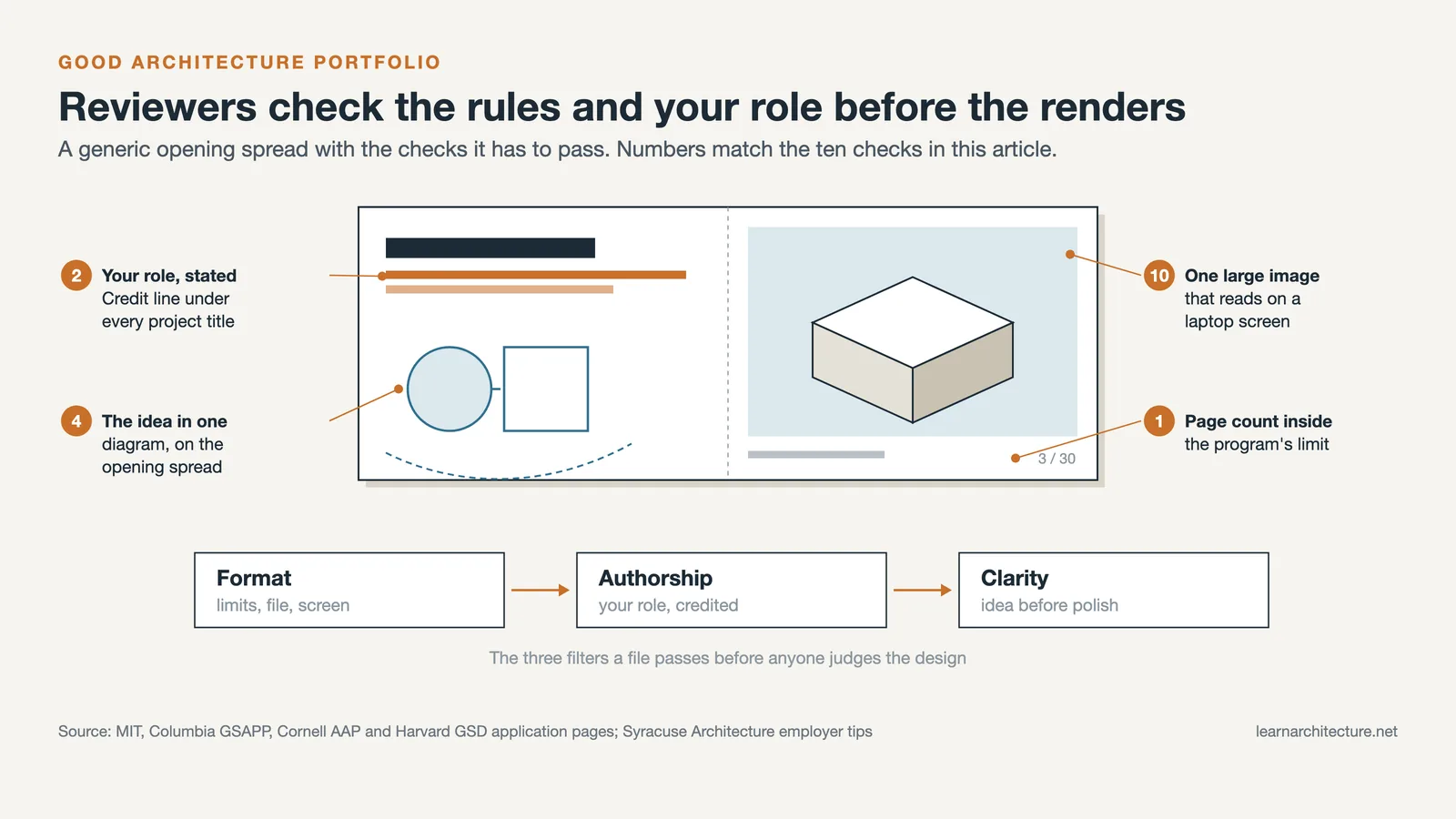
A good architecture portfolio is one that a reviewer can judge quickly and fairly: it follows the submission rules, makes your own role in every project clear, proves you can think in three dimensions, and states each idea so plainly that it reads on a laptop screen in seconds. Beautiful renders help only after those basics are in place.
Most portfolio advice explains how to make one. This piece looks at the other side of the table: what the people reading it are told to look for. The criteria below come from what graduate schools publish in their own application requirements and from what practices say about hiring. If you still need to build the document itself, start with our guide to creating an architecture portfolio that gets you hired, and for choosing the work, see which projects belong in a student portfolio. Here the question is narrower: once the file lands, what do reviewers check first?
Where Reviewers Get Their Criteria
Admissions committees rarely publish a scoring rubric, but their requirement pages say a lot about what they value. The wording is specific, and it tends to repeat across schools. Harvard GSD, for example, says the purpose of the M.Arch I portfolio is to demonstrate creativity, aptitude for design, and a capacity to think and design in three dimensions. Columbia GSAPP says its M.Arch portfolios are evaluated with a focus on the capacity to articulate and communicate concepts in visual and spatial form.
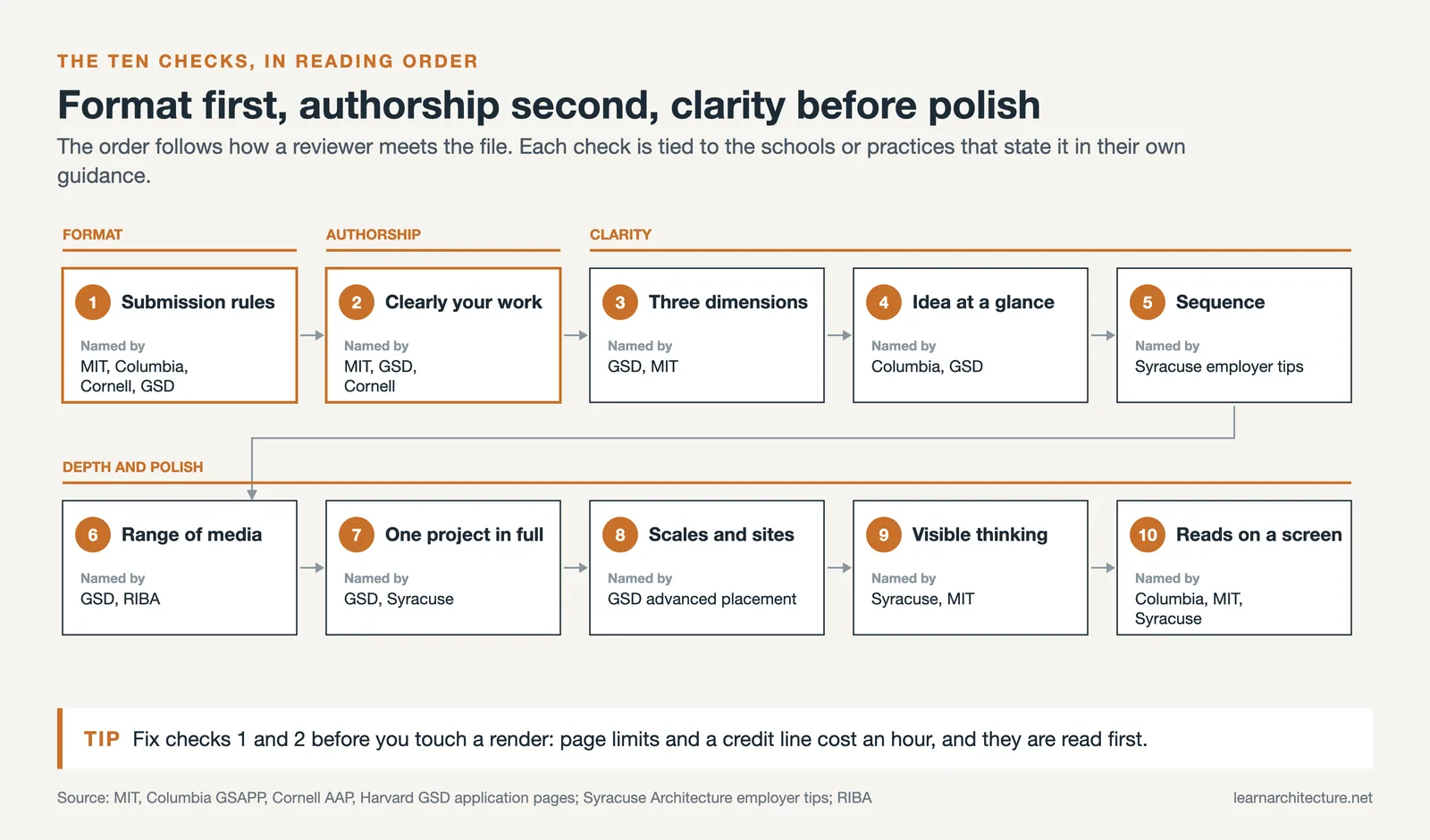
Practices publish less, yet the advice they give is close to the same list. Syracuse Architecture’s career services office has a page of portfolio tips that it says are based on employer comments about student portfolios, and the RIBA has printed interviews with practice directors on what they ask candidates to show. Read together, these sources point to the same ten checks.
Published Limits at Four Graduate Programs
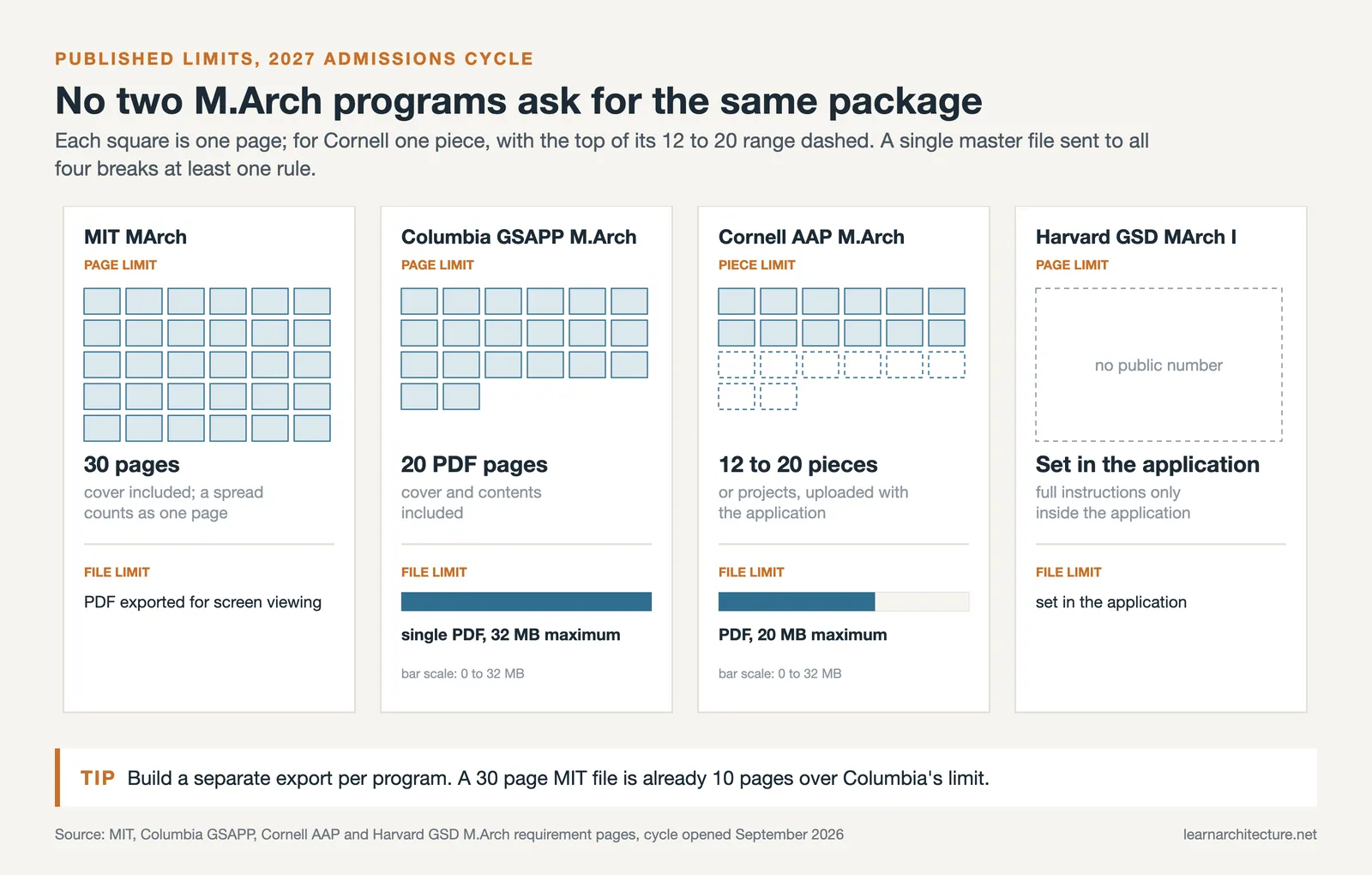
Format rules are the first filter, so it helps to see how much they vary. These are the limits each school states on its own M.Arch requirements page for the admissions cycle that opened in September 2026:
| Program | Length limit | File limit | Stated focus |
|---|---|---|---|
| MIT MArch | 30 pages, including cover; a spread counts as one page | PDF exported for screen viewing | Thinking visually and in three dimensions, at any scale |
| Columbia GSAPP M.Arch | 20 PDF pages, including cover and contents | Single PDF, 32 MB maximum | Communicating concepts in visual and spatial form |
| Cornell AAP M.Arch | 12 to 20 pieces or projects | PDF, 20 MB maximum | Highest level of conceptual and technical development |
| Harvard GSD MArch I | Full instructions only inside the application | Set in the application | Creativity, design aptitude, three-dimensional thinking |
Notice that no two programs ask for the same package. A single “master” portfolio sent everywhere will break at least one of these rules.
10 Things Reviewers Check First
The order below follows roughly how a reviewer meets your file: format before content, authorship before quality, clarity before polish.
1. Did You Follow the Submission Rules?
This is the cheapest check to make and the easiest reason to set a file aside. MIT caps the MArch portfolio at 30 pages, and a two-page spread counts as one of the 30. Columbia wants 20 PDF pages or fewer, cover and table of contents included, in a file no larger than 32 MB. Cornell asks for a PDF of no more than 20 MB and requires it to be uploaded at the same time as the application.
A reviewer who sees page 34 on a 30 page limit has learned something about you before looking at a single drawing: you did not read the brief. In a studio culture built around briefs, that is not a small signal. Harvard GSD also notes that complete, current instructions exist only inside the application itself, so the public page is a preview, not the final word.
2. Is It Clearly Your Work?
MIT, Harvard GSD, and Cornell all ask the same question in different words. MIT says collaborative work should be identified as such and the applicant’s role in the project defined. Harvard GSD strongly prefers a majority of individual projects and, if possible, not more than one group project and not more than one office project, with your role stated for any group work. Cornell goes furthest: each drawing from a group or office project must be labeled with the number of designers, which drawings you produced, and the names of the team; office work must also name the office and supervisor.
The reason is simple. A reviewer is judging you, not a team. When authorship is vague, the safest reading is the least generous one. GSD’s application guidance applies the same logic to AI tools: wherever it would be inappropriate to ask a person to do the work for you, it is equally inappropriate to prompt an AI tool to do it.
💡 Pro Tip
Put the credit line in the same spot on every project, directly under the title: collaborators, your role, and the instructor or office. When a reviewer has to hunt for it, they assume the answer is unflattering. A consistent credit line also saves you from explaining authorship out loud at interview.
3. Can You Think in Three Dimensions?
This is the criterion most often named outright. Harvard GSD lists “a capacity to think and design in three dimensions” as one of the portfolio’s three purposes, and MIT says it wants to understand your potential to think and operate visually and in three dimensions, at any scale. Neither school says this requires architectural work. Both accept art and design from other fields, and MIT explicitly says it is not looking for previous experience with architecture.
What proves spatial thinking is work that moves between views: a plan read against a section, a model photographed from eye level, a sequence of drawings that walks through a space. A folio of elevations and hero renders tells a reviewer about surfaces, not volumes.
4. Is the Idea Readable at a Glance?
Columbia’s stated focus is the capacity to articulate and communicate concepts in visual and spatial form. In Harvard GSD’s instructions for advanced placement candidates, conceptual clarity at each scale of a proposal is described as the driving factor in the graphic layout of the portfolio. That is a clear hint about where reviewers look first: the opening spread of each project.
If the concept only becomes clear on the third page, most reviewers will not reach it with the attention it deserves. A single diagram, a short title, and one strong image should carry the idea before any supporting sheets appear.
5. Does the Sequence Make Sense?
Order is a design decision, and reviewers read it as one. Syracuse’s employer tips say plainly not to arrange the work chronologically, and to put the best image you have made on the first page and the second best on the last. The same page adds that most employers prefer to see your favorite project first, because it shows what energizes you.
A clear contents page helps a reviewer who wants to jump to a specific project. Our piece on building a portfolio table of contents covers the layout side of that.
6. Is There Range in How You Represent Work?
Harvard GSD asks advanced placement candidates to show fluency in a variety of representational media: hand drawings or sketches, diagrams, orthographic drawings, renderings, and physical models. That list is useful even if you are not applying for advanced placement, because it describes what a reviewer expects an architecture education to have produced.
Practices say something similar. In an RIBA feature on portfolios, Ann Lakshmanan, director of Shepheard Epstein Hunter, put it this way: “Today almost anyone can produce a beautiful CGI render,” adding that a render does not necessarily say much about a candidate’s ability as an architect. She said hand drawings and sketches are what they really like to see, particularly from recent graduates.
7. Is at Least One Project Fully Documented?
A portfolio of highlights can hide gaps. Reviewers look for at least one project shown all the way through. GSD’s advanced placement guidance calls for complete documentation in two-dimensional drawings (site and building plans, sections, elevations) along with three-dimensional views. Syracuse’s employer tips say the same thing from the hiring side: architects like to see at least one project presented in full, from process through final drawings.
For a thesis or a capstone design studio, that full treatment usually earns more space than the other projects. Syracuse suggests the main studio project may need up to four spreads, while the others fit in one or two spreads each.
📌 Did You Know?
Harvard GSD states that once an application is submitted, no changes, additions, or edits can be made to the application materials or the portfolio, and that the portfolio becomes the property of the GSD. A typo on the cover or a missing credit line is permanent, so proof the exported PDF, not the layout file.
8. Does the Work Cover Different Scales and Sites?
For applicants with architecture training, reviewers check whether the work spans more than one kind of problem. GSD’s advanced placement list is specific: work across scales from the small freestanding building to the urban block, at least one project in an urban context, complex programmatic requirements, and engagement with building materials and technology. The same guidance asks for projects from at least four advanced design studios.
Five pavilions, however well drawn, answer only one of those questions. Swapping one of them for a housing scheme or a detailed wall section usually says more about you than a sixth polished render.
9. Can You See the Thinking, Not Only the Result?
Process is where reviewers look for judgment. Syracuse’s employer tips tell students to include sketches, trace, diagrams, study models, and screenshots, noting that employers like to see “early thinking.” MIT frames the same interest in broader terms, asking for work that shows how you perceive and structure the world around you.
Process pages work when they are edited. A wall of thumbnail sketches reads as filler; three iterations that show a decision being made read as design. For worked references on striking that balance, our roundup of architecture portfolio examples worth studying sorts portfolios by how much process they carry.
10. Does It Read Well on a Screen?
Almost every first review now happens on a monitor. Columbia asks for a PDF optimized for viewing on a standard size computer screen; MIT asks for a PDF exported for screen viewing. Syracuse warns against images reduced so small that the reviewer cannot see the information in them, and it adds a blunt line about model photos: a bad photo of a good model counts as a negative.
Hiring reviewers add a file size check of their own. For a first email to a firm that has not stated its requirements, Syracuse recommends a PDF of 5 MB or less. A 40 MB attachment may never reach the person you wrote to.
Do Firms Judge a Good Architecture Portfolio the Same Way?
Mostly, yes, with two differences: time and relevance. Syracuse’s employer tips describe a reviewer who can give a portfolio 15 to 20 minutes and recommend five academic projects as a maximum. The RIBA feature notes that candidates may get 20 to 25 minutes at interview to discuss their portfolio, which means the document has to support a spoken story, not replace it.
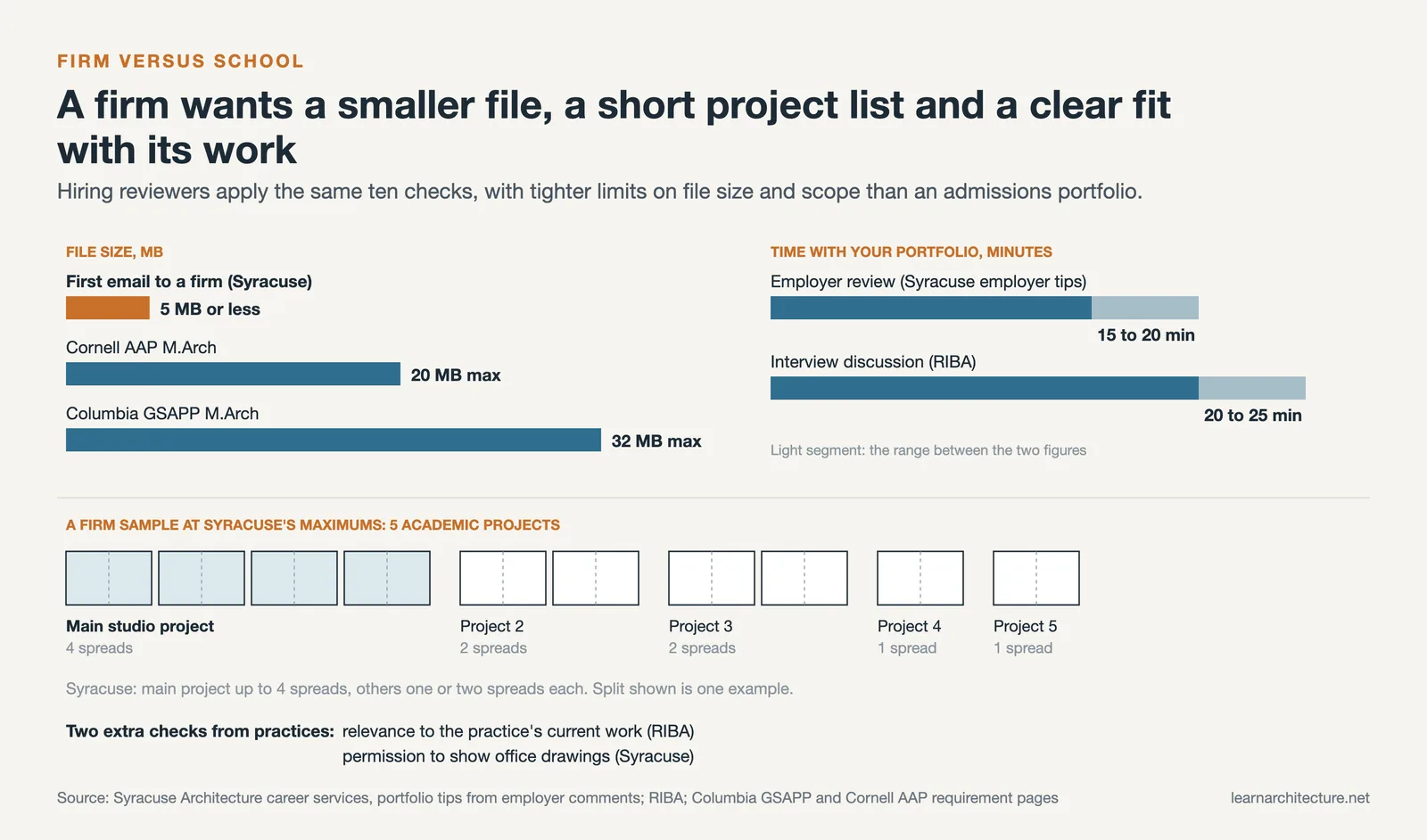
Relevance matters more to a practice than to a school. Lakshmanan says in the same RIBA piece that employers do not want to think a candidate is applying for any job going, and that applicants need to know the practice’s work. A school reviewer asks whether you can learn; a practice asks whether you can contribute to what it does now. That is why the sample you email to a firm should be shorter and more targeted than your admissions portfolio.
Professional work carries one extra check. Syracuse advises asking your employer for permission before adding office drawings, because there may be confidentiality terms you are unaware of. A reviewer who spots unreleased client work in a portfolio is also learning how you would treat their clients.
What a Weak Portfolio Tends to Get Wrong
Taken together, the published guidance also shows what reviewers mark down:
- Pages or file size over the stated limit, or a format the school did not ask for.
- Group work with no named role, or more group and office projects than the program allows.
- A render-heavy set with no plans, sections, or hand drawing.
- Projects that only become clear on their third or fourth page.
- Poor model photography, tiny images, and crowded spreads.
- Everything included: the RIBA feature quotes Lakshmanan saying the most common mistake is trying to show everything.
Putting It All Together
A good architecture portfolio is less about any single brilliant project and more about removing every reason a reviewer might have to stop reading. The format check, the authorship check, and the clarity check happen before anyone forms an opinion about your design talent. Pass those and the work gets the attention it deserves.
Quick Recap:
- Read each program’s limits and build a version for that program, not one file for all.
- State your role on every group or office project in the same place on every page.
- Lead each project with its idea, and document at least one project from process to final drawings.
- Test the exported PDF on an ordinary laptop screen before you submit.














Leave a comment