


Table of Contents Show
Rising 16 stories above Avenida del Libertador, the VILO Tower represents the final architectural contribution of the late Rafael Viñoly to his native Buenos Aires. Completed in 2025, this Class A office building serves as the new headquarters for Corporación América, a global leader in airport operations. Encompassing 13,875 square feet, the tower embodies Viñoly’s lifelong commitment to structural honesty, spatial flexibility, and urban engagement, principles that defined his practice across five decades.
The development occupies a prominent position within Buenos Aires’ commercial corridor, where the city’s architectural landscape continues to evolve. Viñoly’s design philosophy centered on creating buildings that function simultaneously as corporate facilities and civic landmarks, establishing a dialogue between private enterprise and public space.

Architectural Concept: Transparency Meets Structural Expression
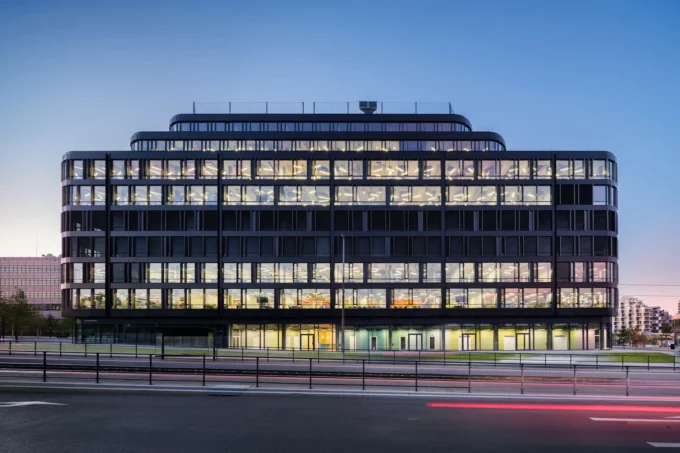
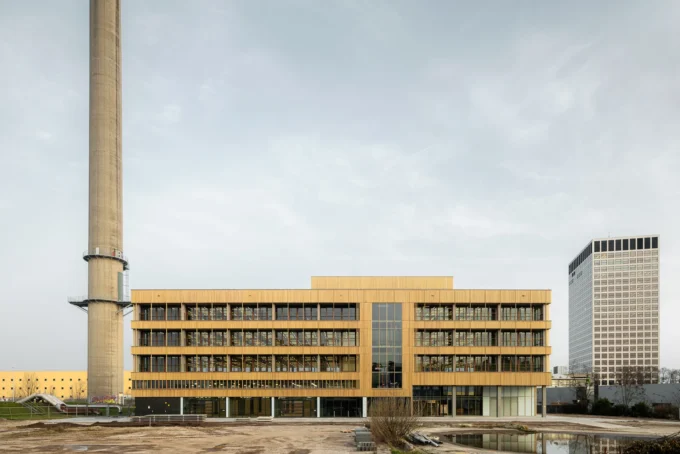
Rather than concealing its bones beneath decorative cladding, VILO Tower celebrates its structural framework as an architectural statement. The building’s engineering system becomes visible through its facade design, where load-bearing elements read clearly against expansive glazing. This approach reflects Viñoly’s conviction that structural clarity enhances both aesthetic integrity and functional performance.
The tower’s organizational strategy prioritizes adaptability for its corporate tenant. Floor plates accommodate diverse programmatic requirements, from collaborative workspaces to executive suites, while maintaining visual connectivity throughout. Natural light penetrates deep into the interior volumes, reducing dependence on artificial illumination and creating healthier work environments, a consideration increasingly central to contemporary commercial architecture.
Transparency operates on multiple levels within the design. Physically, the glass envelope dissolves boundaries between interior and exterior, affording occupants expansive views across Buenos Aires while maintaining climate control. Metaphorically, this openness signals Corporación América’s institutional values, projecting accessibility and accountability to the urban context. According to Dezeen’s coverage of Viñoly’s work, this integration of symbolism and function characterized the architect’s approach throughout his career.

Material Palette and Construction Methodology
The material selection emphasizes durability and contemporary expression. The primary facade system employs high-performance glazing units that optimize thermal efficiency while maintaining visual clarity. Steel structural members, exposed at key moments, articulate the building’s organizational logic and provide seismic resilience, a critical consideration in Buenos Aires’ geotechnical context.
Concrete cores anchor the tower vertically, housing circulation systems and mechanical infrastructure. This centralizing strategy liberates perimeter zones for occupied space, maximizing usable area on each floor. The interplay between glass, steel, and concrete generates a tectonic richness that evolves across different lighting conditions and viewing angles, as explored in discussions of innovative facade systems.
Construction was executed by Amarilla, with structural engineering by Curutchet del Villar and lighting design by Cappiello + Partners. GNBA provided mechanical, electrical, and plumbing engineering services. This collaborative process ensured technical precision throughout the realization of Viñoly’s vision.

Urban Integration and Civic Presence
VILO Tower engages its Avenida del Libertador site through carefully calibrated gestures. The ground plane maintains permeability, allowing pedestrian movement and visual connections into the building’s lobby spaces. This strategy activates the street frontage, contributing vitality to the neighborhood fabric rather than creating a fortress-like corporate enclave.
The tower’s massing responds to surrounding urban conditions. Its proportions and setbacks acknowledge adjacent structures while asserting a distinctive identity. This contextual sensitivity demonstrates architectural concept development that balances assertiveness with neighborly respect, a delicate equilibrium in dense metropolitan settings.
By day, the building reads as a crystalline volume animated by reflected sky and cityscape. After dark, interior illumination transforms the tower into a beacon, revealing its inhabited character to the broader urban landscape. This diurnal transformation enriches Buenos Aires’ nocturnal skyline, as documented in contemporary office architecture critiques.

Interior Spatial Organization
Inside, VILO Tower prioritizes flexibility and human experience. Open floor plans allow tenant customization while maintaining coherent spatial flow. Circulation systems (elevators, stairs, and service cores) consolidate at the building’s center, creating efficient movement patterns without fragmenting occupied zones.
Amenity spaces include dining facilities, meeting rooms, and collaborative areas that foster interaction among Corporación América’s teams. These programmatic elements acknowledge evolving workplace paradigms that emphasize employee wellbeing and social connectivity alongside traditional productivity metrics. The structural grid underlying these spaces enables future reconfiguration as organizational needs shift.
Materials and finishes throughout the interior echo the building’s exterior vocabulary: exposed structural elements, neutral palettes, and natural materials create cohesive environments that feel both polished and authentic. This consistency between inside and outside reinforces architectural honesty, avoiding the dissonance that can occur when external image contradicts internal reality.

Viñoly’s Architectural Legacy
Rafael Viñoly’s death preceded VILO Tower’s completion, rendering the project particularly poignant as his concluding statement in his birthplace. Throughout his career, Viñoly maintained that architecture should serve broader social purposes beyond fulfilling client briefs. VILO Tower embodies this philosophy, functioning simultaneously as corporate headquarters and urban contribution.
The architect’s commitment to structural rationalism, letting engineering systems shape architectural expression rather than disguising them, finds clear articulation here. This approach, controversial at times, challenged prevailing tendencies toward applied ornament and stylistic pastiche. As noted by the Pritzker Architecture Prize foundation in their assessments of contemporary practice, such intellectual rigor distinguishes enduring architecture from transient trends.
VILO Tower joins a distinguished portfolio that spans continents and building types, from cultural institutions to infrastructure projects. Each demonstrates Viñoly’s conviction that thoughtful design elevates daily life, whether through improved functionality, enhanced aesthetics, or strengthened civic identity. For practitioners studying architectural technology and urban development, the tower offers valuable lessons in balancing pragmatic requirements with higher aspirations.

Sustainability and Performance Considerations
While predating the most aggressive contemporary sustainability certifications, VILO Tower incorporates numerous performance-enhancing features. The high-performance glazing system reduces cooling loads in Buenos Aires’ subtropical climate, lowering operational energy consumption. Natural ventilation strategies supplement mechanical systems where feasible, decreasing reliance on powered air conditioning.
Daylighting penetration minimizes artificial lighting needs during occupied hours, yielding additional energy savings. LED fixtures throughout provide efficient illumination when natural light proves insufficient. These measures reflect growing awareness within the profession that environmental responsibility and architectural quality need not conflict, a theme explored extensively in contemporary commercial design discourse.
The building’s durability, ensured through robust materials and meticulous detailing, constitutes perhaps the most fundamental sustainability strategy. Structures that endure physically and remain functionally relevant avoid the environmental costs of premature demolition and replacement, making longevity itself an ecological virtue.

Conclusion: Architecture as Civic Responsibility
VILO Tower stands as testament to Rafael Viñoly’s belief that architecture carries obligations beyond satisfying immediate functional requirements. The building serves Corporación América’s operational needs while enriching Buenos Aires’ built environment, demonstrating that these objectives complement rather than contradict each other. Its transparent facades, expressed structure, and urban engagement create a corporate headquarters that acknowledges its civic context and contributes meaningfully to it.
As cities worldwide grapple with questions about the role of commercial architecture in shaping urban character, VILO Tower offers a compelling case study. It proves that office buildings can honor their structural logic, accommodate corporate activities, and enhance public realm simultaneously, outcomes that require neither compromise nor excessive budgets, merely thoughtful design informed by clear principles.
The tower’s completion ensures that Viñoly’s architectural voice continues resonating in his native city, offering future generations insight into his design philosophy and the values that guided his practice. For Buenos Aires, VILO Tower represents more than another addition to the skyline; it embodies an approach to architecture that values transparency, structural honesty, and civic contribution, qualities increasingly vital as urban densification accelerates globally.
Photography: Courtesy of Rafael Viñoly Architects
- 16-story office tower
- adaptive office building
- airport operator headquarters
- Avenida del Libertador architecture
- Buenos Aires commercial architecture
- Buenos Aires office building
- civic architecture Buenos Aires
- Class A office tower
- contemporary office design
- Corporación América headquarters
- Rafael Viñoly Architects
- Rafael Viñoly final project
- structural clarity architecture
- Transparent façade design
- VILO Tower









Leave a comment