


Table of Contents Show
St. Peter’s Basilica in Vatican City is the largest church in the world by interior measure, standing 136 meters tall with a 42-meter dome designed by Michelangelo. Built over 120 years between 1506 and 1626, the basilica represents the collaborative genius of Bramante, Michelangelo, Maderno, and Bernini across Renaissance and Baroque periods.
Few buildings on earth carry the architectural weight of St. Peters Basilica. Situated at the heart of Vatican City, this structure is not merely a church. It is a record of ambition, rivalry, engineering breakthroughs, and artistic mastery spanning more than a century of construction. The basilica of St. Peters sits directly above what Catholic tradition holds to be the burial site of the Apostle Peter, a fact that has shaped every design decision since the fourth century. For architects and design students, studying this building reveals how multiple creative visions can merge into a single, remarkably coherent structure.
From Constantine to Collapse: The Old Basilica on Vatican Hill
The story of St. Peters Basilica Rome begins not in the Renaissance but in the early fourth century. Emperor Constantine, Rome’s first Christian ruler, ordered a basilica constructed over the purported tomb of Saint Peter around 326 CE. That original structure, now called Old St. Peter’s, served pilgrims for nearly 1,200 years. It followed the classic Roman basilica form: a long nave flanked by double aisles, a timber roof, and an apse oriented toward the west.
By the fifteenth century, the old building was failing. According to records from the Fabbrica di San Pietro, its walls leaned dangerously, and structural repairs could no longer keep pace with decay. Pope Nicholas V (1447-1455) commissioned architect Bernardo Rossellino to plan a new apse, but limited funds stalled the project. It would take another half-century and a far more ambitious pope to set the full reconstruction in motion.

Where Is St. Peters Basilica and Why Does Its Location Matter?
St. Peters Basilica Vatican is located within Vatican City, the independent city-state enclosed by Rome, Italy. Its precise geographic position, on Vatican Hill west of the Tiber River, was dictated by the ancient necropolis believed to contain Peter’s tomb. This was not an ideal building site. The sloping terrain required Constantine’s builders to cut into the hillside and fill the opposite end with earth, creating an artificial terrace. Every architect who worked on the new basilica had to contend with these foundation conditions.
Understanding how proportion and site conditions influence design helps explain why the basilica took its particular form. The requirement to build directly over a specific burial site meant that the crossing point, where nave meets transept, was fixed from the start. Bramante, Michelangelo, and every subsequent architect worked within this non-negotiable constraint.

Bramante’s Greek Cross: The Bold Renaissance Vision
In 1506, Pope Julius II laid the foundation stone for a completely new St. Peters Basilica Rome Italy. Julius chose Donato Bramante as chief architect, and Bramante proposed a radical design: a centralized Greek cross plan crowned by a massive dome inspired by the Roman Pantheon. The concept was staggering in scale. Bramante envisioned four enormous piers supporting a dome that would rival anything built since antiquity.
Bramante’s approach revived ancient Roman construction techniques that had been lost for centuries. He experimented with concrete mixtures and pier construction methods to support loads no Renaissance builder had attempted. The four central piers he began remain the structural backbone of the basilica today, though they required significant reinforcement by later architects. According to research published through Engineering Rome, workers mixed cement with excessive sand ratios, weakening the initial construction. Cracks appeared shortly after Bramante’s death in 1514.

Key Dimensions of St. Peter’s Basilica
The following table summarizes the basilica’s principal measurements, illustrating its monumental scale:
| Feature | Measurement | Context |
|---|---|---|
| Total height (to cross) | 136.57 m (448 ft) | Tallest dome in the world |
| Total length | 220 m (722 ft) | Longest church interior globally |
| Dome internal diameter | 41.47 m (136 ft) | Comparable to the Pantheon (43.3 m) |
| Interior area | 15,160 sq m | Capacity of approximately 60,000 |
| Total site area | 2.3 hectares (5.7 acres) | Includes basilica and surroundings |
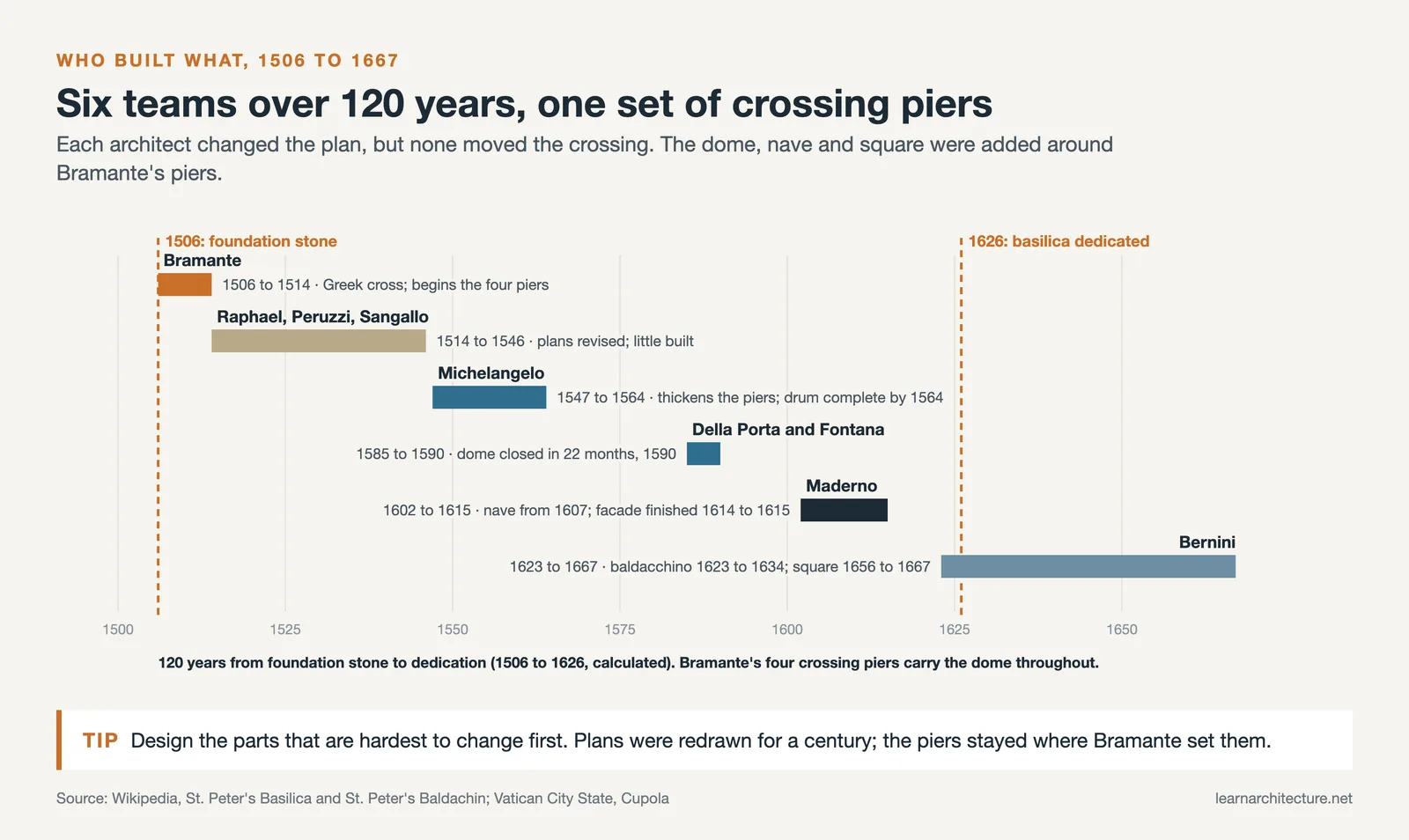
| Construction duration | 120 years (1506-1626) | Spanned 21 papal reigns |
Michelangelo’s Dome: Engineering Sacred Space
After Bramante’s death, the project passed through several hands, including Raphael and Antonio da Sangallo the Younger. Each modified the plan, and progress stalled. On 1 January 1547, at age 71, Michelangelo was appointed chief architect by Pope Paul III. He accepted the role without pay, stating he served only for the love of God.
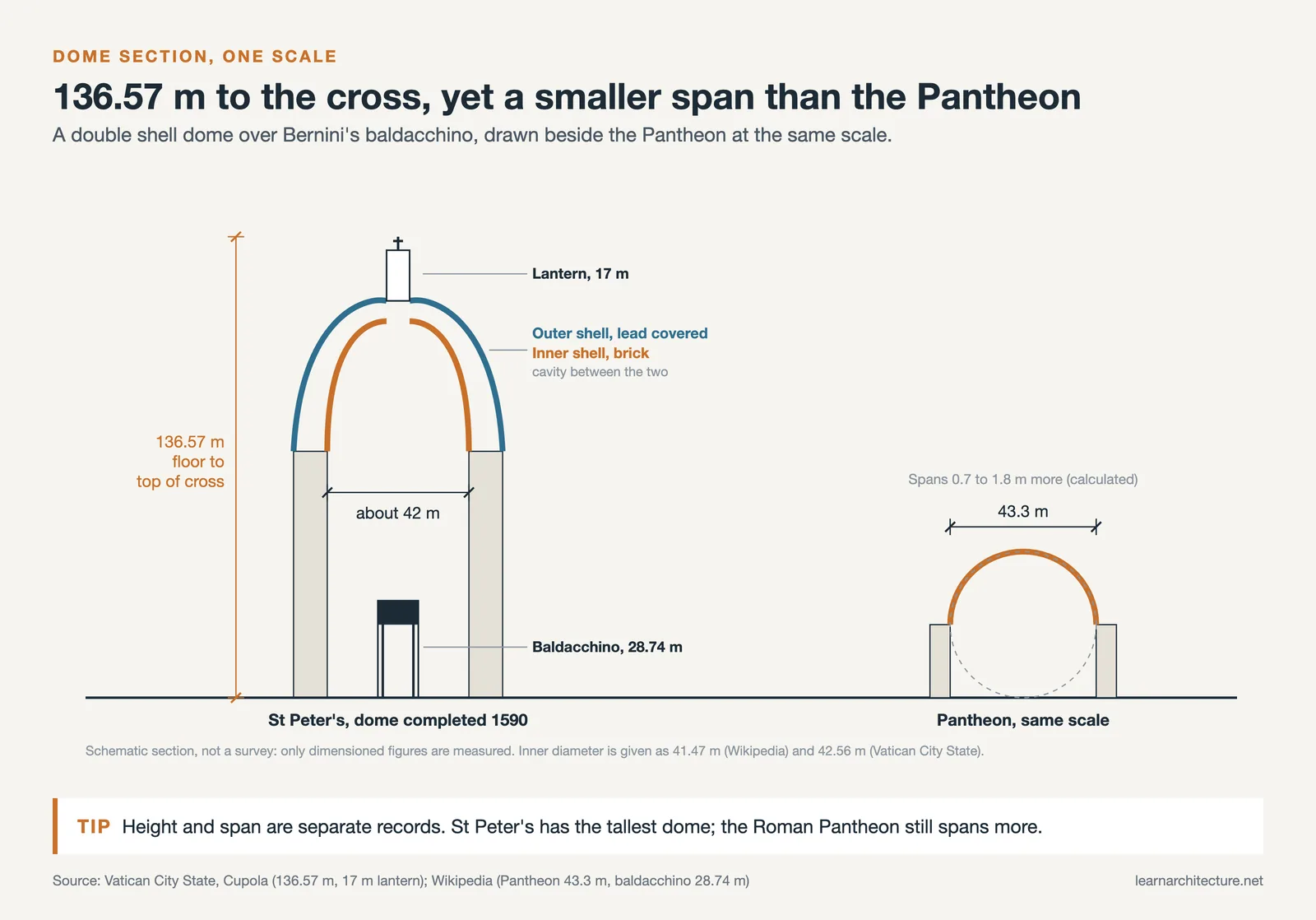
Michelangelo’s intervention was decisive. He stripped away what he considered unnecessary additions by Sangallo, returning to Bramante’s centralized concept while radically strengthening the structural system. He thickened the piers, sank concrete-filled wells beneath their foundations, and reduced the crossing width from approximately 21 meters to about 17.8 meters. His dome design drew on Filippo Brunelleschi’s double-shell solution at Florence Cathedral, using an inner brick shell and an outer lead-covered shell separated by a cavity. This reduced the total weight while maintaining structural rigidity.
Michelangelo worked on St. Peter’s for 17 years but died in 1564 before the dome was completed. He left a detailed wooden model, still preserved in the Vatican, which guided Giacomo della Porta and Domenico Fontana. According to the official Basilica records, the dome was raised in just 22 months between 1588 and 1590 using a workforce of 800 laborers. Della Porta gave the dome a slightly more pointed (ogival) profile than Michelangelo’s original hemispherical design, a change that reduced outward thrust on the supporting structure.

“Despite taking over 120 years to build, being partly demolished and rebuilt by various architects, and constant battles to achieve the perfect form, Saint Peter’s today has a very harmonious appearance.”
Encyclopaedia Britannica, “The Architecture of St. Peter’s Basilica”
St. Peters Basilica Interior: Maderno, Bernini, and the Baroque Transformation
The basilica’s interior owes its final form to two architects who worked after Michelangelo. Carlo Maderno, appointed in 1602, extended the nave eastward to create a Latin cross plan, responding to liturgical requirements that demanded more congregational space. His addition included the current facade, completed around 1614. While this solved practical problems, the extended nave partially obscured the view of Michelangelo’s dome from St. Peter’s Square, a compromise that architectural critics have debated for centuries.
Gian Lorenzo Bernini then brought the st. peters basilica interior to its Baroque climax. His 29-meter bronze baldacchino (1623 to 1634), positioned directly above the papal altar and Peter’s tomb, became the visual anchor of the entire space. Bernini also designed the Cathedra Petri (Chair of Saint Peter) in the apse, an elaborate gilded bronze encasement for what was believed to be Peter’s wooden throne. Between 1656 and 1667, he created the elliptical colonnade of St. Peter’s Square, which he described as the welcoming arms of the Church. The colonnade comprises 284 Doric columns arranged in four rows, forming a space capable of holding 300,000 people.

Structural Lessons: What Architects Can Learn from St. Peter’s
St. Peters Basilica offers several enduring lessons for architectural practice. The project’s 120-year timeline demonstrates how design continuity can survive multiple authorship when fundamental structural and spatial principles are respected. Bramante established the pier locations and central dome concept. Michelangelo refined the structural logic. Maderno adapted the plan to functional needs. Bernini unified the experience through interior and exterior design. Each architect worked within inherited constraints while contributing something original.
The engineering of the dome remains a case study in load management. Michelangelo’s double-shell system, combined with iron chains installed at various intervals (as many as ten over the centuries, according to Wikipedia’s architectural analysis), demonstrates how redundant structural systems can ensure longevity. Mid-eighteenth-century cracks required additional chains, proving that even the finest engineering benefits from monitoring and maintenance over time. These principles directly apply to contemporary approaches to building durability and sustainability.
The basilica also illustrates the tension between centralized and longitudinal church plans, a debate that shaped Western religious architecture for centuries. Bramante and Michelangelo favored the Greek cross for its symbolic perfection. The Church hierarchy ultimately required the Latin cross for its processional utility. This push and pull between aesthetic ideals and functional demands is a challenge every architect confronts, regardless of project type or era.

St. Peter’s Basilica Today: Preservation and Global Influence
The st.peters basilica continues to function as both an active place of worship and one of the most visited architectural landmarks on earth. The Fabbrica di San Pietro, the organization responsible for its maintenance since 1523, oversees ongoing restoration and structural monitoring. In recent years, Microsoft partnered with the Vatican to create a detailed digital twin of the basilica, using AI and 3D scanning technology to document every surface for future preservation planning.
The influence of St. Peter’s dome reaches far beyond Rome. Brunelleschi’s Florence dome inspired Michelangelo, and Michelangelo’s dome in turn inspired Christopher Wren’s St. Paul’s Cathedral in London, the Pantheon in Paris, and the United States Capitol dome in Washington, D.C. This chain of architectural influence demonstrates how a single structural innovation can ripple through centuries of design thinking and innovation.
Architectural dimensions and historical dates referenced in this article are based on records from the Fabbrica di San Pietro, Encyclopaedia Britannica, and Wikipedia. Specific measurements may vary slightly across sources due to different measurement methodologies.











Leave a comment