Home Projects Cachaça Distillery in Torrinha, Brazil
ProjectsCommercial

Cachaça Distillery in Torrinha, Brazil

Nitsche Arquitetos designed this distillery to optimize cachaça production while respecting natural site characteristics in São Paulo's countryside.

Share
Share
Architecture: Nitsche Arquitetos
Year: 2017-2018
Area: 1161 m²
Location: Torrinha, São Paulo, Brazil
Instagram: @nitsche_arquitetos

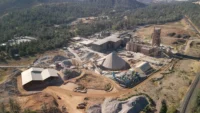
Located in Torrinha, São Paulo’s countryside, this distillery was designed to optimize cachaça production while respecting the natural characteristics of the site. Developed between 2016 and 2017 and built between 2017 and 2018, the project spans a built area of 1,661 m² on a 130,000 m² site. The first production began in 2019, marking the realization of a project that combines functionality, efficiency, and harmony with its surroundings.

Cachaca Distillery in Torrinha 1 in architecture
Photography by Pedro Mascaro

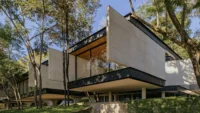
The architectural design was crafted to meet the specific demands of cachaça production, which involves milling, filtering, fermentation, distillation, and storage. The building takes the form of a linear and terraced structure, leveraging gravity to move the liquid through the different stages without pumps, ensuring a continuous and sustainable process.

Cachaca Distillery in Torrinha 6 used by architects
Photography by Pedro Mascaro

The main building, 75 meters long and 15 meters wide, adapts to the natural slope of the terrain, with heights ranging from 6.20 meters at the upper end to 11.30 meters at the lower end. This level variation is connected by a large staircase, with landings housing the various production stages. Two courtyards were planned at the ends: one for sugarcane reception and the other for the dispatch of bottled products.

Cachaca Distillery in Torrinha 7 in architectural design
Photography by Pedro Mascaro

The primary metallic shell structure is supported by two concrete retaining walls that follow the terrain’s slope. Corrugated and perforated metal brises form the facades, allowing natural ventilation and controlled light entry. Inside, independent volumes with concrete and masonry structures house specific production sectors, while external perimetral ramps and pathways ensure operational efficiency.

Share
Written by
Bahattin Duran

Bahattin Duran is an architect and Editor in Chief of illustrarch who also leads learnarchitecture.net, where he writes and oversees content. He holds a Bachelor's Degree in Architecture from Düzce University.

Leave a comment

Leave a Reply

Your email address will not be published. Required fields are marked *

Related Articles
Long low house of timber and dark metal volumes on open grassland at dusk, Casa Solis 21 by iHouse estudio
ResidentialProjects

Casa Solis 21 by iHouse estudio

iHouse estudio builds a 125 square metre weekend house in rural Canelones,...

White and red gridded tower rising above older masonry blocks of Center City, 210 South 12th Building by RSHP
Mixed UseProjects

210 South 12th Building by RSHP

RSHP and Perkins Eastman complete a 31 storey tower in Center City...

Timber cottage on steel posts above a rocky bluff beside a cypress, Mr. Fool Moves a Mountain by Schwartz and Architecture
ResidentialProjects

Mr. Fool Moves a Mountain by Schwartz and Architecture

Schwartz and Architecture spent nearly nine years helping a client build a...

Aerial view of Junqueira 307 Apartments by Fragmentos with a rooftop pool and terraces, a suspension bridge and river behind
HousingProjects

Junqueira 307 Apartments by Fragmentos

Junqueira 307 Apartments by Fragmentos turns a former warehouse on Lisbon's Rua...

Subscribe to Our Updates

Enjoy a daily dose of architectural projects, tips, hacks, free downloadble contents and more.

Copyright © Learn Architecture Online. All rights reserved.
Made with ❤️ by learnarchitecture.online

iA Media's Family of Brands