



Table of Contents Show
Sustainable building certifications are third-party rating systems that measure how well a building performs against environmental and health standards. The three most recognized programs are LEED, BREEAM, and WELL. Each scores projects on energy, water, materials, or occupant wellbeing, then awards a tiered level that signals verified performance to owners and tenants.
Choosing between these programs is rarely about which one is “best.” It is about which set of priorities matches your project. A developer chasing lower operating costs in Chicago has different needs from a London office landlord answering to European regulations, or a wellness brand that wants to prove its headquarters supports staff health. The three systems overlap in places and diverge sharply in others. This comparison looks at what each one rewards, where it carries the most weight, and how the rating levels actually work so you can match a certification to real goals rather than a logo.

What Are Sustainable Building Certifications?
A sustainable building certification is a structured way to prove that a building meets defined environmental or health targets. Instead of a designer simply claiming a project is “green,” the building is assessed against a published rubric and scored by an accredited assessor. That third-party verification is what gives the result credibility with banks, regulators, and tenants.
Most programs work on a points model. A project earns credits across categories such as energy use, water efficiency, materials, indoor air quality, and site ecology. The total determines the award level. This shared logic is why people group LEED, BREEAM, and WELL together, even though each sustainable building certification system weighs the categories differently and was built to answer a different question. LEED and BREEAM ask how light a building’s footprint is on the planet. WELL asks how good the building is for the people inside it.
The reason these labels matter goes beyond bragging rights. A recognized rating affects asset value, rent levels, and access to green finance. Lenders increasingly tie favorable loan terms to certified performance, and corporate tenants with their own climate targets often filter buildings by certification before they ever schedule a viewing. A certified building is also easier to benchmark over time, because the rating forces measurable data rather than vague claims.
If you are new to the wider topic, our overview of green architecture and eco-friendly design sets out the design strategies these ratings are built to reward, and the sustainability section collects related case studies and material guides.
🔢 Quick Numbers
- Buildings and construction account for around 37% of global energy-related CO2 emissions, according to the 2022 Global Status Report for Buildings and Construction by the United Nations Environment Programme.
- LEED has been applied to projects in more than 180 countries and territories, according to the U.S. Green Building Council.
- BREEAM has certified over 2.3 million buildings since the scheme launched in 1990, according to BREEAM.
LEED, BREEAM, and WELL at a Glance
Before going system by system, the table below sets the three programs side by side. It is the fastest way to see why a sustainable building certifications comparison rarely produces a single winner. The columns cover what each program measures, where it dominates, and the rating levels you can earn.
Comparison of LEED vs BREEAM vs WELL
| Certification | Focus | Region | Levels |
|---|---|---|---|
| LEED | Overall environmental performance: energy, water, materials, and site | Global, originated in the USA | Certified, Silver, Gold, Platinum |
| BREEAM | Whole-building environmental impact across the lifecycle | Global, originated in the UK and Europe | Pass, Good, Very Good, Excellent, Outstanding |
| WELL | Human health and occupant wellbeing | Global, originated in the USA | Bronze, Silver, Gold, Platinum |
LEED: The North American Benchmark
LEED (Leadership in Energy and Environmental Design) is run by the U.S. Green Building Council and is the rating most people in North America recognize on sight. It uses a points-based system spread across categories including Location and Transportation, Sustainable Sites, Water Efficiency, Energy and Atmosphere, Materials and Resources, and Indoor Environmental Quality.

A project banks credits in each category, and the running total maps to one of four awards. Certified starts at 40 points, Silver at 50, Gold at 60, and Platinum at 80 or more, on a 110-point scale. Energy and Atmosphere carries the heaviest weighting, which tells you a lot about LEED’s center of gravity: it rewards measurable operational efficiency. Full credit definitions and current versions sit on the official USGBC LEED pages.
LEED is also organized into rating systems tuned to project type, including Building Design and Construction, Interior Design and Construction, Operations and Maintenance for existing buildings, and Neighborhood Development. That structure lets an owner certify a brand new tower and a decades-old office under the same family of standards, using whichever path fits the work actually being done.
LEED’s reach is its strength. The scheme works across offices, schools, retail, data centers, and whole neighborhoods, and its global recognition makes a Gold or Platinum plaque useful for marketing a building far beyond the United States. For teams already studying high performance projects, our roundup of green architecture projects redefining sustainable design includes several LEED-rated landmarks worth examining in detail.
BREEAM: Europe’s Original Rating System
BREEAM (Building Research Establishment Environmental Assessment Method) launched in the United Kingdom in 1990, which makes it the oldest sustainable building certificate of the three. It remains the default standard across much of the UK and Europe, and many European investors treat a strong BREEAM score as a baseline expectation rather than a bonus.
Where LEED leans on operational energy, BREEAM emphasizes lifecycle assessment and the full environmental cost of a building from materials sourcing through demolition. Its categories include Management, Health and Wellbeing, Energy, Transport, Water, Materials, Waste, Land Use and Ecology, and Pollution. Scores translate into five rating levels: Pass, Good, Very Good, Excellent, and Outstanding, with Outstanding reserved for a small fraction of projects. The current technical manuals are published on the official BREEAM website.
BREEAM also tends to reward strong project management and ecological protection more explicitly than LEED, so it suits developments where site biodiversity and process documentation matter as much as energy numbers. For wider context on how these material choices play out, our guide to sustainable materials in construction covers many of the products that earn credits under BREEAM’s Materials category.
The scheme is split into versions for different situations, including BREEAM New Construction, BREEAM In-Use for existing stock, BREEAM Refurbishment, and BREEAM Infrastructure. The In-Use path matters in particular for portfolio owners, because it lets them measure and improve buildings already in operation without a major renovation. That focus on the operational phase, rather than only the design and build stage, is part of why BREEAM holds such a strong position with European institutional investors.
🏗️ Real-World Example
Shanghai Tower (Shanghai, 2015): The 632-meter supertall holds LEED Platinum from the U.S. Green Building Council alongside China’s Green Building Three Star rating, the top tier in each program. Its double-skin facade and sky gardens show how a single project can satisfy more than one certification framework at once.
WELL: Certification Focused on People
WELL is the newest of the three and answers a different question entirely. Administered by the International WELL Building Institute, it measures how a building supports human health rather than how light its environmental footprint is. A building can be energy efficient and still have poor air quality, harsh lighting, or noise problems, and WELL exists to address exactly that gap.
The standard organizes credits into concepts such as Air, Water, Nourishment, Light, Movement, Thermal Comfort, Sound, Materials, Mind, and Community. Projects earn one of four levels: Bronze, Silver, Gold, and Platinum. Because many WELL features depend on how a space is operated and not just how it is built, certification often requires ongoing performance testing, including on-site air and water sampling. The full feature list lives on the official WELL Building Standard site.
WELL pairs naturally with an environmental rating. A growing number of offices pursue LEED or BREEAM for the building shell and WELL for the human experience inside it, which is why the three programs are often complementary rather than competing.

What Does the Certification Process Involve?
The certification path looks broadly similar across the three schemes, even though the details differ. A project registers with the awarding body, appoints an accredited professional or assessor, and assembles evidence against the chosen credits. That evidence is reviewed, points are confirmed, and a level is awarded. Where the programs split is in timing and proof.
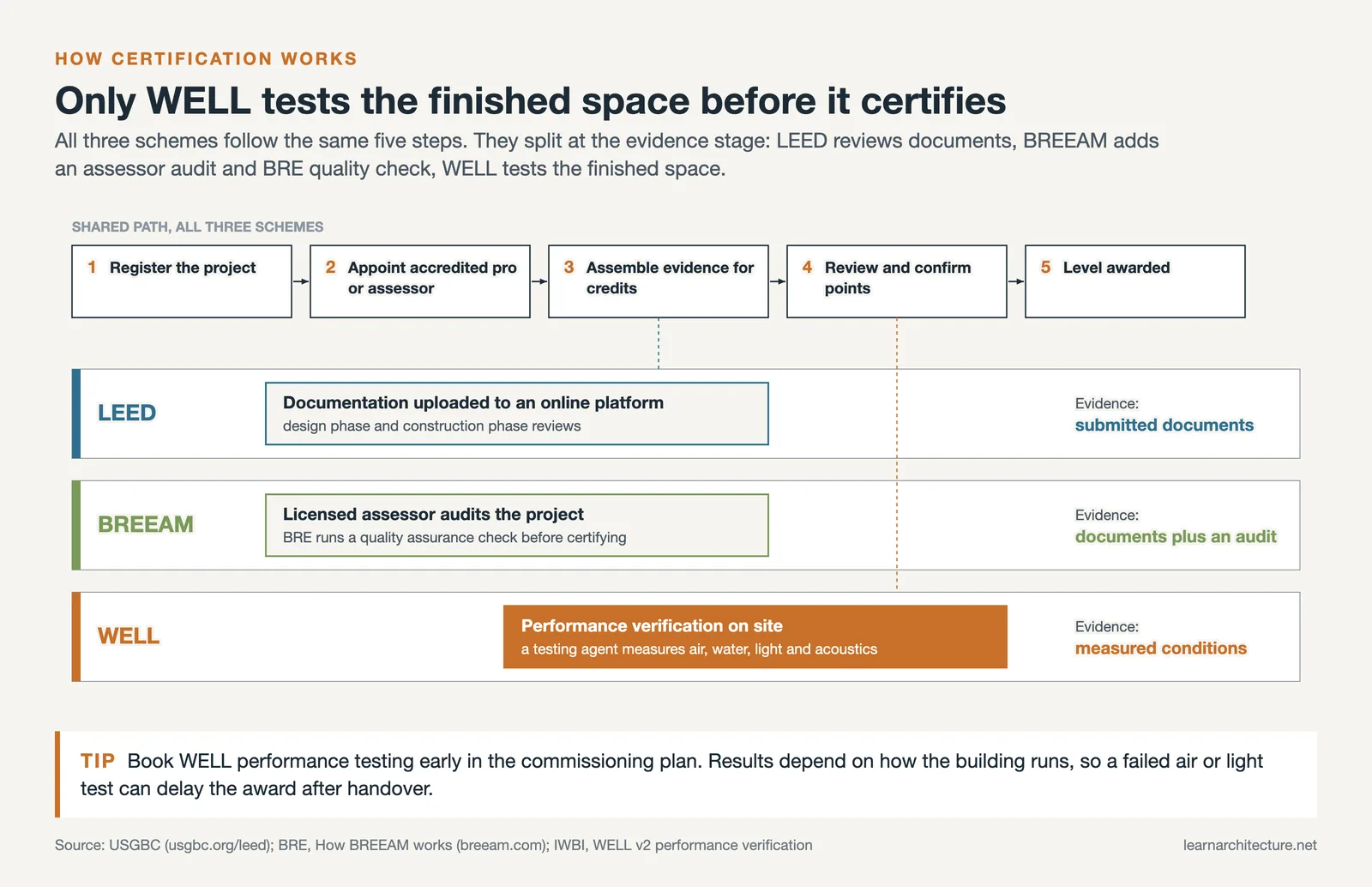
LEED relies heavily on documentation submitted through an online platform, with design-phase and construction-phase reviews. BREEAM runs through licensed assessors who audit the project and submit it to the Building Research Establishment for quality assurance, which keeps scoring consistent between buildings. WELL adds a step the other two do not require in the same way: performance verification on site, where an agent measures real conditions such as air quality, water, lighting, and acoustics before certification is granted. Recertification cycles also vary, so a rating is a commitment to keep performing, not a one-time trophy.
How Do You Choose the Right Sustainable Building Certification?
Start with your primary goal, not the certification name. If you want to prove environmental performance to investors and reduce operating costs, LEED or BREEAM is the logical route. If your project sits in the UK or Europe, BREEAM is often the expected standard and can simplify approvals. If your aim is occupant health, recruitment, or tenant retention in a competitive office market, WELL speaks directly to that audience.
Budget, timeline, and location all shape the decision. BREEAM assessments are handled by licensed assessors and lean heavily on documentation, while WELL’s performance testing adds an operational commitment that continues after handover. Many teams reach the strongest position by combining an environmental rating with a health rating, accepting the extra coordination in exchange for a building that performs on both fronts.
💡 Pro Tip

Register for certification at the concept stage, not after the design is fixed. Many credits in all three systems depend on early decisions about orientation, structural grid, and mechanical strategy. Teams that wait until construction documents are complete routinely lose easy points and pay for retrofits that a single early workshop would have avoided.
It also helps to look at how leading buildings stack their certifications in practice. Our feature on sustainable stadiums across the USA shows how large venues use LEED ratings as anchor credentials, while broader industry coverage such as ArchDaily’s LEED archive tracks how firms apply these standards across building types. For organizations setting policy at scale, the World Green Building Council coordinates the national councils behind many of these schemes.
What Certification Actually Costs
Certification cost splits into two parts that are easy to confuse: the fees paid to the rating body, and the design and documentation effort needed to earn the credits. The second is almost always the larger number.
Registration and certification fees scale with project size and are the predictable part. The real cost sits in modelling, commissioning, consultant time and the documentation trail, and in the design decisions that a target rating forces. A project aiming for a high rating late in design pays far more than one that set the target at brief stage, because by then the cheap credits have already been designed out.
The practical rule: decide the target rating before concept design, not after. The certification that costs least is the one the building was designed for from the start.
Can One Project Hold More Than One Certification?
Yes, and it is increasingly common. The systems measure different things: LEED and BREEAM are building-performance frameworks with different regional emphases, while WELL measures the effect of the building on the people inside it. A project can hold BREEAM for environmental performance and WELL for occupant health without the two conflicting.
The overlap is real enough that documentation can often be shared, but the assessment processes are separate and so are the fees. Dual certification makes sense when a client has two distinct audiences to satisfy: a regulator or investor on one side, tenants or staff on the other. It rarely makes sense for its own sake.
Why This Comparison Is Getting Harder
All three systems have been revised, and the versions differ meaningfully from the ones most reference material describes. Embodied carbon has moved toward the centre of the environmental schemes, health and indoor air quality have grown across all three, and regional adaptations mean the same nominal rating can represent different achievements in different markets.
Two consequences follow. Compare current versions rather than the ones you learned, and treat a rating as a description of what was measured rather than as a single ranking of how green a building is.
Putting It All Together
The three programs are not rivals fighting over the same crown. LEED gives you globally recognized environmental performance with a strong North American base. BREEAM offers a lifecycle-focused standard rooted in Europe with deep credit detail. WELL shifts the lens onto the people who use the space. The right answer depends on geography, audience, and what you most need to prove, and an increasing number of projects simply pursue more than one.
Bottom Line: Pick the certification that matches the priority you can least afford to miss. For carbon and cost, reach for LEED or BREEAM. For health and tenant experience, add WELL. The most credible buildings increasingly carry both, signaling that performance and wellbeing were designed in from day one.
- sustainability certification of buildings
- sustainability certifications for buildings
- sustainable building certificate
- sustainable building certification
- sustainable building certification system
- sustainable building certifications
- sustainable building certifications comparison
- sustainable buildings certificate
- sustainable design certifications for buildings












Leave a comment