


Table of Contents Show
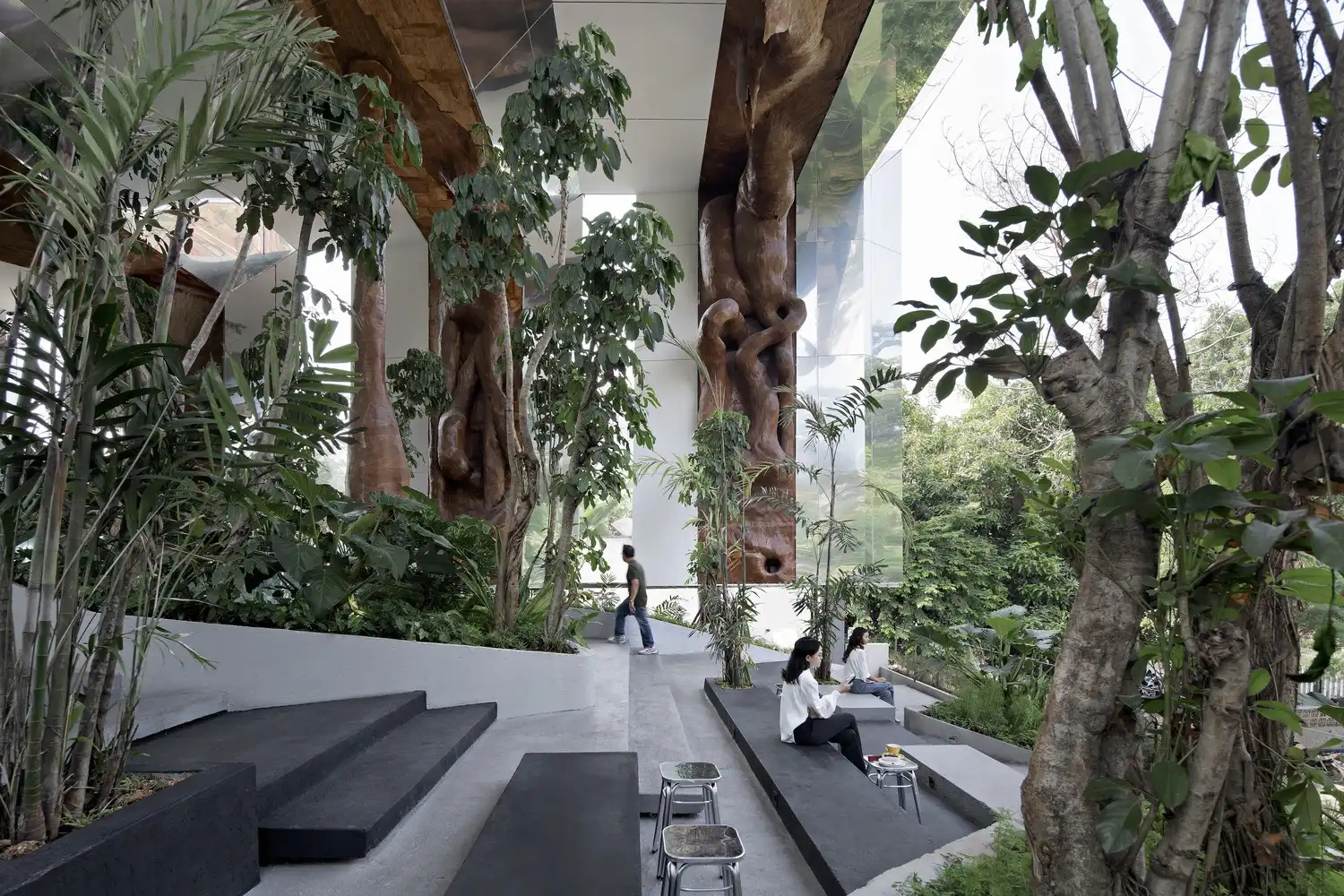
Tanatap Frame Garden, designed by RAD+ar (Research Artistic Design + architecture), is an experimental café and garden hybrid that challenges conventional architectural boundaries in dense tropical cities like Jakarta. Conceived as a multi-leveled greenspace, the project transforms architecture into an inhabitable landscape, one that rises, folds, and hovers to create a walkable roofscape and a new kind of public living room. Rather than relying on a fixed façade or formal frontage, Tanatap Frame Garden positions activity, movement, and nature as the defining identity of the building itself.

Architecture Without a Façade
The design began with a fundamental question: What if community activities, art exhibitions, and garden life could replace the façade entirely? Rejecting the idea of a singular front or back, the project embraces a façade-less architecture, where flexibility and use define perception. The building is approachable from all directions, dissolving the boundary between public park and private café.
This openness transforms the structure into a framed garden rather than a building, where architecture acts as a quiet host for social interaction. Sheltered indoor spaces are hidden within a simple, stacked garden system, unfolding as a sequence of experiences rather than predetermined rooms. Each space is discovered gradually, reinforcing a sense of curiosity and exploration.

Frames as Structure, Art, and Urban Interface
A key architectural strategy lies in the playful juxtaposition of four different frame types: stainless steel, artwork frames, GRC, and glass. These frames operate simultaneously as structure, spatial organizer, and visual device. They frame views outward toward the public park while also framing visitors themselves, turning people into living exhibits within the urban landscape.
This mutual visibility creates a dynamic relationship between café users and park visitors, blurring observer and observed. The frames also act as environmental tools, channeling airflow and generating shaded microclimates. In a city where publicly maintained green spaces can be unreliable, the project proposes a self-sustaining, privately operated civic alternative that remains open, inclusive, and visually porous.

A Passive Oasis in a Harsh Urban Climate
Built within a compact residential area with extreme thermal conditions, Tanatap Frame Garden serves as proof that low-energy, passive commercial architecture can thrive in tropical developing cities. The structure is double-shaded and highly ventilated, minimizing reliance on mechanical cooling. At the heart of the building, a rainbow-toned skylight punctures the garden, allowing sunset light to filter into the café below and creating constantly shifting atmospheres throughout the day.
Negative sectional spaces, often dismissed as leftover volume, are deliberately optimized to generate casual contrast zones, where light, shadow, and airflow vary subtly. The result is an oasis-like environment that remains comfortable despite the surrounding heat, reinforcing the economic and environmental viability of sustainable design.

Geometry, Volume, and Spatial Freedom
The architectural language is rooted in simple geometric clarity. Strong cubic volumes are carved through symmetrical ground-floor layouts, while the second floor introduces an organic amphitheater form in contrast. This interplay between rigid geometry and fluid landscape encourages multiple modes of occupation, from gathering and performance to retreat and observation.
Without a defined orientation, the building adapts naturally to its surroundings. Frames act as catalysts for a wind-tunnel effect, enhancing natural ventilation and allowing visitors to experience the park through both sight and breeze. Architecture here is not static; it responds continuously to climate, movement, and time.

A Spatial Journey of Compression and Release
Visitor experience is carefully choreographed through changes in scale and proportion. Entry begins under a low ceiling of 2.2 meters, creating a sense of compression. As visitors move inward, the space gradually expands to heights of 7.5 meters, unfolding into larger garden volumes that visually connect across levels.
Pathways weave between two existing gardens, intentionally dissolving the distinction between indoor and outdoor. Visitors are teased by glimpses of skylights and human activity above, drawing them deeper into the structure. Tunnel-like sequences lead upward into 9-meter-high sheltered gardens, where perspectives shift continuously, rewarding movement and exploration rather than direct arrival.

Redefining Inside and Outside in Tropical Architecture
True to RAD+ar’s experimental approach, Tanatap Frame Garden pushes a bespoke interpretation of the inside and outside relationship. Floating garden layers cast different shades and ambiances hour by hour, while borrowed views from the adjacent public park become integral to the interior experience.
The layout supports fluid interaction between bar areas, communal tables, and circulation paths, creating an efficient yet informal spatial network. The café, gallery, and garden function as a single environment: a man-made jungle infused with art and social life.

Architecture as Social Experiment
Beyond design and sustainability, the project operates as a behavioral study. By deliberately destabilizing conventional spatial hierarchies, RAD+ar observes how people occupy spaces they do not immediately understand. Furniture is intentionally undefined, merged with landscape and hardscape, inviting users to negotiate their own comfort and social norms.
This adaptability reveals how the concept of a “third space” evolves throughout the day, responding to crowd density, weather, and social dynamics. The architecture does not dictate use; instead, it invites continuous reinterpretation.
A Public Living Room for Creative Communities
Tanatap Frame Garden ultimately positions itself as a public living room, a shared platform for locals, artists, and visitors drawn to creative exchange. Conceived by Antonius Richard, the project aligns with Tanatap’s broader mission to decentralize sustainable architecture through sustainable business models. In the context of Indonesia’s rapid urbanization, the café-garden becomes both a cultural incubator and a demonstration of how commerce, ecology, and community can coexist.
Rather than seeking spectacle, Tanatap Frame Garden quietly redefines how architecture participates in everyday life, through openness, experimentation, and an unwavering belief in the social power of space.
Photography: Mario Wibowo


- Architecture and landscape融合
- Art and architecture integration
- Café garden design
- Community-focused design
- Contemporary Indonesian architecture
- Creative Community Spaces
- Experimental architectural design
- Façade-less architecture
- Garden café architecture
- Inside-outside architecture
- Low-energy tropical buildings
- Multi-level garden architecture
- Passive tropical design
- Public living room concept
- Public space architecture Jakarta
- RAD+ar architecture
- Social space design
- Sustainable commercial architecture
- Tanatap Frame Garden
- Tropical architecture Indonesia









Leave a comment