


Table of Contents Show
Located along Avenue de la Grande Armée, just moments from the Arc de Triomphe, the Grande Armée L1ve Office Building represents a powerful example of how architectural restructuring can intensify an existing identity rather than erase it. Designed by Baumschlager Eberle Architekten, the project transforms the former modernist Peugeot headquarters, originally designed by Sainsaulieu, into a contemporary workplace that responds to today’s urban, environmental, and social demands while preserving the strength of its original structure.
Rather than pursuing demolition and replacement, the architects embraced the logic and potential of the existing concrete frame. The result is a project that treats renovation as an act of architectural amplification, offering central Paris a renewed urban façade and a flexible interior world shaped for evolving modes of work.

A 110-Metre Urban Façade as Architectural Statement
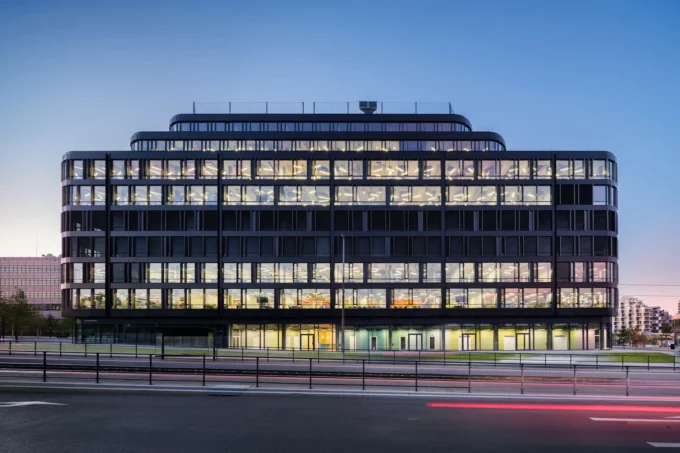
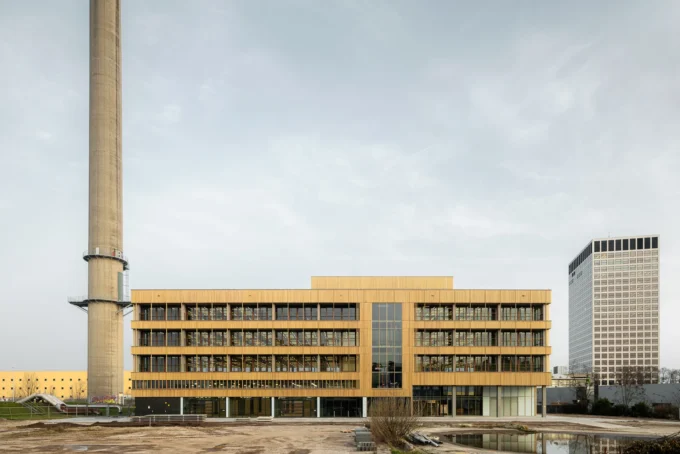
One of the defining features of the project is its striking 110-metre-long façade, which establishes a strong presence along one of Paris’s most prominent avenues. The original concrete structure serves as a robust backdrop for an innovative window system based on a simple yet highly effective principle. Flat window openings alternate rhythmically with deep, box-like windows recessed at varying depths within the concrete grid.
This carefully calibrated composition generates a façade that is both orderly and expressive. Through rhythm, plasticity, and repetition, the building gains a sculptural depth that changes with light and movement along the avenue. The façade does not rely on decorative excess; instead, it draws strength from restraint and logic, giving Grande Armée L1ve a distinctive and confident urban physiognomy.

From Perimeter Block to Green Interior World
Behind the monumental façade, the building unfolds as a permeable perimeter block extending from Avenue de la Grande Armée to Rue Pergolèse. Two internal courtyards structure the project, introducing generous green spaces that soften the scale of the complex and enhance environmental comfort.
At the heart of the building lies an agora and a conference center, conceived as shared spaces that foster interaction, exchange, and informal collaboration. Former showroom areas on the ground floor have been reimagined as open, flexible zones that blur the boundaries between work, meeting, and social life. This spatial openness reflects a broader shift away from rigid office typologies toward more adaptive and human-centered working environments.

Use-Neutral Offices for an Evolving Workplace
The interior organization prioritizes use-neutral office spaces, allowing future tenants to adapt layouts without structural intervention. Open office areas, collaborative zones, and quiet workspaces coexist within a framework designed for long-term flexibility. Columns, façades, and service cores are clearly articulated, ensuring that spatial transformations can occur without compromising architectural coherence.
This approach redefines the building not as a static workplace, but as a living environment, where work, meeting, learning, and social interaction overlap. The architecture supports change rather than prescribing fixed patterns, making Grande Armée L1ve resilient to future shifts in how and where people work.

Recycling as Architectural Strategy
Sustainability is embedded in the project not as an afterthought, but as a core architectural strategy. During construction, 5,165 tonnes of demolished building material (approximately 92% of the original fabric) were recycled. Of this, around 80 tonnes were reused directly within the building, including materials incorporated into the gallery flooring.
Composite materials were deliberately avoided to ensure future recyclability. Instead, the architects relied on simple, durable materials such as wood, concrete, and metal, materials that can be dismantled, reused, or repurposed with minimal energy input. This material honesty defines both the tactile quality and the long-term sustainability of the building.

Low-Energy Systems and Responsible Infrastructure
The environmental strategy extends beyond material reuse to include low-carbon energy systems. The building is supported by geothermal wells, rooftop photovoltaic panels, and, when necessary, Paris’s district heating network, which already sources approximately 50% of its energy from renewable resources.
Together, these systems significantly reduce operational energy demand while reinforcing the project’s ambition to align architectural quality with environmental responsibility. This integrated approach earned Grande Armée L1ve the Austrian Green Planet Building Award in 2024, recognizing its contribution to sustainable architecture through intelligent transformation rather than new construction.

A Contemporary Future Built on Modernist Foundations
Grande Armée L1ve demonstrates how restructuring can generate architectural value equal to, or greater than, new construction. By extending the principles embedded in the original modernist design, Baumschlager Eberle Architekten created a project that is both contextually grounded and future-oriented.
As Anne Speicher, head of the Paris office, notes, the project shows how restructuring can create places that are differentiated, attractive, and responsive to both present and future needs. Grande Armée L1ve stands as a compelling model for urban renewal, one that respects architectural heritage, embraces sustainability, and transforms the working world into a vibrant, adaptable living environment.
Photography: Cyrille Weiner


- adaptive reuse architecture
- Adaptive reuse in Paris
- Architectural Facade Design
- Austrian Green Planet Building Award
- Avenue de la Grande Armée
- Baumschlager Eberle Architekten
- Concrete architecture
- Contemporary workplace design
- energy-efficient buildings
- European office projects
- Flexible office spaces
- Grande Armée L1ve
- Green architecture Paris
- Modernist renovation
- Office renovation project
- Paris office architecture
- Recycled construction materials
- Sustainable office building
- Urban office redevelopment
- Workplace transformation






Leave a comment