


Table of Contents Show
Designed as a catalyst for interdisciplinary research, the Helmholtz Pioneer Campus (HPC) by wulf architekten introduces a new spatial model for scientific collaboration on the outskirts of Munich. Conceived as both laboratory and workplace for international researchers operating within limited-term “pioneer groups,” the building rethinks how architecture can actively support innovation, exchange, and intellectual mobility. Rather than functioning as a neutral container for research, the campus positions spatial organization, circulation, and identity as tools for shaping scientific culture.

A New Architectural Presence within the Helmholtz Campus
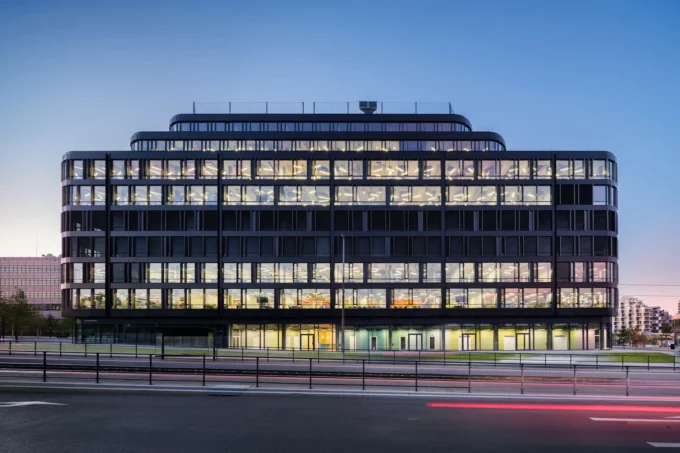
Located in Neuherberg, the HPC asserts a clear architectural identity within the otherwise orthogonal fabric of the Helmholtz Center. Its distinctive rhomboid footprint breaks from the surrounding geometry, establishing a strong visual presence and anchoring the newly formed Gaborplatz as a spatial and symbolic center.
This deliberate formal deviation is not an aesthetic gesture alone. It signals a different institutional culture, one centered on openness, experimentation, and interdisciplinary overlap. The building’s shape acts as both orientation device and statement: the Pioneer Campus is not an extension of conventional research infrastructure but a prototype for new academic environments.
The reinforced concrete frame expresses solidity and longevity, while the interior organization communicates flexibility and change. This duality reflects the building’s mission: to host transient research groups within a stable architectural framework.

Architecture Designed for Collaboration
The internal logic of the Helmholtz Pioneer Campus is guided by the goal of fostering interaction, both structured and spontaneous. Rather than separating laboratories and offices into isolated zones, the plan weaves them into a spatial continuum centered around a generous atrium.
At the core of the building, this multi-level atrium functions as a social and intellectual condenser. It accommodates informal workspaces, meeting areas, and communication zones, allowing researchers to encounter one another across disciplines and hierarchies. Visibility across levels reinforces a sense of shared endeavor, transforming the building into a vertical landscape of exchange.
The spatial openness is carefully calibrated: it supports collaboration without compromising the functional requirements of scientific work. Laboratories remain operationally efficient, yet never entirely detached from the collective life of the building.

Modular Laboratories and Flexible Work Environments
Two symmetrically organized laboratory modules form the backbone of the plan. These are flanked on three sides by office zones that can be configured in multiple ways depending on team size, working style, and research focus. This adaptability reflects the temporary nature of pioneer groups, whose spatial needs evolve over time.
Between laboratories and offices, so-called “flex zones” operate as transitional territories. These areas support hybrid uses (informal meetings, temporary workstations, collaborative discussions) and can be reprogrammed as required. The laboratories themselves are designed to be subdivided using modular boxes that can be assembled and dismantled like furniture, offering a rare degree of spatial agility within a scientific environment.
This flexibility is not merely practical; it embodies the ethos of the institution. Research is understood as dynamic, uncertain, and iterative, and the architecture responds by remaining open to transformation rather than enforcing static order.

Orientation as Identity
Wayfinding within the building is conceived as an experiential and symbolic system rather than a purely functional one. Upon entering, visitors encounter a large-scale black-and-white mural that establishes a strong atmospheric presence and immediately distinguishes the interior from conventional institutional environments.
The orientation system is further articulated through nine ribbon-like elements that extend up to 18 meters in length across different levels. Together, these ribbons form a sculptural composition that guides movement while simultaneously communicating the identity of the Pioneer Campus. Navigation becomes an embodied experience, reinforcing the idea that architecture here is not background but active participant.
This integration of art, identity, and circulation contributes to a cohesive spatial narrative in which researchers do not simply occupy the building but engage with it on a perceptual and symbolic level.

An Architecture for Temporary Communities
One of the most compelling aspects of the Helmholtz Pioneer Campus is its accommodation of temporality. Researchers remain for five to seven years before moving on, meaning that the building continuously hosts evolving communities. Rather than resisting this instability, the architecture embraces it.
Spaces are designed to support the rapid formation of social bonds, offering a variety of environments for concentration, exchange, presentation, and informal gathering. Conference rooms, communal kitchens, flexible lounges, and open work areas are distributed strategically to encourage interaction beyond disciplinary boundaries.
In this way, the building acts less like a traditional institutional facility and more like an incubator for intellectual culture. Architecture becomes an infrastructure for belonging, enabling short-term users to feel embedded within a collective environment.

A Contemporary Model for Research Architecture
The Helmholtz Pioneer Campus demonstrates a shift in how research environments are conceived. It moves beyond the idea of laboratories as purely technical spaces and positions them instead within a broader architectural ecosystem of communication, identity, and adaptability.
Through its strong formal presence, collaborative spatial organization, modular flexibility, and integrated orientation system, the building articulates a vision of science as a social, interdisciplinary, and evolving practice. It suggests that architecture, when carefully conceived, can actively shape not only how research is conducted, but how scientific communities are formed.
Photography: Brigida González


- Architecture and Identity
- Architecture for Education and Research
- Architecture for Innovation
- Atrium Architecture
- Collaborative workspaces
- Concrete architecture
- contemporary architecture
- flexible architecture
- German Architecture
- Helmholtz Pioneer Campus
- Institutional architecture
- Interdisciplinary Design
- Laboratory design
- modular design
- Munich Architecture
- Research Architecture
- Scientific Campus
- University and Research Buildings
- Workplace Architecture
- wulf architekten









Leave a comment