


Table of Contents Show
A spider produces silk that is stronger than steel by weight, at room temperature, using water as a solvent. A termite colony maintains a constant 87°F inside its mound while external temperatures swing from 35°F to 104°F. These are not abstract facts from a biology textbook. They are blueprints. Biomimicry in architecture takes exactly these kinds of biological strategies and translates them into buildings that perform better, cost less to operate, and work with their environment rather than against it.
Coined by biologist Janine Benyus in her 1997 book Biomimicry: Innovation Inspired by Nature, the term describes a design discipline that studies nature’s models and processes to solve human problems. For architects, it offers something that CAD software and engineering calculations alone cannot: 3.8 billion years of research and development. This article examines what biomimicry means in architectural practice, walks through seven built examples, and explains how you can start applying these principles to your own projects.
What Is Biomimicry in Architecture?
At its core, biomimicry in architecture is the practice of studying how organisms and ecosystems solve functional problems, then applying those solutions to building design. It goes well beyond copying the shape of a leaf or the curve of a shell. The discipline operates on three distinct levels, each offering progressively deeper lessons from the natural world.
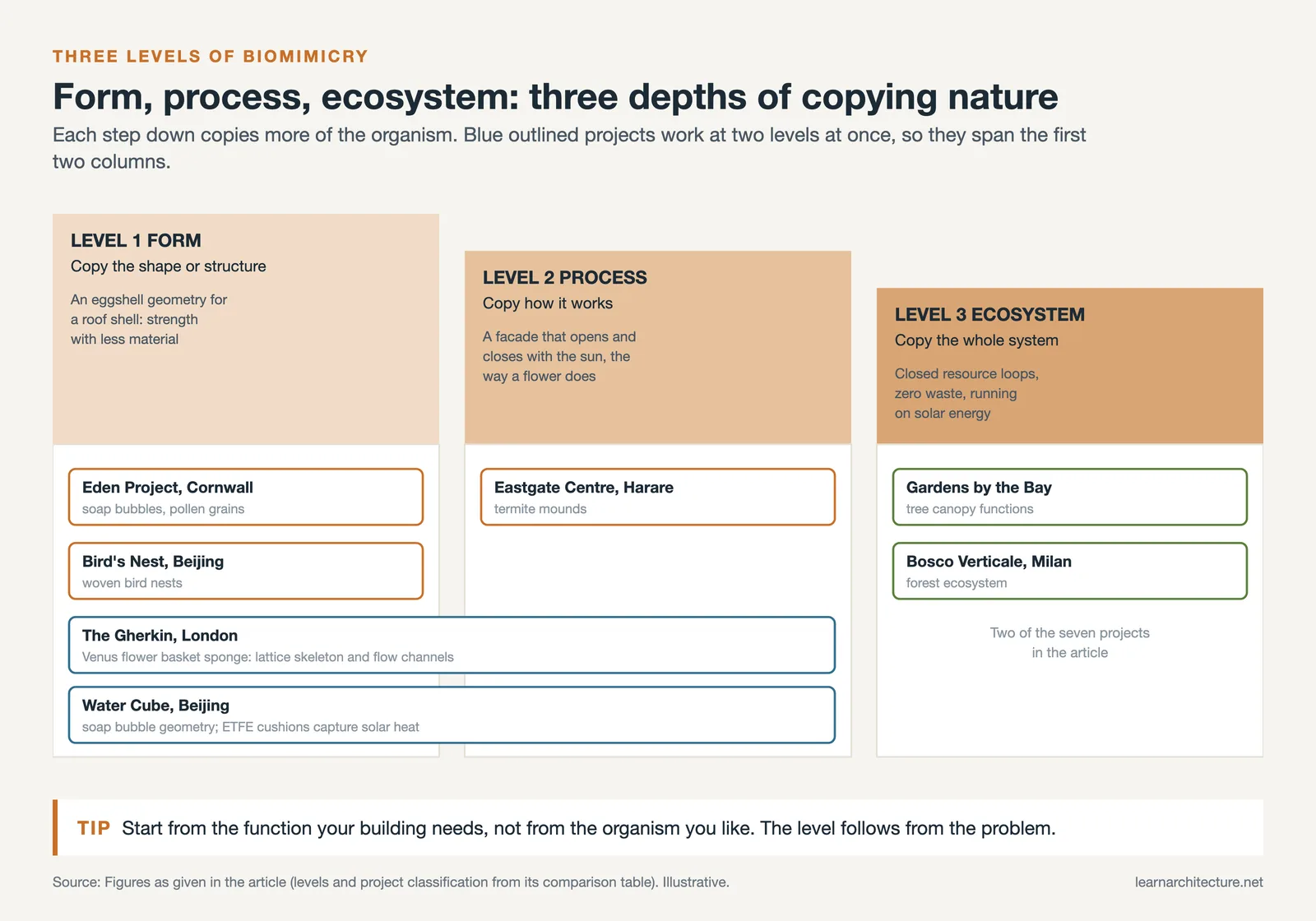
The first level is form-based mimicry, where a building’s shape or structure draws directly from a biological organism. Think of a roof shell modeled on an eggshell’s geometry to maximize strength with minimal material. The second level is process-based mimicry, where architects replicate how nature does something, such as a facade that opens and closes in response to sunlight the way a flower does. The third and most ambitious level is ecosystem-based mimicry, where an entire building or campus operates like a natural ecosystem, with closed-loop resource cycles, zero waste, and reliance on solar energy.
According to a 2023 literature review published in the journal Biomimetics (MDPI) by researchers analyzing case studies of biomimicry in architecture, built examples remain relatively scarce, but interest in the field has grown significantly over the past two decades. The review found that most successful projects combine at least two of these three levels. Understanding this framework is essential before examining specific examples of biomimicry in architecture.
Eastgate Centre, Harare: Termite Mound Ventilation
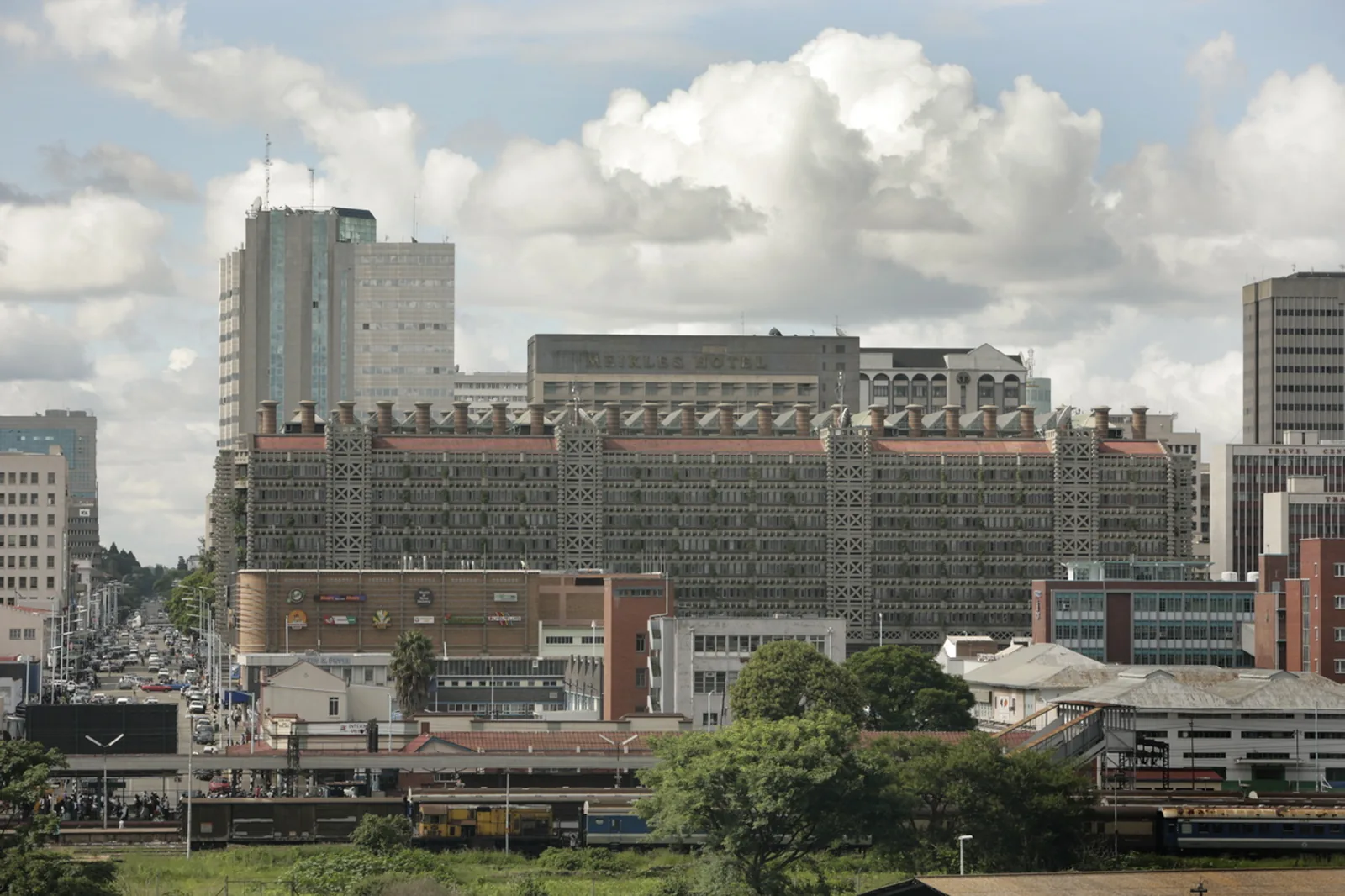
The Eastgate Centre in Harare, Zimbabwe, remains the most cited example of biomimicry architecture worldwide, and for good reason. Designed by architect Mick Pearce in collaboration with engineering firm Ove Arup & Partners, this nine-story office and shopping complex opened in 1996 and uses no conventional air conditioning. Its passive cooling system draws directly from the ventilation strategies found in African termite mounds.
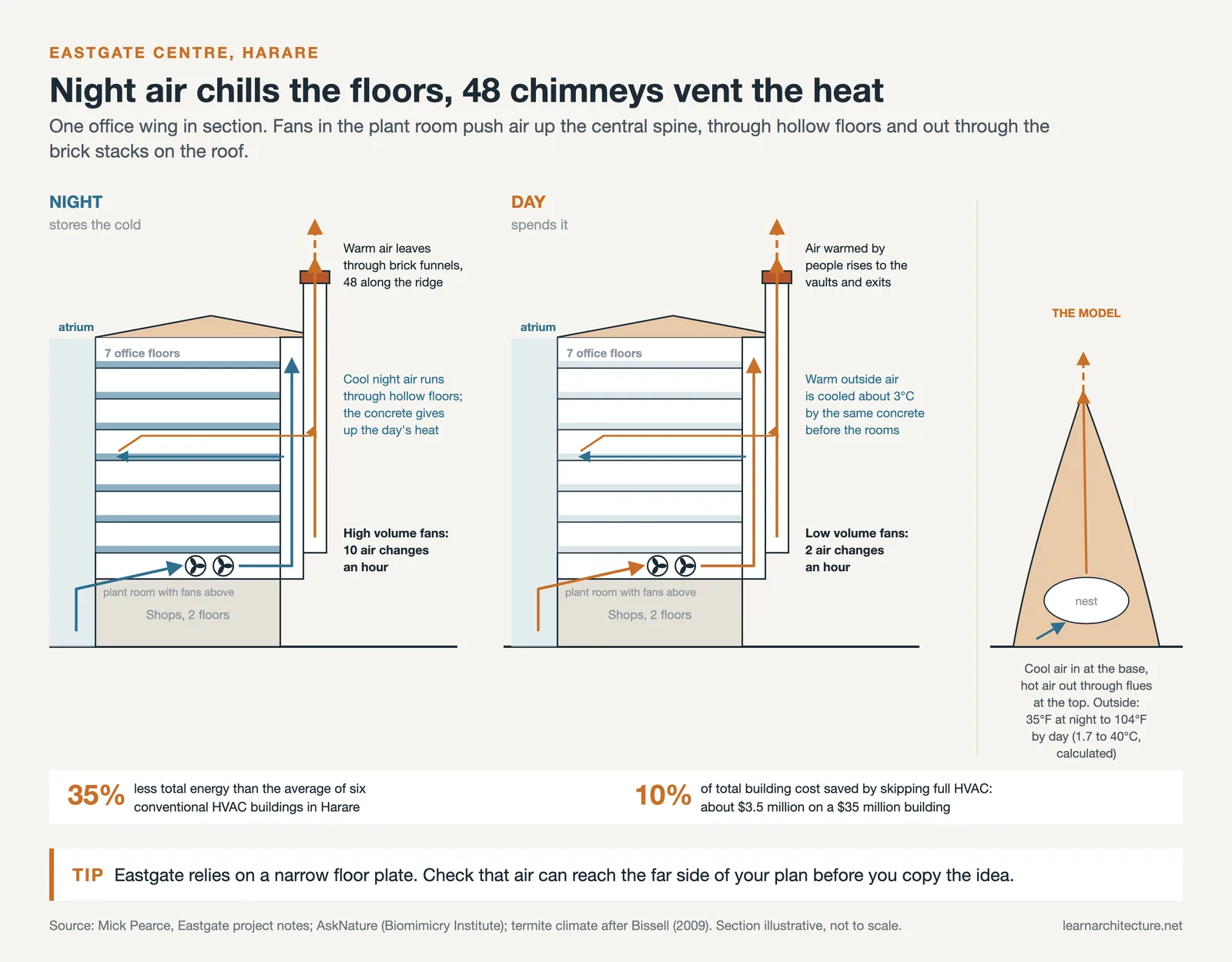
Termites maintain a near-constant internal temperature of about 87°F inside their mounds despite external conditions that swing between 35°F at night and 104°F during the day. They achieve this through a network of tunnels that draw cool air in at the base and vent warm air through flues at the top. Pearce adapted this principle using 48 brick chimneys along the building’s roof ridge, connected to a system of internal air shafts. At night, fans pull cool air through the concrete structure, which absorbs the cold. During the day, this stored coolness radiates into the office spaces while warm air rises and exits through the chimneys.
The results are measurable. According to data published on Mick Pearce’s architectural firm website, Eastgate uses 35% less total energy than the average consumption of six comparable conventional buildings with full HVAC systems in Harare. The building saved 10% on construction costs by eliminating the need for a conventional air-conditioning installation, which translated to approximately $3.5 million, as reported by AskNature (The Biomimicry Institute).
30 St Mary Axe (The Gherkin), London: Venus Flower Basket Sponge
Norman Foster’s 30 St Mary Axe, commonly known as The Gherkin, draws structural and ventilation inspiration from the Venus flower basket sponge (Euplectella aspergillum), a deep-sea organism whose lattice skeleton is remarkably efficient at distributing structural loads while allowing water to flow through it.
The building’s diagrid exoskeleton mirrors this lattice pattern, providing exceptional structural rigidity while minimizing the amount of steel required. But the biomimicry goes beyond form. The spiraling light wells that wrap around the tower mimic the sponge’s filtration channels. These gaps between each floor plate allow air to circulate naturally through the building, reducing dependence on mechanical ventilation. According to multiple architectural analyses, this design reduces energy consumption by up to 50% compared to conventional office towers of similar size.
The Gherkin demonstrates a critical principle in architecture and biomimicry: the most effective nature-inspired solutions often address both structure and environmental performance simultaneously, just as they do in the organism itself. The sponge’s skeleton is not just strong; it channels water flow for feeding. The building’s exoskeleton is not just rigid; it channels airflow for ventilation. For a deeper look at how structural design and environmental systems interact in building design, see The Future of Sustainable Architecture on learnarchitecture.net.

Eden Project, Cornwall: Soap Bubbles and Pollen Grains
Nicholas Grimshaw’s Eden Project in Cornwall, UK, consists of geodesic biomes that house plant species from different climate zones. The structural geometry of these domes draws from two biological references: the natural formation of soap bubbles and the geometry of pollen grains. Both demonstrate how spherical and hexagonal arrangements distribute loads across surfaces with minimal material.
The biomes are clad in ETFE (ethylene tetrafluoroethylene) pillows rather than glass. This material choice itself reflects biomimetic thinking. ETFE mimics properties found in plant cuticle layers: it is transparent to allow maximum light transmission, resistant to UV degradation, and self-cleaning due to its non-stick surface, much like a lotus leaf. Each ETFE pillow weighs less than 1% of equivalent glass panels, allowing the entire superstructure to be lighter than the air contained inside it.
The project covers more than 30 acres and functions as the world’s largest greenhouse. Michael Pawlyn, one of the lead architects on the Eden Project, went on to write Biomimicry in Architecture (RIBA Publishing, 2011), which remains the standard reference text for practitioners working with nature-inspired design. His TED talk on the subject has been viewed over 2 million times. For related reading on how natural environments influence design thinking, visit Finding Architectural Concepts in the Environment on learnarchitecture.net.

National Aquatics Center (Water Cube), Beijing: Bubble Geometry
Built for the 2008 Summer Olympics, the National Aquatics Center in Beijing is commonly called the Water Cube. Its design team, led by PTW Architects with Arup, used the Weaire-Phelan structure as their starting point. This mathematical model is the most efficient known way to partition space into equal-sized cells, a problem first posed by thinking about the geometry of soap bubbles.
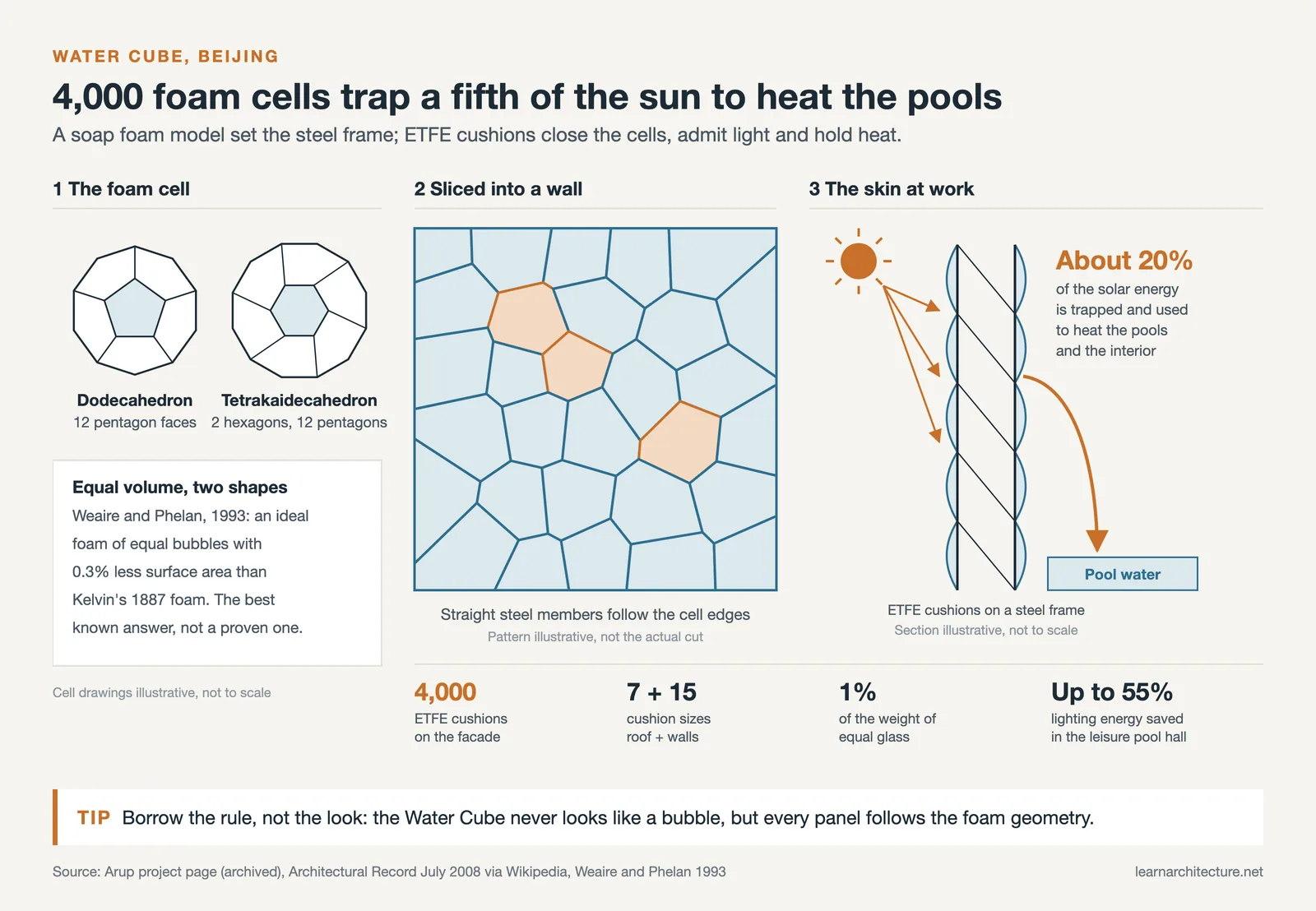
The result is a facade made of 4,000 ETFE cushions arranged in a seemingly random, organic pattern. The randomness is deceptive. Every bubble was computationally generated to optimize structural distribution. The ETFE cladding traps solar energy: it allows more light in than glass and captures approximately 20% of solar radiation, which is then used to heat the swimming pools inside. This passive heating strategy reduces the facility’s energy consumption for water temperature management significantly.
The Water Cube is a strong example of how examples of biomimicry in architecture do not always look like the organism they reference. The building does not look like a soap bubble in any obvious way. Instead, it borrows the underlying geometric principle and applies it at an architectural scale.
Beijing National Stadium (Bird’s Nest): Woven Nest Structures
Designed by Herzog & de Meuron in collaboration with artist Ai Weiwei for the 2008 Olympics, the Beijing National Stadium draws from the nest-building patterns of birds. The exterior is a lattice of interlocking steel beams that cross, weave, and overlap in a pattern that appears chaotic but is structurally precise.
This interlocking lattice serves multiple functions simultaneously. It provides structural stability without relying on interior columns, creates a visually permeable skin that allows natural ventilation and daylight into the stadium, and distributes seismic loads across the entire surface rather than concentrating them at specific points. The design references the nest of the Chinese red-crowned crane, known for building intricate, interlocking structures from available materials.
What makes this project significant within biomimicry and architecture is that it demonstrates form and function working as one. The aesthetic quality of the building is not a decorative layer applied over an engineering solution. The structure is the architecture. This is precisely how natural systems work: a bird’s nest is simultaneously its structure, its skin, and its thermal envelope. For additional examples of how architects integrate natural systems into design, read Techniques for Incorporating Nature into Architectural Design on learnarchitecture.net.

Gardens by the Bay, Singapore: Supertree Vertical Gardens
Singapore’s Gardens by the Bay features 18 Supertrees ranging from 25 to 50 meters tall, designed by Grant Associates and Wilkinson Eyre Architects. These vertical gardens function like real trees. They collect rainwater, generate solar energy through photovoltaic cells on their canopies, and act as air intake and exhaust ducts for the adjacent conservatories.
The tallest Supertrees are connected by an elevated walkway, and at night, they are illuminated using energy harvested during the day. The planting strategy uses over 200 species of tropical plants, mosses, and ferns, which serve as a living skin that provides shading and absorbs heat, reducing the surrounding ambient temperature. This addresses the urban heat island effect that Singapore, like many tropical cities, faces.
Gardens by the Bay shows how architecture biomimicry can operate at an urban scale, not just at the level of a single building. The Supertrees are not buildings in the traditional sense, yet they perform architectural functions: climate control, energy generation, water management, and public space creation.

Bosco Verticale, Milan: Forest Ecosystem Integration
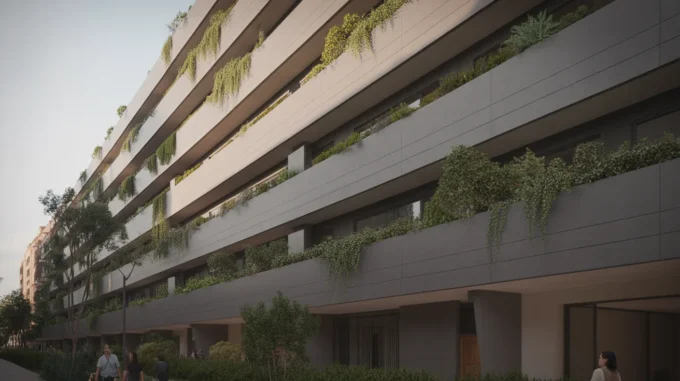
Stefano Boeri’s Bosco Verticale (Vertical Forest) in Milan takes ecosystem-level biomimicry to its logical urban conclusion. The two residential towers, completed in 2014, hold about 800 trees, 4,500 shrubs, and 20,000 plants from around a hundred species across their facades. According to Stefano Boeri Architetti, this vegetation is equivalent to about five hectares of parkland on flat land, concentrated on roughly 1,000 square meters of urban land.
The planting is not decorative. Each species was selected and positioned based on its solar exposure, wind tolerance, and interaction with adjacent species, mimicking how plants self-organize in a natural forest canopy. The trees provide shade in summer, reducing interior cooling loads, and lose their leaves in winter to allow sunlight through. The leaf canopy filters dust and particulate matter, and the plants collectively absorb CO2 while producing oxygen.
Bosco Verticale represents the ecosystem level of biomimicry in its fullest expression within a residential context. The building does not mimic a single organism or process. It replicates an entire ecological system, with all the interdependencies that implies. You can explore more about how living systems integrate with building design at Symbiotic Architectural Design with the Environment on learnarchitecture.net.

Comparing Key Biomimicry Examples in Architecture
The following table summarizes the biological inspiration, design strategy, and measurable outcomes of the projects discussed above.
| Building | Biological Source | Biomimicry Level | Key Performance Outcome |
|---|---|---|---|
| Eastgate Centre, Harare | Termite mounds | Process | 35% less energy than comparable HVAC buildings |
| The Gherkin, London | Venus flower basket sponge | Form + Process | Up to 50% energy reduction vs. typical towers |
| Eden Project, Cornwall | Soap bubbles, pollen grains | Form | Superstructure lighter than the air inside |
| Water Cube, Beijing | Soap bubble geometry | Form + Process | 20% solar energy capture via ETFE cladding |
| Bird’s Nest, Beijing | Bird nest weaving | Form | Column-free interior, seismic load distribution |
| Gardens by the Bay | Tree canopy functions | Ecosystem | Rainwater collection, solar energy, air filtration |
| Bosco Verticale, Milan | Forest ecosystem | Ecosystem | 800 trees, CO2 absorption, seasonal shading |
How to Apply Biomimicry to Your Own Architectural Projects
Moving from inspiration to implementation requires a structured approach. Carl Hastrich of the Biomimicry Institute developed the Biomimicry Design Spiral, a six-step framework that guides designers from problem identification through biological research to final application. Here is how you can adapt it for architectural practice.
Start with the Function, Not the Form
The most common mistake in architecture biomimicry is starting with a visually appealing organism and trying to force it into a building shape. Instead, begin by identifying the specific performance challenge your project faces. Does it need passive cooling? Water collection? Structural efficiency with minimal material? Once you define the function, search for organisms that solve the same problem. Resources like AskNature.org (maintained by the Biomimicry Institute) catalog thousands of biological strategies organized by function.
Abstract the Principle Before Designing
The Eastgate Centre does not look like a termite mound. Mick Pearce abstracted the ventilation principle (stack effect driven by thermal mass and chimney venting) and applied it using concrete and brick. Your job is to identify the underlying mechanism, not replicate the organism’s appearance. This abstraction step separates effective biomimicry from superficial biomorphism.
Collaborate Across Disciplines
Biomimicry works best when architects partner with biologists, engineers, and material scientists. The most successful projects in this article involved interdisciplinary teams. Pearce worked with Arup’s environmental engineers. The Eden Project involved Grimshaw Architects working alongside structural engineers and botanists. If your practice does not have in-house biology expertise, consider consulting with organizations like Biomimicry 3.8, which provides professional consulting services for design teams. For more on how collaboration shapes sustainable projects, explore Natural Construction Resources for Sustainable Building on learnarchitecture.net.

The Future of Biomimicry and Architecture
Computational design tools and additive manufacturing are accelerating what is possible with biomimicry in architecture. Architects can now model complex biological geometries that were impossible to fabricate even a decade ago. 3D-printed structures that mimic bone growth patterns use as little as one-thousandth of the material of a solid object with equivalent volume, as demonstrated by Exploration Architecture’s research into bird skull structures.
Self-healing concrete, inspired by the way biological organisms repair damage, is moving from laboratory research into commercial application. Bio-receptive facade panels that support moss and lichen growth are being developed to give buildings the air-purifying capacity of living walls without the irrigation infrastructure. Adaptive facade systems that respond to sunlight, modeled on flower opening mechanisms, are already in prototype stage at multiple research institutions.
The trajectory is clear. As the building sector accounts for roughly 40% of global energy consumption according to the United Nations Environment Programme (UNEP), the pressure to find more efficient design strategies will only increase. Biomimicry offers a proven, evidence-based path forward, not as a replacement for engineering, but as its most powerful complement.
Environmental impact data referenced in this article is based on available research and published performance metrics from the respective architectural firms and engineering consultants. Specific performance figures may vary based on local climate conditions, building operation, and measurement methodology.






Leave a comment