



Table of Contents Show
To transition from architecture to UX design, reframe your spatial problem-solving, drafting, and client skills for digital products, then learn UX research, wireframing, and prototyping in tools like Figma. Most architects can build a junior-ready UX portfolio within six to twelve months of focused, project-based practice.
Plenty of trained architects reach a point where the long studio hours and slow project timelines of practice no longer add up. UX design offers faster feedback loops, steady demand, and work that still revolves around how people use space, just digital space instead of physical buildings. More of your architecture training carries over than you might expect. Here is how the move actually works.

What Is UX Design, and Why Do Architects Switch?
UX (user experience) design shapes how people interact with a product, app, or website so the result feels clear, useful, and easy to use. As the Nielsen Norman Group puts it, user experience covers every aspect of a person’s interaction with a company and its products. UX is broader than UI (user interface) design: UI handles the visual surface like buttons, color, and type, while UX covers research, information architecture, and the full journey. A ui/ux designer usually works across both.
Architects switch for practical reasons. Design thinking travels well beyond buildings, and skills in spatial reasoning, stakeholder facilitation, and systems integration map directly onto product roles. As this look at architecture as a career notes, the discipline’s toolkit opens doors well outside traditional practice. Digital design also tends to bring shorter project cycles and, in many markets, stronger early-career pay growth.

Which Architecture Skills Transfer to UX Design?
A large share of the daily UX toolkit overlaps with architectural training. You already think in systems, iterate through critique, and turn messy client needs into structured solutions. The core work of an architect is exactly what product teams hire for, just applied to screens instead of sites.
Architecture-to-UX Skill Map
The table below shows how common architecture skills line up with their UX equivalents:
| Architecture Skill | UX Design Equivalent |
|---|---|
| Spatial organization and zoning | Information architecture and navigation |
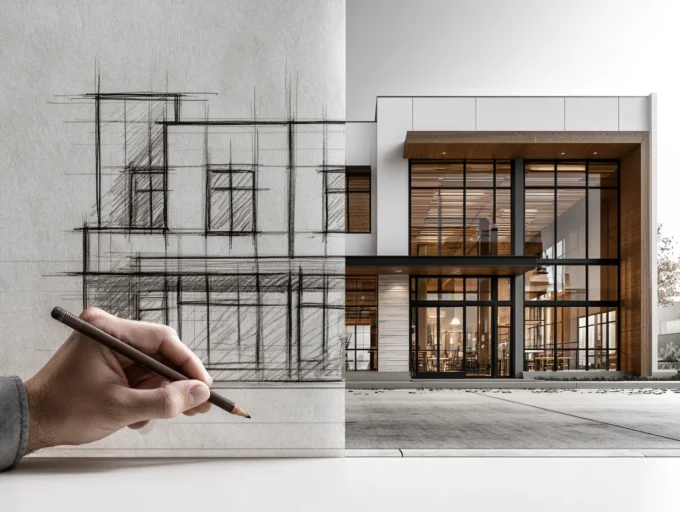
| Concept sketching and drafting | Wireframing and low-fidelity prototyping |
| Iterative studio critique | Design iteration and usability testing |
| Client briefs and design reviews | Stakeholder management and design critiques |
| Circulation and movement planning | User journey and task flow mapping |
| Observing how people use a building | User research and behavioral observation |
The mental model is nearly identical. You start from a brief, work within constraints, test options, then refine. Going from architecture to UX designer is less a full reset and more a change of medium.
New Skills You Will Need to Learn
The real gap sits in three areas: formal UX research, interaction design, and digital tooling. Architecture trains you to watch how people behave, but UX makes that rigorous through structured user research, including user interviews, usability tests, and synthesis. You will also pick up interaction patterns, prototyping, and designing for many screen sizes rather than a single fixed layout.
On tools, the learning curve is gentle. If you have worked in Rhino, Revit, or AutoCAD, Figma will feel approachable within a couple of weeks, and it sits close to the software architects already use every day. The basics of UX design, meaning research, information architecture, wireframing, prototyping, and testing, are all learnable through a structured course without committing to another degree.
💡 Pro Tip
Skip generic “design a fictional app” exercises early on. Pick a real product you use daily, document three concrete usability problems, and redesign one flow from start to finish. Hiring managers respond far better to a focused redesign with clear reasoning than to a polished concept with no real problem behind it.

How to Transition from Architecture to UX Design, Step by Step
The move breaks into five practical steps you can work through in order:
- Learn the fundamentals. Take a structured UX course or certificate that covers research, information architecture, interaction design, and testing in a logical sequence.
- Reframe your existing work. Re-describe your architecture projects in UX language, focusing on the problem, your process, and the outcome rather than the final render.
- Do real UX projects. Redesign an app flow, volunteer for a nonprofit, or take small freelance work so you build evidence of UX thinking, not just architecture output.
- Build a UX portfolio. Replace pretty drawings with case studies that walk through a problem, your research, your decisions, and the result. The narrative discipline you used assembling an architecture portfolio applies directly here.
- Network and apply. Target junior UX, product design, or UX-adjacent roles, and treat your background as a differentiator rather than a deficit.
⚠️ Common Mistake to Avoid
Treating a UX portfolio like an architecture portfolio. Architects often fill case studies with beautiful visuals but skip the research, problem framing, and decision rationale that UX reviewers actually look for. Show how you reached a solution, not only how it looks. A clear thought process beats a glossy mockup almost every time.
What Does the UX Job Market Look Like?
Demand is steady and pay is competitive with architecture. The occupational category that includes most UX roles, web and digital interface designers, earns a median wage close to that of licensed architects, and it is growing at a faster rate.
🔢 Quick Numbers
- Web and digital interface designers earned a median annual wage of $98,090 in May 2024, compared with $96,690 for architects (U.S. Bureau of Labor Statistics, Occupational Outlook Handbook).
- Employment of web developers and digital designers is projected to grow 7% from 2024 to 2034, well above the 3% average for all occupations and the 4% projected for architects (U.S. Bureau of Labor Statistics).
- About 14,500 web developer and digital designer openings are projected each year through 2034 (U.S. Bureau of Labor Statistics).
Entry points include in-house product teams, design agencies, and contract work. Many former architects start in a hybrid role such as design systems, architecture-software UX, or proptech, where their domain knowledge becomes a genuine advantage rather than something to leave behind.
Salary figures are approximate and vary by region, experience level, and employer.

Where to Go From Here
Your Next Step: Pick one app you use every day, run a short usability review of a single flow, and rebuild that flow in Figma this week. That one finished case study, with your reasoning written out, becomes the first real piece of your UX portfolio and the clearest proof that your transition has already started.
Frequently Asked Questions
Can architects become UX designers without a degree?
Yes. Most UX roles weigh a strong portfolio and a demonstrated process more heavily than any specific degree. A structured course or certificate plus two or three solid case studies is usually enough to reach junior and mid-level interviews, and an architecture background tends to stand out in the applicant pool.
How long does it take to transition from architecture to UX design?
For most architects working at it consistently, six to twelve months is realistic. That window covers learning UX fundamentals, completing a few real projects, and building a focused portfolio. Architects who already know design software and design thinking often move faster than career changers from unrelated fields.
Do UX designers earn more than architects?
At the median, the two are close. U.S. data place web and digital interface designers slightly above architects, though individual pay varies widely by city, company, and seniority. Tech hubs and senior product roles tend to sit at the higher end of the range.
What software do architects need to learn for UX design?
Figma is the main tool to learn, and it is the industry standard for both UX and UI work. Architects comfortable with Rhino, Revit, or AutoCAD usually pick it up quickly. Some teams also use FigJam for collaboration and tools like Maze or Dovetail for research and testing.










Leave a comment