Home Architecture News Adobe Text-to-3D Patent Application Describes Walkable Scenes Generated From a Prompt
Architecture NewsArtificial Intelligence

Adobe Text-to-3D Patent Application Describes Walkable Scenes Generated From a Prompt

A newly published Adobe patent application describes a two stage system that turns a text prompt into a navigable 3D scene. It is a filing, not an announced product.

Share
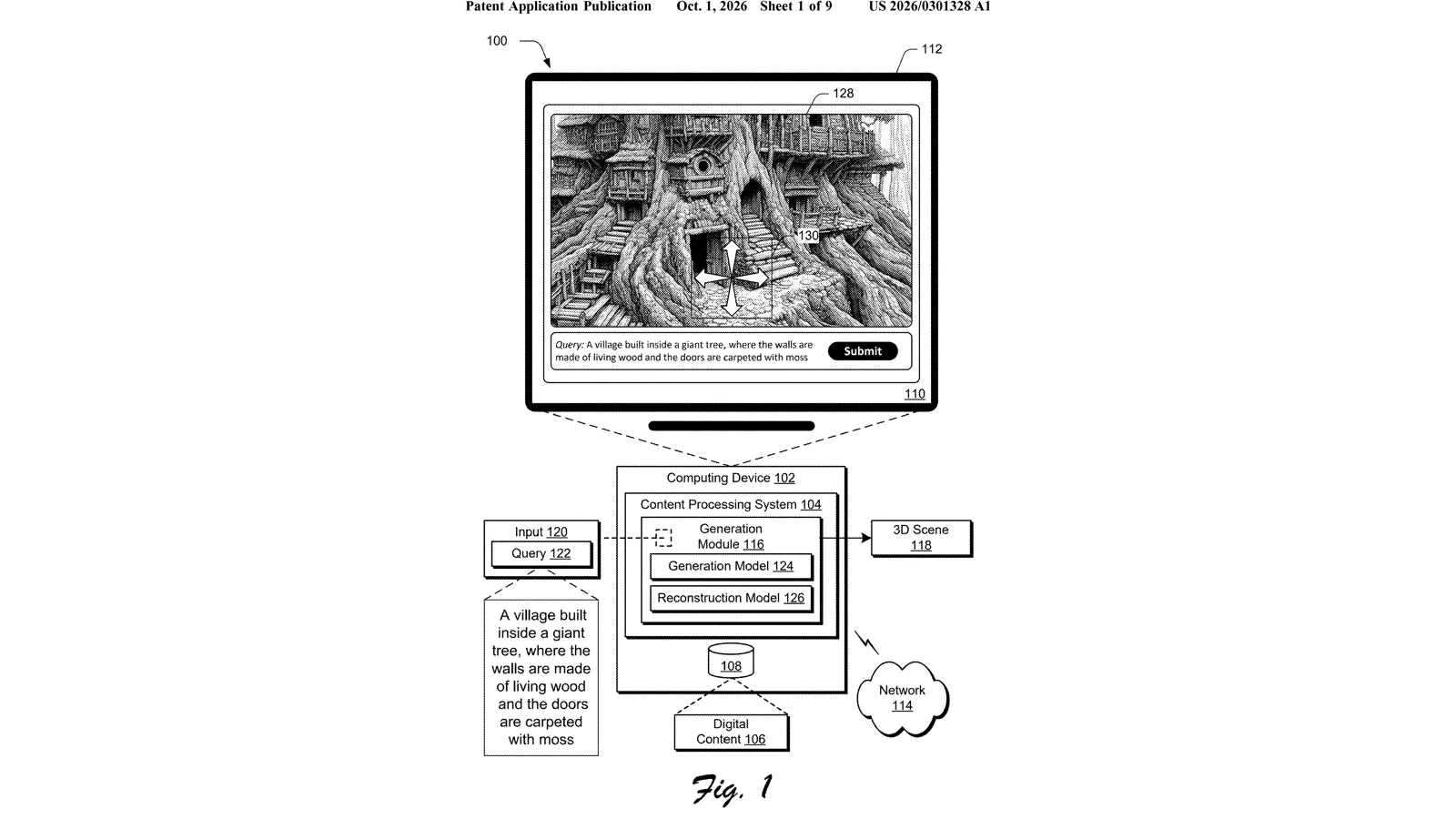
Patent drawing of a monitor showing a village inside a giant tree above a text query box and a system block diagram
Figure 1 of the filing: a text query about a village inside a giant tree and the resulting navigable scene. · Image: Adobe Inc., US 2026/0301328 A1, via USPTO
Share

An Adobe text-to-3D system that builds a scene you can walk through from a single written prompt is set out in a newly published US patent application. The filing, US 2026/0301328 A1, is titled “Query-Based Generation of Traversable Three-Dimensional Scenes”. The US Patent and Trademark Office published it on 1 October 2026; Adobe filed it on 30 March 2025. It describes a method, not a product, and Adobe has not announced any tool based on it.

Creative Bloq picked up the filing after it was flagged by the patent tracking site Patentlyze. The named inventors are Yiwei Hu, Zhaoyang Zhang, Yannick Hold-Geoffroy, Miloš Hašan and Fujun Luan.

How the Adobe text-to-3D pipeline works

The application splits the job into two steps. First, a generation model reads the prompt and produces what the filing calls a spherical representation: a sequence of 360 degree panoramic frames showing the scene from several viewpoints. In some versions this model is a text-to-video diffusion model that has been fine-tuned on panoramic video.

Second, a reconstruction model, for which the filing gives a long-LRM (large reconstruction model) as an example, turns those panoramas into geometry. The system pulls perspective views out of the panoramic frames, estimates a virtual camera pose for each, and uses them to assemble a traversable scene. The result is placed in a 3D environment where the user can move around and look from different positions.
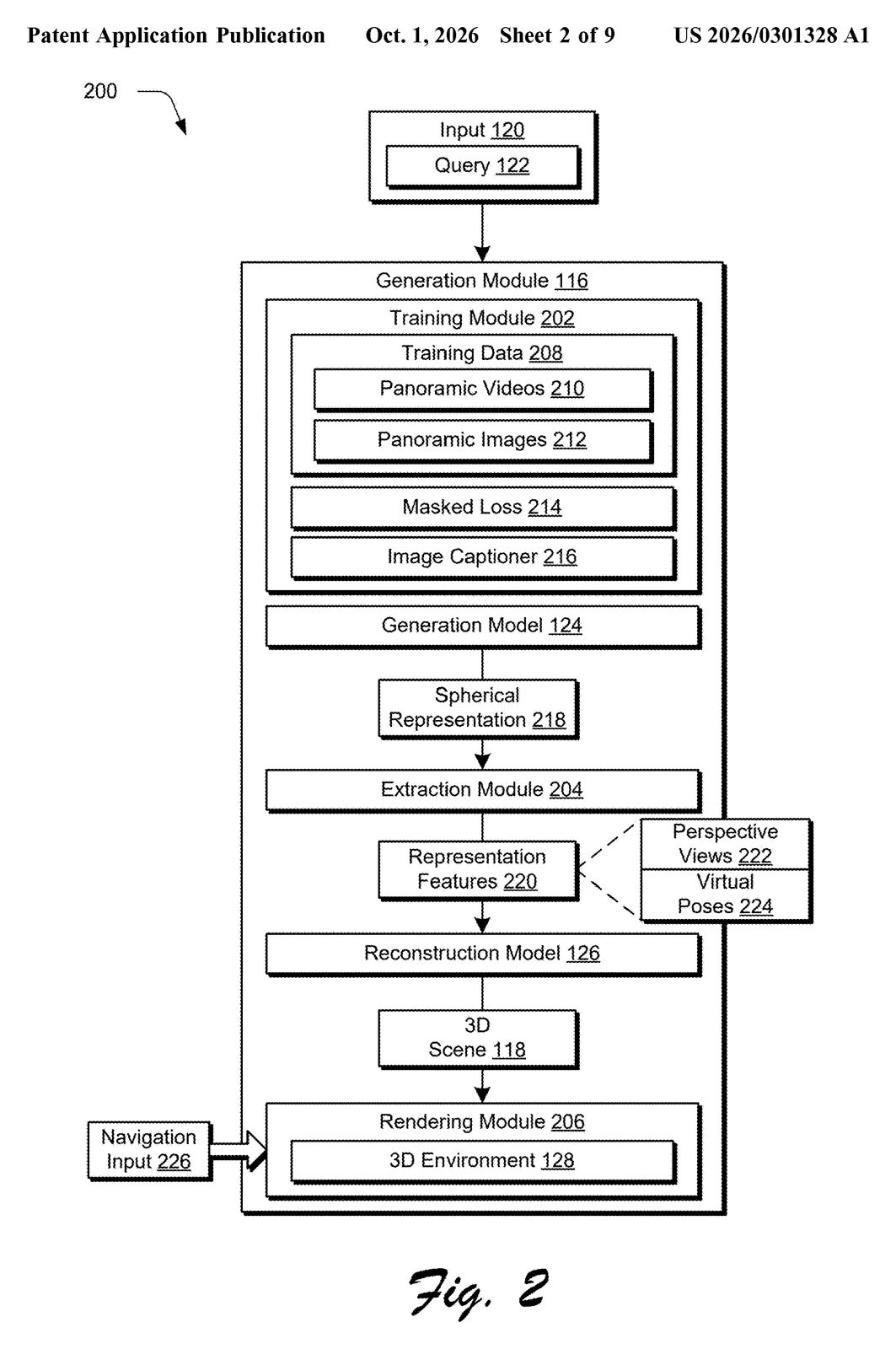
Patent block diagram linking a text query, generation model, spherical representation and reconstruction model to a 3D scene
Figure 2: the pipeline from query to spherical representation, reconstruction and rendering. · Image: Adobe Inc., US 2026/0301328 A1, via USPTO

Adobe argues in the filing that skipping the slow, repeated refinement steps of earlier methods makes the process lighter on computing resources, and that it keeps the scene consistent from one viewpoint to the next. These are the applicant’s claims; the document does not include independent test results.

An opera house as the worked example

The application’s main example is architectural. It imagines a user who wants to preview a design concept in virtual reality and types a request for a grand opera house with ornate balconies and a dimly lit stage. The generated environment would then let that user move between the stage, the seating and the balconies while the architecture, lighting and spatial relationships stay coherent.

The drawings show other prompts too: a village built inside a giant tree, a Greek temple on a sunny cliff, and a room with a fireplace of glowing stones and furniture carved from tree trunks.
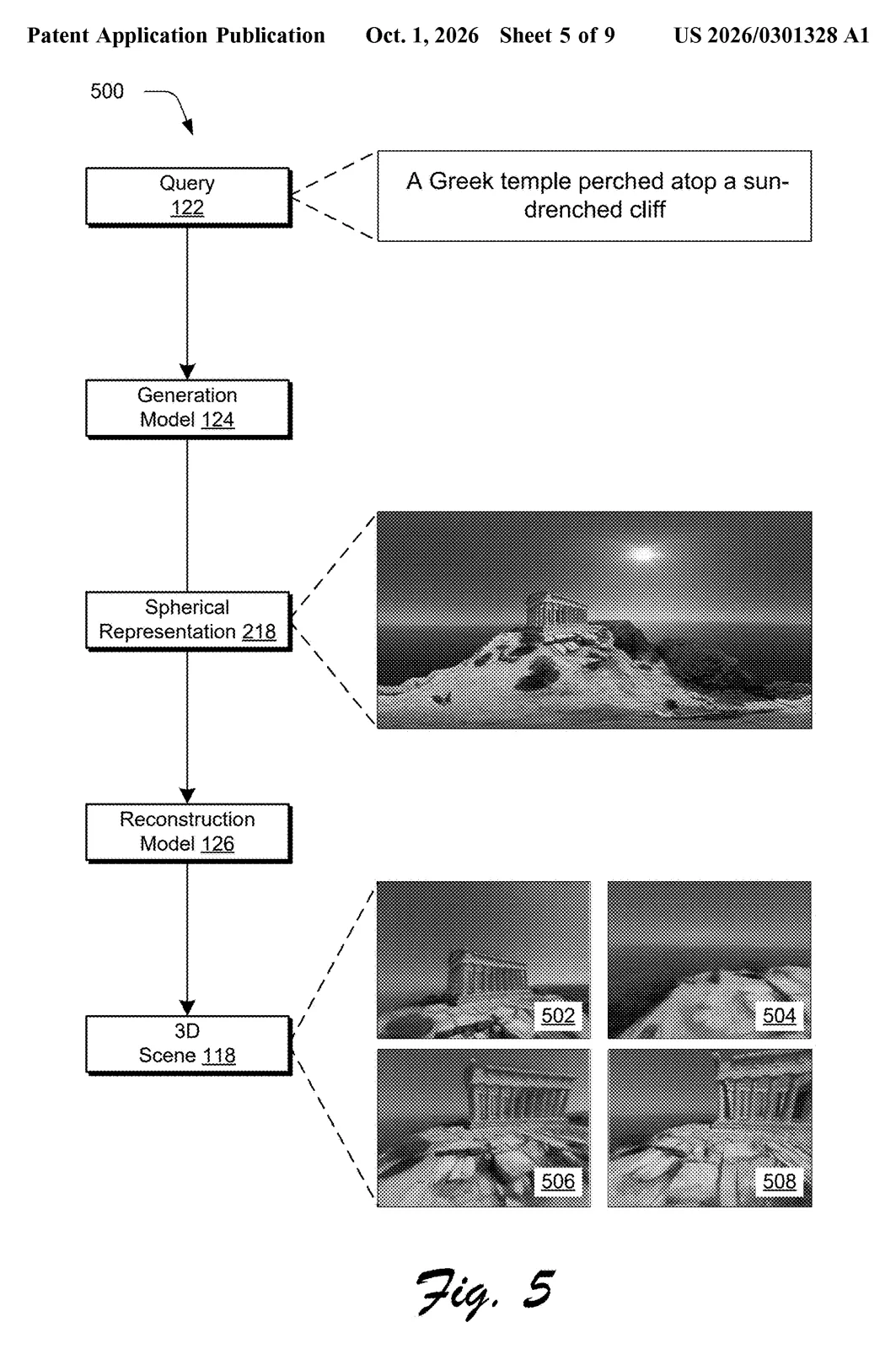
Patent figure with a Greek temple prompt, a panoramic image of the temple and four views of the generated 3D scene
Figure 5: a Greek temple on a sunlit cliff, from panorama to four views of the 3D scene. · Image: Adobe Inc., US 2026/0301328 A1, via USPTO

A filing, not a launch

A published application is neither a granted patent nor a product roadmap. As Creative Bloq points out, companies file patents for many reasons, including keeping rivals away from an idea. Adobe already sells the Substance 3D apps, but Substance 3D Modeler has no Firefly generative features so far. Other recent Adobe filings cover generating new camera angles from one photo, finding matching materials across 3D models and previewing garments in 3D.

Share
Written by
LA Editorial Team

The Learn Architecture editorial team is a group of architects, designers, and writers who research, write, and review content on architecture, design, technology, sustainability, and education for students and professionals worldwide.

Leave a comment

Leave a Reply

Your email address will not be published. Required fields are marked *

Related Articles
Modern white office building with the Arcadis logo above the entrance and a horse sculpture in front
Architecture NewsCareer

Arcadis Plans to Sell Most of Its Architecture Business in a Strategic Reset

Design and engineering group Arcadis plans to divest most of its architecture...

Isometric diagram of orange block buildings with roads and labels shown in the Axogram interface
3D VisualizationArchitecture News

Lumion Launches Axogram, a Free Tool for 3D Architectural Diagrams Linked to SketchUp, Revit and Archicad

Lumion's Axogram builds sequence, context, section and circulation diagrams around SketchUp, Revit...

Aerial view of a Minecraft city on a peninsula between two blue rivers, packed with towers and green slopes
Architecture NewsUrban Design

An Architect Rebuilt Chongqing’s Yuzhong District in Minecraft to Understand Its Vertical City

Using Rhino, Grasshopper and Minecraft, architect Seth of Sluda Builds recreated more...

Subscribe to Our Updates

Enjoy a daily dose of architectural projects, tips, hacks, free downloadble contents and more.

Copyright © Learn Architecture Online. All rights reserved.
Made with ❤️ by learnarchitecture.online

iA Media's Family of Brands

Privacy Overview

This website uses cookies so that we can provide you with the best user experience possible. Cookie information is stored in your browser and performs functions such as recognising you when you return to our website and helping our team to understand which sections of the website you find most interesting and useful.