


Table of Contents Show
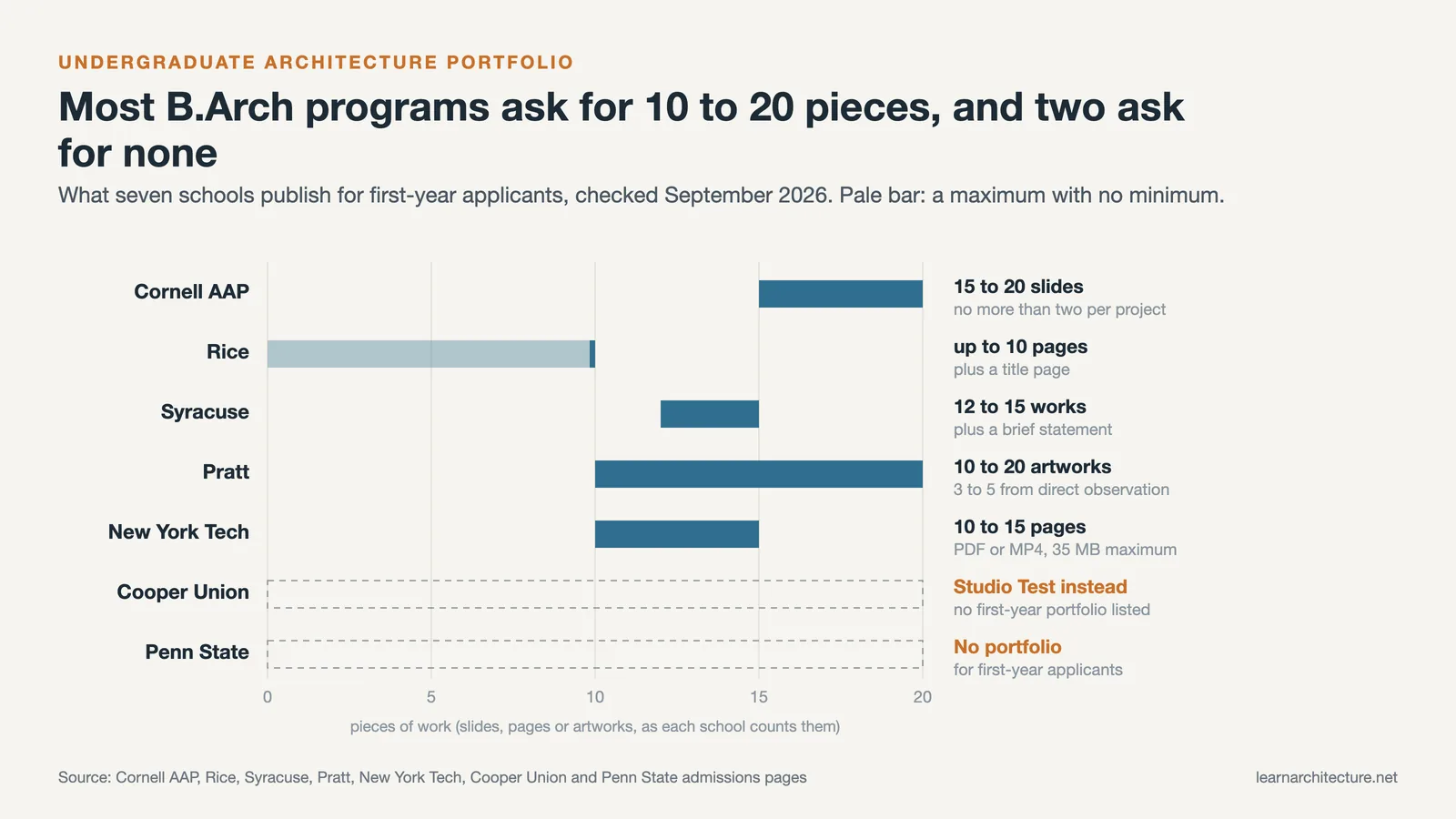
An undergraduate architecture portfolio is a short collection of your own creative work, usually 10 to 20 pieces, that architecture schools use to judge your creative potential before you have studied architecture. Most programs do not expect building designs. They want observational drawing, work in several media, some three-dimensional making, and clear captions, delivered in the exact format each school specifies.
This is the portfolio you send with a first-year application to a B.Arch or pre-professional architecture program, and it is a different document from the studio portfolio you will build once you are enrolled. If you are already in school and choosing studio projects, our guide to the best projects for an architecture student portfolio is the better fit. If you are a year or two away from applying and want the wider picture (math, drawing practice, visits), start with how to prepare before you apply to architecture school. What follows is the portfolio itself, based on what admissions offices say on their own pages as of September 2026.
What Schools Look For in an Undergraduate Architecture Portfolio
The criteria are stated more openly than most applicants expect. Rice School of Architecture says the portfolio should demonstrate creative aptitude and potential as well as spatial comprehension, and that it is not necessarily expected to be architectural in focus. Rice adds that it is particularly interested in your capacity to think creatively, critically, and independently.
Syracuse says work will be evaluated on demonstrated skill, discipline, and creativity. Cornell lists seven attributes it values in B.Arch applicants, from “Expressive Designers” who convey legible design intent to “Rigorous Makers” who develop and refine technical and creative abilities, and asks for evidence of creative ability and commitment to architecture alongside strong academics.
Pratt explains its review in the most detail. It reads every portfolio through two lenses: an admissions lens focused on the potential your work shows, and a scholarship lens focused on the accomplishment it shows. Pratt also says it will never compare your portfolio to anyone else’s and assesses your work relative to your own educational and creative experience. That is useful to know if your school offered little or no art.
Portfolio Requirements at Seven Schools
Requirements differ enough that you should plan one version per school. The table below lists what each program publishes for first-year applicants, checked in September 2026:
| School | How much work | Format | Also required |
|---|---|---|---|
| Cornell AAP (B.Arch) | 15 to 20 slides, no more than two per project | SlideRoom only; JPG, PNG, GIF images | Video interview, three minutes maximum |
| Rice (B.Arch) | Up to 10 pages plus a title page | One PDF, 15 MB maximum, landscape A4 or Letter | Upload through the Rice applicant portal |
| Syracuse (B.Arch) | 12 to 15 works plus a brief statement | Single multi-page PDF, landscape pages | Optional portfolio interview |
| Pratt (Architecture) | 10 to 20 artworks, 3 to 5 from direct observation | Uploaded after the Common App | Work made within the last 18 months |
| New York Tech (B.Arch) | 10 to 15 pages of visual work | PDF or MP4, 35 MB maximum | Common Application |
| Cooper Union (B.Arch) | No first-year portfolio listed | Studio Test, physical and digital | About one month to complete the test |
| Penn State (B.Arch) | No portfolio for first-year applicants | Not applicable | Portfolio review only for change of major |
Two things stand out. First, “portfolio” can mean slides in a web portal, a single PDF, or no portfolio at all. Second, the limits are firm: Rice states that submissions exceeding its specifications will not be accepted, and Cornell says all portfolio requirements must be met for the application to be considered.
📌 Did You Know?
Cooper Union’s architecture school replaces the usual first-year portfolio with a Studio Test: a set of visual and written prompts developed by its core faculty with students, released after the application deadline, with roughly a month to finish. Early Decision and Regular Decision applicants receive different tests, and the school says no prior experience in architecture is required.
What to Include When Applying to Architecture School
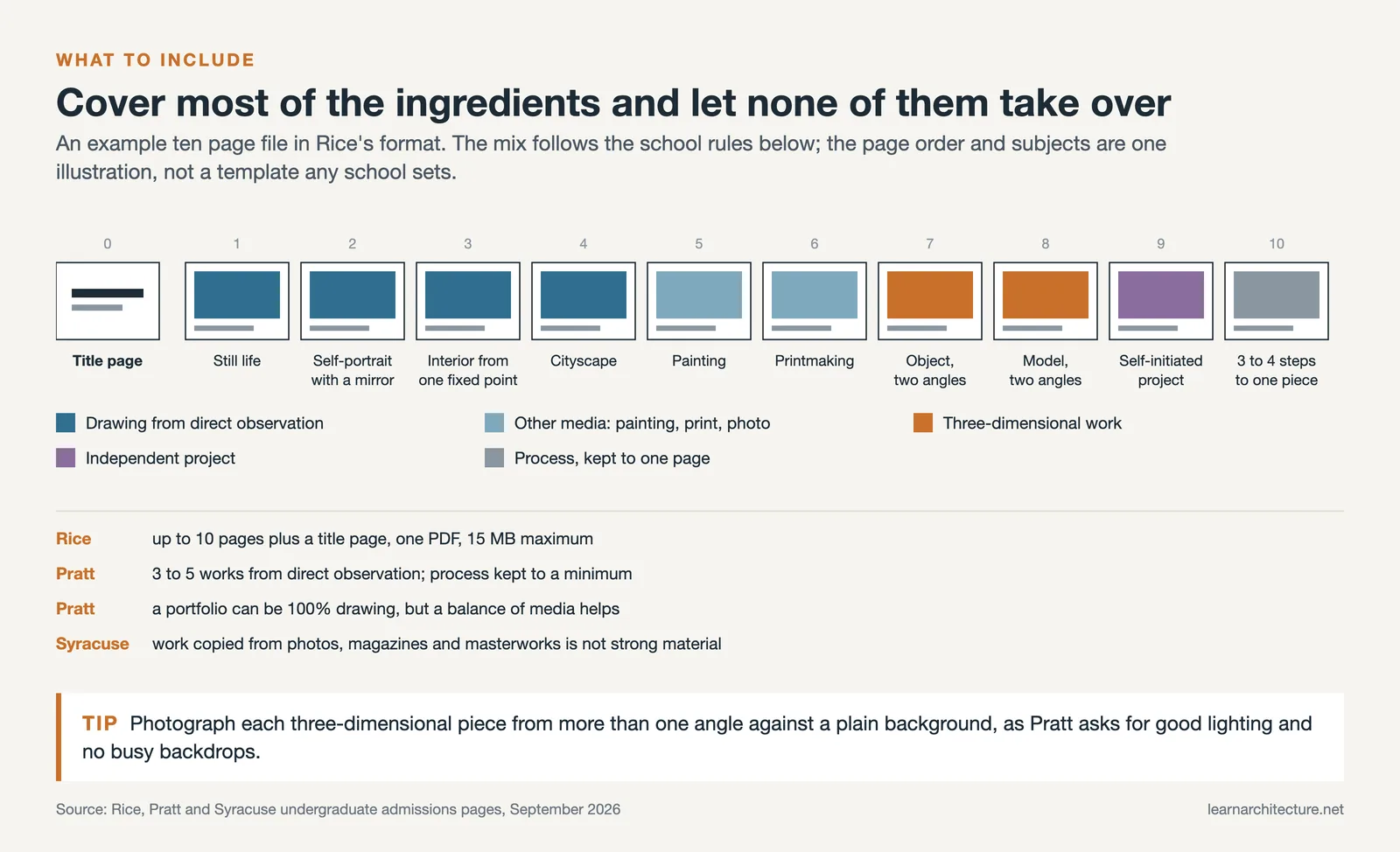
Across these schools, the same kinds of work keep coming up. Think of them as ingredients, and aim to cover most of them without letting any one take over.
Drawing From Direct Observation
This is the closest thing to a universal requirement. Pratt asks for 3 to 5 examples of original work done from direct observation of three-dimensional situations and objects: self-portraits using a mirror, figure studies, still lifes, landscapes, and cityscapes. Syracuse especially encourages still life, figure drawing, portraits, and landscapes, and warns that works copied from photos, magazines, and masterworks are not considered strong material.
Observation matters because it shows you can read space, light, and proportion from the real world, which is what the first year of design studio will ask you to do daily. Syracuse also asks that drawings consider background and composition and avoid “floating” figures or objects.
💡 Pro Tip
Draw the room you are sitting in, not a photo of a famous building. An interior drawn from one fixed point, with furniture, a window, and the light falling across the floor, shows perspective, proportion, and shadow in a single sheet. It also answers the spatial comprehension question Rice asks without any architectural training.
Work in Several Media
Cornell asks applicants to show freehand drawings, from sketches to fully developed work, plus a range of media such as painting, constructed drawing, design work, sculpture, video, photography, woodworking, and other crafts. Rice’s list adds printmaking, film, graphic design, product design, ceramics, theater design, installations, and fashion design.
Range does not mean one piece of everything. Pratt notes that a portfolio can be 100% drawing, while adding that a balance of color, mixed media, or three-dimensional studies is always helpful. Four strong drawings and two well-photographed objects beat ten media sampled once each.
Something Three-Dimensional
Sculpture, furniture, woodworking, ceramics, set design, a model built for a school project: any of these shows how you handle material and volume, which drawings alone cannot prove. Photograph each piece from more than one angle against a plain background. Pratt specifically asks applicants to watch lighting, focus, and cropping and to avoid busy backgrounds that are not part of the work.
Your Own Independent Projects
Rice says the work may come from a formal course or be conceived independently, and it encourages you to submit your own design work that shows creative, critical, and independent thinking. Self-initiated projects often say the most about you: a bike rack you designed and built, a zine, a redesigned bedroom, a short film. Cornell asks you to note whether each piece was made in class, in a portfolio workshop, or independently, so label it honestly.
A Little Process, Not a Sketchbook Dump
Pratt welcomes process work but asks that it be kept to a minimum and that applicants refrain from submitting only sketchbook pages; it wants final, fully resolved work first. One page that shows three or four steps toward a finished piece is enough to prove you can develop an idea.
Should You Include Architectural Drawings?
Only if they are genuinely creative. Syracuse says mechanical and architectural drawings are not necessary and, if included, will be judged on artistic merit rather than on the manipulation of software. Rice says the portfolio does not need to be architectural. A floor plan drafted in a high school CAD class usually shows that you followed instructions, which is not what these reviewers are looking for.
How to Label and Caption Each Piece
Captions are part of the assessment, and schools are specific about them:
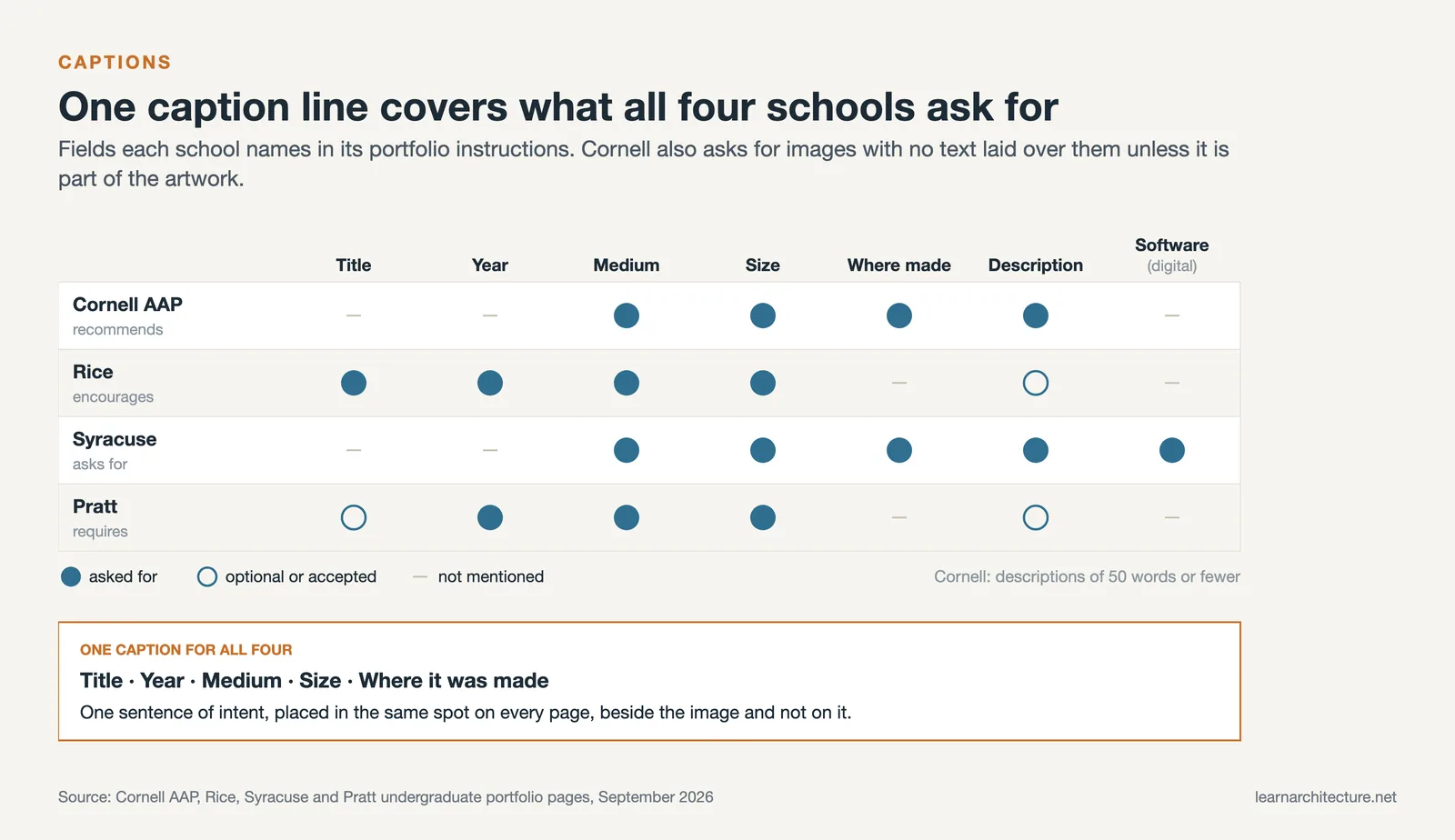
- Cornell recommends descriptions of no more than 50 words that explain intent, process, and outcome, plus size, medium, and where the piece was made.
- Rice encourages title, year of execution, media, and size, and accepts a one to two sentence description.
- Syracuse wants the medium, whether the work was done on your own or in class, original size, and a one to two sentence comment; for digital 2D work, say how it was made and which software you used.
- Pratt requires the media or materials, dimensions, and year for each artwork; a title and description are optional.
A caption that covers all four schools would read: title, year, medium, size, where it was made, then one sentence of intent. Keep that line in the same place on every page. Cornell also asks for clear images with no text unless it is part of the artwork, which rules out captions laid over the image itself.
Rules on AI, Help, and Originality
Schools now address generative tools directly, and the rules are strict. Cornell says do not outsource your portfolio to a third party, including AI-generated images, and asks you to credit collaborators and specify your role on group projects. Pratt prohibits images fully rendered by generative AI; it allows AI image-enhancement on select pieces only if the work stays original, and you must disclose the tools and every text prompt used. Syracuse asks for original work, not clip art, and says any cartoon work must be your own characters and ideas.
The same logic covers paid portfolio services. If an instructor or workshop shaped a piece, say so in the caption. Cornell’s “in a portfolio workshop” label exists precisely so you can be honest about it without being penalized for it.
Formatting the File
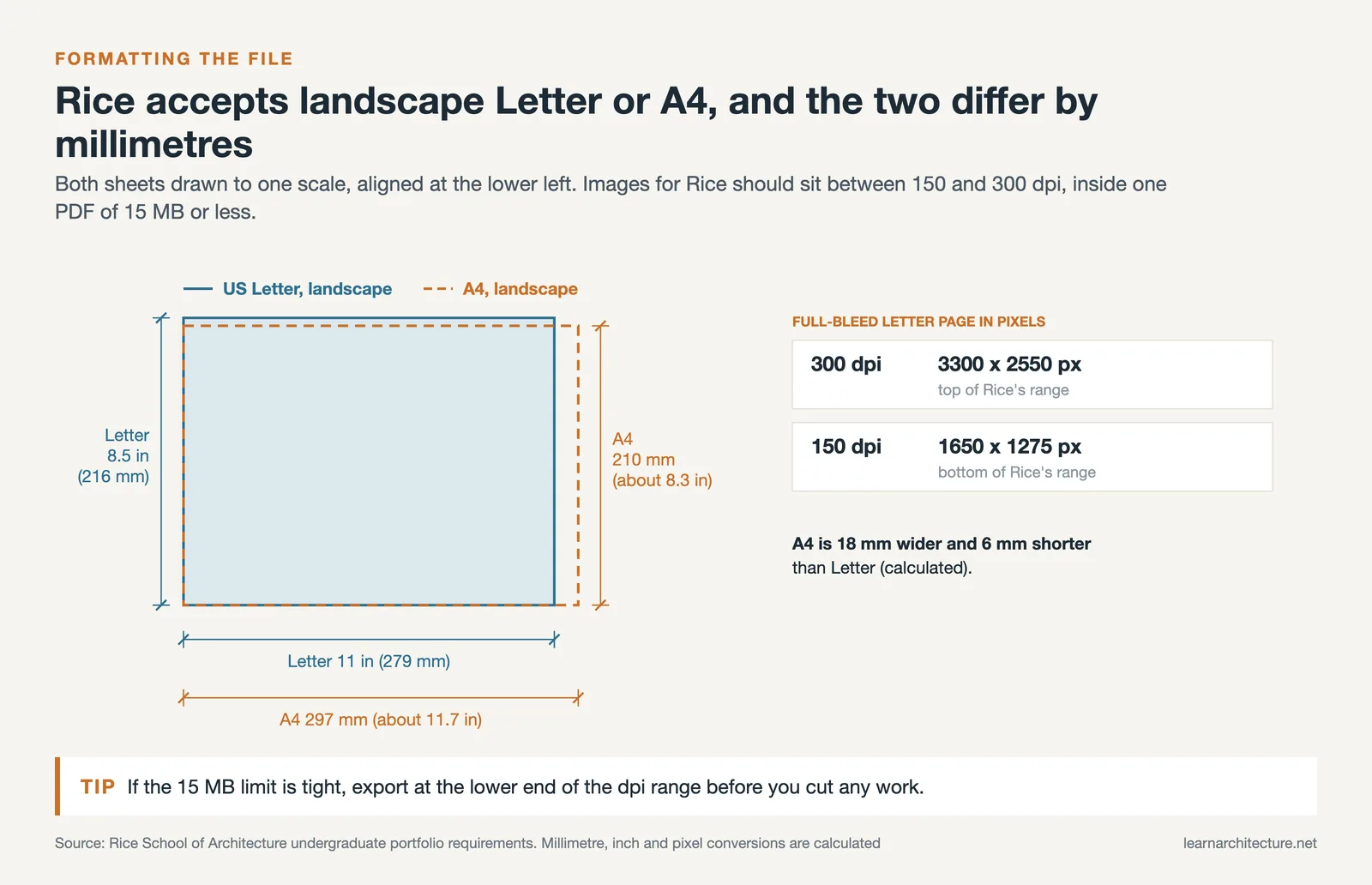
Format is where the most avoidable mistakes happen. Syracuse requires a single, multi-page PDF with every page in landscape orientation and descriptions integrated into each page. Rice wants one PDF named with your name (FirstLast.pdf), a title page first, and no more than 10 content pages. Cornell accepts uploads only through SlideRoom and will not take portfolios by email.
📐 Technical Note
Rice specifies horizontally oriented A4 or US Letter pages with images between 150 and 300 dpi. Landscape Letter is 11 x 8.5 inches (279 x 216 mm) and landscape A4 is 297 x 210 mm (about 11.7 x 8.3 inches). At 300 dpi, a full-bleed Letter page is 3300 x 2550 pixels; at 150 dpi it is 1650 x 1275. Export at the lower end if the 15 MB limit is tight.
If you are laying out pages in InDesign for the first time, our walkthrough of architecture portfolio layouts in InDesign covers grids and export settings. Rice’s own advice is worth repeating: keep the design of the portfolio and its pages simple, and let the work speak.
The Extras: Statements, Videos, and Interviews
Several schools pair the portfolio with a short piece of self-presentation. Cornell requires a continuous, unedited video of no more than three minutes answering three prompts: how you express your creativity, the design process and impact of one creative project, and why you want to study architecture. Syracuse asks for a brief statement of interest inside the portfolio and offers an optional one-on-one portfolio interview, which it says is not a critique of your work.
Deadlines arrive early. For fall 2027 entry, Cornell’s portfolio deadlines are November 1 for Early Decision and January 2 for Regular Decision, and Syracuse lists November 1, 2026 for Early Action and Early Decision I and January 5, 2027 for Regular Decision. Cornell states that it will not accept portfolios submitted after its deadlines, and Syracuse gives you only 24 hours from portal access to upload once its application deadline has passed. Build your calendar backward from the earliest date on your list.
Choosing where to apply shapes all of this, since a school without a portfolio requirement changes your workload. Our guide to choosing an architecture school covers the other factors. It also helps to know which kind of degree you are applying for: a five-year B.Arch is a professional degree in the United States, while a four-year pre-professional architecture degree is typically followed by an M.Arch before licensure.
Final Thoughts
A strong undergraduate architecture portfolio is honest, observed, and tidy. It proves you can see and make things, labels every piece plainly, and fits each school’s rules to the letter. Architectural polish is optional; attention to the brief is not.
Your Next Step: Open the portfolio page of every school on your list, copy each one’s limits into a single sheet (piece count, file size, format, deadline), and draw the room you are in today as the first observational piece.








Leave a comment