



Table of Contents Show
Negotiating your salary as an architect requires preparation, market data, and a clear understanding of your own value. Whether you are accepting your first job offer or pushing for a raise after years of project delivery, the difference between asking and not asking can add up to tens of thousands of dollars over a career. This guide breaks down the specific steps architects can take to approach salary conversations with confidence.

What Does a Typical Architect Salary Look Like?
Before you walk into any negotiation, you need to know the numbers. The architect average salary in the United States sits at a national median of $99,280 as of May 2025 (BLS), according to the Occupational Employment and Wage Statistics survey of the U.S. Bureau of Labor Statistics. But that number shifts dramatically depending on where you work, how long you have been practicing, and what you specialize in.
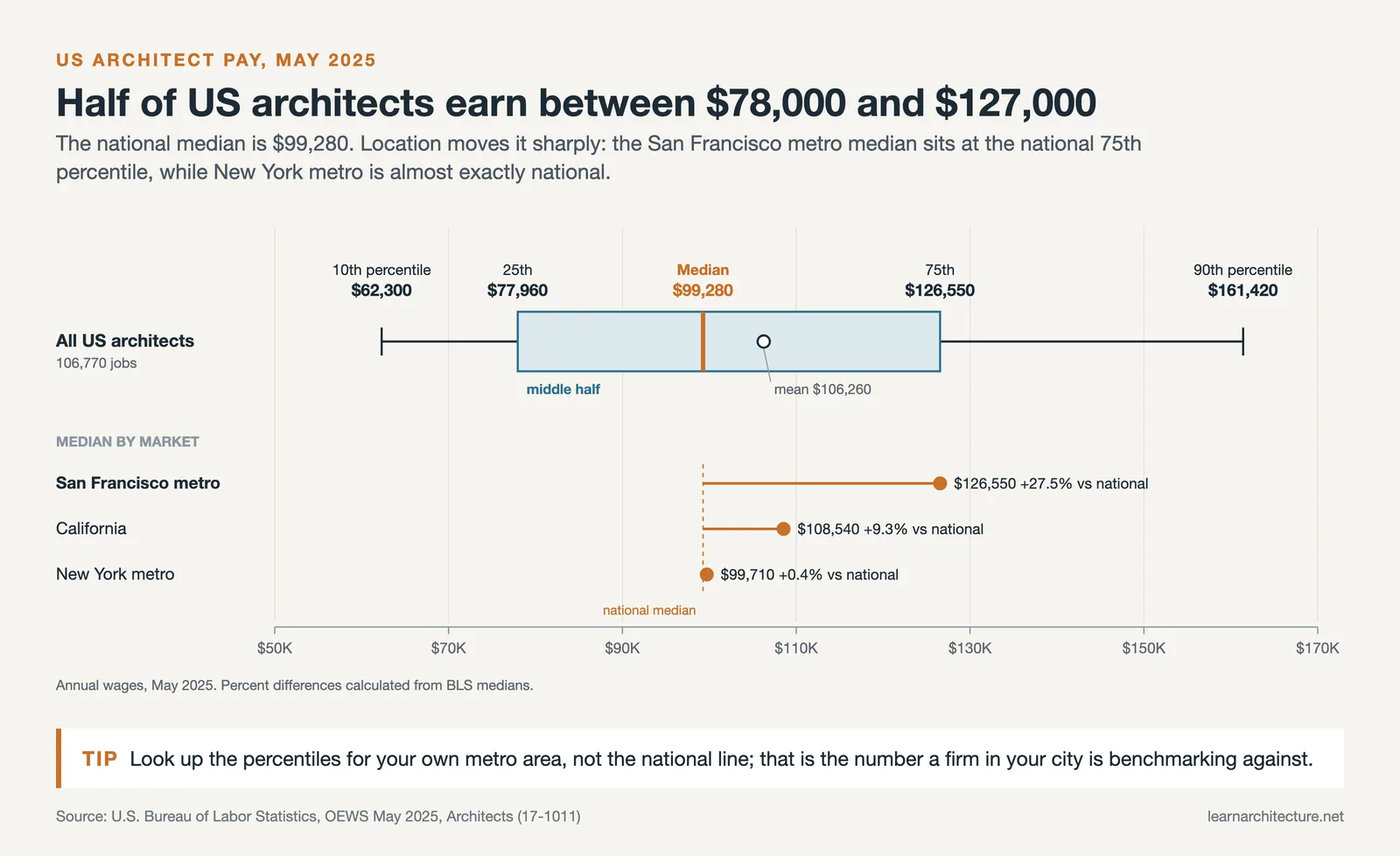
The spread around that median is wide. The lowest paid 10% of architects earn under $62,300, the middle half earn between $77,960 and $126,550, and the top 10% earn more than $161,420 (BLS OEWS, May 2025). An architect starting salary usually sits in the lower part of that range, while senior architects and principals cluster toward the top. The salary of an interior architect or a specialist in sustainable design can vary even further based on firm type and regional demand.
🔢 Quick Numbers
- National median architect salary: $99,280 (BLS, May 2025)
- Middle half of architects: $77,960 to $126,550 (BLS, May 2025)
- Bottom 10% earn under $62,300; top 10% earn over $161,420 (BLS, May 2025)
- Location matters: the San Francisco metro median is $126,550 and the California median $108,540, while the New York metro median ($99,710) is close to the national figure (BLS, May 2025)

Architect Salary by Percentile
The BLS does not publish architect pay by job title or years of experience, so the most reliable public ladder is the national wage distribution. The table below shows annual wages for architects at each percentile, from the U.S. Bureau of Labor Statistics Occupational Employment and Wage Statistics (OEWS) survey for May 2025:
| Percentile | Annual Wage | What It Means |
|---|---|---|
| 10th | $62,300 | 10% of architects earn less than this |
| 25th | $77,960 | The bottom of the middle half of earners |
| 50th (median) | $99,280 | Half earn more, half earn less |
| 75th | $126,550 | The top of the middle half of earners |
| 90th | $161,420 | Only 10% of architects earn more than this |
As a rough guide, early career architects working toward licensure tend to sit toward the lower percentiles, and principals and senior managers toward the upper ones, but where you land depends on your market, firm size and responsibilities. Use these figures with the percentile approach later in this guide: find the band you are in now and the band your role and track record justify.
Do Your Research Before You Talk Numbers
The single most effective thing you can do before a salary conversation is show up with data. Firms expect you to know what the market pays. If you do not, you are leaving money on the table.
Start with the AIA Compensation and Benefits Report, which surveys thousands of positions across hundreds of firms every year. Cross-reference that with the BLS Occupational Outlook Handbook for Architects, and use platforms like Glassdoor and Salary.com for firm-specific or city-specific figures. The more sources you check, the stronger your position.
Pay attention to your specific region. The median architect salary in the San Francisco metro area was about 27% above the national median as of May 2025, while New York metro sat close to the national figure and the same role in a smaller metro area may sit below average. Your negotiation should reflect local cost of living and local demand for architects, not just national averages.
💡 Pro Tip
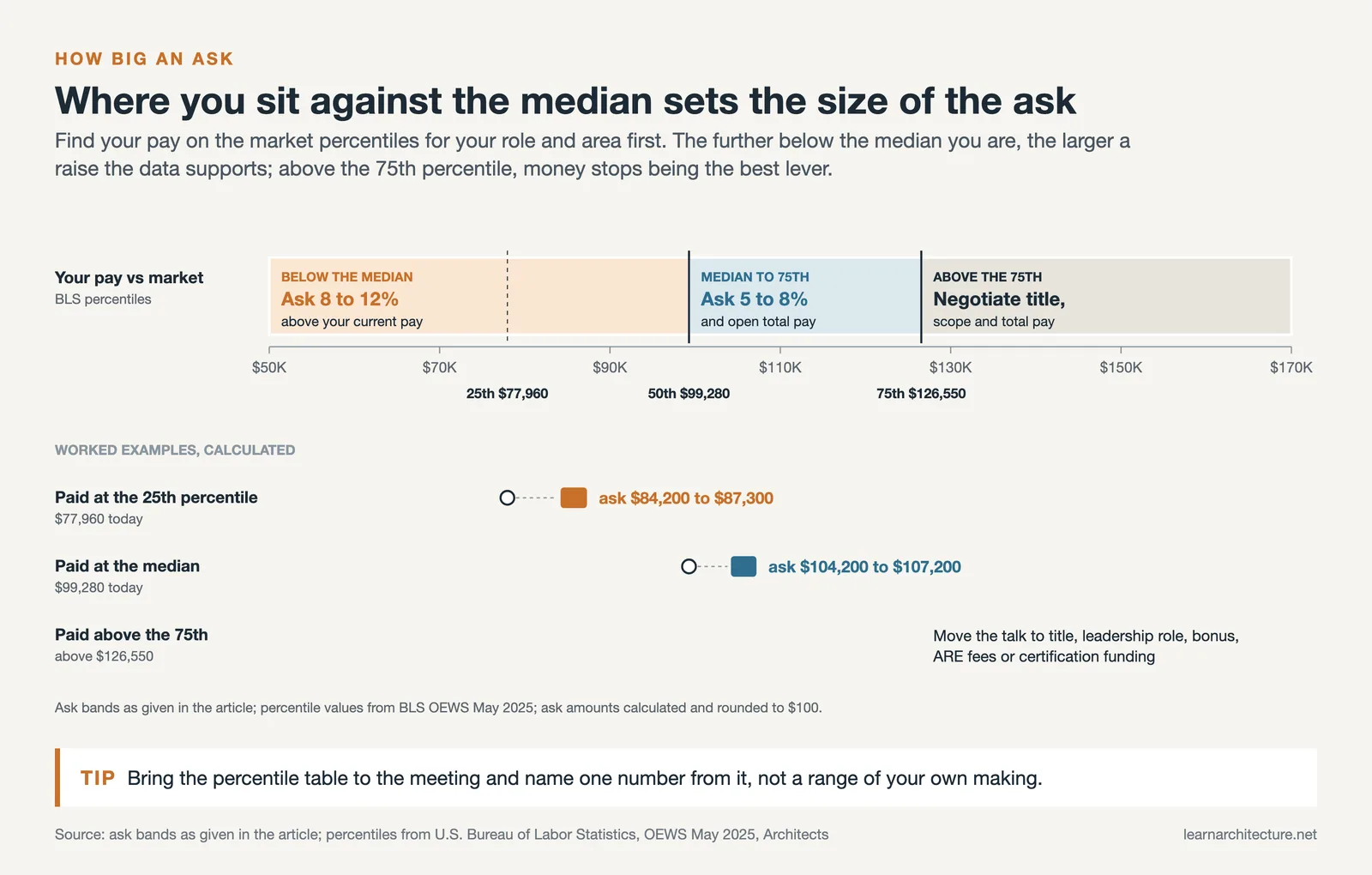
When researching salaries, always look at the 25th, 50th, and 75th percentile for your specific role and region. If your current pay falls below the 50th percentile, you have a strong, data-backed case to ask for an 8% to 12% increase. Between the 50th and 75th, aim for 5% to 8% and shift the conversation toward total compensation.

How to Build Your Case for a Higher Salary
Data gets you in the door. Your track record closes the deal. Architects who can point to specific project outcomes are in a much stronger position than those who rely on years of experience alone.
Before the meeting, write down three to five concrete contributions you have made. Did you bring a project in under budget? Did you manage a team through a complex permitting process? Have you brought in new clients, earned a certification like LEED AP, or developed a BIM workflow that saved hours of coordination time? Each of these is a tangible reason why you deserve more.
Frame your ask around value, not need. Saying “I need a raise because rent went up” puts the firm in a defensive position. Saying “I managed a $3M renovation from schematic design through CA, and I would like my compensation to reflect that level of responsibility” gives them a reason to say yes. A polished architecture resume or a well-organized portfolio can reinforce your case if you are negotiating with a new firm.
Timing Your Salary Negotiation
Timing matters more than most architects realize. The best moments to ask are right after a successful project milestone, during an annual review, or when you have just received your license. Avoid asking during a company downturn, right after layoffs, or in the middle of a stressful project deadline.
If you are negotiating a new job offer, the sweet spot is after the firm has made the offer but before you have signed. This is when your leverage is highest. The firm has already decided they want you, and they expect some back and forth on compensation.
For interior architect salary discussions or salary for interior architect roles, the same principle applies. Specialty positions often have less standardized pay bands, which gives you more room to negotiate if you can demonstrate niche expertise.
⚠️ Common Mistake to Avoid
Many architects accept the first number a firm offers without countering. Even if the initial offer seems fair, you should always respond with a counteroffer. According to a survey cited by The Architect’s Guide on ArchDaily, failing to counter can mean losing $5,000 to $10,000 in annual income. Firms typically budget for negotiation and expect candidates to push back.

Think Beyond Base Pay
Salary as an architect is not just your base number. Total compensation includes bonuses, profit sharing, retirement contributions, health insurance, professional development budgets, and paid time off. According to AIA data, total compensation adds $3,000 to $28,000 on top of base salary, depending on your level and firm type.
If a firm cannot move on base pay, ask about other items. Can they cover your ARE exam fees? Fund a LEED or WELL AP certification? Offer an extra week of vacation? Pay for conference attendance? These benefits have real dollar value and are often easier for firms to approve than a salary bump.
Flexible work arrangements are another form of compensation. Remote work days, compressed schedules, or the ability to take on side projects can significantly affect your quality of life and earning potential. The long-term outlook for architecture careers increasingly includes these non-salary factors as part of the package.
What to Say (and What Not to Say)
Keep the conversation professional and grounded in facts. Use phrases like “based on AIA compensation data for this region” or “given my project history and licensure status, I believe a range of $X to $Y reflects the market.” Anchor your request to external benchmarks, not personal expenses.
Avoid ultimatums, emotional appeals, or comparing yourself to a specific coworker. If the firm says no to your first ask, respond with a question: “What would I need to achieve over the next six months to reach that number?” This keeps the door open and shows you are invested in the firm’s success, not just your paycheck.
If you are negotiating the starting salary for an architect position right out of school, be realistic but do not sell yourself short. Entry-level roles have less room for negotiation, but even a small increase at the start compounds over years of raises calculated as percentages of your base.

How Much Should You Ask For?
A practical framework from recent AIA guidance: if your current pay is below the 50th percentile for your role and market, request 8% to 12% above your current number. If you sit between the 50th and 75th percentile, aim for 5% to 8%. If you are already above the 75th percentile, shift your focus to total compensation, title advancement, or leadership responsibilities that position you for the next jump.
For architect and interior designer salary comparisons, keep in mind that interior-focused roles may have different benchmarks. Use the same data-driven approach, but source your numbers from interior design salary surveys alongside the AIA report to get an accurate picture. Firms that handle both architecture and interior design work often have separate pay scales for each track.
Where to Go From Here
Your Next Step: Before your next review or job interview, spend 30 minutes on the AIA Compensation Report and the BLS Occupational Outlook Handbook. Write down the 25th, 50th, and 75th percentile figures for your exact role, region, and firm size. Then list three project wins or skills that justify your target number. Walk in with that sheet, and you will negotiate from a position of strength rather than hope.
Salary figures cited in this article are approximate and vary by region, firm size, specialization, and individual qualifications. Data sources include the AIA Compensation and Benefits Report (2025), the U.S. Bureau of Labor Statistics (OEWS, May 2025), Salary.com, and Glassdoor. Always cross-reference multiple sources for your specific market.

Frequently Asked Questions
How much can architects realistically increase their salary through negotiation?
Most architects can expect a 5% to 15% increase when negotiating a new offer or a raise, depending on their current position relative to market benchmarks. Those who are significantly underpaid (below the 25th percentile) may see larger jumps, especially when moving to a new firm. The key is presenting market data alongside your track record.
When is the best time to negotiate architect salary?
The strongest moments are right after receiving a job offer (before signing), during annual performance reviews, or shortly after a major project milestone. Avoid negotiating during company-wide budget cuts or immediately after a project setback. Licensure milestones like passing the ARE are also strong negotiation triggers.
Should entry-level architects try to negotiate their starting salary?
Yes, though the range is narrower at junior levels. Even a $3,000 to $5,000 increase in your architect starting salary compounds over your career, since future raises are typically calculated as a percentage of your base. Research the local market using BLS and AIA data, and counter respectfully with a specific number rather than a vague request.
What salary resources are most reliable for architects?
The AIA Compensation and Benefits Report is the industry standard, covering thousands of positions across hundreds of firms. The BLS Occupational Outlook Handbook provides government-verified national and state-level data. Glassdoor and Salary.com offer firm-specific and city-specific figures. Using at least two of these sources gives you a well-rounded benchmark.
















Leave a comment