



Table of Contents Show
Architecture vs interior designer is a common comparison for students and career changers weighing creative professions in the built environment. Architects design entire buildings, handling structure, safety, and site context, while interior designers focus on the layout, finishes, and furnishings inside a space. The two fields share visual thinking and client collaboration, but they differ in education length, licensing, salary, and daily scope of work.
What Does an Architect Do?

An architect plans and designs buildings from the ground up. That includes everything from the foundation and structural frame to the exterior envelope and mechanical systems. Architects coordinate with engineers, contractors, and local authorities to make sure a building meets safety codes, zoning laws, and environmental standards. Their drawings become the legal documents that guide construction.
On a typical day, an architect might draft floor plans in Revit, review structural calculations, visit a job site to inspect concrete formwork, or present design options to a client. The work shifts constantly between creative problem-solving and technical precision. A residential project may take six months of design work; a hospital or airport can stretch over several years. If you want a deeper look at day-to-day duties, this guide on what it is like to be an architect walks through the full picture.
Licensure is a defining feature of the profession. In the United States, architects must complete the Architectural Experience Program (AXP) and pass the Architect Registration Examination (ARE) before they can stamp drawings or call themselves licensed architects. The National Council of Architectural Registration Boards (NCARB) oversees this process.
What Does an Interior Designer Do?

An interior designer shapes how people experience the inside of a building. That means selecting color palettes, specifying furniture, choosing lighting fixtures, planning space layouts, and picking materials for walls, floors, and ceilings. The goal is a space that works well, feels right, and meets the client’s functional needs.
Interior designers often work on residential homes, corporate offices, hotels, restaurants, and retail stores. Some specialize in healthcare design, where evidence-based decisions about lighting and wayfinding directly affect patient outcomes. Others focus on hospitality, creating atmospheres that shape a guest’s entire stay. For a closer look at how interior spaces are planned, see this article on interior architecture concepts.
Licensing rules for interior designers vary by state and country. Some U.S. states require the NCIDQ certification (National Council for Interior Design Qualification) to practice, while others have no licensing requirement at all. The American Society of Interior Designers (ASID) is one of the profession’s main advocacy and credentialing organizations.
🏗️ Real-World Example
Apple Park (Cupertino, 2017): Foster + Partners designed the building’s ring-shaped structure, glass facades, and natural ventilation systems. Interior design teams then specified the custom desks, acoustic paneling, and workspace layouts for thousands of employees. The project shows how architectural design vs interior design responsibilities split on a single building, with each discipline handling distinct layers of the same space.
Architecture vs Interior Design Degree Requirements
Education is one of the sharpest differences between interior design vs architecture. Architecture programs are longer and more technically demanding, while interior design programs allow faster entry into the workforce.
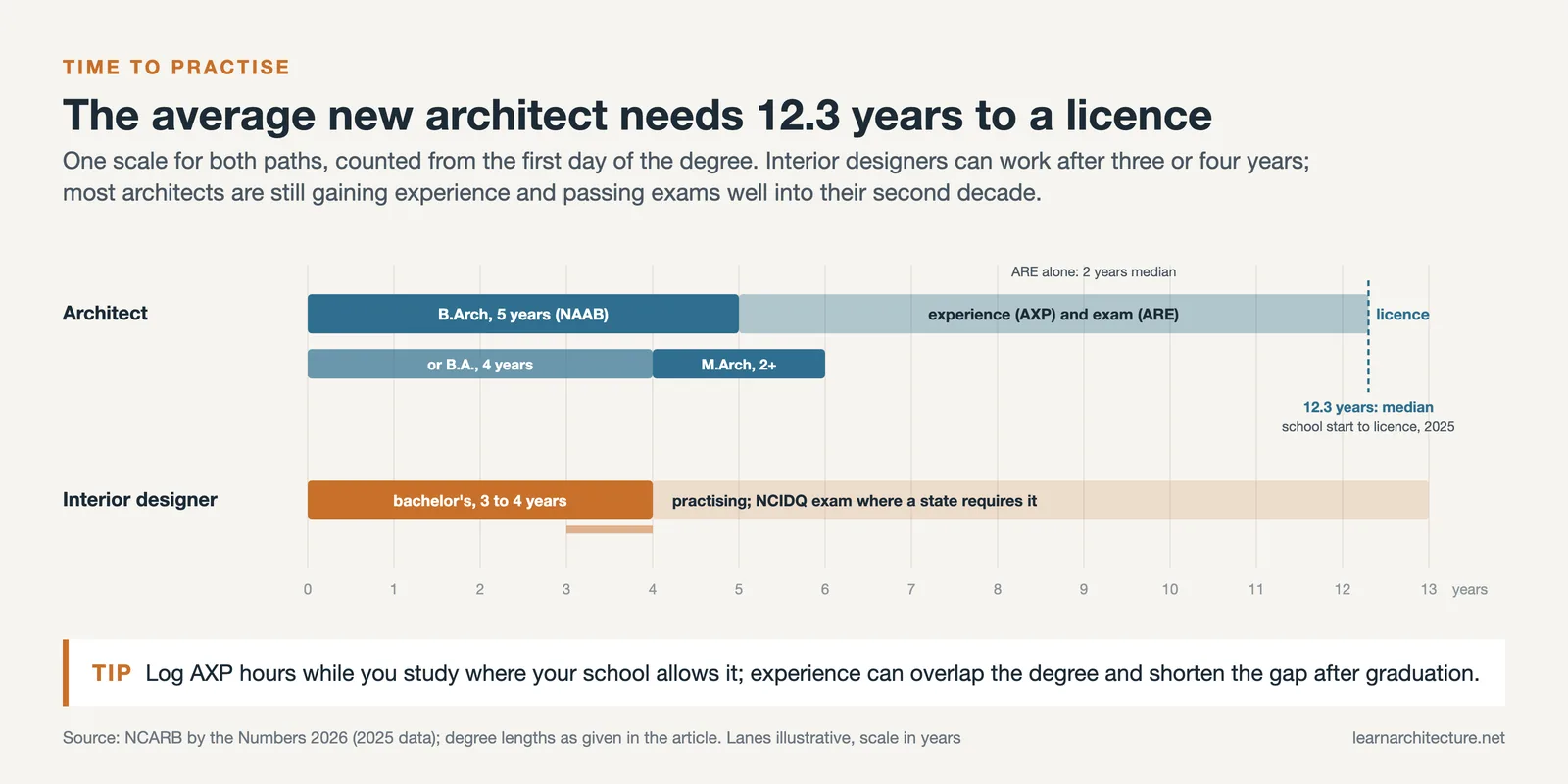
A Bachelor of Architecture (B.Arch.) typically runs five years and is accredited by NAAB in the United States. Students cover structural engineering, building physics, environmental systems, construction technology, and design studio. Many architects later pursue a Master of Architecture (M.Arch.), adding another two to three years. After graduation, the AXP internship and ARE exam sequence can take several more years; NCARB reports that architects licensed in 2025 took 12.3 years on average from starting school to licensure. If you are weighing architecture schools, this list of top architecture programs covers what to look for.
Interior design degrees usually take three to four years at the bachelor’s level. Programs accredited by CIDA (Council for Interior Design Accreditation) cover space planning, color theory, furniture specification, building codes relevant to interiors, and digital tools like SketchUp and AutoCAD. Some designers enter the field with an associate degree or certificate, though a bachelor’s degree opens more doors for the NCIDQ exam and higher-paying roles.
Side-by-Side Comparison of Architecture vs Interior Design
The table below highlights the core differences between the two career paths:
| Factor | Architecture | Interior Design |
|---|---|---|
| Typical Degree Length | 5 years (B.Arch.) or 4+2 (B.A. + M.Arch.) | 3-4 years (B.F.A. or B.A.) |
| Licensing | Required in all U.S. states (ARE exam) | Required in some states (NCIDQ exam) |
| Scope of Work | Entire building: structure, envelope, systems | Interior spaces: layout, finishes, furnishings |
| Primary Software | Revit, AutoCAD, Rhino, ArchiCAD | SketchUp, AutoCAD, 3ds Max, Enscape |
| Median U.S. Salary (BLS, May 2025) | $99,280 per year | $67,190 per year |
| Job Growth (2025-2035) | 4% | 3% |
| Key Professional Body | AIA, RIBA, NCARB | ASID, IIDA, NCIDQ |
Architecture vs Interior Design Salary

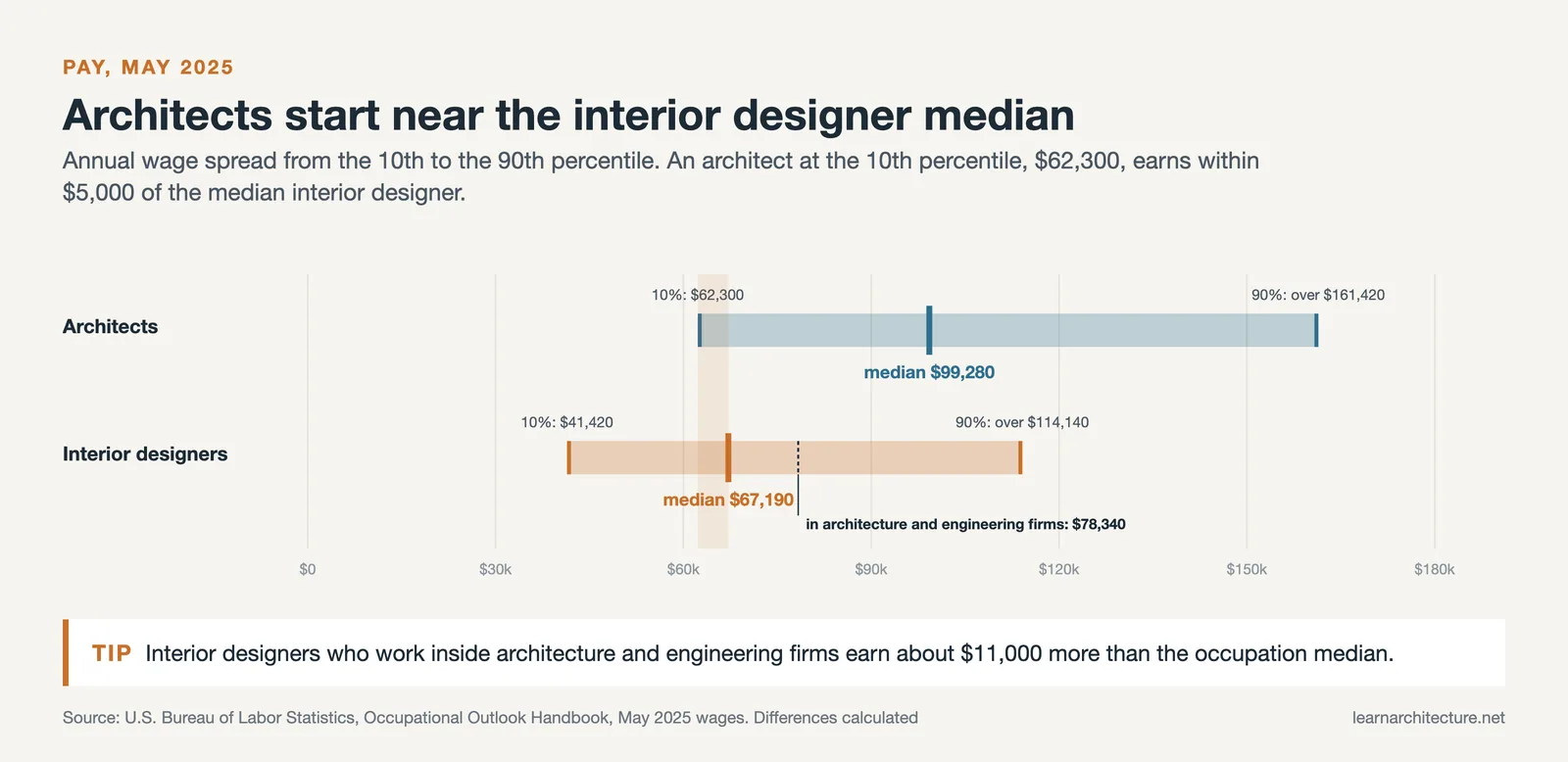
Salary is often the first question people ask when comparing an architect vs interior designer career. According to the U.S. Bureau of Labor Statistics (May 2025), the median annual wage for architects was $99,280. The top 10% earned more than $161,420, while entry-level architects at the 10th percentile earned less than $62,300.
Interior designers, by contrast, earned a median of $67,190 per year according to the BLS (May 2025). Top earners surpassed $114,140 annually, while those starting out earned closer to $41,420. Interior designers working within architectural or engineering firms reported higher median pay of approximately $78,340.
🔢 Quick Numbers
- Architect median salary: $99,280/year (BLS, May 2025)
- Interior designer median salary: $67,190/year (BLS, May 2025)
- Interior design market projected to reach $204 billion by 2031 at 5.83% CAGR (ASID 2025 State of Interior Design Report)
- Projected job openings for architects: ~6,900 per year through 2035 (BLS)
The architecture vs interior design salary gap narrows when you factor in time to earning. Architects often spend around 12 years in education, experience and exams before reaching full licensure and mid-career pay. Interior designers can start practicing and earning sooner, and freelance or studio ownership offers flexible income scaling. For a detailed breakdown of architect compensation, see this analysis of architect earning potential.
Salary figures are approximate and vary by region, employer, specialization, and experience level. Always verify current data through official sources like the BLS.
How Do Architecture and Interior Design Overlap?
Despite their differences, architecture and interior design share a wide strip of common ground. Both professions require spatial thinking, client management, knowledge of building codes, and proficiency in CAD software. On many projects, architects and interior designers work side by side from schematic design through construction.
A growing hybrid role, interior architect, sits directly at the intersection. Interior architects hold architecture training but specialize in reconfiguring interior spaces, often involving structural changes like removing load-bearing walls or altering floor levels. This role is especially common in Europe, where the title carries formal recognition in several countries.
Students interested in both fields sometimes pursue a double concentration or switch directions mid-career. An architect might move into high-end residential interiors after years of commercial work. An interior designer might return to school for an M.Arch. to expand their scope into building design. The article on career paths with an architecture degree covers several of these crossover routes.
Which Career Path Is Right for You?
Choosing between interior designing vs architecture comes down to what kind of problems you want to solve. If you are drawn to structural systems, site planning, and the engineering side of buildings, architecture is the stronger fit. If you are more interested in materials, color, furniture, and the human experience within a room, interior design may feel more natural.
⚖️ Pros & Cons at a Glance
✔️ Architecture Pros: Higher earning ceiling, legally protected title, broad project scope, strong demand in infrastructure and housing
✖️ Architecture Cons: Longer education (5-7+ years), expensive licensure path, slower career progression in early years
✔️ Interior Design Pros: Faster entry to workforce, freelance flexibility, lower education cost, growing market demand
✖️ Interior Design Cons: Lower median salary, inconsistent licensing standards, narrower scope of legal authority
Consider your tolerance for long educational timelines. An architecture vs interior design degree comparison shows a minimum two-year difference in study length, plus the additional internship and exam years for architects. If earning income quickly matters to you, interior design offers a shorter runway. If you want the broadest possible design authority and are willing to invest the time, architecture delivers that scope.
Building a strong portfolio matters in both fields. Whether you choose architecture or interior design, your project work will speak louder than your degree title in job interviews and client pitches. This step-by-step guide on building an architecture portfolio applies to both disciplines. And for a realistic look at whether the architecture path pays off long-term, read this assessment of architecture as a career.
Where to Go From Here
Your Next Step: Pick one firm in each field, an architecture office and an interior design studio, and request an informational interview or a half-day shadow session. Seeing how each profession handles a real project will tell you more about the right fit than any article or salary table can.














Leave a comment