



Table of Contents Show
The time to become an architect is typically 8 to 13 years in the United States, combining a five-year accredited degree, roughly three to five years of documented experience, and the licensing exams. NCARB data puts the average at 12.3 years from the start of college to license for architects licensed in 2025 (as of September 2026).
That single number hides a lot of variation. Some people earn a license in well under a decade by stacking experience during school and sitting exams back to back. Others stretch the path across fifteen years because of part-time study, career breaks, or a switch into architecture from another field. This breakdown walks through each stage so you can see where the years actually go and which parts you can speed up.
The Short Answer: How Many Years to Become an Architect

Three milestones define the journey: a professional degree, supervised experience, and licensure through examination. In the US these stages are set by the National Council of Architectural Registration Boards (NCARB) and your state board. The table below shows a typical range for each stage so you can map the full timeline at a glance.
Architect Timeline by Stage
The following table summarizes the standard pathway and how long each part usually takes:
| Stage | What Happens | Typical Years |
|---|---|---|
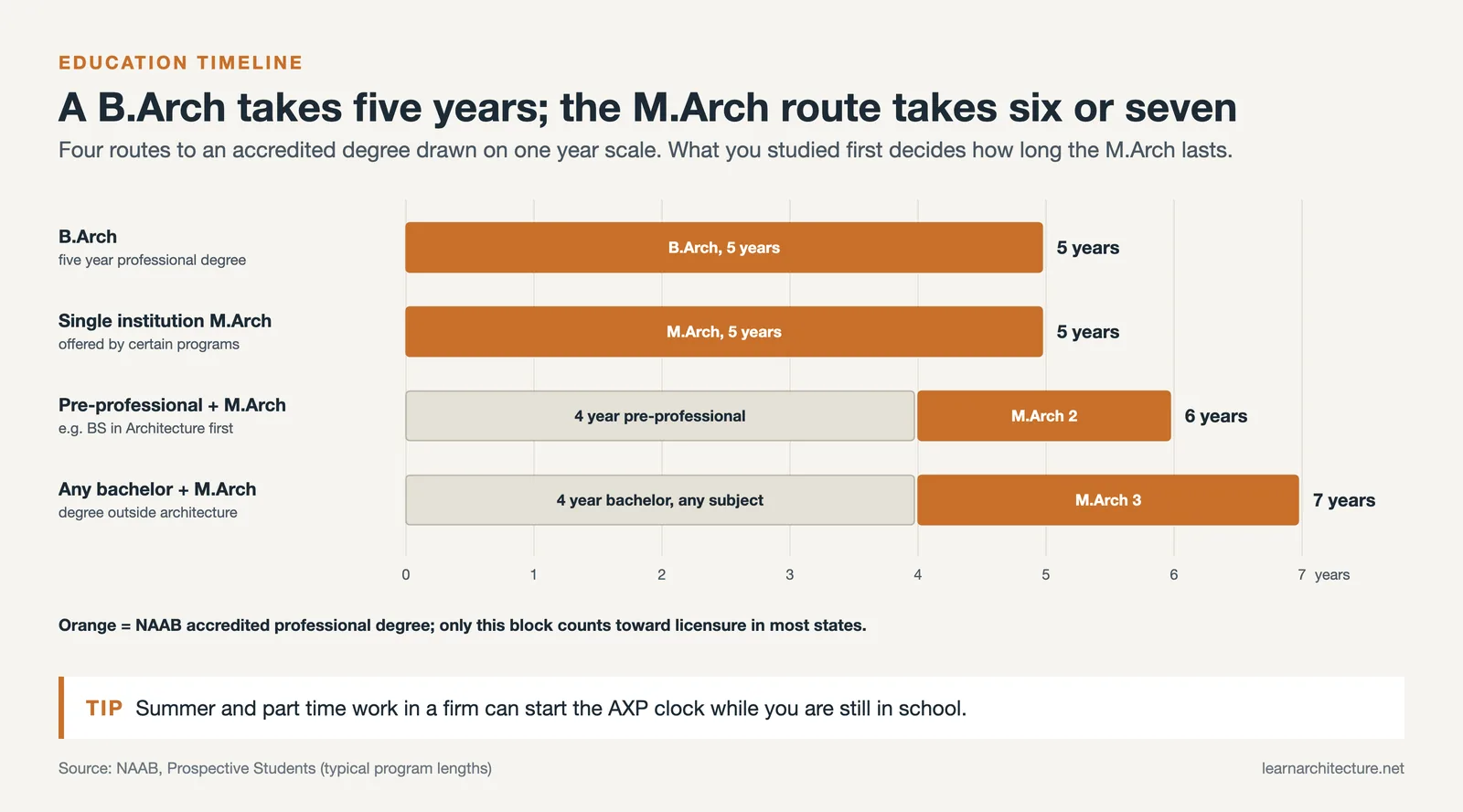
| Professional degree | NAAB-accredited B.Arch or M.Arch | 5 to 7 years |
| Experience (AXP) | Documented hours under a licensed architect | 3 to 5 years |
| Licensing exam (ARE) | Six divisions of the registration exam | 1 to 3 years |
| Total to licensure | Stages often overlap | 8 to 13 years |
🔢 Quick Numbers
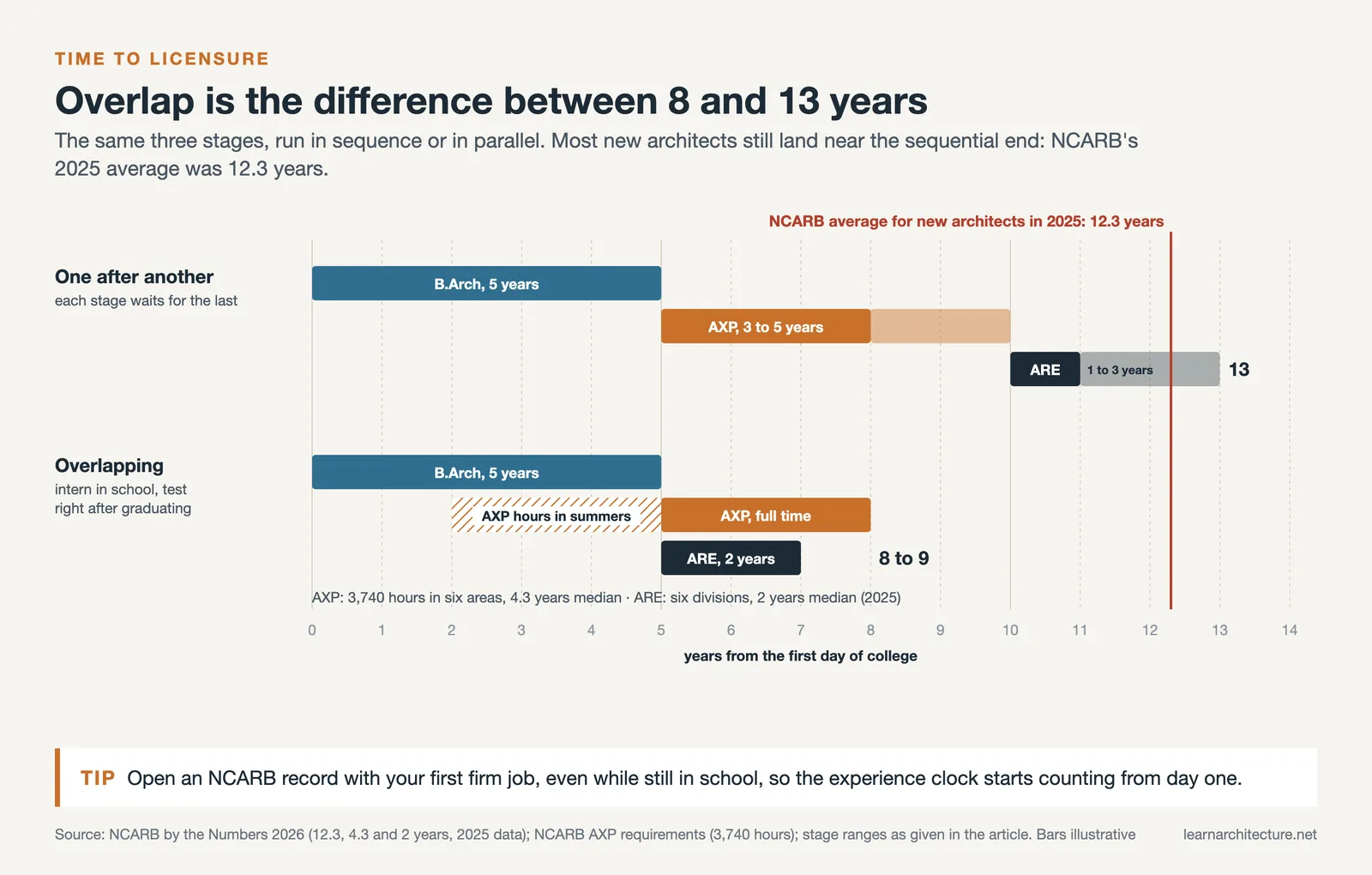
- The average time to licensure fell to 12.3 years in 2025, about four months less than in 2024 (NCARB by the Numbers 2026).
- The Architectural Experience Program requires 3,740 hours across six experience areas (NCARB Experience Requirements).
- Candidates who finished all six Architect Registration Examination divisions in 2025 took a median of 2 years, four months faster than in 2024 and a record low (NCARB by the Numbers 2026).
The Education Timeline: How Long Is Architecture School?
Education is the longest fixed block in the path, and the architecture degree length depends on which route you take. A Bachelor of Architecture (B.Arch) is a five-year professional degree that satisfies the education requirement on its own. A Master of Architecture (M.Arch) usually follows a four-year bachelor’s, which can add up to seven total years of school before you start counting experience.
The key word is accredited. In the US, only a degree accredited by the National Architectural Accrediting Board (NAAB) qualifies you for licensure in most states. Picking a program without that stamp can quietly add years later, because you may need a second qualifying degree. Browsing the top architecture schools in the world is a good starting point, and comparing a MArch against an MS in Architecture helps if you are weighing the graduate route.
B.Arch vs M.Arch: Which Is Faster?
If you are certain about architecture out of high school, the five-year B.Arch is the most direct path. The M.Arch route suits people who studied something else first or want extra time to build a portfolio. Cost matters too, since tuition stretches the financial timeline as much as the academic one. A look at the most affordable architecture schools in the USA shows that public programs can deliver an accredited degree for a fraction of private-school prices.
💡 Pro Tip
Start working in a firm during your degree, even part-time or over summers. Many NCARB records can be earned before graduation, so students who intern early often shave a full year off the experience stage. Treat your first studio summer as the start of your AXP clock, not a break.
School itself is demanding, and dropping out adds the biggest delay of all. The advice in this set of tips for surviving architecture school centers on organization and resilience rather than raw talent, which is exactly what keeps students on schedule through five intense years.
Gaining Experience: The AXP Years

After or during your degree, you log supervised hours through the Architectural Experience Program (AXP). This is where the timeline becomes personal. The AXP requirement is fixed at 3,740 hours across areas such as project management, site design, and construction documents, but how fast you reach it depends on your job. A full-time position at a busy firm fills the log quickly, while part-time or specialized roles slow it down.
According to NCARB, candidates who completed the AXP in 2025 took a median of 4.3 years, often overlapping it with exams (as of September 2026). The hours must be documented under the supervision of a licensed architect, and recent experience counts for more credit than older entries, so steady reporting pays off.
⚠️ Common Mistake to Avoid
Many graduates wait months to set up their NCARB record and lose credit on early work. Experience older than one year is worth only 75 percent credit, so delays directly stretch your timeline. Open your record on day one of your first job and report hours every few weeks.
Licensing: Steps to Becoming a Licensed Architect
The final stage is the exam. The steps to becoming a licensed architect end with the Architect Registration Examination (ARE), six divisions covering practice management, project planning, construction, and more. Candidates can take divisions in any order, and many sit them while still finishing AXP hours. NCARB reports that candidates who finished the exam in 2025 took a median of about 2 years.
Once you pass all six divisions, hold an accredited degree, and complete your experience, your state licensing board issues the license. State rules differ, so a few jurisdictions let you test earlier or apply experience differently, which can move your finish line by a year either way. Professional bodies such as the American Institute of Architects (AIA) also offer membership and continuing education that support your career once you are licensed. If you are still deciding whether the full path fits you, the honest pros and cons in this look at whether architecture is a good career are worth reading before you commit.
What Affects the Time to Become an Architect?

The biggest variable in the time to become an architect is overlap. People who treat the three stages as strictly sequential add years, while those who run them in parallel finish faster. A student who interns through school, opens an AXP record early, and starts the ARE right after graduation can reach licensure in eight to nine years instead of thirteen.
Other factors include degree choice, whether you study full-time, how busy your firm is, exam pass rates, and your state’s specific rules. Personal circumstances such as relocation, parenthood, or a career change also shift the timeline, which is part of why the national average sits above twelve years rather than near the theoretical minimum. If you are weighing the trade-offs, the reflections in should I be an architect can help you set realistic expectations.
Does the Path Differ Outside the US?
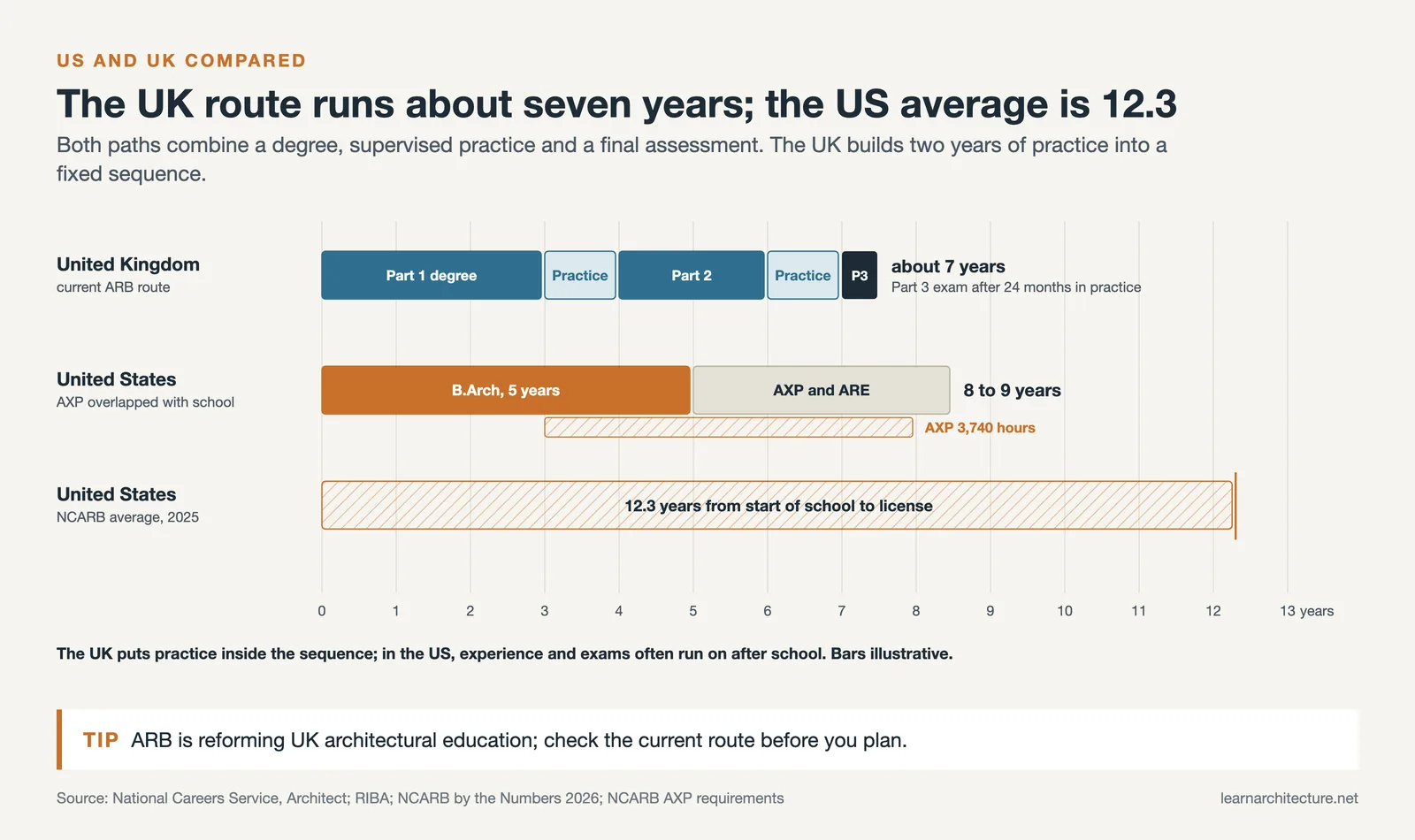
Yes. In the United Kingdom, the Architects Registration Board (ARB) structures the route around three stages: Part 1 (a bachelor’s degree), Part 2 (a master’s or equivalent), and Part 3 (a professional practice exam) plus practical training. The combined path usually takes about seven years, similar in length to the US once experience is included. Other countries set their own degree and registration rules, but the pattern of education, supervised practice, and a final qualifying assessment holds almost everywhere.
Licensing and registration requirements vary by state and country. Always confirm the current rules with your local architectural registration board before planning your route.
Frequently Asked Questions

How long does it take to become an architect after high school?
Plan on eight to thirteen years from your first day of college. That covers a five-year B.Arch or a four-plus-two M.Arch sequence, three to five years of documented experience, and the licensing exams. Overlapping experience with study can pull this toward the shorter end.
Can you become an architect in fewer than 8 years?
It is possible but uncommon. The fastest realistic route combines a five-year accredited degree with AXP hours earned during school and exams taken immediately after graduation. Even then, most state boards and the exam phase keep the total at roughly eight years.
Do you need a license to call yourself an architect?
In the US and UK, yes. The title is legally protected, so you must complete the required degree, experience, and exams before using it professionally. Graduates working toward licensure are usually called designers, architectural designers, or interns until they register.
Is the M.Arch path longer than the B.Arch path?
Usually. A B.Arch is a single five-year professional degree, while the M.Arch follows a four-year bachelor’s and adds two to three more years of school. The graduate route can run two years longer overall, though it suits career changers and portfolio builders.
Where to Go From Here
Your Next Step: Pick a NAAB-accredited degree program first, then open an NCARB record the moment you land any role in a firm so your experience clock starts counting from day one rather than after graduation.














Leave a comment