


Table of Contents Show
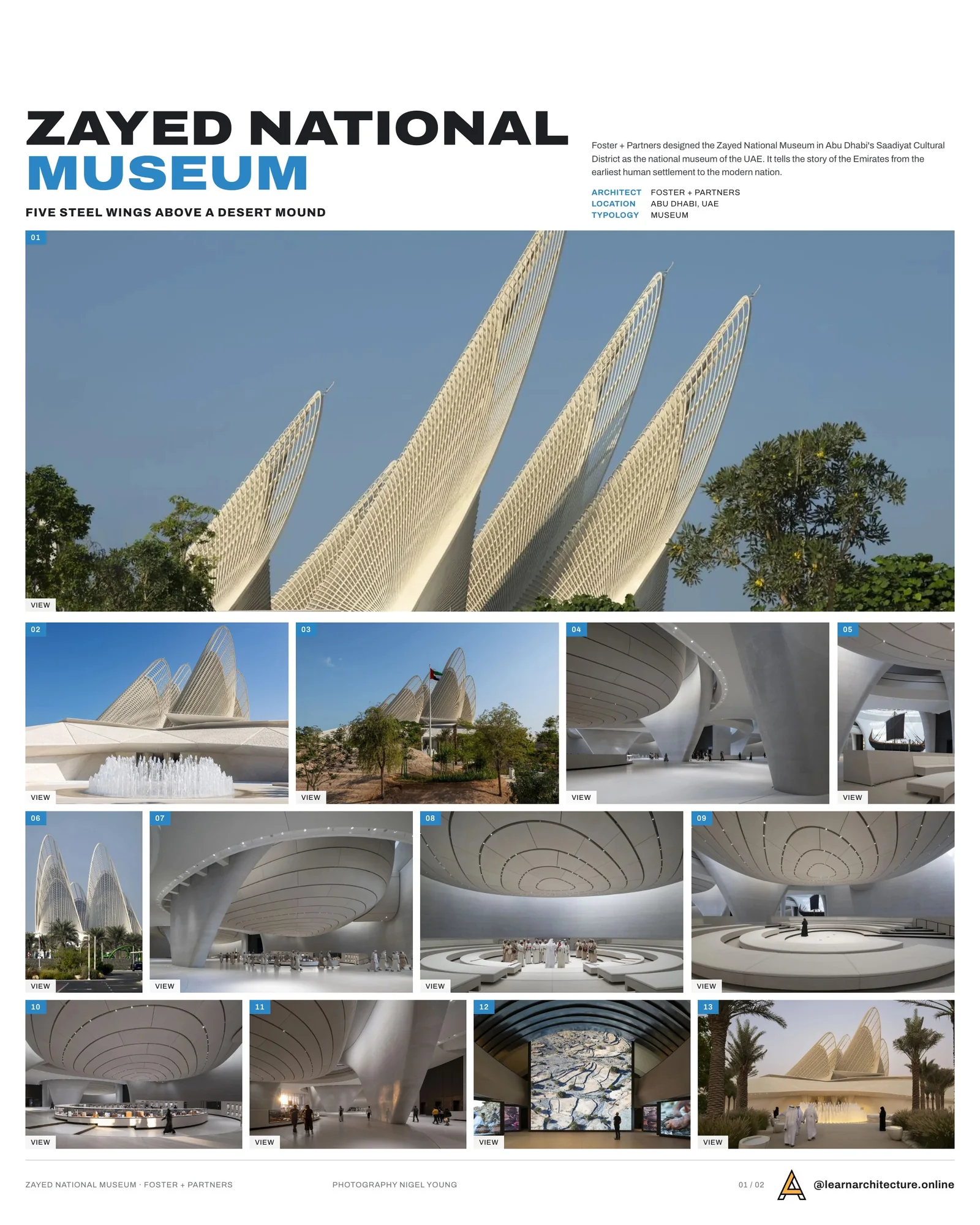
The Zayed National Museum, designed by Foster + Partners, stands as a powerful cultural landmark within the Saadiyat Cultural District in Abu Dhabi. As the national museum of the United Arab Emirates, it narrates the history of the Emirates from the earliest traces of human settlement to the formation of a modern nation, guided by the vision and values of the UAE’s Founding Father, Sheikh Zayed bin Sultan Al Nahyan. More than a museum, the building itself becomes a narrative device, an architectural response to desert life, sustainability, and deeply rooted cultural traditions.

A Museum Shaped by Desert Climate and Cultural Identity
The architectural form of the Zayed National Museum responds directly to the environmental challenge of sustaining life in a harsh desert climate. Rising above the museum mound are five lightweight steel wings, which have become the project’s most iconic feature. These wings are not merely symbolic; they play an integral role in the building’s passive environmental strategy.
Working as thermal chimneys, the wings draw hot air upward through vents at their tips, using negative pressure created on the leeward side of their aerodynamic profiles. This natural airflow is reinforced by heat buildup at the wing tops, allowing hot air to be continuously expelled from the building. In parallel, cooled air, channeled through pipes buried deep beneath the desert floor, flows into the museum’s atrium via low-level ventilation, creating a naturally regulated internal climate.

A Protective Mound Inspired by UAE Topography
The museum’s main exhibition spaces are embedded within a large sculpted architectural mound, whose faceted, textured surfaces abstract the varied landscapes of the UAE. This mound operates as a protective thermal envelope, shielding the interior from intense solar radiation while reinforcing the museum’s connection to the land.
Upon entering, visitors arrive in Al Liwan, a luminous central atrium that functions as both an orientation space and a cultural gathering area. Flooded with filtered daylight, Al Liwan accommodates performances such as poetry readings, traditional dance, and community events, establishing the museum as a living cultural forum rather than a static exhibition hall.

Gallery Organization and Controlled Exhibition Environments
The permanent exhibition program is distributed across six galleries, each designed to support conservation requirements while enriching visitor experience. Four pod-shaped galleries are suspended above Al Liwan, appearing to float within the atrium space. These pods provide carefully controlled interior conditions to protect delicate artefacts, ensuring stable temperature, humidity, and light levels.
Daylight entering the atrium and gallery areas is finely managed through triple-laminated glazing systems that incorporate dense mesh interlayers. Each suspended gallery pod features a rooflight made from electrochromic glass, allowing transparency to shift dynamically in response to exterior light conditions. This technological precision ensures visual comfort while preserving artefact integrity.

Flexible Circulation and Individual Museum Journeys
The museum’s layout encourages exploration rather than prescribing a fixed route. Connecting nodal spaces between galleries provide contextual information that links themes together, allowing visitors to choose their own paths through the narrative of the Emirates. Movement through the building culminates at the upper levels via a sculptural spiral staircase or lifts, enhancing spatial drama and wayfinding clarity.
At ground level, additional permanent galleries are positioned close to the museum entrances, complemented by a temporary exhibition space. Public programs extend beyond exhibitions to include a fine dining restaurant and café, integrating cultural exploration with social interaction.

Falcon Wings as Symbol and Environmental Engine
The steel wings have also taken on symbolic significance. Inspired by Sheikh Zayed’s love of falconry, they resonate deeply with Emirati heritage while serving as powerful markers on Abu Dhabi’s skyline. Their elegant silhouettes reinforce the museum’s identity as both a national symbol and an architectural innovation rooted in sustainability.
As Norman Foster notes, the project synthesizes decades of research into climate-responsive architecture, bringing together symbolism, environmental intelligence, and spatial performance in a single coherent form.

Landscape, Community, and Connection to the Coast
Surrounding the museum, the Al Masar Garden translates Sheikh Zayed’s passion for nature into a public landscape that connects the building to the coastline. Designed as a shared civic asset, the garden offers shaded pathways, spaces for reflection, play areas, and social zones that extend the museum experience outdoors.
Visitors can also follow a gently shaded route from ground level up to a viewing platform atop the mound, located at the base of the steel wings. From this elevated point, panoramic views unfold across Saadiyat Island, the cultural district, and the surrounding sea, reinforcing the museum’s relationship with its geographical context.

Materiality Rooted in Place and Tradition
Material selection plays a crucial role in embedding the museum within its regional context. Both interior and exterior surfaces reflect the warm-white tones of Saadiyat Island’s sand, echoing historic buildings across the seven Emirates where material color shifts in response to local terrain. This chromatic continuity strengthens the building’s sense of belonging and timelessness.
The project was delivered through close collaboration with the Department of Culture and Tourism, Abu Dhabi, ensuring architectural ambition aligned with cultural authenticity.

A National Story Given Architectural Form
At its core, the Zayed National Museum provides a permanent home for the story of the United Arab Emirates. It preserves heritage while actively connecting generations, offering a space where values such as unity, humility, openness, and respect for tradition are not only displayed but spatially embodied. Through its synthesis of sustainability, symbolism, and storytelling, the museum stands as a forward-looking cultural institution, one that honors the past while shaping the nation’s future.
Photography: Nigel Young


- Abu Dhabi cultural architecture
- Al Liwan atrium
- Architecture and identity UAE
- climate-responsive architecture
- Contemporary cultural buildings
- Cultural landscape Abu Dhabi
- Falcon-inspired design
- Foster + Partners
- Foster Partners museum projects
- innovative museum design
- Landmark museum design
- Middle Eastern architecture
- Museum architecture Middle East
- National heritage architecture UAE
- Passive Cooling Architecture
- Saadiyat Cultural District
- Sustainable desert architecture
- Sustainable public buildings
- UAE national museum
- Zayed National Museum









Leave a comment