Free Architect Fee Calculator
Work out an architect’s professional fee the way practices actually price it: as a percentage of the construction budget, from roles and hourly rates, as a fixed fee, or with the German HOAI 2021 fee table. Add structural, MEP and landscape consultants, expenses, a discount and tax, then turn the total into a payment schedule by AIA phase, RIBA stage or HOAI Leistungsphase. You enter your own construction budget: the architect fee calculator prices the design service, not the building.
How to use this architect fee calculator
- Pick a fee method. Choose % of construction, Hourly, Fixed fee or HOAI (Germany). The rest of the form changes to match the method.
- Enter the basis. For a percentage fee, type the construction budget and choose the range, project type and complexity; the suggested rate appears and you can overwrite it. For an hourly fee, list the roles with their hours and rate per hour. For a fixed fee, type the agreed lump sum. For HOAI, enter the eligible costs, the service type, the fee zone and where in the span the fee sits.
- Choose a phase split. Pick the AIA five phases, RIBA Plan of Work 2020, HOAI buildings, HOAI interiors or Custom. Every share is editable and you can add phases, but the shares must total 100% before a result is shown.
- Add the extras. Add consultants as a percentage of the architect fee, a percentage of the construction budget or a fixed amount. Then set expenses, a discount, your tax or VAT rate and the currency.
- Read and export. The fee breakdown and the payment schedule update as you type. Download CSV for a spreadsheet, download PNG for a presentation, print a one page summary for your proposal, or save the whole setup as JSON and load it again later.
A project name, client and author added under the details appear on the printout, PNG and CSV. Nothing is uploaded: the calculator works in your browser and remembers your last setup on this device until you press Reset.
How the fee is calculated
- Percentage of construction. Fee = construction budget × rate. The suggested rate comes from published typical ranges by project type. Simple projects sit at the low end of the range, average ones at the midpoint and complex ones at the high end. Ticking work to an existing building adds 2 to 4 points to the US ranges, using the same position rule. These are typical ranges, not a fee scale: fees are negotiated.
- Hourly. Fee = sum of hours × billing rate for each role. The tool also shows the blended rate, which is the total fee divided by the total hours.
- Fixed fee. The agreed lump sum, split across phases for invoicing.
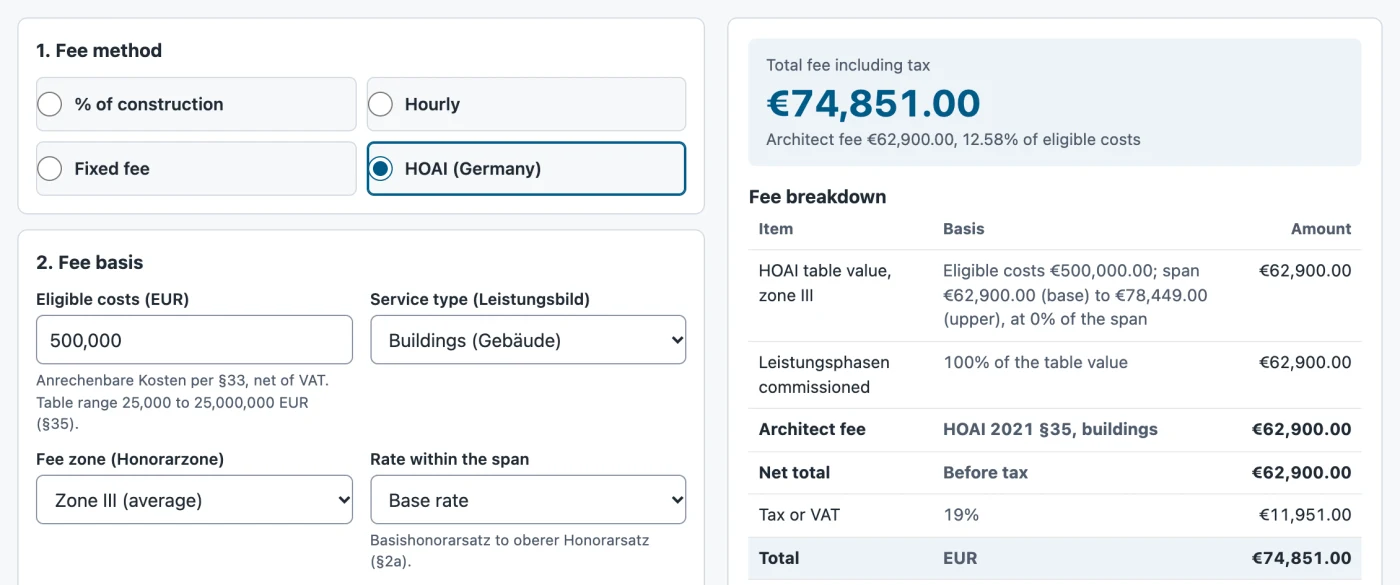
- HOAI 2021. The Section 35 fee table gives a span for each eligible cost and fee zone. Values between table rows are found by linear interpolation (Section 13). The fee is the base rate, the midpoint, the upper rate or your own position in between, times the share of the Leistungsphasen you are commissioned for (Section 34), plus any alteration surcharge (Sections 6 and 36).
Then come the totals. Consultants are added to the architect fee to give the professional fees. The discount comes off the fees, expenses are added, and tax is charged on the net total. Each phase in the payment schedule gets its share of the net total and of the tax, rounded to the currency, with the last row taking any remainder so the schedule always adds up exactly to the total.
With the default settings, a $500,000 construction budget for a single family house of average complexity in the US gives a 10% rate and a $50,000 architect fee. The AIA split then turns that into $7,500 for schematic design, $10,000 for design development, $20,000 for construction documents, $2,500 for bidding and $10,000 for construction administration.

Typical architect fee percentages by project type
The percentage method uses these basic services ranges. Choose Custom rate to type a percentage you agreed instead.
| Project type (US) | Typical fee |
|---|---|
| Single family house | 8% to 12% |
| Office fit out, school or hotel | 4% to 10% |
| Simple: warehouse, core and shell | 3% to 9% |
| Complex: hospital, laboratory | 5% to 12% |
| United Kingdom, all building types | 8% to 12% |
The US ranges come from Archtoolbox (2021), which cites The Architect’s Handbook of Professional Practice. The UK figure is the commonly quoted range reported by Designing Buildings Wiki; the Architects’ Journal 2017 survey it mentions found a wider span of 2.75% to 15%. Within any range, the percentage tends to fall as the budget grows, because design effort does not rise in step with cost.
You will see wider spans quoted elsewhere, for example 5% to 20% for residential and 3% to 12% for commercial work in homeowner surveys. Those figures mix partial and full services, which is why the calculator sticks to basic services ranges. If you want a fuller picture of what drives the number on a house, see our guide to architect fees for a house.
Architect fee by phase: AIA, RIBA and HOAI splits
The phase split turns the total into stage payments. Three presets are built in.
AIA five phases. Schematic design 15%, design development 20%, construction documents 40%, bidding or negotiation 5% and construction administration 20%. If you want the scope behind each of those phases, our article on the AIA design phases walks through them.
RIBA Plan of Work 2020. RIBA’s homeowner guidance gives three invoicing groups rather than a share per stage: 35% across Stages 0 to 3, 35% at Stage 4 (Technical Design) and 30% across Stages 5 to 6. Stage 7 (Use) is listed at 0%. The preset keeps those groups; add rows to divide them yourself.

HOAI Leistungsphasen. The Section 34 shares differ slightly between buildings and interiors:
| Leistungsphase | Buildings | Interiors |
|---|---|---|
| LPh 1 Grundlagenermittlung | 2% | 2% |
| LPh 2 Vorplanung | 7% | 7% |
| LPh 3 Entwurfsplanung | 15% | 15% |
| LPh 4 Genehmigungsplanung | 3% | 2% |
| LPh 5 Ausführungsplanung | 25% | 30% |
| LPh 6 Vorbereitung der Vergabe | 10% | 7% |
| LPh 7 Mitwirkung bei der Vergabe | 4% | 3% |
| LPh 8 Objektüberwachung | 32% | 32% |
| LPh 9 Objektbetreuung | 2% | 2% |
In the HOAI method, untick the phases you are not commissioned for and the fee drops by their share. You can also lower a share for partial services, but not raise it above the Section 34 value. In the other methods, a phase set to 0% is simply left out of the payment schedule.
Hourly rates and the blended rate
The hourly method starts with four roles, each set to the midpoint of a published US range: principal or senior partner $160 to $350, project architect or PM $125 to $250, licensed architect $100 to $250, and intern or unlicensed designer $60 to $100. The default hours are 10, 40, 60 and 80, and you can rename roles or add and remove rows.
With those defaults the fee is $26,950 over 190 hours, a blended rate of $141.84 per hour. Because most hours go to staff below principal level, the blended rate sits well below the top rate, and it is the number to compare with a single quoted hourly rate. Our guide to architect hourly rates explains where the ranges come from.
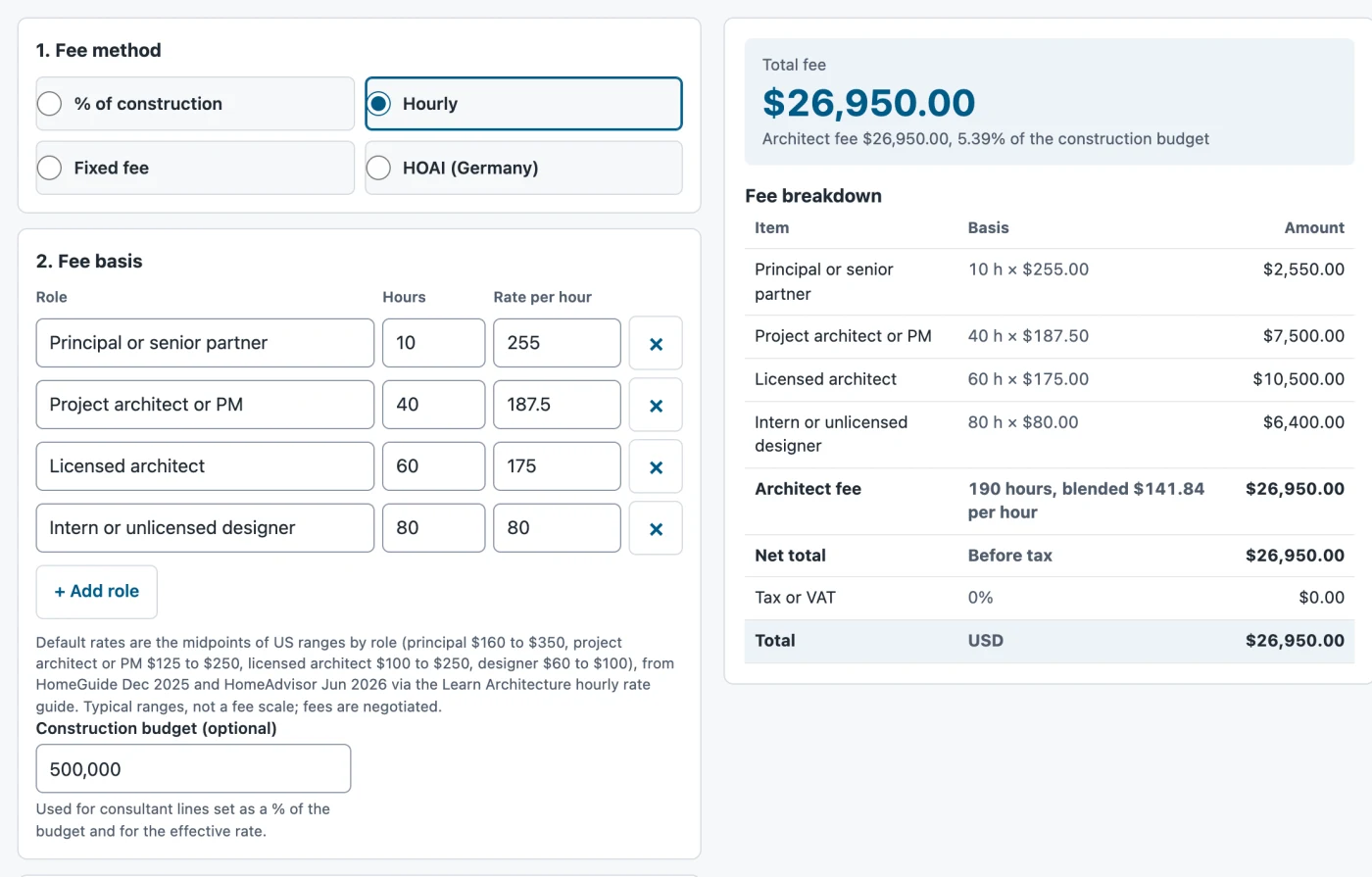
In the hourly and fixed fee methods the construction budget is optional: fill it in to price consultants as a percentage of the budget, or to see the fee as a percentage of construction.
Percentage, hourly or fixed: choosing a fee structure
The quickest sense check is to run the same project through all three methods and compare the totals. A percentage fee moves with the budget, an hourly fee leaves the client carrying the risk of the hours growing, and a fixed fee only works with a tightly defined scope. For the full pros and cons, read architect fee structures.
HOAI 2021 in Germany: fee zones and the eligible amount
The HOAI (Honorarordnung für Architekten und Ingenieure) is the official German fee regulation. Since the version in force from 1 January 2021, its table values are orientation values (Section 2a) rather than binding minimums and maximums, following the 2019 ruling of the Court of Justice of the European Union in case C-377/17. The fee is agreed in text form (Section 7). The calculator covers the Section 35 table for buildings and interiors, from 25,000 to 25,000,000 EUR of eligible costs; outside that range it shows no result, because the fee is freely agreed. In the HOAI method the currency is fixed to EUR.
Fee zone. Honorarzone I to V runs from very low to very high planning requirements. If unsure, score the six criteria in “Find the fee zone from points”. For buildings these are fit into surroundings (0 to 6), functional areas (0 to 9), design (0 to 9), structure (0 to 6), technical services (0 to 6) and fit out (0 to 6). The total sets the zone: up to 10 points is zone I, 11 to 18 zone II, 19 to 26 zone III, 27 to 34 zone IV and 35 to 42 zone V. Interiors use their own six criteria, which the helper switches to automatically. Also check the object list in Anlage 10.
Eligible costs. The anrechenbare Kosten are not the whole construction budget. Open “Work out eligible costs from cost groups” and enter cost group 300 (building construction) and cost group 400 (technical systems you do not plan yourself). Under Section 33, cost group 400 counts in full up to 25% of the other eligible costs and half of the amount above that. With 400,000 EUR in cost group 300 and 150,000 EUR in cost group 400, the eligible costs come to 525,000 EUR.
Position and surcharge. Choose base rate (Basishonorarsatz), midpoint, upper rate or a custom position in the span. Work to existing buildings can carry an alteration surcharge (Umbauzuschlag): the tool notes the limits in Section 6 and Section 36, and leaves it at 0 for new build.
Worked example. Eligible costs of 500,000 EUR in zone III give a span of 62,900 EUR (base rate) to 78,449 EUR (upper rate). At the base rate with all nine Leistungsphasen, the fee is 62,900 EUR net. Add 19% VAT in the tax field for the gross figure. You can check the table yourself in the official text of HOAI Section 35.
Building a fee proposal from the result
The printout is a one page A4 summary with the project, client, author, date and method at the top, then the fee breakdown and the payment schedule by phase, with the source of each preset noted underneath. Attach it to a proposal that still sets out the scope, exclusions and what happens if the brief changes.
If this is one of your first proposals, our guide on how to start an architecture business covers the contracts and insurance that sit behind it. List each consultant on its own line so the client sees the architect fee separately from the team, keep printing, travel, models and permit copies in the expenses line, and show a discount as a line rather than a lower rate. Note that the schedule spreads expenses and tax across phases by share; if you invoice expenses as they are incurred, adjust the invoice.
Currency changes only the formatting: there is no exchange rate conversion, so enter amounts in the currency you choose.
Frequently asked questions
How much does an architect charge as a percentage?
Commonly 8% to 12% of the construction budget for a house, and roughly 4% to 10% for offices, schools and hotels in the US. The percentage falls as the budget grows and rises for small or intricate work. These are typical ranges, not a fee scale; homeowner surveys that mix partial and full services quote wider spans, such as 5% to 20% for residential work.
How do I split an architect’s fee by phase?
A common AIA split is 15% schematic design, 20% design development, 40% construction documents, 5% bidding and 20% construction administration. RIBA’s homeowner guidance invoices 35% across Stages 0 to 3, 35% at Stage 4 and 30% across Stages 5 to 6.
What is a blended hourly rate?
The total fee divided by the total hours across all roles. Because most hours go to staff below principal level, it is usually well below the principal’s rate.
Is HOAI still mandatory in Germany?
Since 1 January 2021 the HOAI tables are orientation values. The parties agree the fee in text form; if nothing is agreed in text form, the base rate (Basishonorarsatz) applies.
Does the calculator include consultants and VAT?
Yes. Add structural, MEP and landscape consultants, or your own, as a percentage of the architect fee, a percentage of the construction budget or a fixed amount. Then add expenses, a discount and your tax or VAT rate.
Is this architect fee calculator free?
Yes, and there is no sign up. The calculation runs in your browser and nothing you type is sent to a server.