



Table of Contents Show
To start an architecture business you need three things in place before the first invoice goes out: an active licence in the jurisdiction where you will stamp drawings, a registered legal entity, and separate approval of the practice itself from your state board. Insurance and a signed agreement follow immediately after, before any drawing leaves your desk.
Most guides on how to start an architecture business treat registration as one task. It is two, and they are handled by different offices with different rules. Getting that sequence wrong is the reason new practices spend their first month unable to sign the work they have already won. The rest of the decisions, what you sell, who you sell it to and what you charge, are business decisions that the profession rarely teaches.
What Does It Take to Start an Architecture Business?

It takes a licence, a legal entity, firm approval, professional liability cover and one client who has already said yes. Everything else, including the website and the name, can wait. The order matters because a client who is ready to sign will not wait three weeks while you form a company.
The market context is worth understanding before you resign. Small practice is the normal condition of the profession, not the exception, but the share of work it holds has moved sharply.
🔢 Quick Numbers
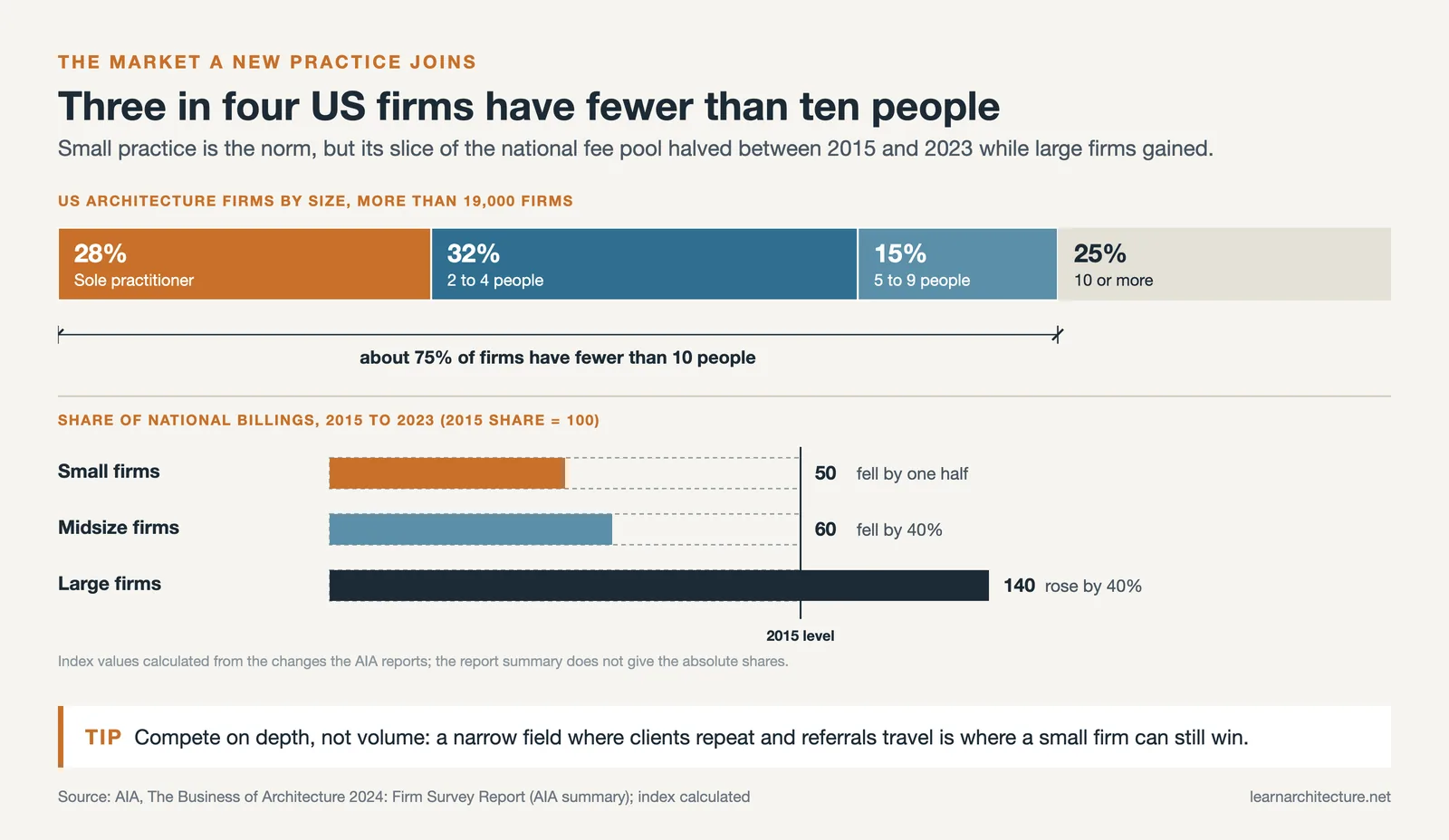
- More than 19,000 architecture firms operate in the United States, and 28 percent of them are sole practitioners (AIA, The Business of Architecture 2024: Firm Survey Report)
- About 75 percent of US firms have fewer than 10 employees, a share that has held steady across several report cycles (AIA, 2024 Firm Survey Report)
- Between 2015 and 2023 the share of national billings generated by small firms fell by one half, offset by a 40 percent rise in the share held by large firms (AIA, 2024 Firm Survey Report)
- The median annual wage for architects was $99,280 in May 2025, across 124,600 jobs, with 4 percent projected growth to 2035, as of September 2026 (US Bureau of Labor Statistics, Occupational Outlook Handbook)
Read those numbers together and the strategy writes itself. A new practice is joining a crowded segment whose slice of the national fee pool is shrinking, which means competing on volume against firms with dedicated business development staff is a losing plan. Depth in a narrow field, where clients repeat and referrals travel, is the opening that remains. The AIA’s own summary of the report shows where design revenue actually sits, and it is not where construction spending sits, which is useful when you pick a target sector.
Two Registrations, Not One
Forming a company and being allowed to practise architecture through that company are separate permissions. You file the entity with the Secretary of State, choosing between a sole proprietorship, an LLC or PLLC, an S corporation or a partnership. The US Small Business Administration covers the planning side of that decision, though it says nothing about the second permission.
The second permission comes from your architecture board, usually as a certificate of authorization, and it is what lets the entity offer architectural services under its own name. Some boards also require a named licensee responsible for the work, plus a corporate seal. If you plan to work across state lines, an NCARB Certificate is the mechanism that makes additional licences practical rather than repetitive. Readers outside the US should check the equivalent split, since the UK route through ARB registration compared with NCARB works on different logic.
⚠️ Common Mistake to Avoid
Founders assume the firm name is a branding decision. It is often a filing decision. South Carolina’s Section 40-3-270, summarised on the state Board of Architectural Examiners FAQ, exempts an architect practising under his or her own name who employs no other architect, so “John Doe, Architect” needs no firm registration. “John Doe, Architects” or “Doe Associates” does, because the plural and the word Associates read as a firm. Check your board’s exact wording before you buy the domain or print anything.
First Year Setup Sequence
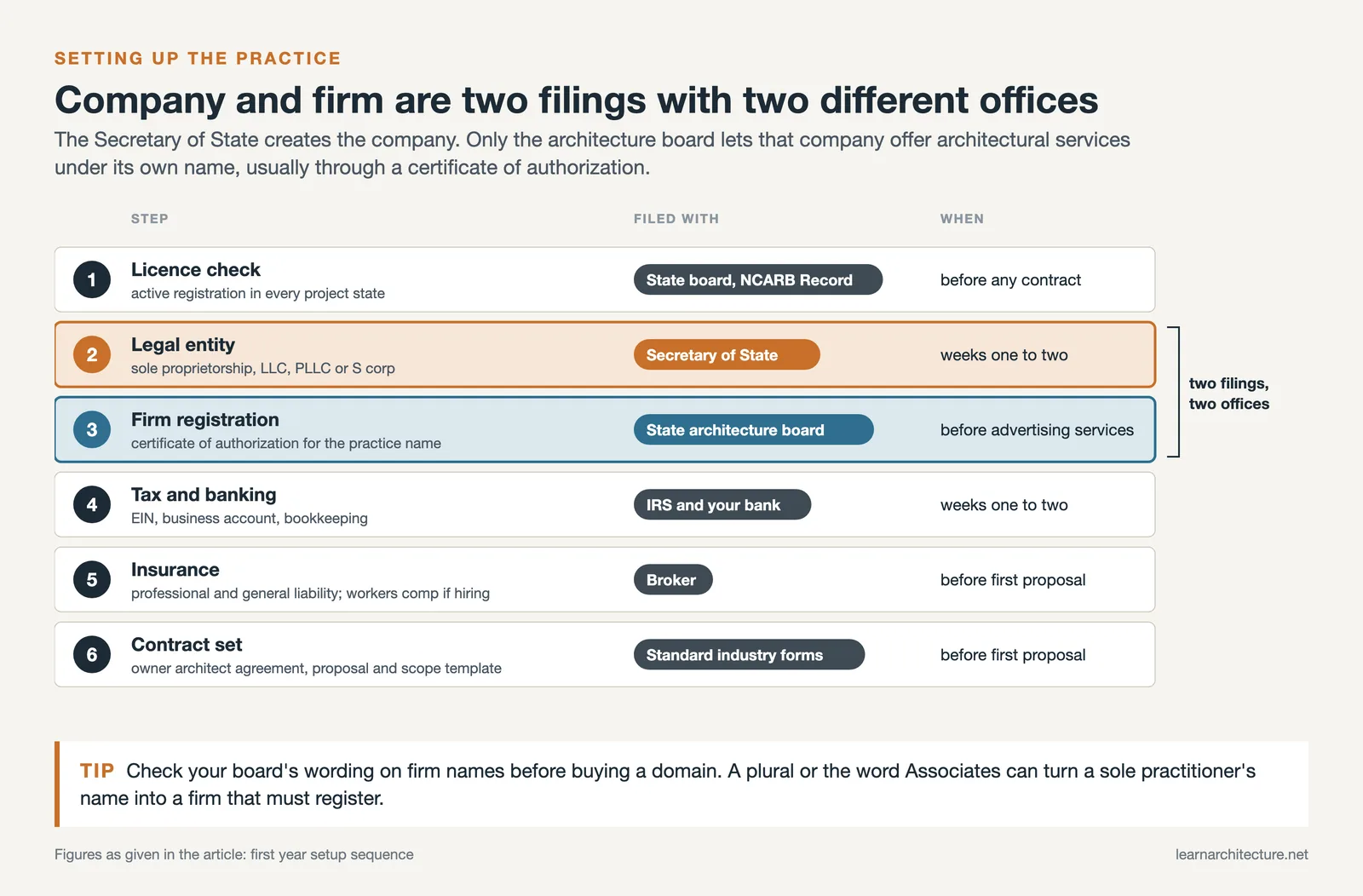
The table below sets out the order most new practices follow, and who each step is filed with.
| Step | What it involves | Filed with | Timing |
|---|---|---|---|
| Licence check | Active registration in every project jurisdiction | State board, NCARB Record | Before any contract |
| Legal entity | Sole proprietorship, LLC, PLLC or S corp | Secretary of State | Weeks one to two |
| Firm registration | Certificate of authorization for the practice name | State architecture board | Before advertising services |
| Tax and banking | EIN, business account, bookkeeping system | IRS and your bank | Weeks one to two |
| Insurance | Professional liability, general liability, workers comp if hiring | Broker | Before first proposal |
| Contract set | Owner architect agreement, proposal and scope template | Standard industry forms | Before first proposal |
If you are still working out whether the licence itself is settled, the route through education, experience and the exam is covered in this guide to getting licensed as an architect.
Choose the Work Before You Choose the Name

A practice is defined by the projects it can win repeatedly, not by its identity design. Founders who pick a narrow field first, small commercial fit outs in one municipality, accessory dwelling units in a jurisdiction with a difficult review process, envelope consulting for contractors, tend to reach a predictable pipeline faster than founders who describe themselves as full service and wait to see what arrives.
The reason is procedural rather than artistic. A narrow field lets you build one set of details, one code checklist and one relationship with a plans examiner, then run it repeatedly at improving margins. It also gives referral sources something specific to say about you. The same logic underpins independent work generally, which the practical side of freelance architecture practice covers in more detail on the services and toolstack side.
🏗️ Real-World Example
Bibliotheca Alexandrina (Alexandria, 1989 competition): Snøhetta was a young and unknown practice when its entry was chosen from 524 submissions in an anonymous international competition, and the win effectively launched the office. The detail founders skip is the calendar. The library did not open until 2002, so the competition bought recognition rather than thirteen years of cash flow. Competitions can start a reputation, but they do not pay a first year’s salaries.
Setting Fees You Can Defend
New practices lose money in the gap between what a project costs to produce and what was quoted before anyone counted the hours. Anyone working out how to start an architecture business that covers its own salaries should price from a work breakdown structure, phase by phase, with level of effort hours assigned to each deliverable, then apply your rate and add a margin for the unknowns. Hourly with a cap, fixed fee by phase and a percentage of construction cost each behave differently under scope creep, and the differences are set out in this breakdown of architect fee structures.
Whatever model you choose, write down what is excluded. Number of design iterations, sheet count, level of visualisation and construction administration hours are the four exclusions that most often decide whether a job is profitable. It also helps to know what clients on the other side of the table already expect to pay, which is where an understanding of what an architect costs for a house gives you a reference point during the first conversation.
Finding the First Clients
The first year is won on relationships that already exist. Former employers with work they cannot take, contractors who need drawings turned around quickly, engineers, realtors and property managers all produce leads faster than any campaign. Ask directly, describe the specific service you are offering, and be the person who answers the phone.
Inbound work follows later, and it needs somewhere to land. A site with clear service pages and case studies that state the problem, the constraint and the result will outperform a gallery of images, and the practical structure for that is covered in this guide to marketing for architects. If you are still assembling the work you can legally show, the platform choices in this comparison of architecture portfolio websites will save you a week of evaluation.
Systems You Set Up in Month One
Three systems decide whether the practice survives its own success. The first is a written agreement for every engagement, including the small favour for a friend, because a project without a signed scope is a dispute waiting for a trigger. The second is bookkeeping separated from personal accounts from day one, with monthly reconciliation rather than an annual scramble. The third is a simple record of hours by project, which is the only way to learn whether your fee model works before the third project repeats the mistake of the first.
Professional liability cover belongs in the same month. Clients in institutional and commercial work will ask for minimum limits before they sign, and a policy arranged in a hurry costs more than one arranged in advance. Broader questions about whether the independent route suits you at all are worth sitting with, and this honest look at architecture as a career is a reasonable place to test that.
💡 Pro Tip
Log your hours by project and phase from the first week, even on the jobs you priced as a fixed fee. Founders who start tracking only after a project goes wrong have no baseline to compare it against, so they cannot tell whether the fee was too low or the scope quietly doubled. Two completed projects with honest time records will fix your pricing faster than any published fee benchmark.
Registration requirements, firm naming rules and insurance minimums vary by jurisdiction, and fee levels move with local markets. Confirm the current rules with your state board or registration body before you file anything.
The founders who last tend to describe the first year the same way, as a sequencing problem rather than a design problem. Licence, entity and board approval of the name come first, a narrow field you can win repeatedly comes second, and pricing built from counted hours comes third. Design ambition survives that sequence. It rarely survives its absence.
Frequently Asked Questions

How much money do you need to start an architecture business?
The unavoidable costs are entity formation fees, firm registration fees, professional liability insurance, software subscriptions and a licence renewal. The larger requirement is personal runway, because design fees are billed against phases that take months to complete and clients rarely pay before work is delivered. Most founders plan for several months of living costs rather than a single startup figure.
Do you need a licence to start an architecture business?
You need an active licence to offer architectural services and to stamp drawings in the project’s jurisdiction. Unlicensed designers can run a business offering drafting, visualisation or interior work, but they cannot call the practice an architecture firm or use the protected title. The rules on titles and stamping are set by each state board.
What is the difference between registering a company and registering a firm?
Registering a company creates a legal entity with the Secretary of State and governs liability and tax. Firm registration, usually a certificate of authorization, is issued by the architecture board and permits that entity to practise architecture under its name. Both are normally required, and the second one often depends on how the firm name is written.
Should you start an architecture firm alone or with a partner?
Working alone keeps decisions and profit undivided, and it suits a narrow service line with predictable projects. A partner adds capacity, complementary skills and shared risk, which matters when projects need continuous coverage during construction. Whichever you choose, put the ownership split, the exit terms and the decision rules in writing at the start rather than after the first disagreement.

















Leave a comment