



Table of Contents Show
A typical architecture firm hourly rate in the United States runs from about $60 per hour for an unlicensed designer to $350 for a principal, with most licensed staff billed between $100 and $250. The rate reflects salary, overhead, and the share of time a firm can actually bill to projects.
That last part is where most explanations stop, and it is the part that decides the number. A rate card is not a price list someone picked from the market. It is an output of three figures the firm already knows: what it pays people, what it costs to keep the office running, and how many of those paid hours ever reach an invoice. Once you can see those three inputs, the spread between a $110 quote and a $240 quote for similar work stops looking arbitrary.
What Is a Typical Architecture Firm Hourly Rate in 2026?
Rates are quoted by staff level, not by firm. A single project touches several people, and each one bills at a different line on the same rate card. Published U.S. cost data puts the bands roughly as follows.
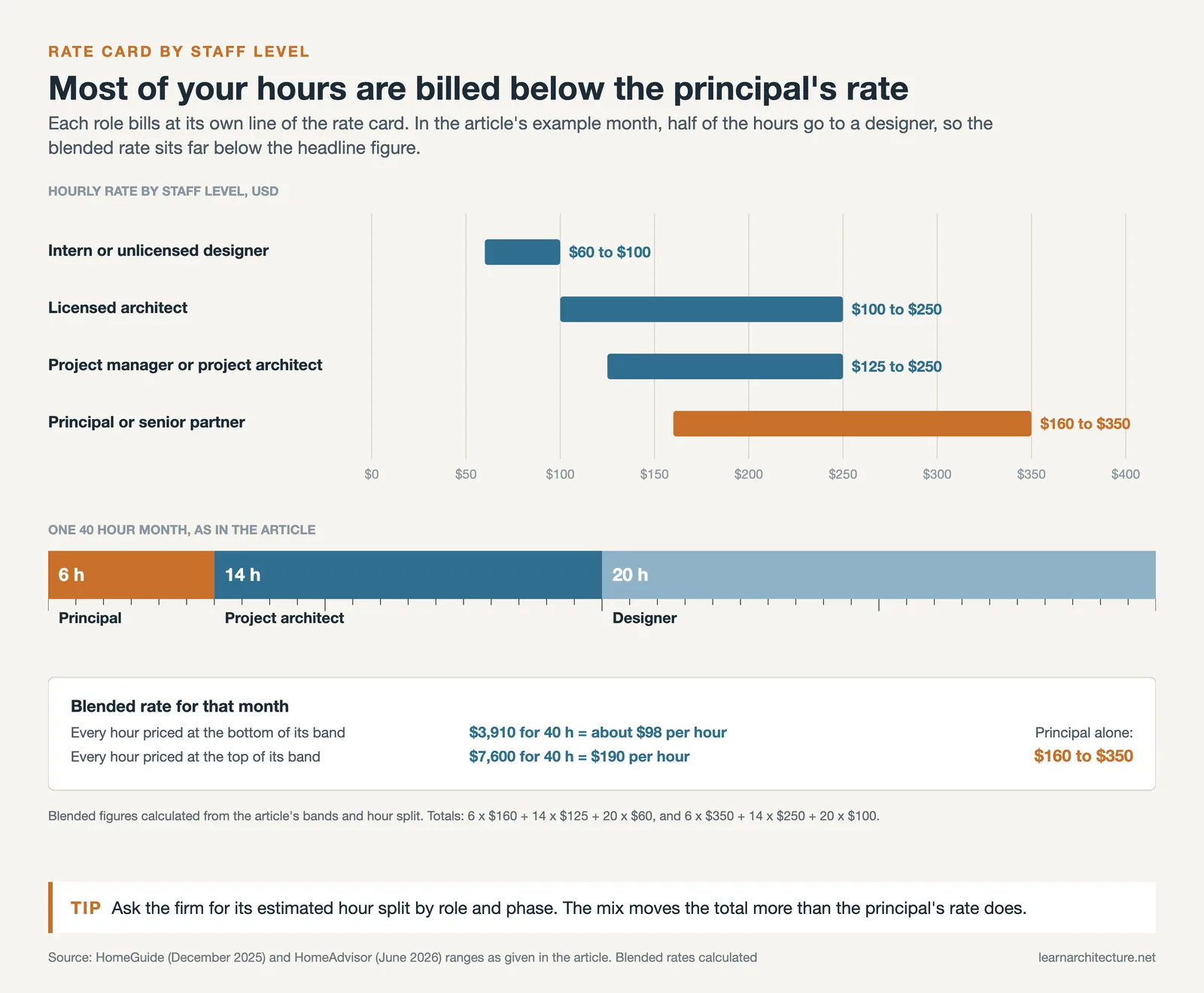
U.S. Hourly Billing Rates by Staff Level
| Staff level | Typical hourly rate | What they do on your project |
|---|---|---|
| Intern or unlicensed designer | $60 to $100 | Modelling, drawing production, sheet setup |
| Licensed architect | $100 to $250 | Design decisions, code review, stamped drawings |
| Project manager or project architect | $125 to $250 | Scope, schedule, consultant coordination, client meetings |
| Principal or senior partner | $160 to $350 | Concept direction, negotiation, approvals, risk calls |
Ranges above are drawn from HomeGuide’s December 2025 architect cost data and HomeAdvisor’s June 2026 update, both of which survey U.S. residential and small commercial work. Commercial and institutional engagements are often quoted 15 to 25 percent lower per hour and made up on volume, because the hours run into the thousands rather than the dozens. If you are budgeting a house rather than an office fit-out, the fuller picture sits in this breakdown of what an architect costs for a house, which works through total project fees rather than the hourly line.
One thing the table does not show: almost nobody is billed a single rate for a whole job. A 40 hour month might be 6 principal hours, 14 project architect hours and 20 designer hours, which produces a blended rate well below the headline principal figure. Ask for the mix, not just the top number.
How Architecture Firms Actually Calculate the Rate

The formula behind almost every rate card in the profession is the same, and it is worth understanding whether you are hiring a firm or setting rates inside one.
Step one: direct labor cost per hour
Start with direct labor cost, meaning what the person is actually paid. The U.S. Bureau of Labor Statistics put the median annual wage for architects at $99,280 in May 2025. Spread across a standard 2,080 hour year, that is roughly $48 an hour of raw salary. For firms that want more granular figures by role and region, the AIA Compensation & Benefits Report collects data on 45 positions from more than 800 firms, which is the reference most practices actually price against.
Step two: the multiplier
Salary is only a fraction of what an employee costs. Payroll taxes, health coverage, software seats, professional liability insurance, rent, admin staff, business development and paid leave all sit on top of it, and none of them can be invoiced to a client directly. Firms cover this by multiplying direct labor by a factor, usually somewhere between 2.85 and 3.2. The resulting net labor multiplier is the single most watched number in architectural finance.
Step three: the hours that never get billed
Here is the part clients rarely see. Even a well run firm cannot bill most of the working day, and the metric that captures this is the utilization rate. Proposals, marketing, staff training, software troubleshooting and internal reviews all consume paid hours that no client is charged for. That is why the multiplier has to be around three rather than around 1.5, and it explains most of the distance between a $48 salary hour and a $150 billing hour.
🔢 Quick Numbers
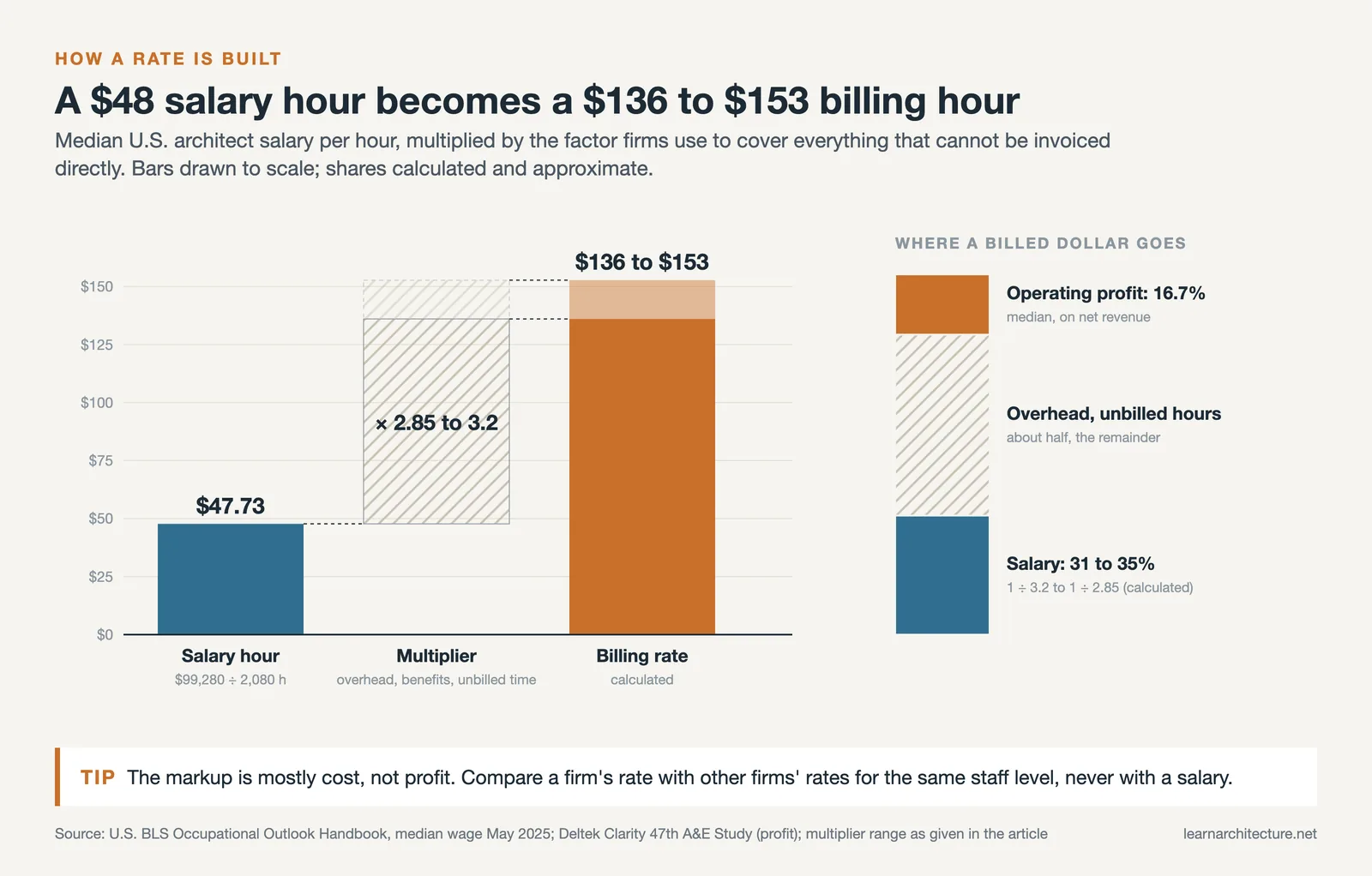
- Median annual wage for U.S. architects: $99,280 as of May 2025 (U.S. Bureau of Labor Statistics, Occupational Outlook Handbook)
- Average net labor multiplier across A&E firms: 3.15, a ten year high, with high performers at 3.62 (Deltek Clarity 46th Annual Architecture & Engineering Industry Study, 2025)
- Median operating profit on net revenue fell to 16.7 percent, down from a 10 year high in 2024 (Deltek Clarity 47th Annual Architecture & Engineering Industry Study, May 2026)
- Architect compensation grew less than 3 percent per year between 2023 and 2025 (AIA Compensation & Benefits Report 2025, 817 firms)
Read those last two together and you get the story of 2026 rate cards. Salaries are climbing slowly, and profit on net revenue has come down from a decade high. When utilization drops, the multiplier has to rise for the arithmetic to hold. That is why many practices are rebuilding their rate schedules this year rather than applying a flat inflation bump. Deltek’s 2026 industry findings describe the same squeeze from the firm side: steady demand, constrained delivery capacity, and margin pressure.
Why Two Firms Quote Very Different Rates for the Same Work

Three variables explain most of the gap, and none of them is design talent.
Firm size
Larger practices consistently charge more per hour for the same job title. They carry heavier overhead, deeper insurance, specialist staff and formal QA processes, and all of that lands in the multiplier. A five person studio and a 200 person practice can put an equally capable project architect on your job and quote rates 40 percent apart. Sole practitioners show the widest internal spread of anyone, because some price against boutique practices and others price against unlicensed drafting services.
Geography
Rates track local salary levels and construction costs closely, which is why the same role can differ by a factor of two across a single country. The pattern holds internationally too, as the differences set out in this comparison of architect salaries across cities and countries make clear, and within the U.S. the state level picture is covered in this look at architect salaries by state. In the UK, RIBA’s annual Business Benchmarking survey tracks charge-out rates by staff type and region for chartered practices, with respondents in the 2025 edition expecting hourly rate increases of only 3 to 5 percent.
Risk and project type
Healthcare, laboratory, aviation and high-rise residential work carries more code exposure, more consultant coordination and more liability, and rates rise accordingly. A firm quoting a hospital renovation and a firm quoting a garden studio are not selling the same hour, even if both people hold the same license.
Hourly Rate, Percentage Fee, or Fixed Fee: Which Applies When?

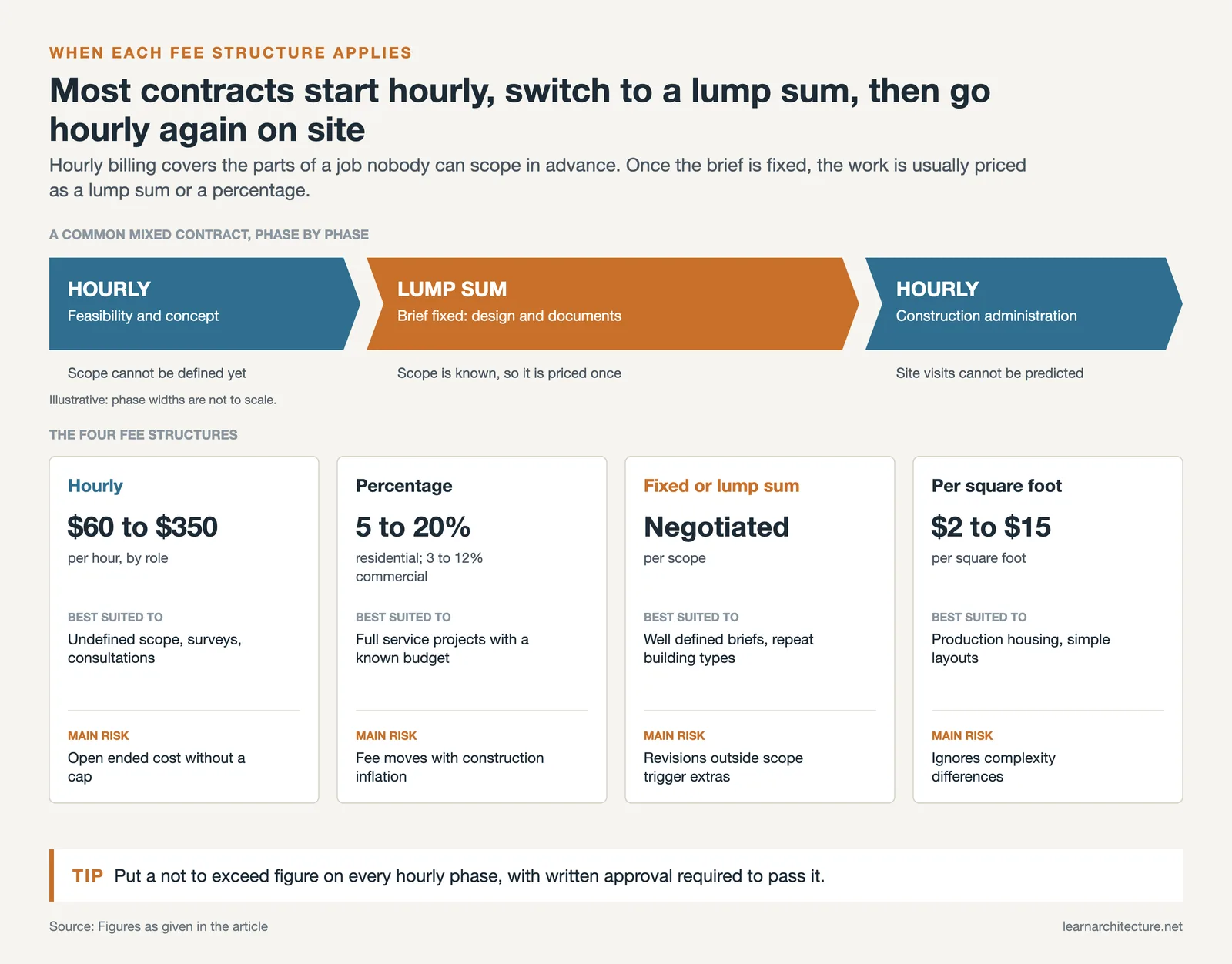
Hourly billing is one of four common structures, and it is rarely used for a whole project. It shows up where scope genuinely cannot be defined in advance: early feasibility work, existing building surveys, planning appeals, or a client who wants open-ended design exploration. Once the scope firms up, most agreements convert to a percentage or a lump sum.
Fee Structures Compared
| Structure | Typical figure | Best suited to | Main risk |
|---|---|---|---|
| Hourly | $60 to $350 per hour by role | Undefined scope, surveys, consultations | Open-ended cost without a cap |
| Percentage of construction cost | 5 to 20 percent residential, 3 to 12 percent commercial | Full-service projects with a known budget | Fee moves with construction inflation |
| Fixed or lump sum | Negotiated per scope | Well-defined briefs, repeat building types | Revisions outside scope trigger extras |
| Per square foot or square metre | $2 to $15 per square foot | Production housing, simple layouts | Ignores complexity differences |
Many contracts mix them. A common pattern is hourly billing through feasibility and concept, a lump sum once the brief is fixed, then hourly again for construction administration where site visits are impossible to predict. If your project is still at the viability stage, the sequencing set out in this guide to running an architecture feasibility study shows where hourly work usually starts and stops.
⚠️ Common Mistake to Avoid
Comparing a firm’s hourly rate against an architect’s salary and concluding the markup is profit. It is not. With salary at roughly a third of the billing rate and median operating profit on net revenue at 16.7 percent in the latest Deltek Clarity A&E study, roughly half of a billed hour goes to overhead and unbillable time. A useful comparison is against other firms’ rate cards for the same staff level in the same market, not against a payroll figure.
How to Read a Rate Card Before You Sign
Whether you are the client or the architect, the same four questions turn a rate sheet into something you can budget against.
Ask who is doing the work. A proposal that lists only a principal rate tells you nothing about the blended cost, since most production hours will be billed at lower levels. Ask for an estimated hour split by role and phase.
Ask whether there is a cap. Hourly agreements without an upper limit are where budget disputes start. A not-to-exceed figure per phase, with written approval required to pass it, protects both parties and costs nothing to add.
Ask what counts as billable. Travel time, site visits, printing, model production, consultant markups and revision rounds are handled differently by different firms, and the difference can exceed the gap between two headline rates.
Ask how long the rates hold. Most firms escalate annually. On a project running more than a year, the rate you sign is not the rate you finish on, and the escalation clause should say so in writing.
For architects on the other side of that conversation, rate setting is a business skill rather than a design one, and it is not taught in studio. The practical fundamentals sit closer to the material in this look at what a project architect actually does day to day and this overview of making money as an architect. Licensure also shifts the arithmetic directly, since a stamped drawing carries liability an unlicensed designer cannot take on, which is a large part of why the two bill so differently. The route itself is covered in this guide to getting licensed as an architect.
AIA’s own 2025 finding that compensation grew under 3 percent annually while specialized roles such as medical planners and specification writers gained 11 to 14 percent points to the same conclusion from the staffing side: rates follow scarcity, and scarcity is now concentrated in technical specialisms rather than in general practice.
The most useful shift in thinking is to stop treating the hourly rate as a price and start treating it as a measurement. It tells you how a practice is staffed, how much overhead it carries, and how confident it is about the work in front of it. A firm that cannot explain its own number is telling you something too. Going into 2027, with billable hours tightening across the industry, the practices worth hiring will be the ones that can walk you through the arithmetic without flinching.
Rate figures are approximate and vary by region, firm size, project scope, and contract terms. Always obtain a written proposal for your specific project.
Frequently Asked Questions

Is a typical architecture firm hourly rate negotiable?
The published rate per staff level is rarely negotiable, because it is tied to the firm’s cost structure. What is negotiable is the scope, the staffing mix, the number of revision rounds, and whether a not-to-exceed cap applies. Reducing the principal hours in a proposal usually saves more than arguing about the rate itself.
Why do architects charge so much more per hour than they earn?
Because the rate covers far more than one person’s wage. Benefits, taxes, rent, software licenses, professional liability insurance, administrative staff, and every unbillable hour spent on proposals and training are all recovered through the same number. Industry multipliers of roughly three times direct labor are standard across architecture and engineering.
Do small firms charge less than large firms?
Usually yes, for the same job title, since overhead is lighter. Sole practitioners show the widest spread of any group, with some pricing near boutique practice levels and others near drafting service levels. Lower rates do not automatically mean a lower total fee, because a smaller team may take more hours on unfamiliar building types.
Should I choose hourly billing or a percentage fee?
Hourly suits work where the scope genuinely cannot be pinned down, such as feasibility studies, surveys of existing buildings, or planning negotiations. A percentage or lump sum suits a defined brief with a known construction budget. Many contracts use both, switching structures at the point where the scope becomes fixed.
How often do architecture firms raise their hourly rates?
Most review rates annually, usually at the start of the calendar or fiscal year. UK chartered practices surveyed by RIBA in 2025 anticipated hourly rate increases of 3 to 5 percent over the following twelve months. On multi-year projects, check whether the agreement fixes rates for the duration or allows scheduled escalation.











Leave a comment