


Table of Contents Show
Le Corbusier architecture stands as one of the most radical and consequential bodies of work in the history of the modern movement. Born Charles-Édouard Jeanneret in 1887 in Switzerland, he developed a design philosophy rooted in function, industrial materials, and the systematic organization of space. His five points of architecture (pilotis, roof terrace, free plan, ribbon windows, and free facade) gave the 20th century a new grammar for building. The eight works examined here show how that grammar evolved from crisp Purist villas to monumental civic complexes.
What Are Le Corbusier’s 5 Points of Architecture?
Le Corbusier’s five points of architecture, formally published in 1927 as Les cinq points d’une architecture nouvelle, defined the structural and spatial logic that would underpin his most celebrated buildings. They were a direct response to what reinforced concrete made possible: columns replaced load-bearing walls, freeing the plan and the facade simultaneously.
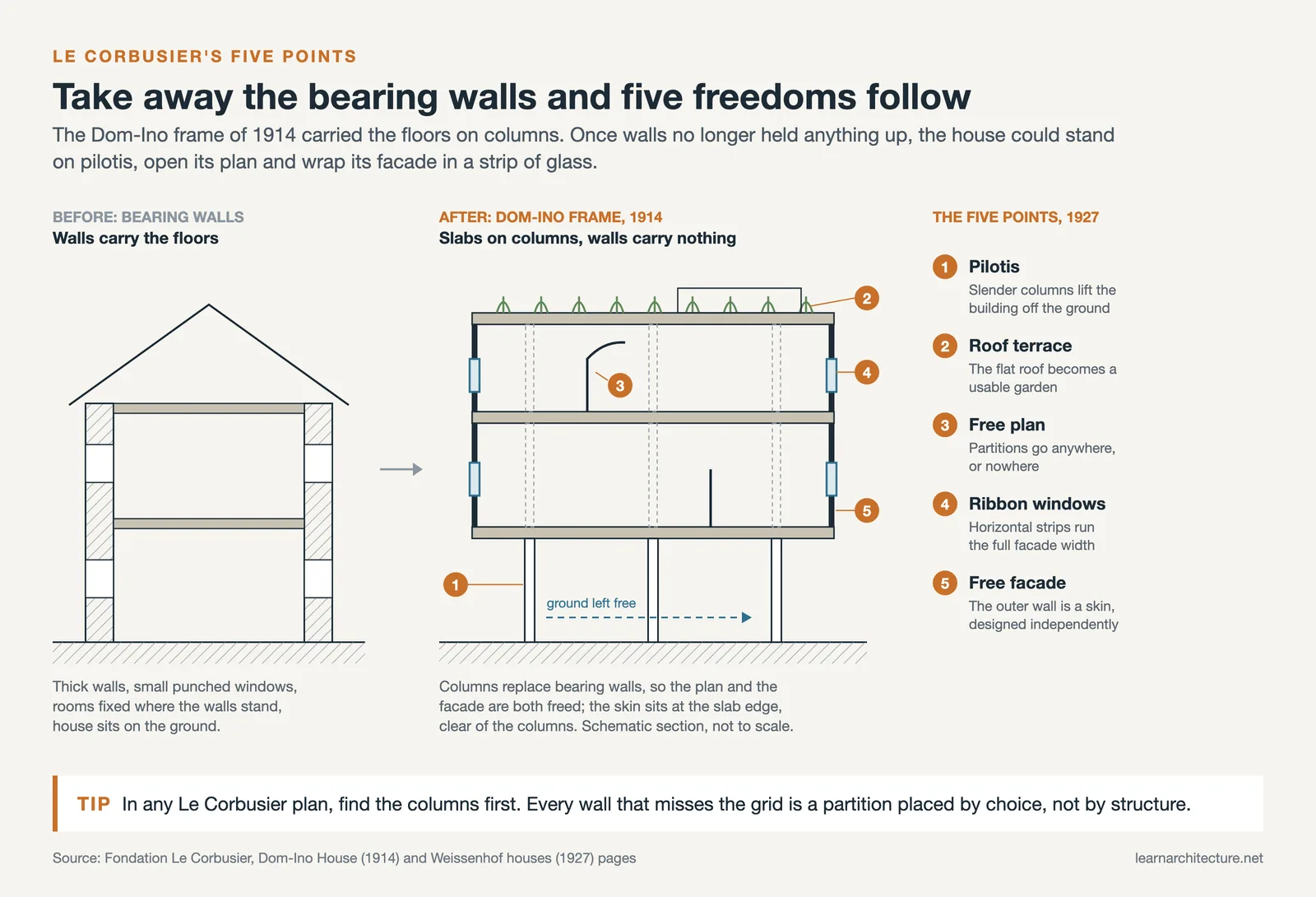
The five points are:
- Pilotis: slender columns lift the building off the ground, freeing the site beneath and allowing light and air to circulate
- Roof terrace: flat roofs replace pitched ones and become usable outdoor gardens or promenades
- Free plan: without load-bearing walls, interior partitions can be placed anywhere, or removed entirely
- Ribbon windows: horizontal strip windows run the full width of a facade, admitting even, controlled daylight
- Free facade: because the structure is internal, the exterior wall becomes an independent skin that can be designed freely
These principles were not merely aesthetic preferences. They were technical consequences of the Dom-Ino structural system Le Corbusier had developed as early as 1914: a skeleton of concrete slabs and columns that could be endlessly repeated and infilled. Understanding these five points is the clearest way to understand what le corbusier modern architecture was trying to accomplish: to give architecture a rational, reproducible, and humane foundation for the machine age.
💡 Pro Tip
When studying Le Corbusier’s buildings in section, always look for the ramp first. Unlike stairs, which break movement into discrete steps, his ramps create a continuous promenade architecturale, a deliberate choreography of how the body moves through space. This spatial sequencing is invisible in plan but defines the experience of nearly every major project he designed.
📌 Did You Know?
In 2016, seventeen projects by Le Corbusier across seven countries were inscribed on the UNESCO World Heritage List under the title The Architectural Work of Le Corbusier, an Outstanding Contribution to the Modern Movement. This is one of the few World Heritage designations that spans multiple continents and recognizes the transnational influence of a single architect’s output, according to the UNESCO World Heritage Centre.
1. Villa Savoye (Poissy, France, 1929 to 1931)

No single building captures the principles of Le Corbusier more completely than Villa Savoye. Commissioned as a weekend retreat for the Savoye family on the outskirts of Paris, the villa was designed as a literal demonstration of all five points simultaneously. Thin white pilotis raise a pure rectangular volume above a meadow. A continuous ribbon window wraps the first floor. The roof carries a solarium. Interior walls float freely within the concrete frame.
The arrival sequence is extraordinary. A car drives under the building, following the curve of the ground floor glazing, which was calculated to match the turning radius of the Savoye family’s limousine. From the vestibule, a ramp rises through the interior and onto the roof, making the promenade architecturale a physical, lived experience rather than a theoretical one. Villa Savoye was classified as a historic monument in December 1965, a few months after Le Corbusier’s death.
🏗️ Real-World Example
Villa Savoye (Poissy, France, 1931): The villa’s ribbon window runs continuously for the full width of each facade, a detail that was technically impossible with masonry load-bearing construction. By shifting all structural load to interior concrete columns, Le Corbusier could open the exterior wall completely. The south-facing living room window, for example, slides fully open onto the hanging garden, dissolving the boundary between inside and outside in a way no pre-Modernist house could achieve.
2. Unité d’Habitation (Marseille, France, 1947 to 1952)

If Villa Savoye was the Purist manifesto for the individual house, the Unité d’Habitation in Marseille was Le Corbusier’s answer to collective urban living. The building houses 330 duplex apartments in 23 types, stacked in a massive concrete block set on double-height pilotis. The entire structure is lifted off the ground, with the landscape flowing beneath it.
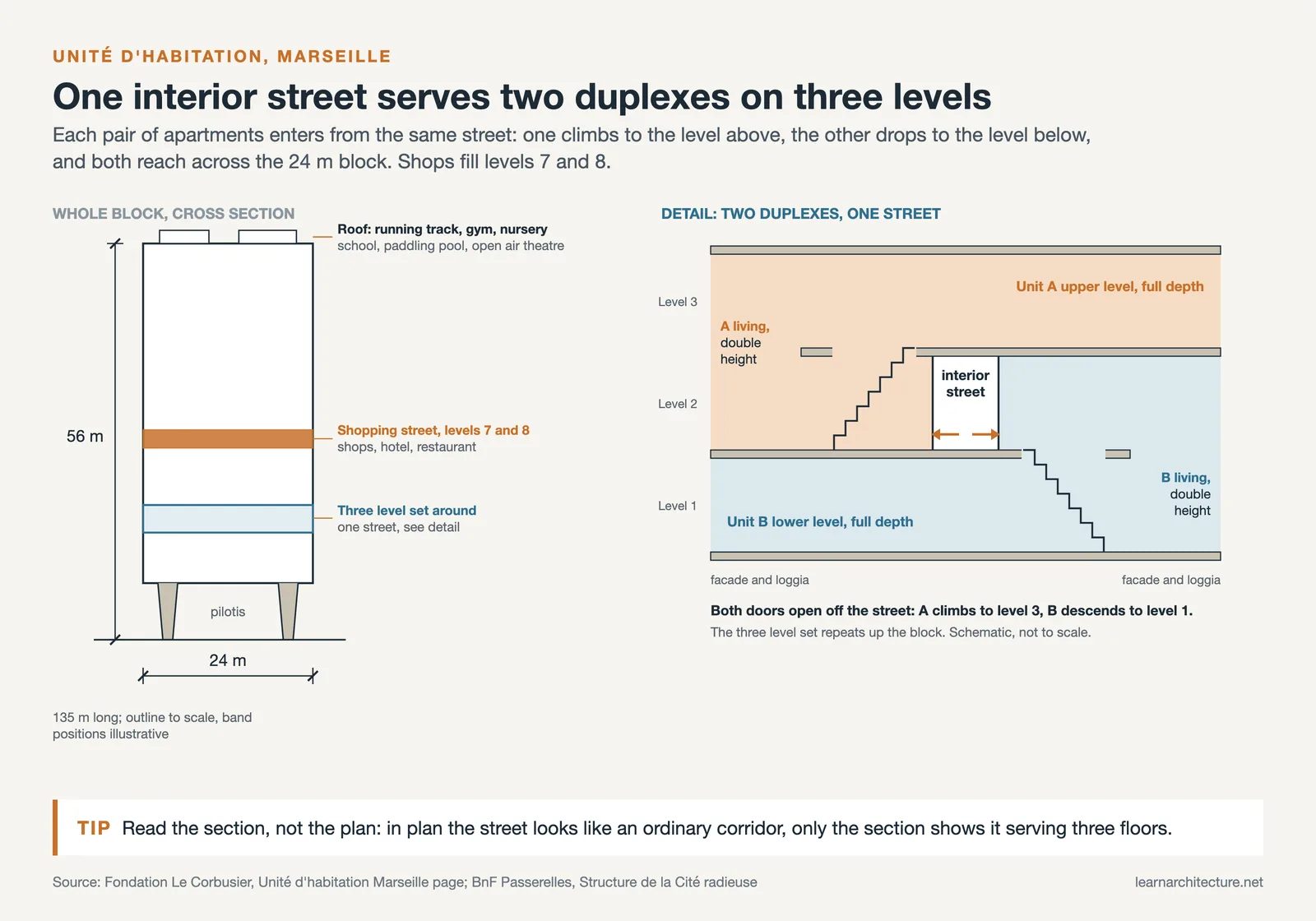
Almost every apartment runs the full depth of the building (from one facade to the other) and has a double-height living space opening onto a private balcony with brise-soleil screens to control sunlight. The section of the building is genuinely complex: units interlock so that a single internal corridor serves a pair of duplexes spread over three levels, so a corridor is needed only on every third level. A separate shopping street on the 7th and 8th floors contains a grocery, pharmacy, hotel, and post office: an internal street within the building. The rooftop carries a running track, nursery school, and outdoor pool. Le Corbusier called the whole thing a Cité Radieuse, a radiant city in vertical form.
3. Chapelle Notre-Dame-du-Haut (Ronchamp, France, 1950 to 1955)
Ronchamp represents the most dramatic shift in le corbusier architecture style across his entire career. Set on a hilltop in the Vosges mountains in eastern France, the chapel abandons the orthogonal geometry and smooth white surfaces of his Purist period entirely. The walls are thick, curved, and rough. The roof is a heavy upturned concrete shell that appears to float above the walls because a hidden gap of glazing runs between them. Light enters through irregular, deeply splayed windows punched through the south wall at varying heights and angles, filling the interior with colored light that changes throughout the day.
This was not a rejection of his earlier principles. It was an extension of them. Le Corbusier on architecture had always insisted on the emotional power of light, proportion, and the promenade. At Ronchamp, those qualities are pursued through sculptural rather than rational means. The building is deeply responsive to its site: the curved roof follows the sight lines of the four horizons, and the three towers bring natural light down into small chapels from above. Ronchamp proved that le corbusier modernist architecture was never dogmatic and was always searching.
🎓 Expert Insight
“The key to architectural emotion is a question of function served by light.”
Le Corbusier, Towards a New Architecture (1923)
This principle, stated decades before Ronchamp was built, explains why the chapel feels so consistent with his earlier work despite its radically different visual character. Light was always the primary material. At Ronchamp, the thick walls and irregular windows simply give that material a more sculptural and spiritual form.
4. The Capitol Complex, Chandigarh (India, 1952 to 1965)

When the Indian government commissioned Le Corbusier to master-plan the new capital of Punjab, it gave him an unprecedented opportunity: to design an entire city from scratch. The Capitol Complex, the governmental heart of Chandigarh, contains the Secretariat, the Palace of Assembly, and the High Court of Justice. These three civic buildings are among the most ambitious expressions of le corbusier architecture ever realized.
Each building is conceived as an independent sculptural object placed within a vast open landscape. The Palace of Assembly is the most dramatic: a hyperbolic concrete cooling tower rises through the roof of the main assembly chamber, creating a monumental interior volume lit from above. The High Court is fronted by a deep brise-soleil (a grid of concrete sun-shading elements) painted in primary colors. The Secretariat is a long, horizontal slab with a complex facade of differently sized brise-soleil units that vary according to the orientation of each office.
The Capitol Complex was inscribed on the UNESCO World Heritage List in 2016. It remains one of the most complete examples of civic architecture as urban design in the 20th century, and a profound influence on later architects working in concrete, from Tadao Ando to Renzo Piano.
5. Villa La Roche / Jeanneret (Paris, France, 1923 to 1925)
Built for Le Corbusier’s brother Albert Jeanneret and the Cubist art collector Raoul La Roche, this pair of semi-detached houses in the 16th arrondissement of Paris is widely regarded as the first fully realized Modernist house. The La Roche section contains a dramatic double-height gallery with a curved end wall and a ramp connecting levels, a direct prototype for the spatial sequences that would reach their fullest expression at Villa Savoye six years later.
The exterior is a composition of pure white cubic volumes, minimal windows, and a single pilotis supporting an overhanging section. Inside, Le Corbusier organized the sequence of spaces as a promenade: a route through changing volumes, levels, and light conditions. The building now operates as the headquarters and museum of the Fondation Le Corbusier, and it is one of the best places to understand the architecture of Le Corbusier at an early and intimate scale.
For those interested in how mathematical proportioning systems shape architectural design, Villa La Roche is a key early example of Le Corbusier applying geometric regulating lines to control facade composition, a practice he would later systematize into the Modulor.
💡 Pro Tip
When analyzing any Le Corbusier floor plan, look for the column grid first. The Dom-Ino skeleton establishes a structural rhythm (typically on a 4.75m or 5m module) that then allows walls, doors, and windows to be placed with complete freedom. Understanding the grid makes it much easier to read why rooms are shaped the way they are, and why the plan feels simultaneously logical and unexpected.
6. Couvent Sainte-Marie-de-la-Tourette (Éveux, France, 1956 to 1960)
La Tourette is Le Corbusier’s other major sacred building, and in many ways it is the counterpoint to Ronchamp. Where Ronchamp is curved, sculpted, and emotionally expressive, La Tourette is orthogonal, severe, and almost brutally honest in its use of concrete. The Dominican priory is organized around a courtyard on a steeply sloping site: four wings of cells and communal rooms drop down the hillside on pilotis, while the church is embedded into the earth at the lowest point.
The glazed corridors on the courtyard facades use a system Le Corbusier called ondulatoires: vertical concrete mullions spaced according to musical harmonic proportions developed with the composer Iannis Xenakis. Light enters the church through three small concrete cylinders called light cannons, which project through the roof and cast colored ellipses of light onto the floor as the sun moves. La Tourette is one of the most complete demonstrations of what le corbusier architecture could achieve when light, structure, and proportion were treated as a unified system, and it became a reference point for the Brutalist movement in Britain and beyond. You can learn more about Brutalism’s relationship to this tradition in our guide to the key differences between Bauhaus and Brutalism.
7. National Museum of Western Art (Tokyo, Japan, 1959)

Le Corbusier’s only completed building in Asia is a direct application of his “museum without end” concept: a spiral plan that begins with a central square nucleus and grows outward by adding new galleries in an expanding square spiral. The idea was that a museum could be extended indefinitely without disrupting its organizational logic. The ground floor of the main building is raised on pilotis, and vertical circulation moves through ramps rather than stairs.
The National Museum of Western Art houses the collection of Kōjirō Matsukata, primarily French Impressionist and Post-Impressionist paintings, along with a significant collection of Rodin sculptures in the forecourt. The building was designed at the same time as Le Corbusier’s museum for Ahmedabad, and both use the same structural approach of pilotis-supported galleries with top lighting. The Tokyo museum was added to the UNESCO World Heritage List in 2016. It remains open today and is one of the few places outside Europe where original Le Corbusier architecture can be experienced directly.
8. Maisons Jaoul (Neuilly-sur-Seine, France, 1954 to 1956)
The Maisons Jaoul mark a significant and often underappreciated shift in le corbusier architecture style. Designed for a father and son on a tight suburban plot, the two houses abandon the smooth white concrete and ribbon windows of the Purist villas in favor of rough brick, exposed concrete beams, and Catalan vault ceilings. The interiors are dark, tactile, and almost cave-like, a quality that was deliberately intensified by the low, heavy ceilings and the deep recesses of the garden-facing windows.
This rawness anticipated the concerns of the British Brutalist architects who were working at exactly the same moment. James Stirling and James Gowan’s Ham Common flats in London (1958) are directly indebted to the Maisons Jaoul. The houses proved that le corbusier modernist architecture was not limited to the white, smooth, industrial aesthetic, and that honesty of material could take many different forms. For architects interested in how material choices define architectural character, the Maisons Jaoul offer a more complex and less familiar side of Le Corbusier than Villa Savoye alone can provide.
How Le Corbusier’s Ideas on Architecture Shaped the Modern City
Le Corbusier toward an architecture, the title of his 1923 manifesto Vers une Architecture, was not simply a design philosophy. It was a social program. He believed that proper housing, light, air, and spatial organization were not luxuries but necessities for a healthy population. This conviction drove his urban planning proposals, most notably the Plan Voisin (1925), which proposed demolishing large areas of central Paris and replacing them with cruciform towers set in open parkland. The plan was never built, and it remains deeply controversial.
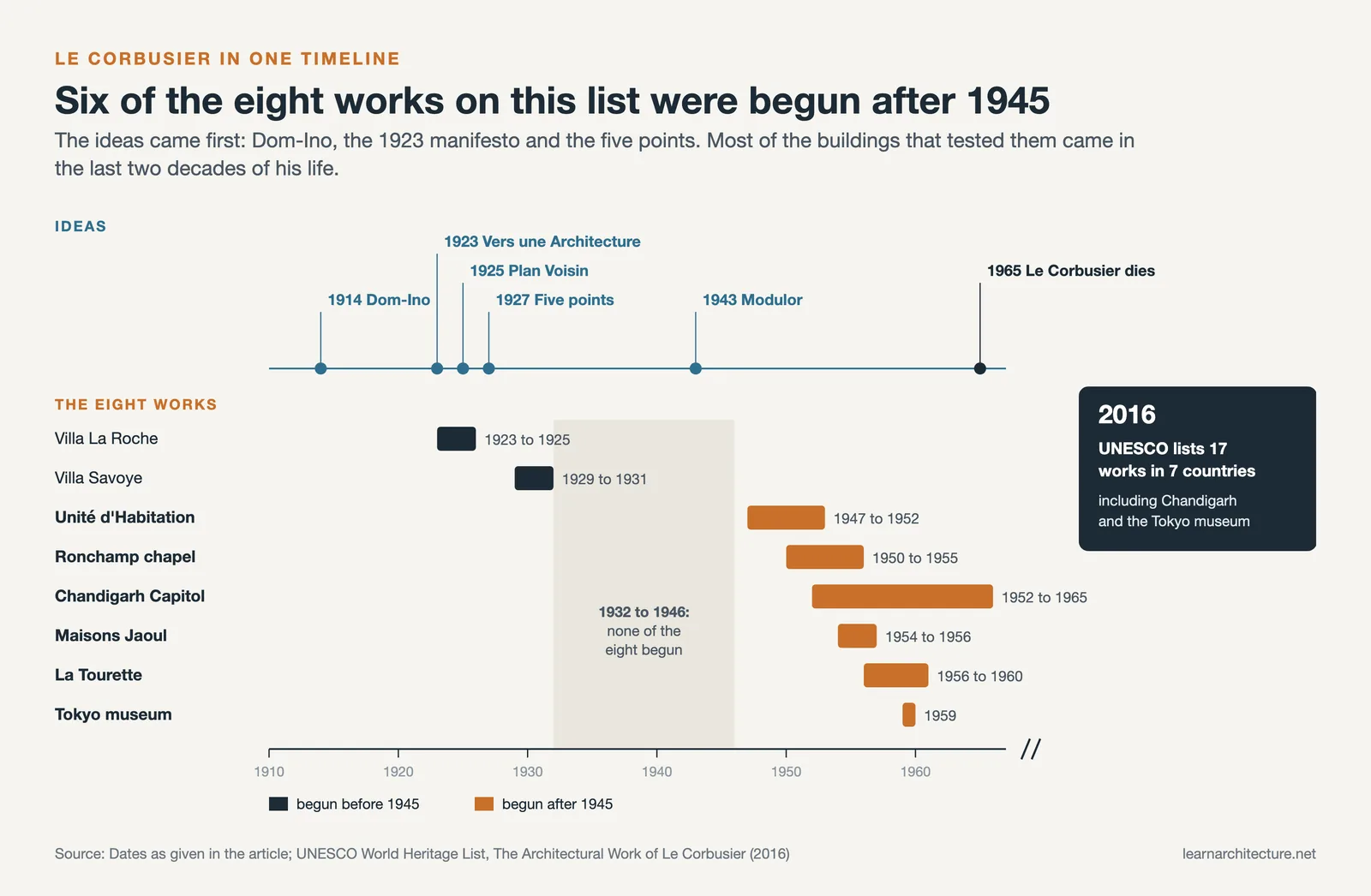
His influence on how architects after him approached proportion and human scale was profound. The Modulor system (a proportioning scale Le Corbusier developed from 1943 onward, combining the Fibonacci series with human body dimensions) was applied to the Unité d’Habitation, the Chandigarh buildings, and La Tourette. It was an attempt to build the golden ratio into the dimensions of every door, window, ceiling height, and staircase, ensuring that the built environment would always feel scaled to the human body. Our guide on iconic buildings of modernism provides additional context for how Le Corbusier’s output relates to the broader movement.
⚠️ Common Mistake to Avoid
Many students treat Le Corbusier’s five points of architecture as a checklist: if a building has pilotis and ribbon windows, it must be “Corbusian.” This misses the deeper idea. The five points are spatial and structural consequences of building in reinforced concrete, not stylistic decorations. A building can have all five elements and fail to generate the spatial richness Le Corbusier was after. Conversely, Ronchamp has almost none of them and is one of his greatest works. The five points describe a structural logic, not an aesthetic recipe.
Le Corbusier Quotes on Architecture Worth Knowing
Several of Le Corbusier’s most quoted lines come from Vers une Architecture (1923) and Towards a New Architecture, its English translation. His writing was polemical and sometimes deliberately provocative, designed to break architects out of historicist habit. A few remain genuinely useful for understanding his design thinking:
- “A house is a machine for living in”: often quoted out of context as a reduction of architecture to engineering, this line was actually an argument for efficiency, hygiene, and rational spatial planning as the starting point for design, not the endpoint.
- “Architecture is the learned game, correct and magnificent, of forms assembled in the light”: this emphasizes that for Le Corbusier, architecture was always an art, and light was always its medium.
- “The home should be the treasure chest of living”: a less well-known quote that shows his commitment to domestic quality, not just urban efficiency.
These le corbusier quotes on architecture reveal a thinker who was simultaneously hard-edged in his rationalism and genuinely passionate about the emotional and sensory experience of built space. The tension between those two impulses is what makes his work so productive to study across eight decades of practice.
✅ Key Takeaways
- Le Corbusier’s five points of architecture (pilotis, roof terrace, free plan, ribbon windows, and free facade) are structural consequences of building in reinforced concrete, not stylistic choices.
- Villa Savoye (1931) is the most complete single demonstration of all five points, but it represents only one phase of a constantly evolving career.
- Ronchamp and the Maisons Jaoul show that le corbusier architecture style was never fixed: he moved from smooth Purist geometry to raw concrete and brick as his understanding of space and light deepened.
- The Chandigarh Capitol Complex and the Unité d’Habitation extend his principles to the civic and urban scale, proving that the five points were scalable from a weekend villa to a city.
- The Modulor system, rooted in the golden ratio and human body proportions, was Le Corbusier’s attempt to give architecture a universal proportioning tool that would make all buildings feel humanly scaled.
- In 2016, UNESCO recognized seventeen of his projects across seven countries as World Heritage Sites, the only architect whose transnational body of work has received this collective designation.
Further Reading and Primary Sources
For architects and students looking to go deeper into le corbusier architecture, the following sources are recommended:
- Fondation Le Corbusier: the official archive in Paris, which maintains the complete collection of drawings, correspondence, and built work records
- UNESCO World Heritage Centre: Le Corbusier’s Architectural Work: the official inscription with detailed descriptions of all seventeen sites
- Villa Savoye official site: Centre des monuments nationaux, with visiting information and documentation on the five points as realized at Poissy
- ArchDaily: Le Corbusier: a continuously updated archive of articles, project documentation, and critical analysis
- Le Corbusier: Wikipedia: a reliable overview of biography, bibliography, and key built projects
- architecture of le corbusier
- le corbusier 5 points of architecture
- le corbusier architecture
- le corbusier architecture style
- le corbusier five points of architecture
- le corbusier modern architecture
- le corbusier modernist architecture
- le corbusier on architecture
- le corbusier quotes on architecture
- le corbusier style of architecture
- le corbusier toward an architecture
- what are le corbusier's 5 points of architecture








Leave a comment