


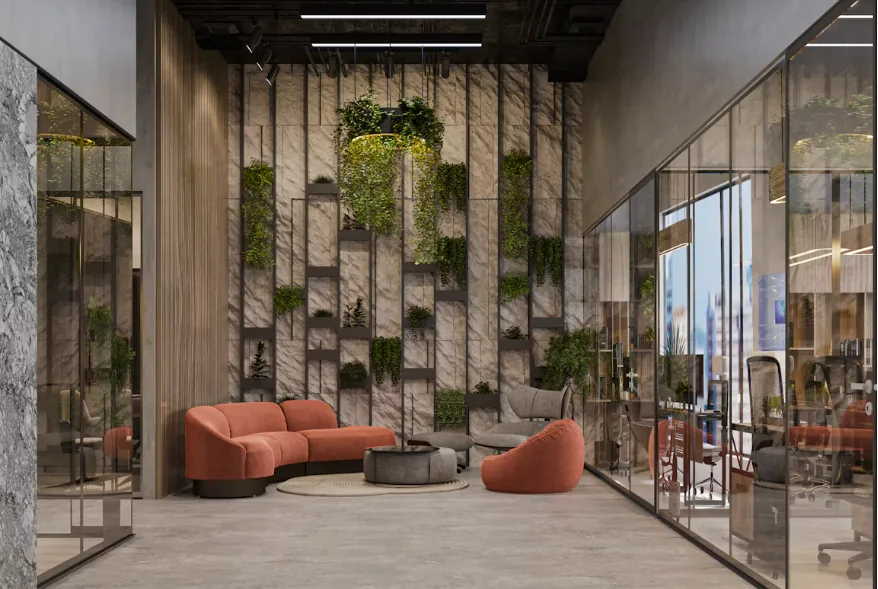
Table of Contents Show
A preserved moss wall tested to ISO 354 came back at an absorption rating of 0.35. That is Absorption Class D, roughly a third of a standard mineral wool panel.
A densely planted living wall tested by a different lab came back at 1.00, which is Class A.
Same category of product. Three times the performance. The reason is not the plants, and most specifications never mention it.
What the Acoustic Test Reports Say
Acoustics is the one benefit in this category with real measured data behind it. Independent labs, named standards, published test reports.
A university lab in Liege tested preserved reindeer moss to ISO 354. The sample was 40mm of moss on 6mm MDF. The result was an absorption rating of 0.35, Class D, with a high-frequency shape indicator.
Preserved ball moss from the same test series rated 0.55. Preserved foliage tested by a Dutch lab rated 0.60, or NRC 0.65 under ASTM C423.
Planted systems do better. A 2017 study at TU Delft tested modules densely planted with ferns over an air cavity. The absorption rating was 1.00 across every configuration tested.
A Spanish study measured a modular planted wall over a 120mm air chamber at 0.40. Its sound reduction index was just 15 dB.
For scale, ISO 11654 sets Class A at 0.90 or above and Class D at 0.30 to 0.55. So a moss wall on MDF sits in the lowest useful class.
Put plainly: to match 10 square metres of Class A panel, you need around 30 square metres of that moss.
The Low Frequencies Are Where It Falls Down
The frequency data matters more than the single number, and it rarely gets printed.
Preserved reindeer moss absorbs 0.10 at 125 Hz. Ball moss absorbs 0.05. Both carry shape indicators marking them as high-frequency absorbers.
That means a moss wall does almost nothing below 250 Hz. HVAC rumble, footfall and the fundamental of a male speaking voice all live at or below that.
It will shorten the ring in a hard lobby. It will not fix a boomy room.
Planted systems with deep substrate behave differently. The Spanish study measured 0.44 at 100 Hz and 0.51 at 125 Hz. That is genuinely broadband.
So the living wall is the better acoustic device. The moss wall is the better looking one. Our guide to acoustic elements in architecture covers where each belongs.
The Absorption Comes From the Backing, Not the Plants
This is the finding that should change how you specify.
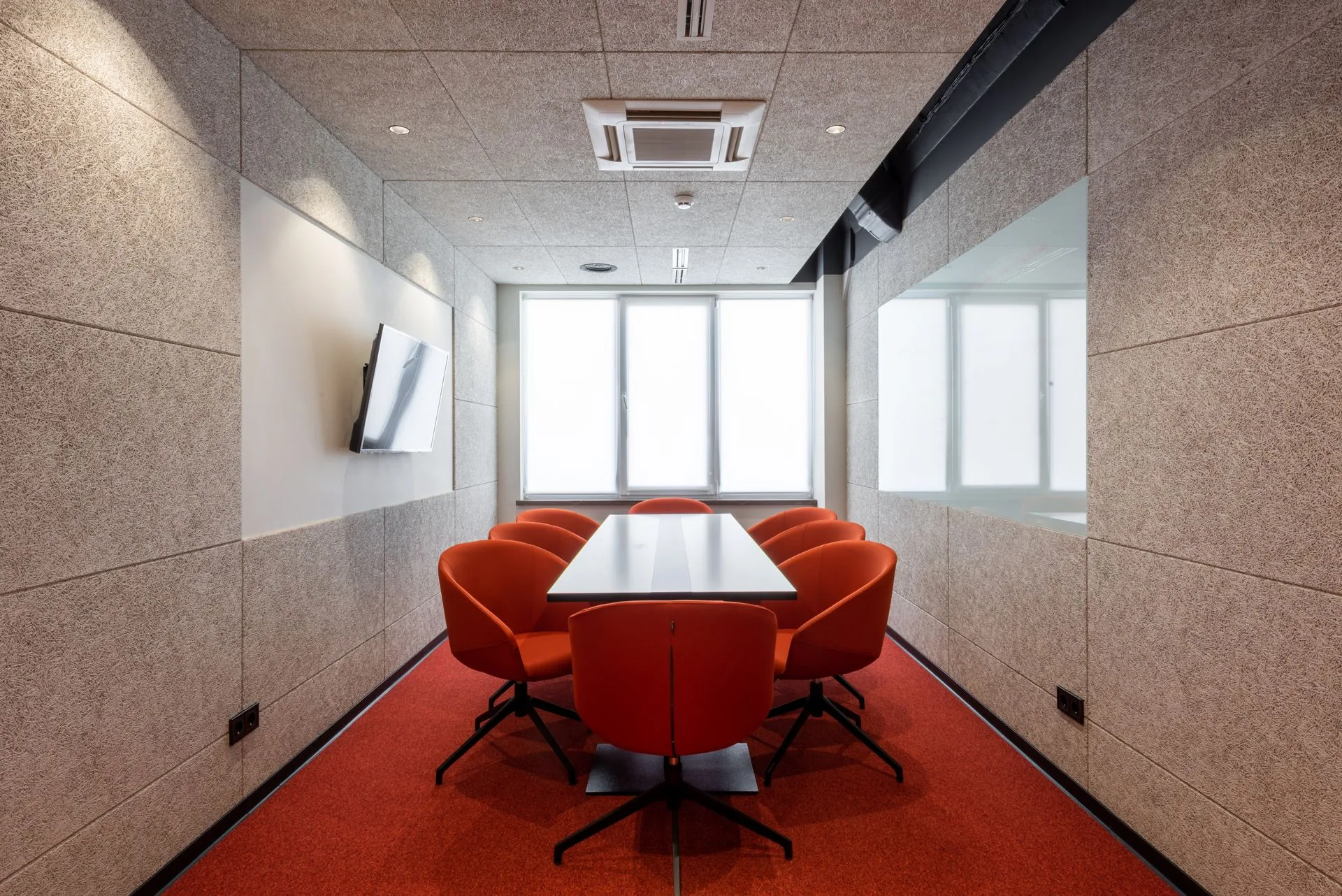
A 2025 study in Buildings measured each component of a modular vegetation system separately. The substrate did roughly 80 to 90 percent of the absorbing. The vegetation contributed 4 to 20 percent.
Grass-planted modules measured about 40 percent lower than bare substrate below 4 kHz. The plants were making it worse.
Earlier work reached the same place differently. Substrate absorbs at low frequencies. Foliage scatters at high frequencies. Scattering is not absorbing.
For moss walls the equivalent component is the board behind it. One manufacturer glues preserved reindeer moss to 6mm MDF, which is acoustically reflective, and tests at 0.35. Another glues the same lichen to a 9 to 12mm PET acoustic panel and claims NRC from 0.70.
Identical visible material. Different acoustic product. The difference is a panel nobody can see and the submittal rarely names.
So specify the backing:
- Ask for the ISO 354 or ASTM C423 report for the assembly as installed, not for the moss
- Check the mounting type, because flat to the wall with no cavity is the worst case and the one usually tested
- If the room has a low-frequency problem, put a cavity and a porous absorber behind the moss
Worth noting that no published test exists for a moss wall mounted with an air cavity behind it. Every report uses the flat mounting. That is a real gap.
What a Preserved Moss Wall Is and Is Not
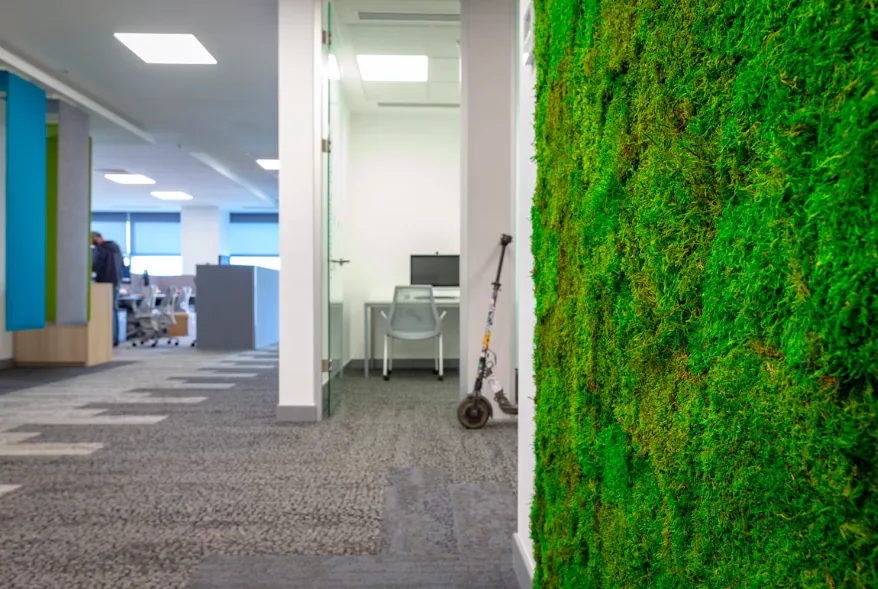
What gets specified as a living moss wall is usually not alive. Most commercial moss walls use preserved or artificial material, with live moss reserved for temporary exhibits.
Preservation means the moss is dried and treated with a vegetable glycerin solution. For reindeer lichen the process uses salt baths and food-grade pigment. The glycerin gradually replaces the plant’s sap.
That has real operational advantages. No light, no irrigation, no feeding, no pruning. It is a finish, not horticulture.
It also means the biological claims do not apply. The material is not metabolically active, so there is no photosynthesis, no gas exchange and no root zone microbiology. A preserved moss wall does nothing for air quality, and it cannot.
Three things to check before you specify one.
Fire class varies by supplier, not by material. One manufacturer’s preserved reindeer moss tests to ASTM E84 at flame spread 0 and smoke 15. That is Class A. Another’s tests under the Canadian equivalent at flame spread 95 and smoke 445. That is Class C, with smoke five points under the limit. Demand the actual report and confirm it covers the assembly as installed.
Humidity limits are real but undefined. Manufacturers quote operating bands of 40 to 80, 45 to 65 and 30 to 60 percent relative humidity. They do not agree. The consistent failure mode is brittleness at the dry end. Keep it out of supply air throw.
Reach height sets lifespan. One supplier rates the same product at five years or more out of reach. Within touching distance it drops to one or two years. That is a design decision, not a maintenance one.
On sourcing, reindeer moss is a lichen and it grows about 4.9mm a year. The 40mm sample in that Liege test report represents eight to twelve years of growth. Ask suppliers for harvest location and permit basis.
Humidity, Air Quality and the HVAC Load
A living wall is a continuous moisture source. The question is whether it is large enough to matter.
A 2024 study put 18 ferns in a sealed 30 cubic metre office. Median relative humidity rose from 29 to 49 percent. Air temperature and CO2 changes were not statistically significant.
That is a sealed box with dense planting and the air conditioning off. A real building behaves differently.
Researchers monitored a 10,300 square metre office with about 40 square metres of foliage. They found no significant difference in relative humidity between planted and control zones. Occupants still perceived the air as better.
So tell the mechanical engineer, but do not expect it to drive sizing. One thing is worth flagging. The load runs 24 hours a day and does not scale with occupancy. Every other latent source in the model does.
There is no ASHRAE guidance on this. Their position document on indoor mould and dampness does not mention indoor plants or living walls anywhere.
Thermal Performance Inside and Out
Exterior green walls do something measurable. A 2025 field study in Colombo recorded surface temperature reductions up to 4.1 degrees Celsius.
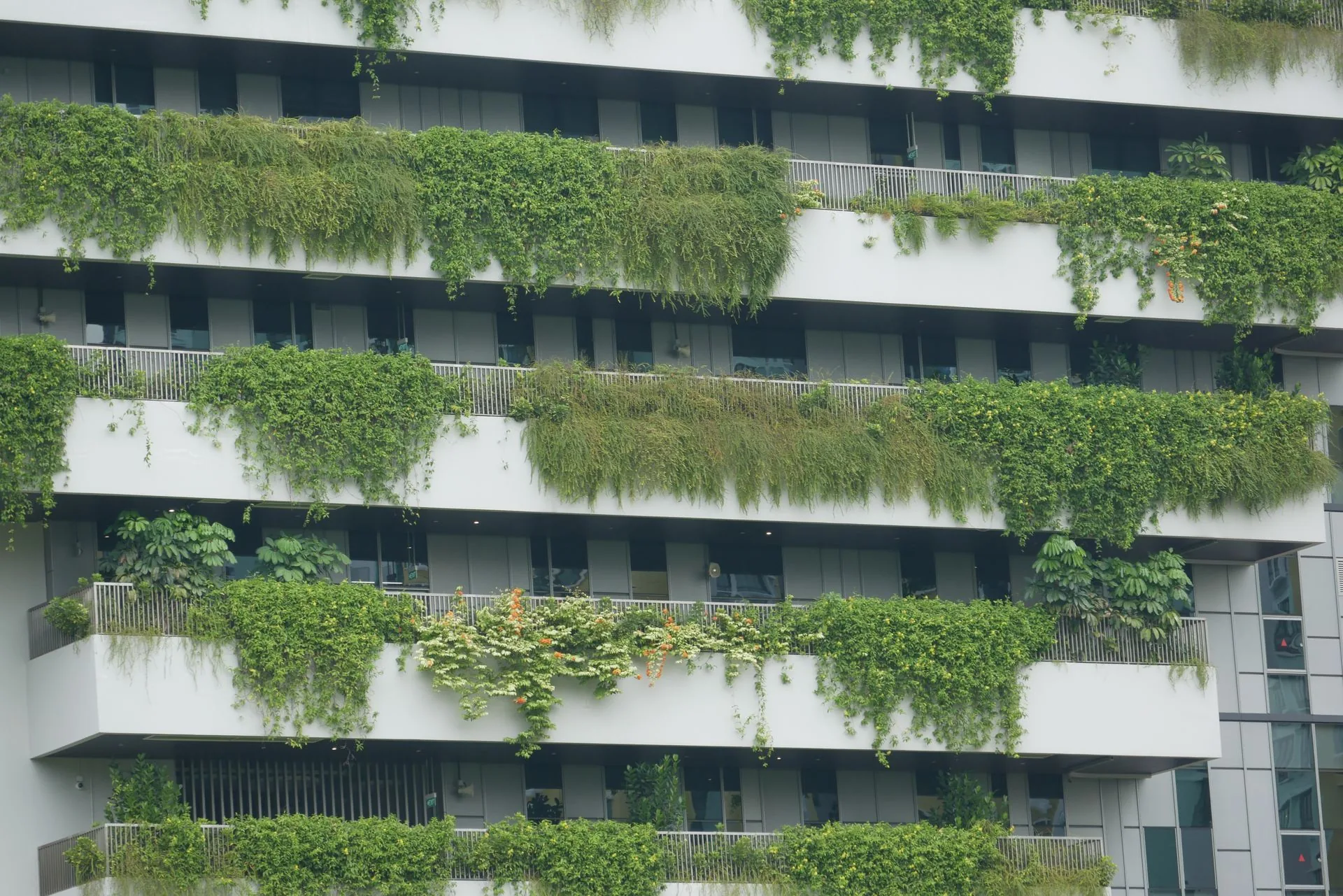
But the same study found no distinguishable difference in interior air temperature. It did not quantify any cooling energy saving.
A 2025 study across three Czech cities found cooling of 1.2 degrees at best, and sometimes none. Benefits came mainly from climbing plants rooted in the ground, not from potted living wall systems.
For interior walls the answer is simpler. There is no measured thermal or energy benefit, and no mechanism for one.
An interior wall sits between two conditioned spaces at the same temperature. There is no heat flux to intercept. Any evaporative cooling becomes a latent load the system then has to remove.
If you see a claim that an interior living wall saves energy, ask for the measurement. There is not one.
What It Does for the People Inside
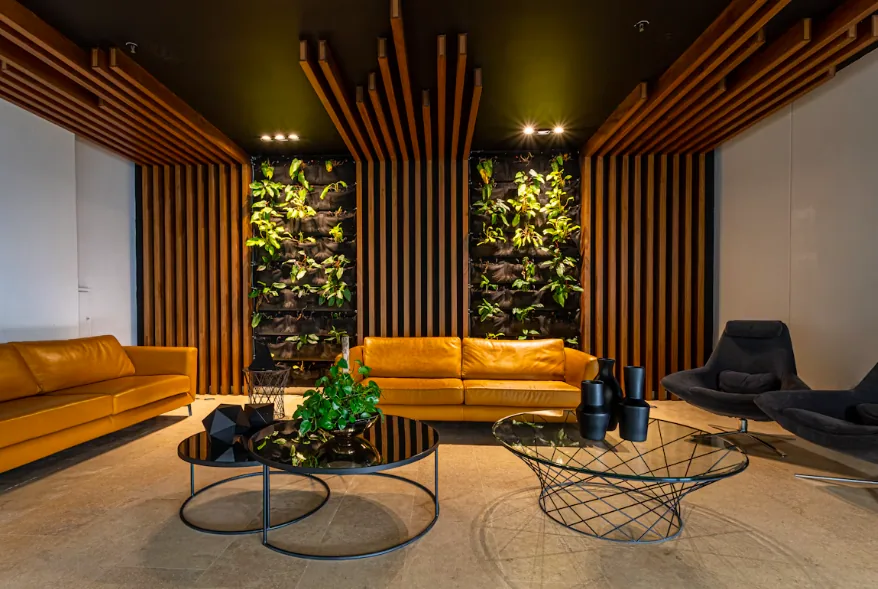
Here the honest answer is uncomfortable, and worth stating clearly.
A 2023 umbrella review synthesised 30 reviews on green walls and health. It found strong evidence for mitigating environmental stressors, including noise.
For restoration it found some evidence. For behaviour change and for direct health outcomes it found none, because no review had addressed them.
The strongest green-wall-specific result comes from a 2025 study with 30 participants in front of a real wall. After a laboratory stressor, heart rate and skin conductance fell and heart rate variability rose over seven minutes.
That is a genuine objective finding. It is also 30 people, seven minutes and one acute stressor. Most of the rest of the literature runs in virtual reality with sample sizes in the twenties.
One older study is more useful than any of it. Researchers compared window views against indoor plants and found the window view had the stronger effect. A nature view plus plants scored best of all.
So treat the wall as a complement to daylight and a view, not a substitute. It is what you do for the people sitting where there is no window. The evidence says they would rather have the window.
Which Credits It Helps You Earn
The certification picture is narrower than most people assume.
- LEED v4 Acoustic Performance. One point, a credit rather than a prerequisite. It sets reverberation targets under 0.6 seconds for private offices and under 0.8 for open plan. A wall contributes the way any absorber does, through total absorption
- WELL v2 Enhanced Access to Nature. An optimization, not a precondition. A vertical garden wall within about 10 metres of regularly occupied space satisfies one route
- LEED Quality Views. Does not count. It requires views to the outdoors through vision glazing, and interior planting does not qualify
Worth knowing that WELL version 1 did set an explicit plant wall requirement at 2 percent of floor area. Version 2 removed it. Specifiers still quote the old figure.
A 2026 analysis found only 3 LEED v5 credits and 4 WELL v2 features align strongly with biophilic patterns. Seven of the 14 patterns appear in neither system. Our comparison of LEED, BREEAM and WELL sets out how the schemes differ.
On asset value, there is no evidence at the feature level. Rent premium studies measure certification, not individual features. A wall may help you reach a certification associated with a premium. It does not command one itself.
Bottom Line: a living wall is a soil-filled broadband absorber with plants on the front. A preserved moss wall is a mid-frequency absorber whose performance is set by a board you cannot see. Both are finishes with a measurable acoustic function and a strong visual one. Neither is building services equipment, and the evidence does not support specifying them as if they were. If you want the wider environmental case, see our piece on green walls in sustainable architecture.
Frequently Asked Questions
Do moss walls really absorb sound?
Yes, but less than most claims suggest, and mostly at mid and high frequencies. Published ISO 354 results put preserved moss at Class D or C. A standard mineral wool panel is Class A.
Does a preserved moss wall clean the air?
No. The preservation process replaces the plant sap with glycerin, so the material is no longer biologically active.
How long does a preserved moss wall last?
Manufacturers quote five to ten years out of reach, dropping to one to three years where people can touch it. No independent figures exist.
Is a living wall better than a moss wall?
Acoustically yes, because the substrate does the absorbing and planted systems reach Class A. Operationally no, because a living wall needs light, water and a service contract.
Do green walls lower cooling costs?
Exterior walls reduce surface temperature by a few degrees. Interior walls have no measured thermal benefit and no mechanism for one.








Leave a comment