


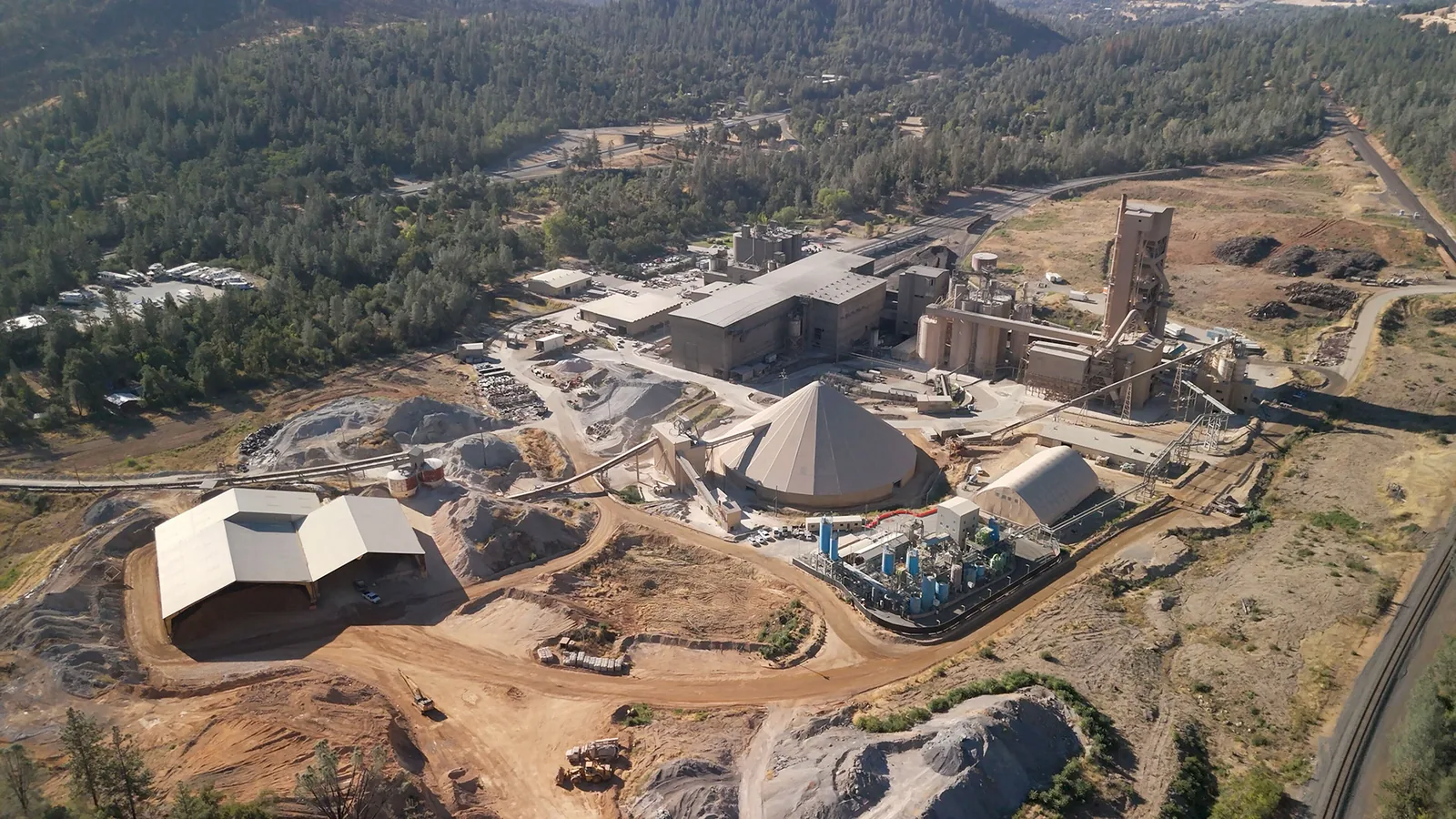
California company Fortera has chosen a lime works in Ste. Genevieve, Missouri, as the home of its first commercial low-carbon cement plant. Announced on 22 October together with Mississippi Lime Company (MLC), the facility would take the carbon dioxide released by MLC’s lime production and lock it into a cement product called ReAct. The partners put annual output at 300,000 tons, and Fortera says its finished cement is close to half captured CO2 by weight.
The two companies signed a development agreement in September. According to the announcement, the Missouri site won out because of the size of the lime operation, which Fortera describes as the largest in the Americas, and its place on the Mississippi River, from where cement could be shipped economically to most of the United States and overseas. The announcement did not include a construction schedule or a cost.
How Fortera’s low-carbon cement process works
Lime is made by heating limestone, and the CO2 driven out of the stone during that step, known as calcination, accounts for roughly 60% of a lime plant’s direct emissions, according to MLC. Fortera’s ReCarb system is meant to be bolted onto an existing cement or lime plant rather than replace its kilns. On its website the company explains that lime is first dissolved with a proprietary solvent, then CO2 from the kiln exhaust is absorbed into the solution so that a reactive calcium carbonate precipitates. The solids are separated, pressed, dried and stored as the powder sold as ReAct.
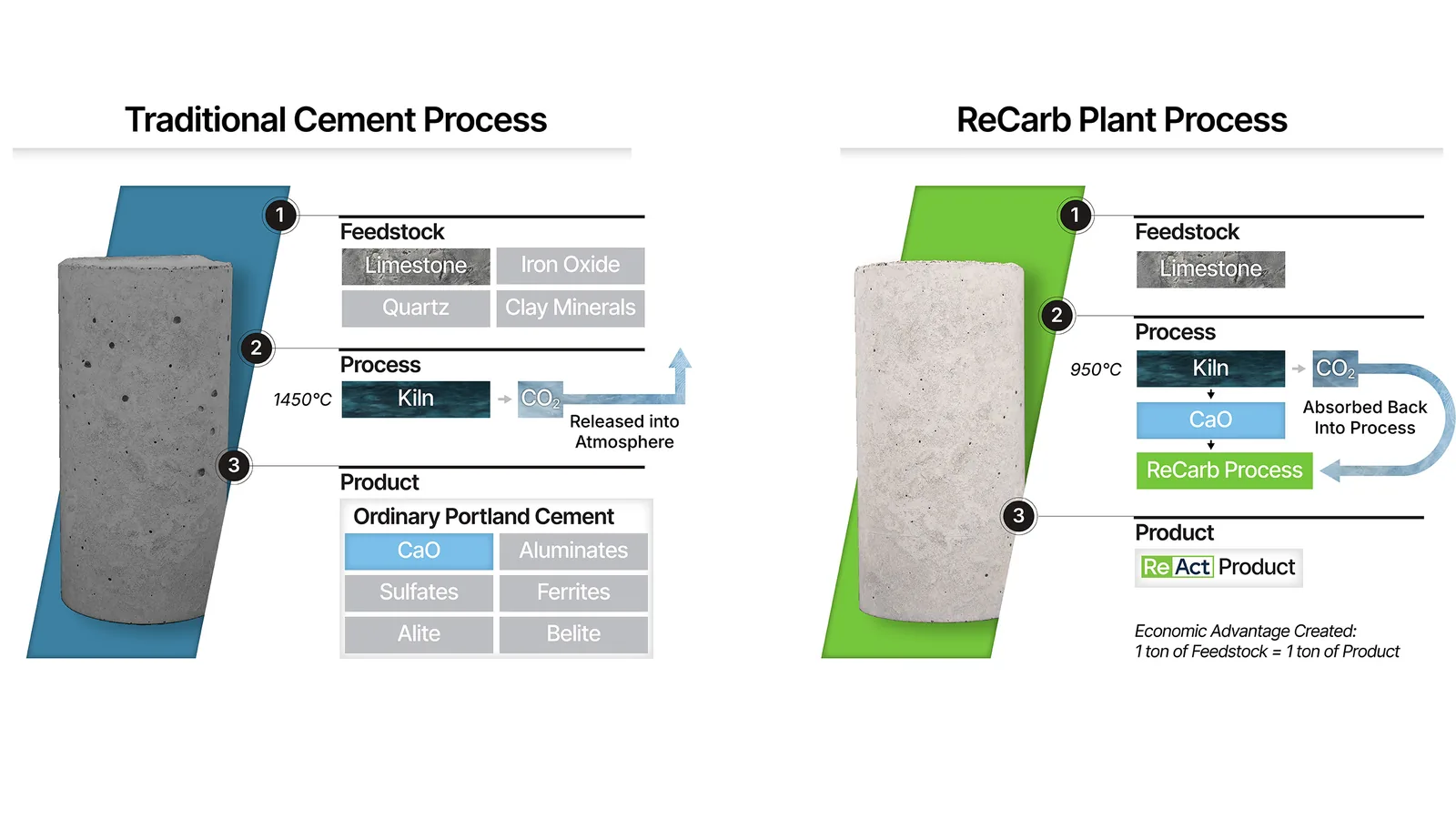
Fortera claims the product cuts CO2 emissions by 70% against ordinary portland cement and can be made at the same cost. It already operates a 15,000-ton-a-year plant in Redding, California, and in December 2025 announced that ReAct had met all six performance categories of ASTM C1157.
Two heavy industries, one emissions stream
“Building alongside the largest lime operation in the Americas lets us turn an existing emissions stream into hundreds of thousands of tons of cement to meet demand that already exists,” said Ryan Gilliam, Fortera’s chief executive and co-founder.
For MLC, the appeal is a route to cutting emissions its own process cannot avoid. Chief executive Paul Hogan, who also serves as president of the National Lime Association, said the company had lowered its carbon footprint by 8% since 2022, but that existing technology has limits and producers need practical ways to capture calcination emissions. The association has set a goal of decarbonising the US lime industry by 2050. Cement itself is responsible for 8% of global greenhouse gas emissions, according to a US Department of Energy figure cited by the partners.
The companies also frame the plant as added domestic supply: imports met 21% of US cement consumption in 2025, they say, citing the U.S. Geological Survey. Cement from Ste. Genevieve is intended for buyers across the Midwest, among them Ozinga, a fifth-generation family business supplying concrete and building materials.
What architects can specify today
ReAct comes in two forms. ReAct Cement is offered as a complete substitute for ordinary portland cement under ASTM C1157 and is pitched at structural applications. ReAct Blend replaces 10%, 15% or 20% of the portland cement in a mix and is listed against ASTM C150, C595, C1157 and C1797.
So far the material has gone into pilot pours rather than whole buildings: a stairway and ramp at DPR Construction’s Santa Clara headquarters, an entrance and staircase at UC Berkeley, a building at Simpson University in Redding and concrete for a new building on Microsoft’s Redmond campus, where Skanska was general contractor. Among the contractors quoted on Fortera’s website, Luis Macias of LCM Concrete Construction said the colour and surface consistency “would make me excited to use ReAct in decorative or architectural concrete.”







Leave a comment