


Table of Contents Show
Famous museums are no longer just containers for art; they are the art. From Frank Lloyd Wright’s spiraling concrete ramp in New York to Frank Gehry’s titanium-clad curves in Bilbao, the most iconic museum buildings in the world have pushed the boundaries of what architecture can do, becoming destinations in their own right and permanently changing how architects think about public space.
Why Museum Architecture Matters
For most of architectural history, a museum was expected to disappear behind its collection. The building served the objects; the walls stayed neutral. That changed gradually through the 20th century, and decisively after 1959, when the Solomon R. Guggenheim Museum opened in New York City and proved that the building itself could be an argument about how people experience space.
Today, museum architecture shapes visitor behavior, attracts tourism, anchors urban regeneration, and signals cultural ambition. Cities have commissioned landmark museum buildings specifically to redefine their identity. The “Bilbao Effect,” a term coined after Gehry’s Guggenheim transformed a struggling Basque port city into a global cultural destination, has been referenced in urban planning discussions ever since.
Understanding how the world’s most iconic museum buildings were conceived, what problems their architects were solving, and what controversies they stirred reveals something important about the relationship between form, function, and cultural meaning in architecture.
💡 Pro Tip
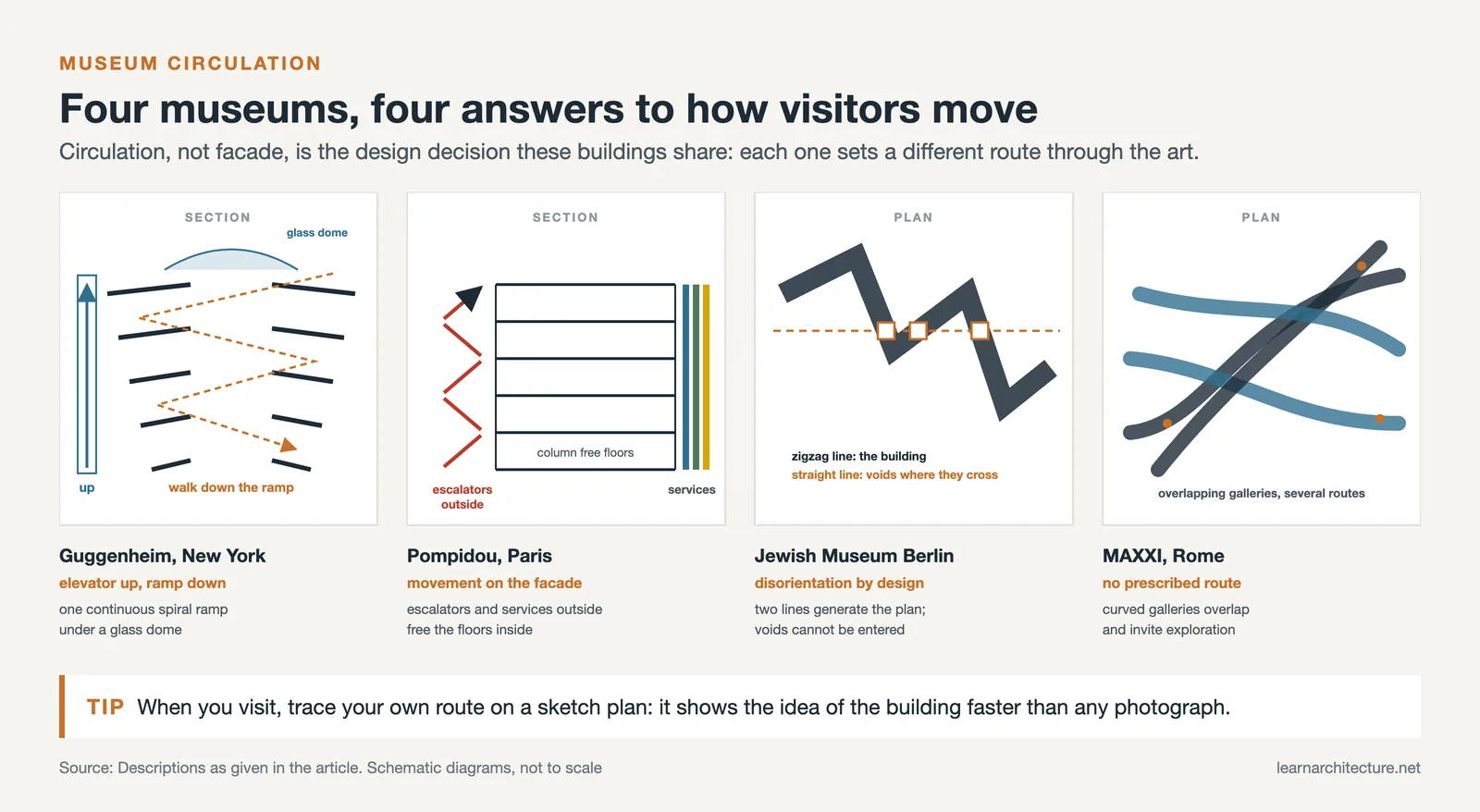
When studying iconic museum buildings as an architecture student or professional, pay attention to circulation as much as aesthetics. The most transformative museum designs (Wright’s Guggenheim, Piano and Rogers’ Pompidou, Herzog and de Meuron’s Tate Modern) all propose a fundamentally different answer to the same question: how should a visitor move through space? That question, more than any surface treatment, drives the architectural concept.
1. Solomon R. Guggenheim Museum, New York (1959)

Frank Lloyd Wright spent 16 years developing the Guggenheim’s design, producing over 700 sketches before construction began. His answer to the museum problem was radical: instead of a series of disconnected rooms, visitors take an elevator to the top and walk down a continuous quarter-mile spiral ramp, viewing art along the way as if on a gentle slope. The 96-foot glass dome above floods the central rotunda with daylight.
The building opened six months after Wright’s death in April 1959. Critical reaction was mixed (some called it a “washing machine” or a concrete snail), but over time, the Guggenheim became what architectural critic Paul Goldberger described as the building that made it “socially and culturally acceptable for an architect to design a highly expressive, intensely personal museum.” It is now a UNESCO World Heritage Site.
For anyone studying famous architects who transformed modern architecture, Wright’s Guggenheim is an unavoidable case study in how a single building can reframe an entire building typology.
📌 Did You Know?
The Guggenheim Museum’s reinforced concrete exterior was originally painted a buff-beige color to match Wright’s vision of warm, natural tones. The bright white seen today came later, after a series of renovations beginning in the 1990s. Wright himself never saw the finished building in its current appearance; he died six months before the 1959 opening.
2. Centre Georges Pompidou, Paris (1977)
Renzo Piano and Richard Rogers won the 1971 international competition for the Pompidou Centre with a design that deliberately turned the building inside out. All structural elements (steel trusses, escalators, ventilation ducts, water pipes) were pushed to the exterior and color-coded by function: blue for air, green for water, yellow for electrical systems, red for movement. The result freed the interior floors for completely flexible, unobstructed exhibition space.
Parisians were shocked. The building was compared to an oil refinery. Before it closed in September 2025 for a renovation expected to run until 2030, the Centre Pompidou received roughly 3.5 million visitors annually, making it one of the most visited cultural institutions in France.
The Pompidou’s influence on architectural styles and their cultural context is significant precisely because it rejected every inherited assumption about what a cultural building should look like.
3. Musée du Louvre Pyramid, Paris (1989)

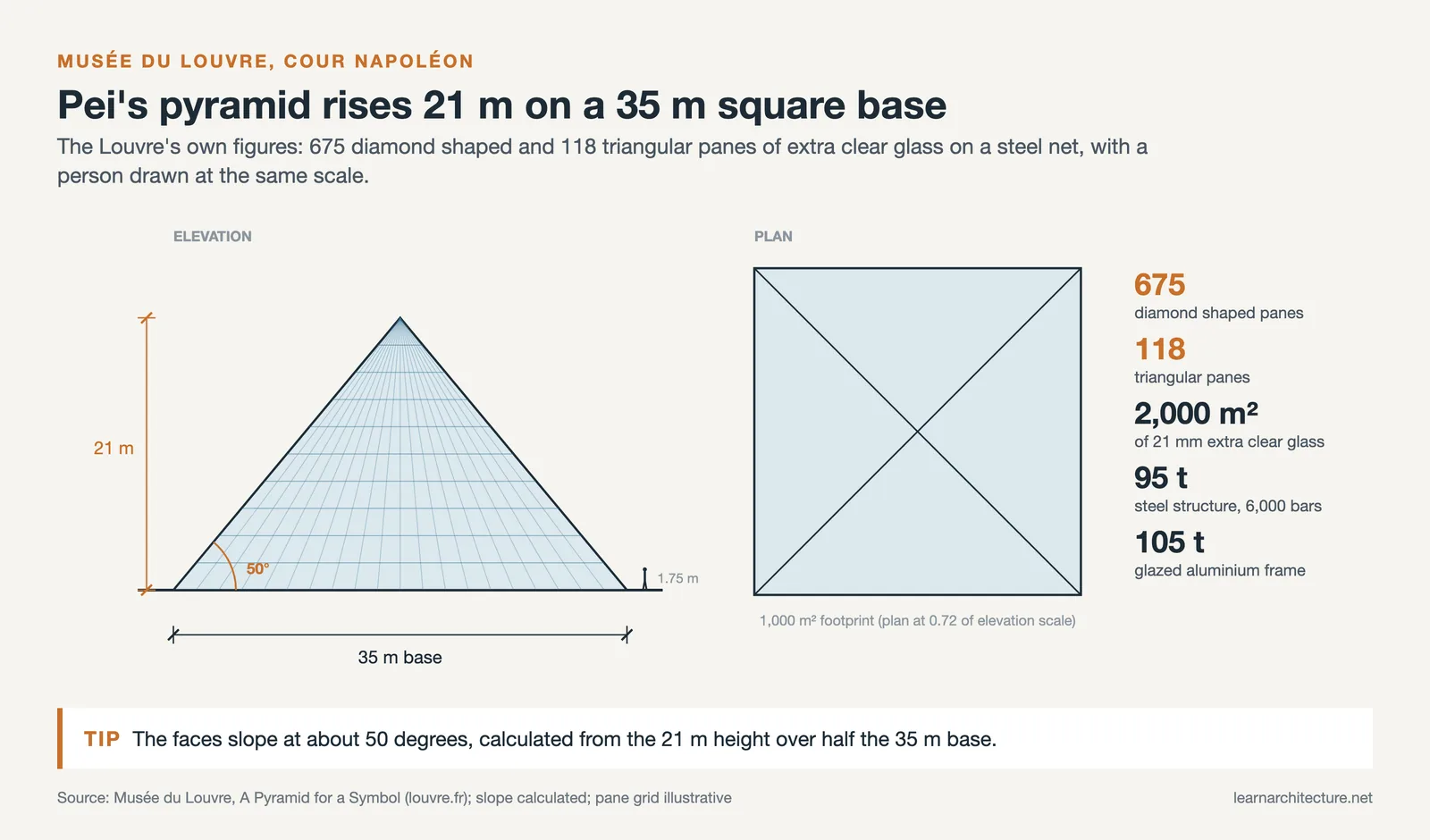
The Louvre is the world’s most visited museum, receiving close to 9 million visitors annually, but its architectural transformation arrived in 1989 when I.M. Pei’s glass pyramid opened in the Cour Napoléon. Commissioned by French President François Mitterrand as part of the Grand Louvre project, the pyramid serves as the main entrance, channeling visitors into a luminous underground lobby that distributes them across the museum’s three wings.
Pei’s pyramid stands about 21 meters tall with a base of 35 meters on each side, and its faces are composed of 675 diamond-shaped and 118 triangular glass panes held in a steel framework. The proportions echo those of the Great Pyramid of Giza without copying its form. Opposition was fierce during planning; critics accused Mitterrand of imposing a foreign aesthetic on a UNESCO-listed palace. The pyramid opened to immediate controversy and eventual acclaim, now considered one of the most successful modern interventions in a historic context.
🎓 Expert Insight
“The pyramid is a new element within the Louvre’s history: light, transparent, and modest in form, yet absolutely clear in its function as an entrance.”
I.M. Pei, architect
Pei’s framing of the pyramid as simultaneously modest and clear captures exactly why the design works: it does not compete with the palace, but it does not hide either. This balance between intervention and deference is a lesson frequently cited in design curricula on heritage contexts.
4. Guggenheim Museum Bilbao, Spain (1997)

When Frank Gehry’s Guggenheim Bilbao opened in October 1997, architecture critics struggled for vocabulary. The building, 24,000 square meters in total and clad in titanium panels, limestone, and glass wrapped around a series of irregular galleries that cascade toward the Nervión River, looked like nothing built before it. Gehry used early CATIA software to model the curving forms, one of the first times computer-aided design was used at this scale to realize something that could not have been drawn by hand.
The economic impact was documented by the University of the Basque Country: the museum generated over €500 million in economic activity in its first three years of operation, far exceeding the €87 million it cost to build. This data point became the foundation of the “Bilbao Effect” concept, cited in planning proposals worldwide as evidence that a single landmark building could trigger urban transformation.
The titanium cladding changes color with light (silver on overcast days, gold in direct sun) and the building’s relationship with the river, including a Jeff Koons floral sculpture and Louise Bourgeois’s spider installation outside, made the site as much landscape as architecture. For anyone interested in how specific architects shaped contemporary design, Gehry’s Bilbao work remains the defining example of deconstructivism applied to a public institution.
5. Tate Modern, London (2000)

Herzog and de Meuron’s conversion of the Bankside Power Station into Tate Modern is one of the most studied adaptive reuse projects in architectural history. The Swiss architects preserved the massive 35-meter-high turbine hall, removing generating equipment but leaving the raw industrial shell intact, creating one of the largest interior spaces in any public building in Europe. The hall became an exhibition space in its own right, hosting large-scale installations by artists including Olafur Eliasson, Carsten Höller, and Doris Salcedo.
The approach of celebrating rather than erasing the building’s industrial origin influenced a generation of cultural architecture projects. Herzog and de Meuron added a low-profile glass structure along the roofline to introduce light, and a major extension (the Switch House) opened in 2016, adding 60% more exhibition space in a twisted pyramid form visible from the Thames.
The Tate Modern received about 4.5 million visits in 2025 (ALVA), making it the most visited modern art gallery in the world. Its success demonstrated that museum design principles could work within an existing industrial structure as powerfully as in a purpose-built one.
6. Jewish Museum Berlin (2001)
Daniel Libeskind’s Jewish Museum Berlin is perhaps the most emotionally charged building on this list. The design generates its plan from two lines: a straight line representing the historical and rational course of German-Jewish history, and a jagged, lightning-bolt line representing the broken and discontinuous nature of that history after the Holocaust. Where these lines intersect, they create voids: empty shafts that cut through the building and cannot be entered. Libeskind called them “the memory of the absent.”
The building’s zinc facade is sliced by irregular windows that appear chaotic from outside but correspond to a map of addresses from which Jewish Berliners were deported. Visitors feel disoriented, walking on sloped floors and through compressed corridors that open suddenly into tall, empty spaces. The architecture does not illustrate the museum’s content; it enacts it.
Libeskind’s approach established a framework for how spatial storytelling in museums can operate beyond conventional exhibition design, using architecture itself to convey meaning.
⚠️ Common Mistake to Avoid
A frequent misreading of the Jewish Museum Berlin is that Libeskind “designed a building about the Holocaust.” This understates the concept. The building is about the relationship between Jewish and German culture across centuries, not only its destruction. The voids represent absence within a longer, richer continuum. Reading only the traumatic dimension misses the architectural argument about history, memory, and continuity that makes the project genuinely significant.
7. MAXXI National Museum of XXI Century Arts, Rome (2010)
Zaha Hadid’s MAXXI in Rome is one of the few buildings on this list situated within a historic urban fabric as dense as any in Europe. Built on the site of a former military barracks in the Flaminio district, the museum’s flowing concrete forms (curved galleries that overlap and intersect without ever producing a conventional right angle) create a circulation experience unlike any other museum. There is no single prescribed route; the building encourages exploration.
Hadid described the project as a “campus of arts” rather than a single object building. Natural light enters through roof slots that track the movement of the sun, shifting conditions throughout the day. The structural system, exposed concrete with visible steel joints, reflects the influence of both Italian architectural traditions and Hadid’s parametric design methods.
MAXXI won the RIBA Stirling Prize in 2010, the most prestigious architecture award in the UK, confirming Hadid’s status as one of the most influential architects in the world before her death in 2016. Her approach to museum design methods, treating circulation as the primary design driver, remains a model studied in architecture schools globally.
8. Louvre Abu Dhabi (2017)
Jean Nouvel’s Louvre Abu Dhabi is perhaps the most technically ambitious museum building of the 21st century. A 180-meter aluminum and steel dome, composed of 7,850 unique geometric elements arranged across eight layers, filters direct sunlight into a pattern of shifting “rain of light” on the buildings and water below. The dome weighs 7,500 tons and took 11 years of engineering to resolve.
The museum is built on Saadiyat Island, at the water’s edge, and its arrangement of low white pavilions connected by shaded walkways and reflecting pools references traditional Arab medina urbanism (clusters of buildings with protected internal passages) while the overall composition remains unmistakably contemporary. Nouvel described the dome as “a new sun” for the desert city.
The project emerged from a 30-year partnership agreement between France and the UAE, allowing the Abu Dhabi institution to use the Louvre name and borrow works from French national collections. Architecturally, it demonstrates how architectural styles can draw from multiple cultural traditions without resolving into pastiche.
🏗️ Real-World Example
National Museum of African American History and Culture, Washington D.C. (2016): Designed by David Adjaye, the museum’s three-tiered form references the corona of Yoruba sculptures from West Africa, directly embedding cultural symbolism into the structural form. The bronze-toned aluminum lattice screens reduce solar heat gain while creating a distinctive visual identity. The museum drew about 3 million visitors in its first full year of operation, averaging 8,000 people a day, double the number anticipated, demonstrating how cultural specificity in museum architecture can drive both critical and popular success.
What These Buildings Have in Common
Looking at these eight projects across seven decades, certain patterns appear. Each building proposed a specific answer to the question of how visitors should move through space, and that answer was always different from what came before. Wright’s spiral ramp, Libeskind’s disorienting voids, Hadid’s campus of interlocking paths: circulation is where architectural meaning is made in museum buildings.
Each building also generated controversy on opening. The Pompidou was compared to a refinery. The Louvre pyramid was called culturally inappropriate. The Guggenheim Bilbao was described as “the greatest building of our time” by Philip Johnson and dismissed as spectacle by others. None of these reactions turned out to be permanent. In every case, the building outlasted its controversy.
Finally, each building changed something beyond its walls: the way a city was perceived, the way a building type was conceived, or the way architects thought about what was formally possible. That impact beyond the site is what separates iconic museum buildings from simply very good ones.
For further reading on how buildings function within cultural contexts, the role of shapes in architecture and their cultural and structural implications provides a strong conceptual foundation. The history of iconic brutalist buildings offers useful context for how the Pompidou Centre positioned itself against the raw institutional architecture of its era.
✅ Key Takeaways
- The most famous museums redefined their building type, not just their aesthetic, by proposing new answers to how people move through and experience space.
- Guggenheim Bilbao’s documented economic impact (€500M+ in three years on an €87M investment) made “landmark museum” a legitimate urban regeneration strategy cited worldwide.
- Nearly every building on this list was controversial on opening; none of those controversies proved permanent, which suggests that architectural novelty and cultural value are not the same thing and often arrive at different speeds.
- Circulation, not facade, is the primary design decision in transformative museum architecture. Wright’s ramp, Libeskind’s voids, and Hadid’s interlocking paths are all answers to the same question about how visitors should move.
- Adaptive reuse (Tate Modern) and historic intervention (Louvre Pyramid) can produce architecture as significant as purpose-built museums, provided the strategy respects and responds to what already exists.
💡 Pro Tip
If you are designing or studying museum architecture, visit these buildings, not just their photographs. The spatial experience of the Guggenheim’s ramp, the disorientation of the Jewish Museum’s tilted floors, and the quality of light inside the Louvre Abu Dhabi’s dome are properties that reproductions cannot convey. The gap between photograph and experience is, in most of these buildings, the point of the architectural argument.












Leave a comment