


Table of Contents Show
The FF&E meaning in interior design is furniture, fixtures and equipment: the movable items a finished space needs in order to work, which are not built into the structure. Chairs, beds, desks, lamps, rugs, artwork and appliances all sit inside FF&E, and they are normally bought under a budget separate from the construction contract.
That short definition hides the part that causes arguments on real projects. Two teams can agree on the words and still disagree about a reception desk, a wall-mounted television or a set of motorised blinds. The dividing line is not really about furniture at all. It is about who signs the purchase order, which contract carries the item, and how the owner will account for it afterwards.
What Does FFE Stand For?

FFE stands for furniture, fixtures and equipment. You will see it written as FF&E, FFE or FF+E, and all three mean the same thing. Some studios use FF&A (furniture, fixtures and accessories) or FFE&A when soft accessories are contracted separately from case goods and seating.
Hospitality projects add a second acronym. OS&E covers operating supplies and equipment: linens, glassware, kitchen smallwares, luggage carts, back of house stock. FF&E is what stays in the room for years. OS&E is what the operator replaces continuously. Mixing the two is one of the fastest ways to blow a pre-opening budget, because OS&E quantities scale with occupancy rather than with room count.
What Counts as FF&E and What Does Not
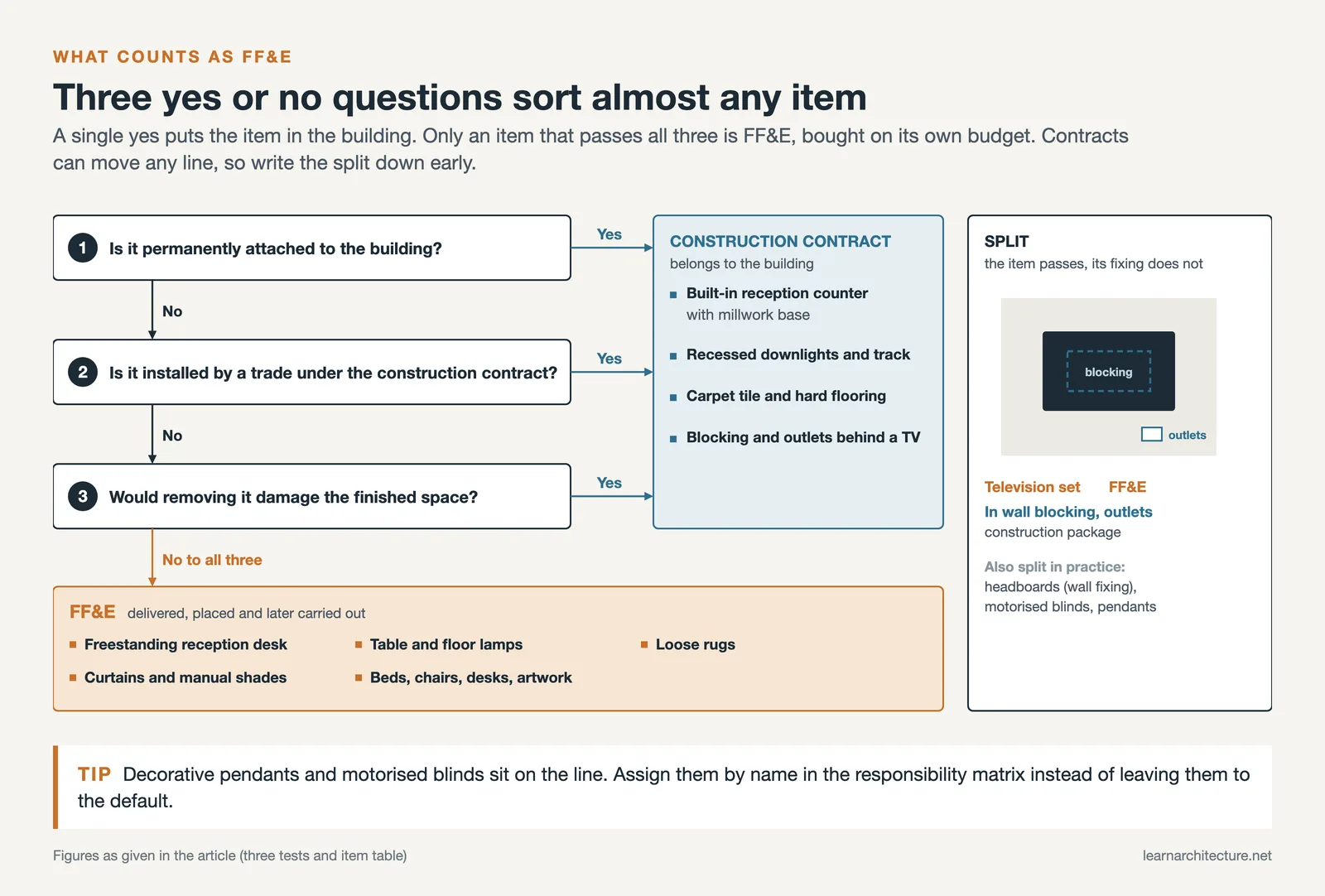
Three questions settle almost every case. Is the item permanently attached to the building? Is it installed by a trade under the construction contract? Would removing it damage the finished space? If the answer is yes, it belongs to the building. If it can be delivered, placed and later carried out, it is FF&E.
The awkward cases are the ones that need both answers at once. A guestroom television is FF&E, but the in-wall blocking and the power and data outlets behind it belong to the construction package. A headboard bought as furniture still needs someone to confirm the wall can take the fixing. This is where interior architecture and interior decoration stop being separate conversations.
Where Common Items Usually Land
The table below shows how typical elements are normally split, and why. Project contracts can move any line, which is exactly why the split gets written down early.
| Item | Usually sits in | Reason |
|---|---|---|
| Freestanding reception desk | FF&E | Delivered and positioned, not fixed to the structure |
| Built-in reception counter with millwork base | Construction contract | Fabricated and fixed as part of the fit out |
| Table and floor lamps | FF&E | Plugged into an outlet, swapped without trade work |
| Recessed downlights and track | Construction contract | Wired into the building electrical system |
| Loose rugs | FF&E | Laid over a completed floor finish |
| Carpet tile and hard flooring | Construction contract | Installed finish, specified with the other finishes |
| Television and its wall bracket | Split | Set is FF&E, blocking and outlets are construction |
| Curtains and manual shades | FF&E | Window treatments, though motorised systems often move across |
📐 Technical Note
In North American practice the FF&E boundary already exists inside the specification system. CSI MasterFormat places furnishings in Division 12, subdivided into Art (12 10 00), Window Treatments (12 20 00), Casework (12 30 00), Furnishings and Accessories (12 40 00), Furniture (12 50 00) and Multiple Seating (12 60 00), with Division 11 covering Equipment. Anything you would call a finish or an assembly sits in Divisions 03 to 10 instead, which is a quick sanity check when a spec section looks misfiled.
Where FF&E Sits in the Interior Design Process

FFE interior design work starts far earlier than most clients expect. During concept and schematic design the team sets an allowance per room type, because a hotel guestroom at one number and the same room at half that number are two different designs, not the same design at two prices. Design development turns the allowance into performance criteria: seat height, upholstery grade, edge detail, finish samples.
Documentation is where the two packages separate. The architectural set goes out for construction bidding, while the FF&E package is issued on its own, with its own drawings, its own specifications and its own bid list. Studios that model furniture inside BIM can drive part of that package straight from the model, which is one practical use for the manufacturer content available through free Revit families.
⚠️ Common Mistake to Avoid
Treating FF&E as a late shopping exercise once the building is nearly finished. By then the walls are closed, so blocking for headboards and mirrors, outlets behind consoles, and floor boxes under conference tables have to be cut back in as change orders. Fix the FF&E layout before the construction drawings are issued, then send the coordination items to the design team as a marked-up plan rather than a list.
What Is an FF&E Schedule?
An FF&E schedule is the master list that turns design intent into an order. It is a line-item document, usually a spreadsheet, that identifies every item, where it goes, how many are needed and exactly what is being bought.
A workable schedule carries these columns:
- Item code and short description, keyed to the FF&E plan
- Room or location, with quantity per location and total quantity
- Manufacturer, product name and model number
- Finish, fabric or leather, including grade and yardage
- Overall dimensions and weight for access and installation checks
- Lead time and required delivery date
- Unit price, extended price and freight basis
- Compliance notes, such as applicable performance standards and flammability requirements
- Remarks: who installs, what fixing is needed, attic stock quantity
Performance requirements deserve more attention than they usually get. Contract furniture is tested against published standards, and the ANSI/BIFMA standards maintained by BIFMA cover seating, desks, tables, panels and storage separately. Naming the relevant standard in the schedule gives the bidder something to prove and gives you something to reject a substitution against. Residential projects need less of this, though dimensional coordination still matters, which is why standard bedroom dimensions and countertop heights tend to drive furniture selection rather than the other way around.
How FF&E Procurement Works

FF&E procurement runs on one of three routes, and the choice affects fee structure, risk and schedule.
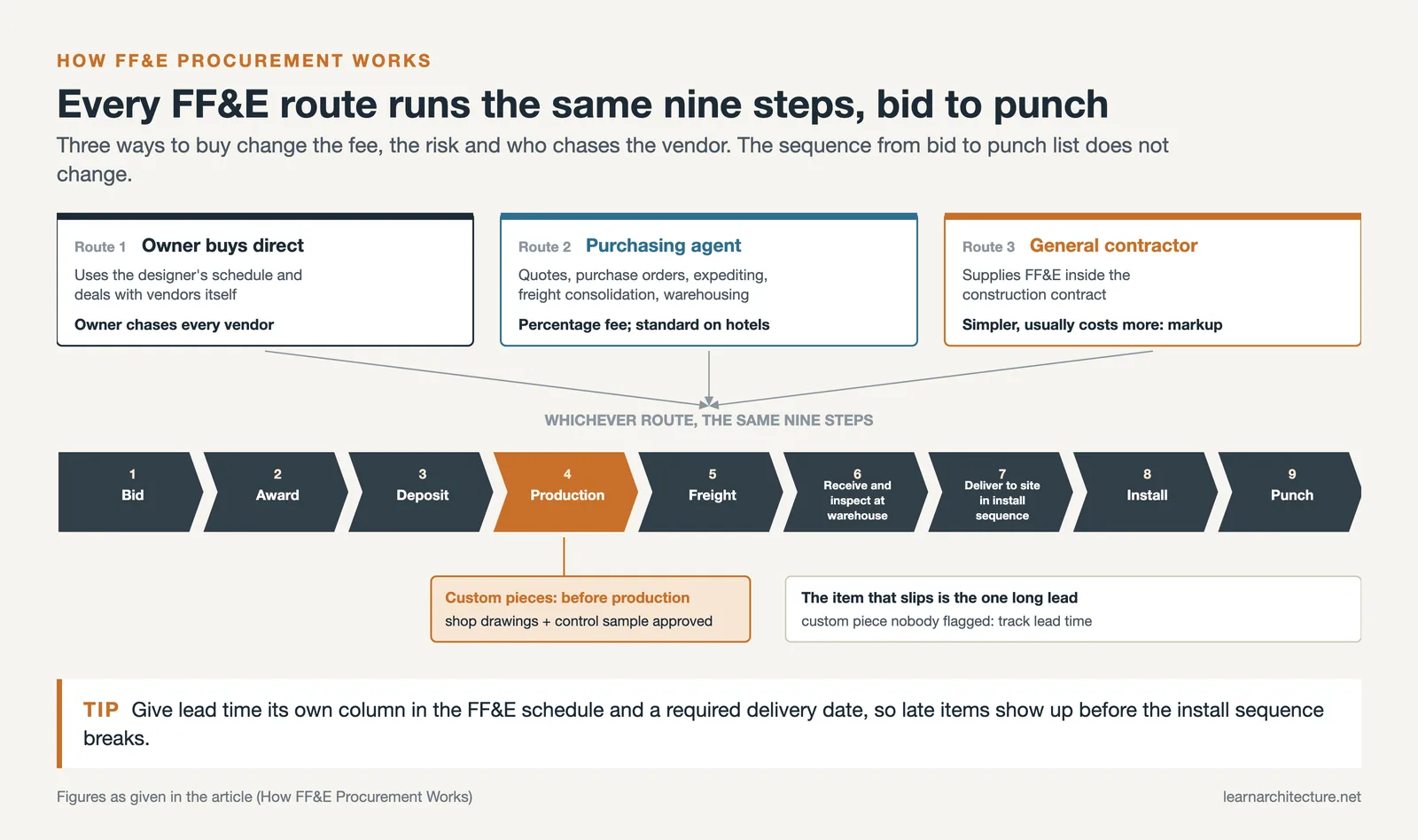
The owner can purchase directly, using the designer’s schedule and dealing with vendors themselves. A purchasing agent can be appointed, which is standard on hotels and larger commercial projects, taking on quotations, purchase orders, expediting, freight consolidation and warehousing for a percentage fee. Or the general contractor can supply FF&E as part of the construction contract, which simplifies coordination and usually costs more, because the items pick up the contractor’s overhead and markup.
Whichever route is chosen, the sequence is the same: bid, award, deposit, production, freight, receiving and inspection at a warehouse, delivery to site in installation sequence, install, then punch. Custom pieces need shop drawings and a control sample approved before production starts. The item most likely to slip is never the sofa, it is the one long-lead custom piece that nobody flagged in the schedule, so lead time deserves its own column and its own tracking, in the same way a feasibility study tracks the assumptions most likely to break.
🔢 Quick Numbers
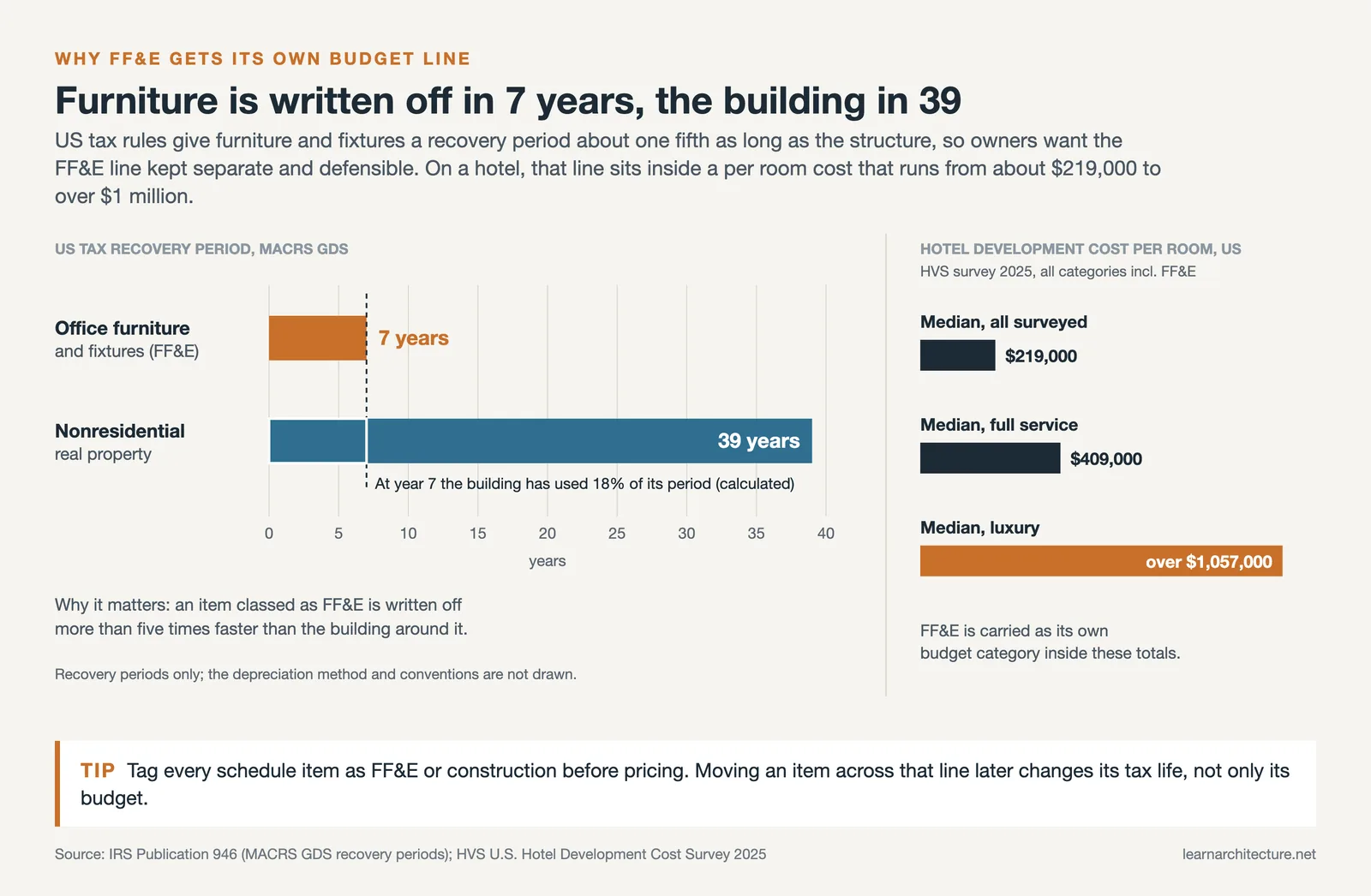
- The HVS U.S. Hotel Development Cost Survey 2025 reports a median development cost of $219,000 per room across all surveyed properties, rising above $1,057,000 per room for luxury hotels, with FF&E carried as its own budget category
- MasterFormat 2026, published by the Construction Specifications Institute, adds 2,185 new listings and reorganises 617 existing ones
- IRS Publication 946 assigns office furniture and fixtures a 7-year recovery period under MACRS GDS, against 39 years for nonresidential structural components
Why FF&E Gets Its Own Budget Line
The last item in that box explains more about FF&E than any design argument does. Under United States tax rules, furniture and fixtures that are not structural components of the building depreciate over seven years, while the building itself runs to 39 years for nonresidential property. An owner therefore has a direct financial reason to want an item classified as FF&E rather than as construction, and the classification has to be defensible.
Contract structure follows the same logic. Owner-supplied FF&E changes who holds title during shipping, who insures the goods in the warehouse, and in many jurisdictions how sales tax is applied. It also changes who chases the vendor when a shipment arrives damaged. None of that is a designer’s decision, but the FF&E schedule is the document everyone will point at, so it needs to be right. If you are setting up a service agreement around this scope, the same care applies to how the work is priced, a point covered in more detail in the breakdown of architect fee structures.
Design intent still leads. The FF&E package is where the character of a space is decided, and the argument for a specific chair is an argument about proportion, comfort and material, questions explored further in this guide to choosing furniture for an interior and in the discussion of whether architects should design furniture themselves. The paperwork exists so that the chair actually arrives.
Cost figures are approximate and vary by region, supplier and project scope. Tax and contract treatment of FF&E differs by jurisdiction and should be confirmed with a qualified professional for your specific project.
Frequently Asked Questions
What does FF&E stand for in interior design?
FF&E stands for furniture, fixtures and equipment. In practice the FF&E meaning covers everything a space needs to function that is not permanently attached to the building, from seating and case goods to portable lighting, artwork and appliances. It is documented and purchased separately from the construction contract.
Is built-in joinery part of FF&E?
Usually not. Built-in wardrobes, fitted counters and fixed millwork are fabricated and installed as part of the interior fit out, so they belong to the construction contract. The same piece designed as a freestanding unit that is delivered and positioned would be FF&E instead. The distinction is attachment and who installs it, not appearance.
What is the difference between FF&E and OS&E?
FF&E covers durable items that stay in place for years, such as beds, desks and lounge chairs. OS&E covers operating supplies and equipment consumed and replaced during normal operation, including linens, crockery, glassware and back of house smallwares. Hospitality budgets separate the two because they are replaced on completely different cycles.
Who prepares the FF&E schedule?
The interior designer normally prepares and maintains it, since it is the direct output of the selection process. On larger projects a purchasing agent takes it over at bid stage, adds commercial columns such as vendor, purchase order number and freight, and manages expediting from there. The designer still approves substitutions and control samples.
Is lighting included in FF&E?
Portable lighting is: table lamps, floor lamps and plug-in task lights are specified and bought as FF&E. Recessed downlights, track systems, cove lighting and any fitting wired into the building are part of the electrical scope in the construction contract. Decorative pendants sit in between and should be assigned explicitly in the responsibility matrix.









Leave a comment