


Table of Contents Show
NCARB vs RIBA is not a like for like comparison. NCARB runs the experience and examination programs behind licensure in the United States, while RIBA is a British membership body. The statutory regulator in the UK is ARB. The real decision is between two national systems, not between two organisations.
That distinction matters because it changes what you actually have to complete. Anyone researching how to become a licensed architect on both sides of the Atlantic runs into the same three questions: who issues the licence, what you must finish before you can call yourself an architect, and whether the qualification travels. This breakdown answers all three, using current figures from the regulators themselves.
What Is the Real Difference Between NCARB and RIBA?

NCARB is a council made up of the architectural licensing boards of the 50 states plus the District of Columbia, Guam, the Northern Mariana Islands, Puerto Rico and the US Virgin Islands. It does not issue licences. It develops the programs that jurisdictions rely on: the Architectural Experience Program, the Architect Registration Examination, and the NCARB Certificate that supports reciprocity. Your licence comes from a state board, which sets its own additional conditions.
RIBA sits in a different position entirely. It is a professional membership body that validates architecture programmes and awards Chartered Membership. RIBA validates over 230 architectural programmes at more than 120 schools worldwide, which is why the terms Part 1, Part 2 and Part 3 travel so widely. But a RIBA validated degree does not, on its own, let you practise under the protected title.
Who Actually Grants the Title Architect?
In the UK, the title is protected by law and controlled by the Architects Registration Board. As RIBA itself sets out in its guidance on changes to studying architecture, applicants for registration currently need ARB recognised qualifications at Parts 1, 2 and 3 plus 24 months of approved experience. Chartered Membership of RIBA is a separate, optional layer on top of that registration.
So the accurate pairing is ARB against a US state board, with NCARB and RIBA both playing supporting roles in their own systems. Once you see it that way, the rest of the comparison becomes far easier to reason about. If you want the full timeline before the mechanics, our breakdown of how long it takes to become an architect covers the stages in order.
The US Route: Degree, AXP Hours, and the ARE
The American route has three components that run in sequence for some candidates and in parallel for many others. First comes a professional degree accredited by the National Architectural Accrediting Board, usually a five year B.Arch or an M.Arch. Second is the Architectural Experience Program, which requires 3,740 documented hours across six experience areas, with at least 1,860 of those earned inside an architecture firm under a licensed architect. Third is the ARE 5.0, six separate divisions taken at a testing centre or online with a proctor.
Two recent policy shifts are worth knowing before you start. NCARB retired the five year expiry on passed exam divisions, and it replaced the old reporting deadline: experience reported within a year earns full credit, older experience now earns 75 percent credit with no cut off date. It also aligned the ARE with its Competency Standard for Architects, effective 27 April 2026, without changing the division structure or testing time.
Jurisdiction rules add a final layer that catches people out. Some boards ask for a set number of years of employment on top of the AXP hours, some let you sit the ARE before the degree is finished, and a few still add a state specific supplemental exam. NCARB’s licensing requirements tool lists the conditions for all 55 jurisdictions, and reading it in year one is cheaper than discovering a duration requirement in your final year.
The system is also loosening at the entry point. According to the 2026 edition of NCARB by the Numbers, 13 percent of new architects in 2025 qualified by earning additional experience instead of an NAAB accredited degree, up two percentage points on 2024. The median time to licensure fell to 12.3 years, the lowest in nearly a decade, and average time to finish the exam dropped to two years.
💡 Pro Tip
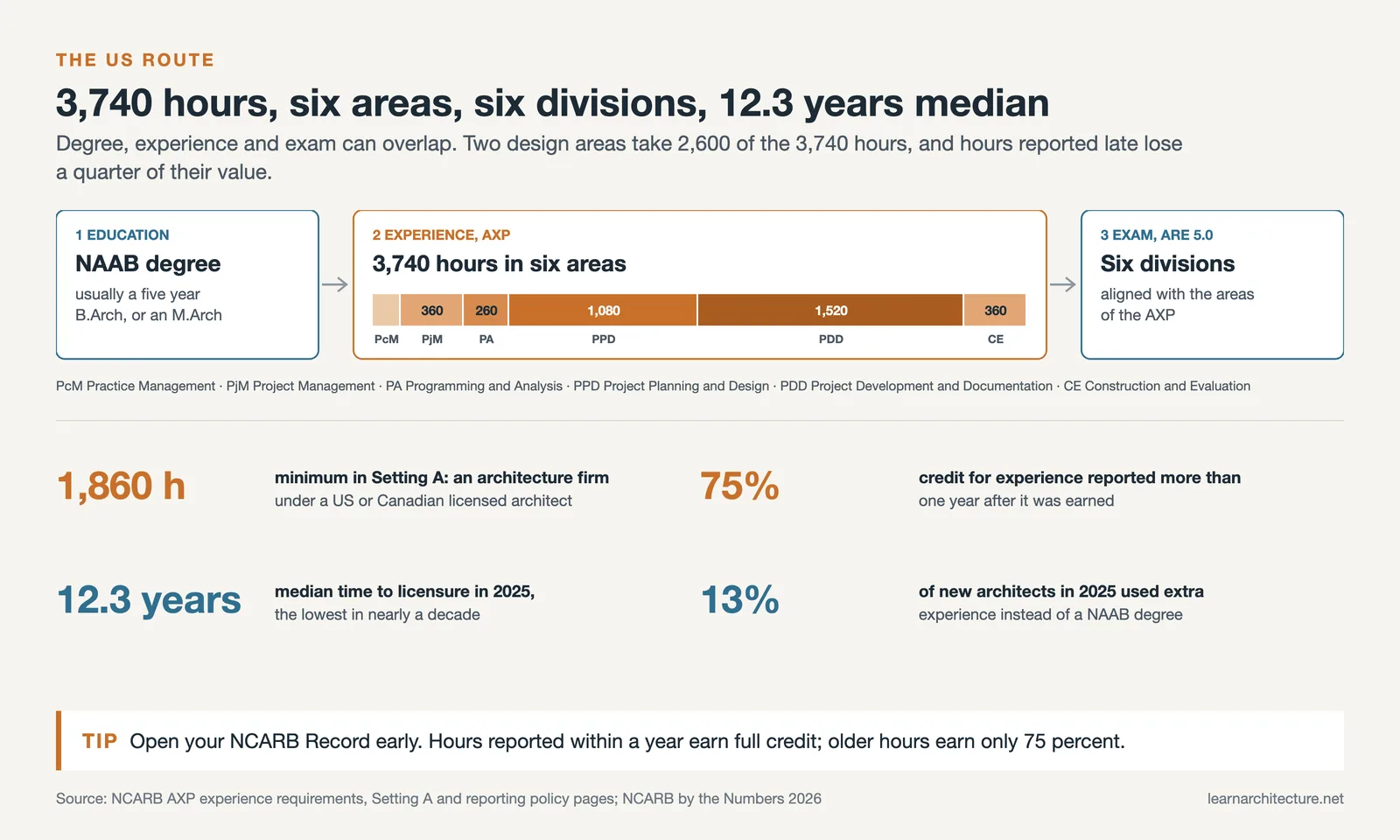
Open your record before you think you need it. Under NCARB’s current reporting policy, hours submitted more than a year after they were earned are worth 75 percent credit instead of full credit. Candidates who wait until after graduation to start an NCARB Record quietly discount a year of genuine office work, which is one of the cheapest mistakes to avoid on the whole path.
The UK Route: Parts 1, 2, 3 and ARB Registration

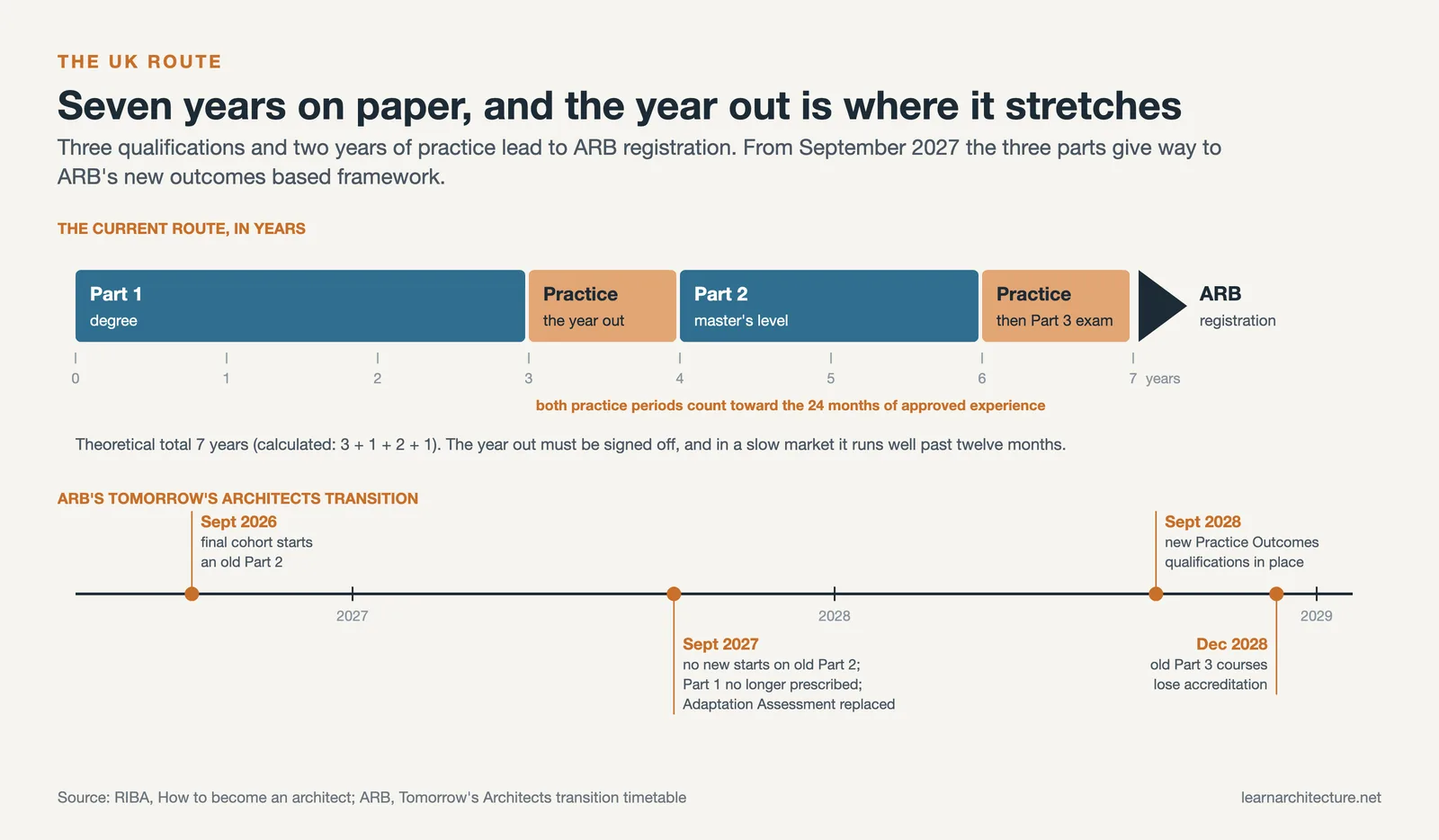
The British route is shorter on paper and tighter on employment. A three year Part 1 degree is followed by a year in practice, then a two year Part 2 at master’s level, then further practice, then the Part 3 professional practice examination. Across the whole route you need 24 months of approved practical experience, and Part 3 requires you to be working in an office while you sit it.
The year out between Part 1 and Part 2 is not a formality. It counts toward the 24 months, it has to be signed off, and in a slow hiring market it can stretch well past twelve months. That gap is the single biggest reason British timelines drift beyond the theoretical seven years.
Registration with ARB is what gives you the legal right to use the title. Since 2024, every registered architect has had to take part in ARB’s continuing professional development scheme as a condition of renewal, a change introduced in the wake of the Building Safety Act 2022. That declaration is made annually alongside the retention fee.
The bigger story is the transition already underway. Under ARB’s Tomorrow’s Architects reforms, the three part structure gives way to two accredited qualifications: one meeting Academic Outcomes at master’s level or equivalent, and one meeting Practice Outcomes. No new students can begin an old Part 2 after September 2027, Part 1 is no longer prescribed by ARB from September 2027, and old Part 3 courses lose accreditation at the end of 2028. RIBA has said it will keep validating at Parts 1, 2 and 3 regardless, so the two labelling systems will run side by side for years.
⚖️ Pros & Cons at a Glance
✔️ Pros: qualifying in the UK first is faster on paper, exam costs are low, master’s level entry widens from 2027 for people arriving from other disciplines, and the qualification carries recognition across many Commonwealth markets.
✖️ Cons: every stage after Part 1 depends on finding an employer, gaps between stages stretch the real timeline well past the theoretical one, and the framework is mid transition until 2028, which leaves open questions about how the new qualifications will be assessed by regulators abroad.
NCARB vs RIBA: A Side by Side Comparison
The table below sets the two systems against each other on the points that actually decide the question.
Comparison of the US and UK Routes to Registration
| Feature | United States | United Kingdom |
|---|---|---|
| Who grants the licence | A state or territory board, one of 55 jurisdictions | ARB, a single national register |
| Role of NCARB or RIBA | NCARB builds the AXP, the ARE and the Certificate | RIBA validates courses and awards Chartered Membership |
| Required education | NAAB accredited B.Arch or M.Arch, with alternative paths growing | Parts 1, 2 and 3, moving to two accredited qualifications |
| Structured experience | AXP, 3,740 hours across six experience areas | 24 months of approved practical experience |
| Final assessment | ARE 5.0, six divisions | Part 3 professional practice examination |
| Typical time from start of study | 12.3 years median in 2025 | Roughly 7 years of study and practice, longer with gaps |
| Ongoing obligation | Continuing education set by each jurisdiction | ARB CPD scheme, mandatory since 2024 |
| Optional professional status | AIA membership | RIBA Chartered Membership |
How Much Does Each Path Cost?

Exams and registration are the smaller half of the bill in both systems, and they are the half you can plan precisely. Tuition is the variable that dominates, which is why the full cost of becoming an architect is worth mapping before you commit to either route. Where you study also changes the arithmetic sharply, as our look at the leading architecture schools shows.
🔢 Quick Numbers
- All six ARE divisions cost $1,578 as of September 2026 (NCARB fee schedule)
- An active NCARB Record costs $105 a year for licensure candidates as of September 2026 (NCARB fee schedule)
- ARB set the annual retention fee for 2026 at £225, a 10 percent rise on 2025 (ARB, October 2025 board decision)
- 38,726 architects renewed their ARB registration for 2026, broadly level with the previous year (ARB figures reported by the Architects’ Journal, January 2026)
The pattern is clear enough. American candidates pay more in examination fees and carry a longer, costlier education. British candidates pay a heavier annual fee to stay registered once qualified, and that fee has climbed steeply, from £119 in 2021 to £225 today.
Moving Between the Two Systems Later
This is where the two bodies finally meet. NCARB and ARB operate a mutual recognition agreement that lets qualified architects cross in either direction without repeating the whole path.
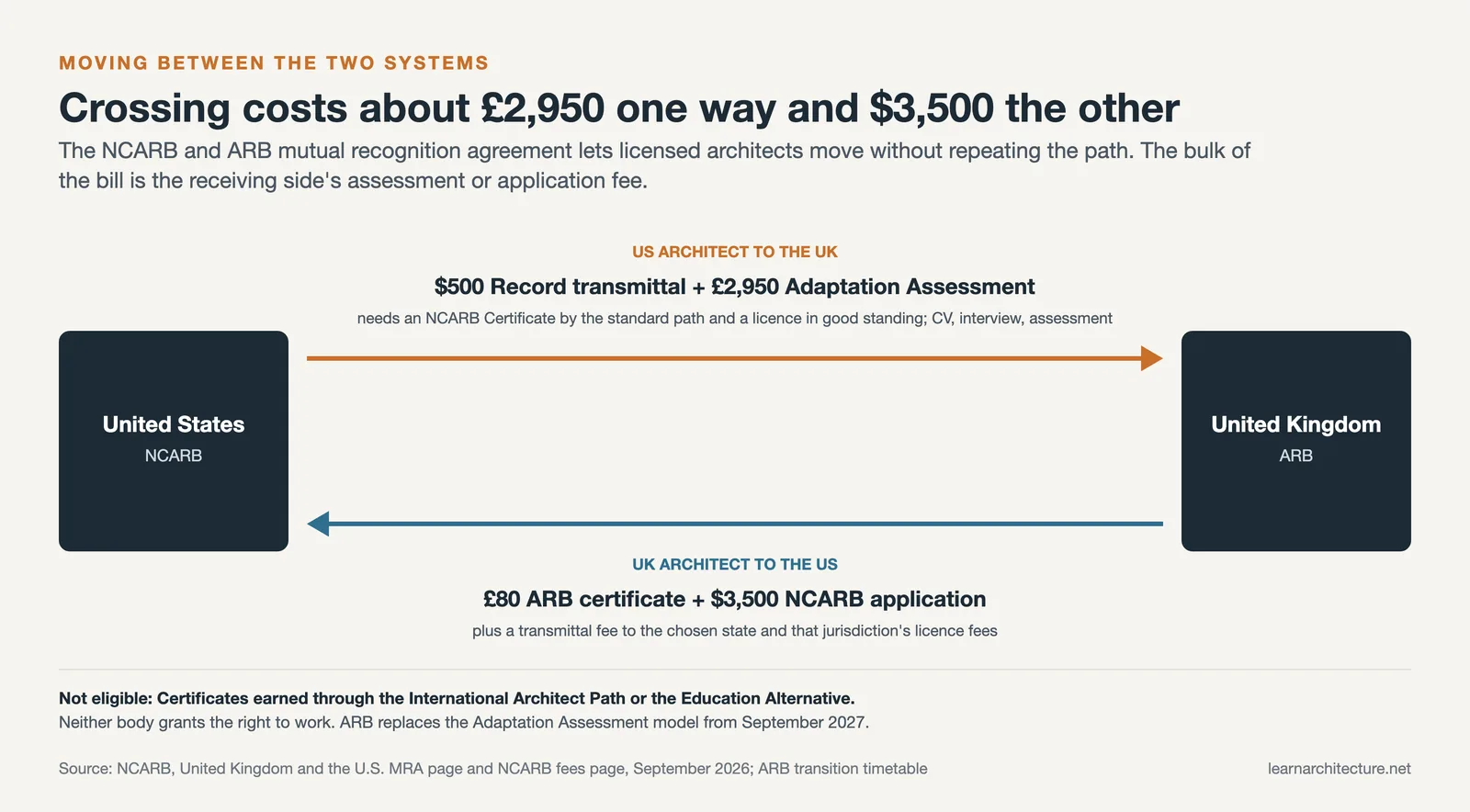
For a US architect, the requirements are an active NCARB Certificate earned through the standard path, a licence in good standing, a $500 Record transmittal fee (as of September 2026), and the UK Adaptation Assessment fee of £2,950 paid to ARB. The process includes a CV, a short interview and an assessment. Certificates granted through the International Architect Path or the Education Alternative do not qualify.
Going the other way, a UK architect needs an ARB certificate costing £80, an NCARB Record with a $3,500 application fee, and the transmittal fee to the chosen state, which must be one of the participating jurisdictions. Neither body can grant you the right to work, so immigration is a separate problem in both directions. One detail with a deadline attached: ARB’s transition timetable says the current Adaptation Assessment model will be replaced from September 2027 as part of the wider reforms.
Matching the Route to Your Plans

Start from where you intend to practise for the next decade, not from which credential sounds stronger. The two systems are built around different assumptions, and the correct answer is almost always determined by geography and employment, not prestige.
If you already hold a degree in another field, the UK is becoming the more open door, since ARB will no longer require an accredited undergraduate architecture degree and providers can admit students at master’s level from other backgrounds. If your work is likely to be in the United States, the NAAB and AXP route remains the cleanest path, and the growing use of experience in place of an accredited degree gives late starters a second option. If you expect to move between markets, qualify fully in one system first, then use the recognition agreement rather than attempting both from scratch.
Money and timing sit underneath all of it. Both routes ask for roughly a decade before the title arrives, and both reward candidates who overlap experience with study rather than treating the stages as a queue. Weighing that commitment honestly is the same exercise covered in our discussion of whether architecture is a good career, and the payoff varies enormously by market, as the spread in architect salaries by city and country makes plain. Candidates already committed to the American route will find the exam mechanics in our guide to getting licensed and preparing for the ARE.
Fees and registration requirements change regularly and vary by jurisdiction. Confirm current figures and eligibility rules directly with NCARB, ARB or the relevant state board before making decisions based on them.
Looking Ahead
The two systems are converging on the same question from opposite directions. NCARB is loosening the degree requirement and letting demonstrated competency carry more weight, while ARB is dismantling a fifty year old three part structure for the same reason. Both regulators have concluded that what a newly registered architect can do matters more than which sequence of courses produced them. If that holds, the NCARB vs RIBA question will look less like a fork in the road in ten years and more like two accents of the same language.













Leave a comment