


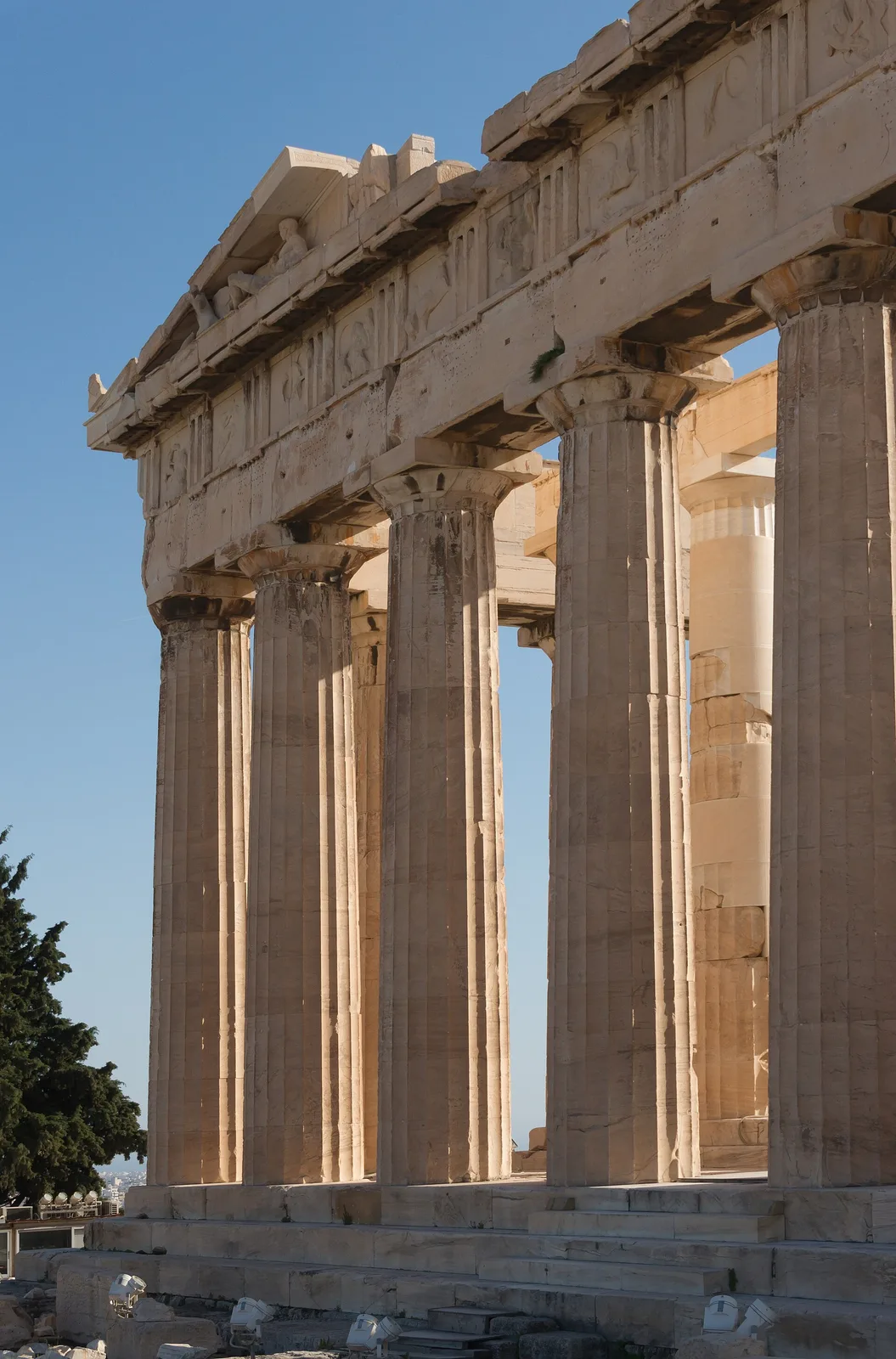
A long standing story about the Parthenon, repeated in architecture courses for generations, may not hold up under scrutiny. Prof Alain Goriely of the University of Oxford has published a study challenging the Parthenon optical illusion theory, concluding that the temple’s curved surfaces were not built to fix optical illusions, as textbooks and even modern AI chatbots often claim.
The building itself, and its curves, are not in dispute. What Goriely questions is the reason behind them.
What the Parthenon optical illusion theory actually claims
The traditional account, taught to generations of architecture students, holds that the Parthenon’s designers bent straight lines slightly out of true in order to trick the eye into seeing them as perfectly straight. Three features are usually cited.
- Stylobate curvature: the base platform of the temple is not flat. Measurements show it forms a shallow arc, rising by 6cm at the centre compared with the corners.
- Entasis: a slight outward swelling partway up each column shaft, rather than a straight taper. At the Parthenon this bulge measures 18mm.
- Column inclination: the columns lean very slightly inward rather than standing perfectly vertical.
According to the classical explanation, without these adjustments the base would appear to sag in the middle and the columns would look pinched or too thin partway up, so the curves were supposedly added to correct the eye’s mistakes.
Goriely traces this explanation back to Vitruvius, the Roman architect and engineer who wrote about the Parthenon roughly four centuries after it was built. His writings were later absorbed into architectural manuals and passed down as settled fact. “I do think it might be the oldest myth that we have,” Goriely said, “apart from religion.”
Where the mathematics breaks down
Goriely’s paper does not question that the curves exist. It questions whether the illusions they are supposed to correct are real in the first place.

On the claim that long horizontal lines appear to sag in the middle, he says he found no supporting evidence. A second explanation, that the Hering illusion causes the base to look bowed because of intersecting vertical lines from the columns, also fails mathematical scrutiny in his view. That illusion is strongest when intersecting lines meet at acute angles, but the Parthenon’s columns are far too close to vertical to produce the effect, and there is no proof the illusion even functions in three dimensions rather than on a flat page.
The entasis explanation fares no better under Goriely’s analysis. He again found no evidence that straight column shafts actually look concave or pinched to viewers. And practically speaking, an 18mm swelling on a column of that scale is close to invisible at the distances from which people actually view the temple.
Goriely, who works through and rejects several other proposed “corrections” in his paper, admits the project pulled him in deeper than expected, saying he “fell into a bit of a rabbit hole” while assembling the evidence. He offers alternative, more practical explanations for the real curves: the arched base may simply have helped rainwater run off rather than pool, while curved columns might have appealed to the ancient Greek eye for reasons that had nothing to do with correcting illusions at all.
Why the story took hold
Goriely suggests the myth has lasted so long partly because of how ancient Greek civilisation is remembered, as a culture credited with almost superhuman ingenuity, which made an elaborate optical explanation easy to believe and repeat.

Frank Salmon, who studies the history of classical architecture at Cambridge, noted that doubts about Vitruvius are not new among specialists. “Some experts have long been cautious of Vitruvius’s explanations, recognising the risks inherent in using his text as a sort of bible to explain architectural practices in Greece centuries before his time, but also the loss of the many Greek texts about their temple architecture he claimed to have read when preparing his own,” Salmon said.
Rather than simply asserting his conclusion, Goriely closes his paper, published in Royal Society Open Science, with an unusual invitation to readers. He urges them to go outside and look for themselves: “Trust your own eyes, question what you see and decide for yourself whether the theory of optical corrections holds up.”











Leave a comment