


Table of Contents Show
The main types of architects include residential, commercial, landscape, urban, interior, sustainable, restoration, and industrial architects. Each specialization focuses on a distinct building type or design problem, from private homes to public parks and entire city districts, and each requires its own blend of technical knowledge, code expertise, and design skill.
Architecture is far from a single job. While every licensed architect shares a common foundation in design, structure, and building codes, the profession branches into many directions once practitioners gain experience. Understanding the different types of architects helps students choose a focus, clients hire the right professional, and early-career designers map a realistic path. This guide breaks down each major specialization, explains what these architects actually do day to day, and shows how to decide which direction fits your goals.
🔢 Quick Numbers
- Median annual wage for architects was $99,280 in May 2025 (U.S. Bureau of Labor Statistics)
- Median annual wage for landscape architects was $79,870 in May 2025 (BLS)
- Architect employment is projected to grow 4 percent from 2025 to 2035, with about 6,900 openings each year (BLS)
What does an architect specialization mean?
An architect specialization is a focused area of practice that an architect develops after earning a license. Specialization usually grows out of the projects a firm takes on, the experience an individual accumulates, and personal interest in a particular building type or design challenge. A licensed architect can legally work across many sectors, but most concentrate where their portfolio and expertise are strongest.
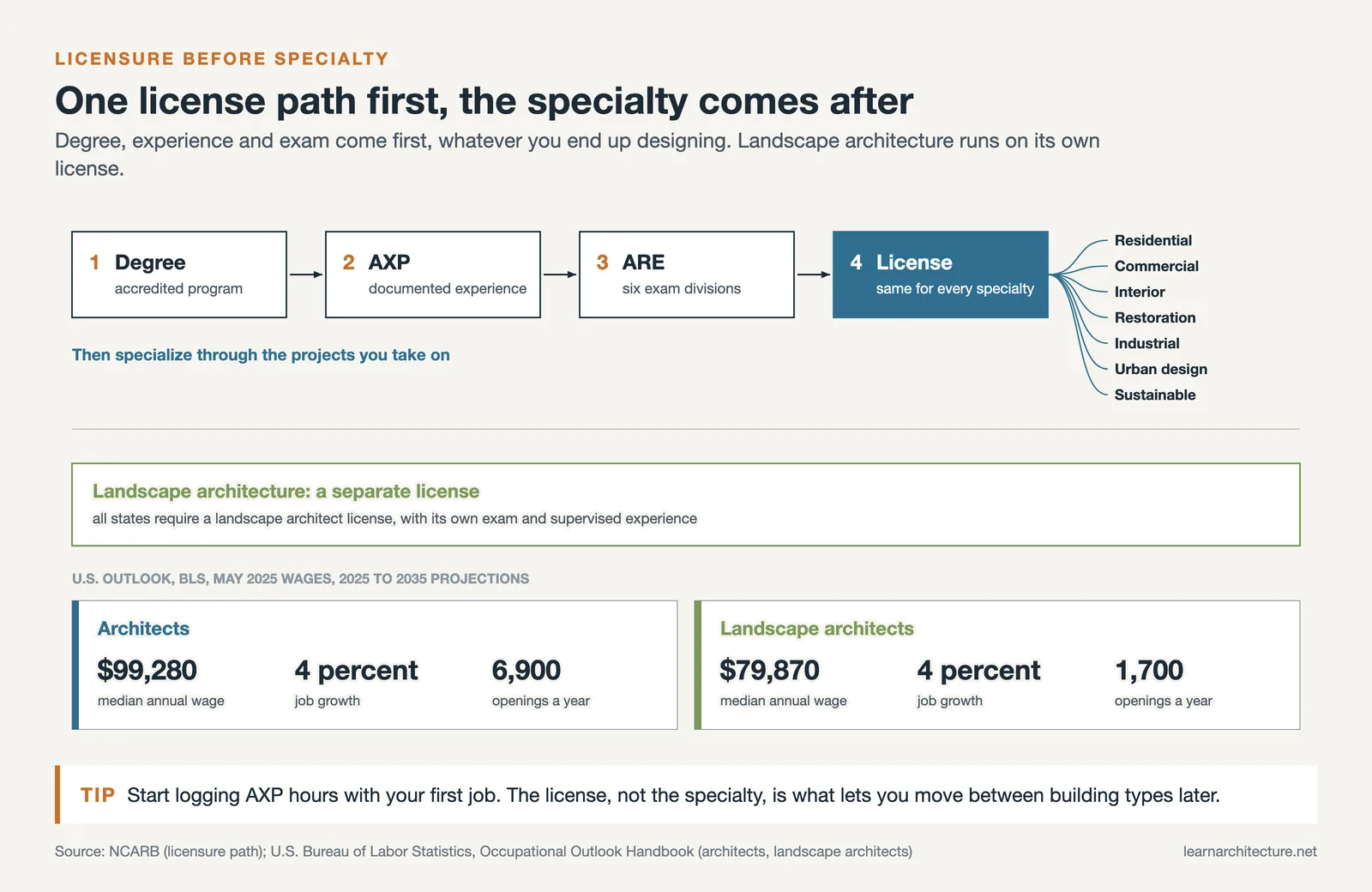
In the United States, the path to licensure is the same regardless of future specialty. Candidates complete an accredited degree, document experience through the Architectural Experience Program (AXP), and pass the six divisions of the Architect Registration Examination (ARE), according to the National Council of Architectural Registration Boards (NCARB). Specialization comes afterward, shaped by the work an architect chooses to pursue.
🎓 Expert Insight
“Architecture is a service profession that touches every part of how people live, work, and gather.” The American Institute of Architects frames the field as broad by design, which is exactly why so many distinct kinds of architects exist within it.
This breadth is the reason a single degree can lead to careers as different as designing a family home or master-planning a waterfront district.

What are the main types of architects?
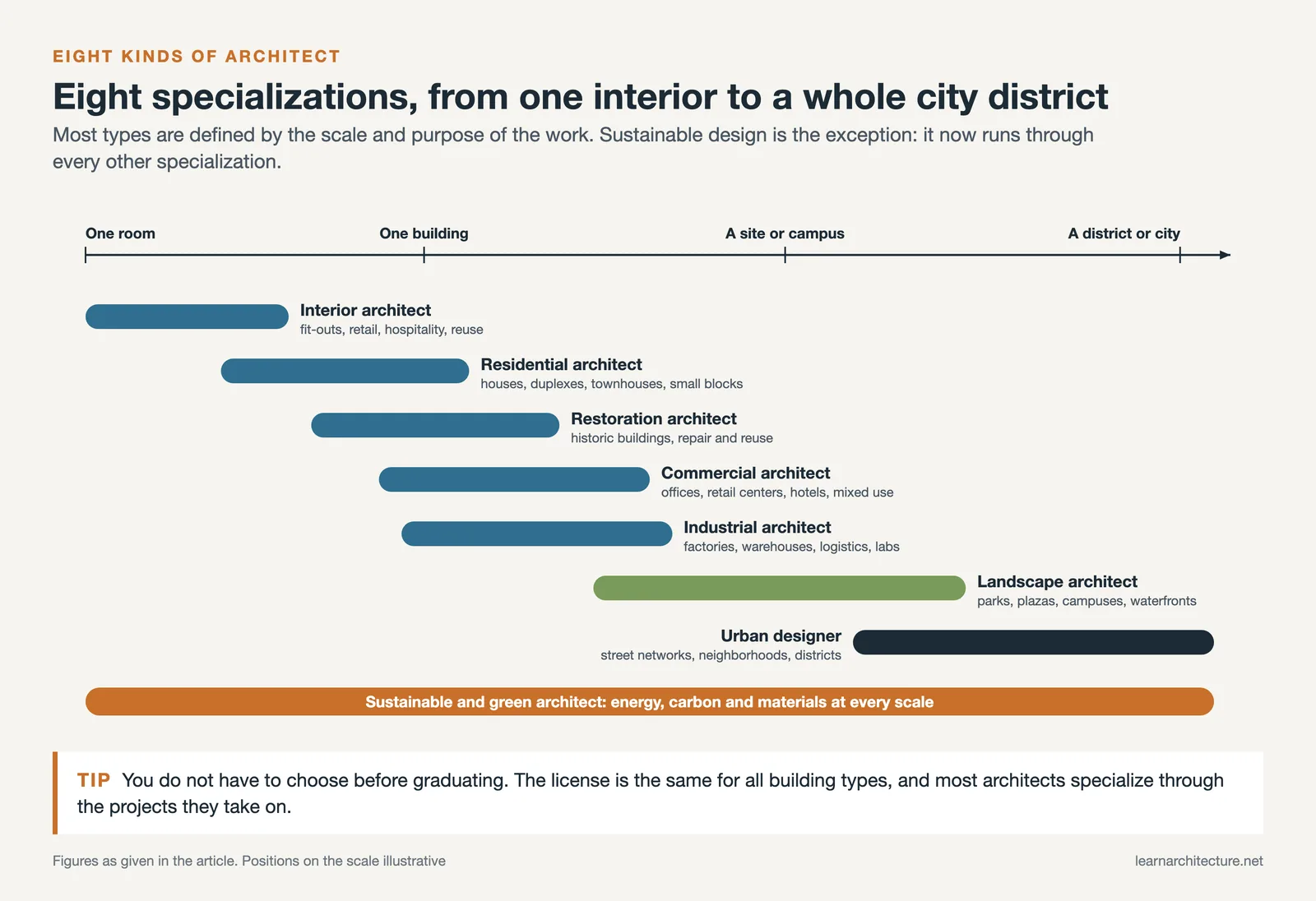
The most common architect specializations fall into eight broad categories based on the scale and purpose of the work: residential, commercial, landscape, urban, interior, sustainable, restoration, and industrial. Below is what each type of architect does and the kind of projects they typically handle.
Residential architect
A residential architect designs private living spaces, including single-family homes, custom houses, duplexes, townhouses, and small apartment buildings. Their work balances a client’s lifestyle, budget, and site conditions with structural requirements and local zoning rules. Because projects are personal and detail-driven, residential architects often work closely with individual homeowners from the first sketch to the final inspection.
This specialization rewards strong communication and a feel for how people use everyday space. Many residential architects build long-term reputations within a region, earning new work through referrals and completed projects.
Commercial architect
Commercial architects design buildings used for business and public activity, such as offices, retail centers, hotels, restaurants, and mixed-use developments. Their projects tend to be larger and more regulated than homes, with greater emphasis on accessibility, fire safety, occupancy loads, and brand identity. Coordinating with engineers, contractors, and city officials is a daily part of the role.
⚠️ Common Mistake to Avoid
Students often assume they must pick a specialization before graduation. In practice, you become a licensed architect first, then specialize through the projects you take on. Committing too early can close doors before you have enough experience to know what you genuinely enjoy.
Landscape architect
Landscape architects design outdoor environments such as parks, gardens, plazas, campuses, and waterfronts. They combine knowledge of horticulture, drainage, ecology, and grading with spatial design to create functional and sustainable outdoor spaces. In many regions landscape architecture is a separately licensed profession with its own exams and credentials, distinct from building architecture.
According to the U.S. Bureau of Labor Statistics, landscape architects earned a median annual wage of $79,870 in May 2025, with employment projected to grow 4 percent through 2035. Demand is tied to environmental planning, stormwater management, and the growing value placed on public green space.
Urban designer and planning architect
Urban designers, sometimes called planning architects, work at the scale of neighborhoods, districts, and cities rather than individual buildings. They shape street networks, public spaces, zoning patterns, density, and the relationship between buildings and infrastructure. Their work sits at the intersection of architecture, transportation, and public policy.
🏗️ Real-World Example
Barcelona Superblocks (Barcelona, ongoing since 2016): Urban designers reorganized groups of city blocks to limit through-traffic and reclaim street space for pedestrians and greenery. The project shows how planning-scale architecture can reshape daily life across an entire district rather than a single site.
Interior architect
Interior architects focus on the design and reconfiguration of interior space, including layout, circulation, materials, lighting, and built-in elements. Unlike interior decorators, interior architects often deal with structural and code-related changes such as moving walls, adjusting egress, or meeting accessibility standards. The role is common in office fit-outs, retail, hospitality, and adaptive reuse projects.
Sustainable and green architect
Sustainable architects, sometimes called green or environmental architects, design buildings that minimize energy use, carbon impact, and resource consumption. They specify high-performance envelopes, renewable systems, and healthy materials, and often pursue certifications such as LEED. As climate concerns grow, sustainable design is increasingly woven into every specialization rather than treated as a standalone niche.
📌 Did You Know?
The building and construction sector accounts for a large share of global energy-related carbon emissions, which is why sustainable design has shifted from an optional specialty to a core expectation across the profession. Many firms now treat energy modeling as a standard part of early design.
Restoration and preservation architect
Restoration architects, also known as conservation or preservation architects, specialize in repairing, restoring, and adapting historic buildings. Their work demands knowledge of traditional construction methods, historic materials, and the regulations that protect heritage structures. Projects range from stabilizing a landmark to sensitively converting an old building for modern use.
Industrial architect
Industrial architects design facilities built for production, storage, and logistics, such as factories, warehouses, distribution centers, and laboratories. These projects prioritize workflow efficiency, structural spans, equipment loads, and safety over aesthetic expression. Close coordination with mechanical and process engineers is essential because the building exists to support an operation.
Beyond these eight core categories, many architects build careers in focused niches such as healthcare, education, sports, transportation, or computational and parametric design. These specializations often draw on the same skills as the broader types above but add deep knowledge of one sector’s regulations, equipment, and user needs. A healthcare architect, for example, must understand infection control and clinical workflows that a general commercial architect would not encounter.
⚖️ Pros & Cons at a Glance
✔️ Specializing early: deeper expertise, stronger portfolio in one sector, clearer marketing to clients
✖️ Specializing early: fewer pivots later, exposure to one market’s downturns, narrower experience base

How do you choose an architecture specialization?
Choosing an architecture specialization comes down to matching your interests and strengths with the kind of projects you want to work on every day. Start broad during education and early practice, then let real experience reveal where your skills and enthusiasm align. There is no single correct path, and many architects shift focus over a career.
Consider three practical questions. First, what scale energizes you, from intimate interiors to citywide planning? Second, do you prefer creative, client-facing work or technical, systems-driven problems? Third, where is demand strong in your region? Weighing these factors against your own temperament leads to a sustainable choice rather than a guess.
💡 Pro Tip
Experienced architects recommend trying at least two project types during your early years before committing. Working on both a residential renovation and a commercial fit-out, for example, teaches you quickly which pace, client relationship, and level of detail suit you best.
If you are still weighing the profession itself, it helps to understand the wider career landscape first. Our guides on what jobs an architect can do and the honest pros and cons in should I be an architect give useful context for choosing a direction. For the financial side of different paths, see our breakdown of whether architects make good money.

How are these architecture roles connected?
While the specializations are distinct, they overlap constantly on real projects. A large mixed-use development might involve a commercial architect leading the building, a landscape architect shaping the surrounding plaza, an interior architect handling tenant spaces, and a sustainable consultant guiding energy performance. Urban designers may have set the framework that made the project possible in the first place.
This collaboration is why a strong general foundation matters. Stage-based frameworks such as the RIBA Plan of Work are built around exactly this: specialists joining and leaving as a project moves through its phases. Knowing how each type of architect contributes makes you a more effective collaborator, whatever your own focus becomes.
Frequently Asked Questions
How many types of architects are there?
There is no fixed number, but the profession is commonly grouped into about eight major specializations: residential, commercial, landscape, urban, interior, sustainable, restoration, and industrial. Many architects also work in hybrid roles or niche areas such as healthcare, education, or computational design, so the categories often blur in practice.
Do different types of architects need different licenses?
In the United States, building architects share one licensure path through NCARB, regardless of specialization. Landscape architecture is usually a separate licensed profession with its own exams. Interior design and urban planning may also carry their own credentials depending on the jurisdiction and the work involved.
Which type of architect earns the most?
Earnings vary by sector, region, and seniority rather than by title alone. Commercial and large-scale project work often pays more than small residential practice, and senior or principal roles command the highest pay. According to BLS data, the median wage for architects overall was $99,280 in May 2025.
Can an architect change specializations?
Yes. Because licensure is general, architects can and often do shift focus over their careers. Moving from residential to commercial work, or from design into urban planning, is common as interests evolve and as the market changes. Building a varied early portfolio makes such transitions easier.
Bringing it together
The many types of architects reflect how wide the profession really is, from a single custom home to the planning of an entire district. Each specialization rewards a different mix of creativity, technical skill, and collaboration, and none is inherently better than another. The smartest approach for most students and early-career designers is to build a solid general foundation, stay curious across project types, and let genuine experience guide where you specialize. Whichever direction you choose, understanding how every role fits together will make you a more capable and adaptable architect.











Leave a comment