


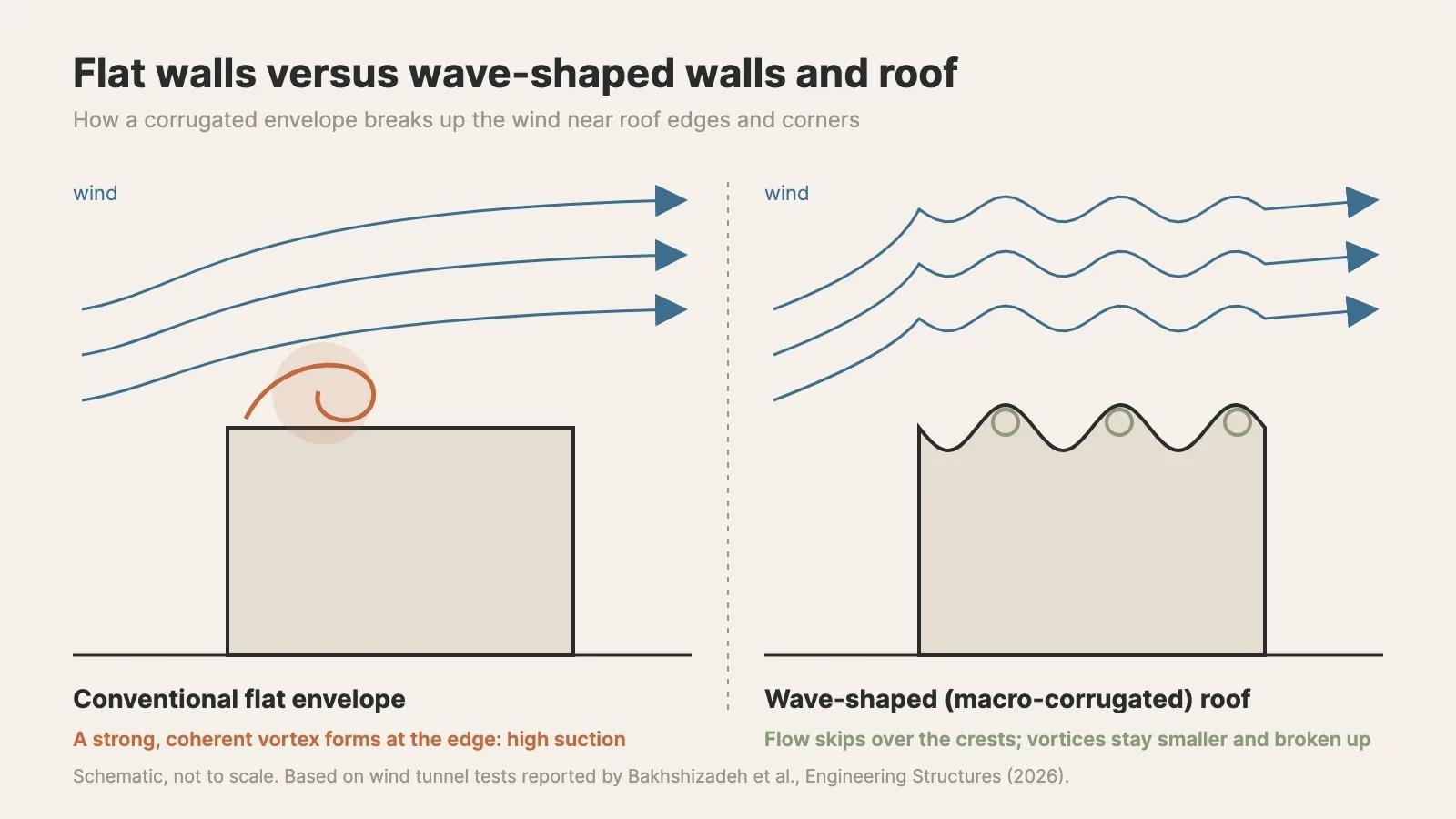
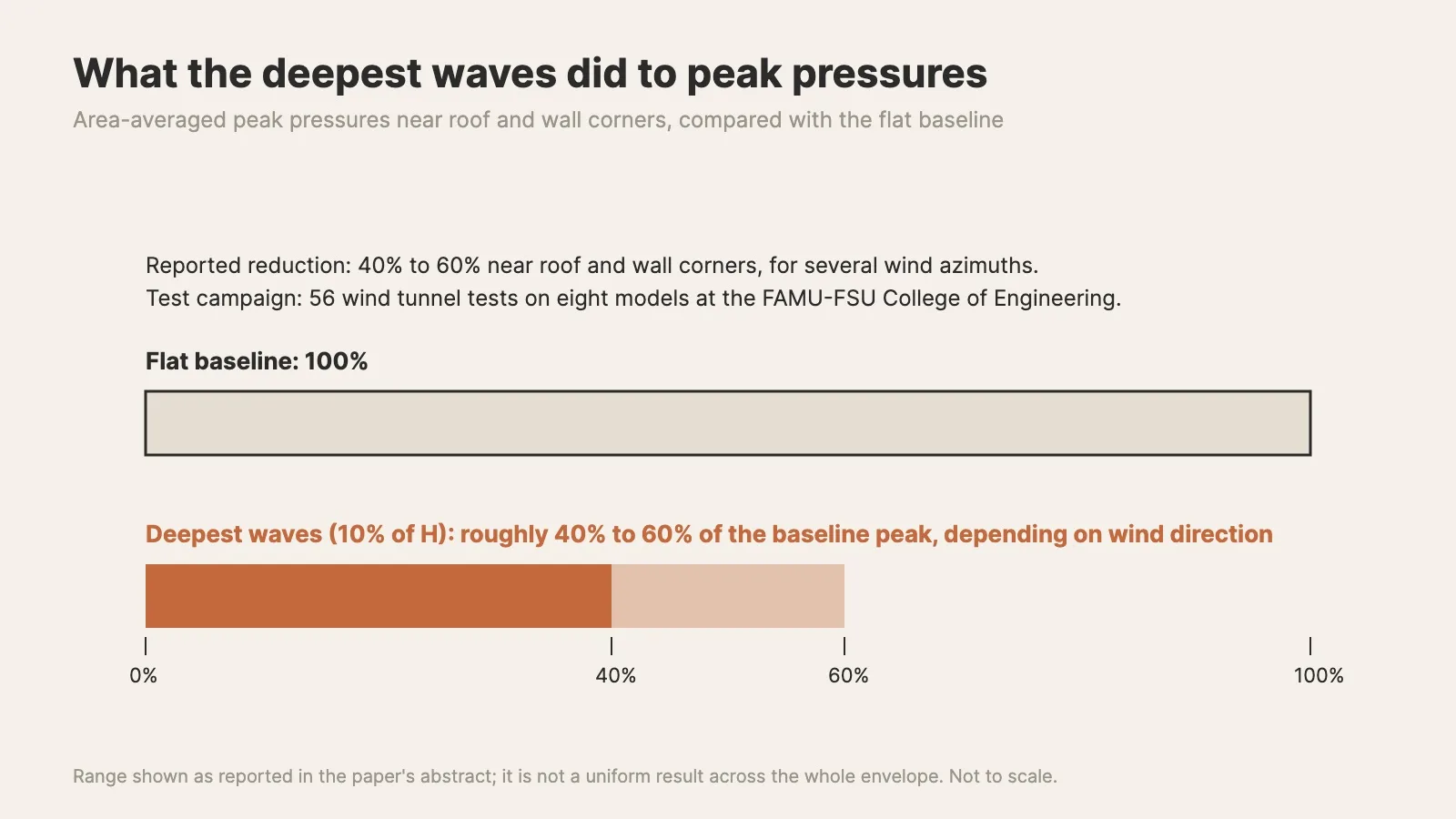
A wave-shaped roof and walls can sharply lower the peak wind pressures that low-rise buildings face at their corners, according to wind tunnel research at Florida State University’s FAMU-FSU College of Engineering. The study, published in Engineering Structures, found reductions of 40 to 60 percent in area-averaged peak pressures near roof and wall corners for several wind directions, compared with the same model built with flat surfaces.
The authors, doctoral student Arezoo Bakhshizadeh, alumnus Peter Tsouroukdissian, associate professor Qian Zhang and assistant professor Pedro Fernández-Cabán, call the shapes macro-corrugations: large, regular waves whose depth is comparable to the size of the building rather than a fine surface ribbing.
How the wave-shaped roof was tested
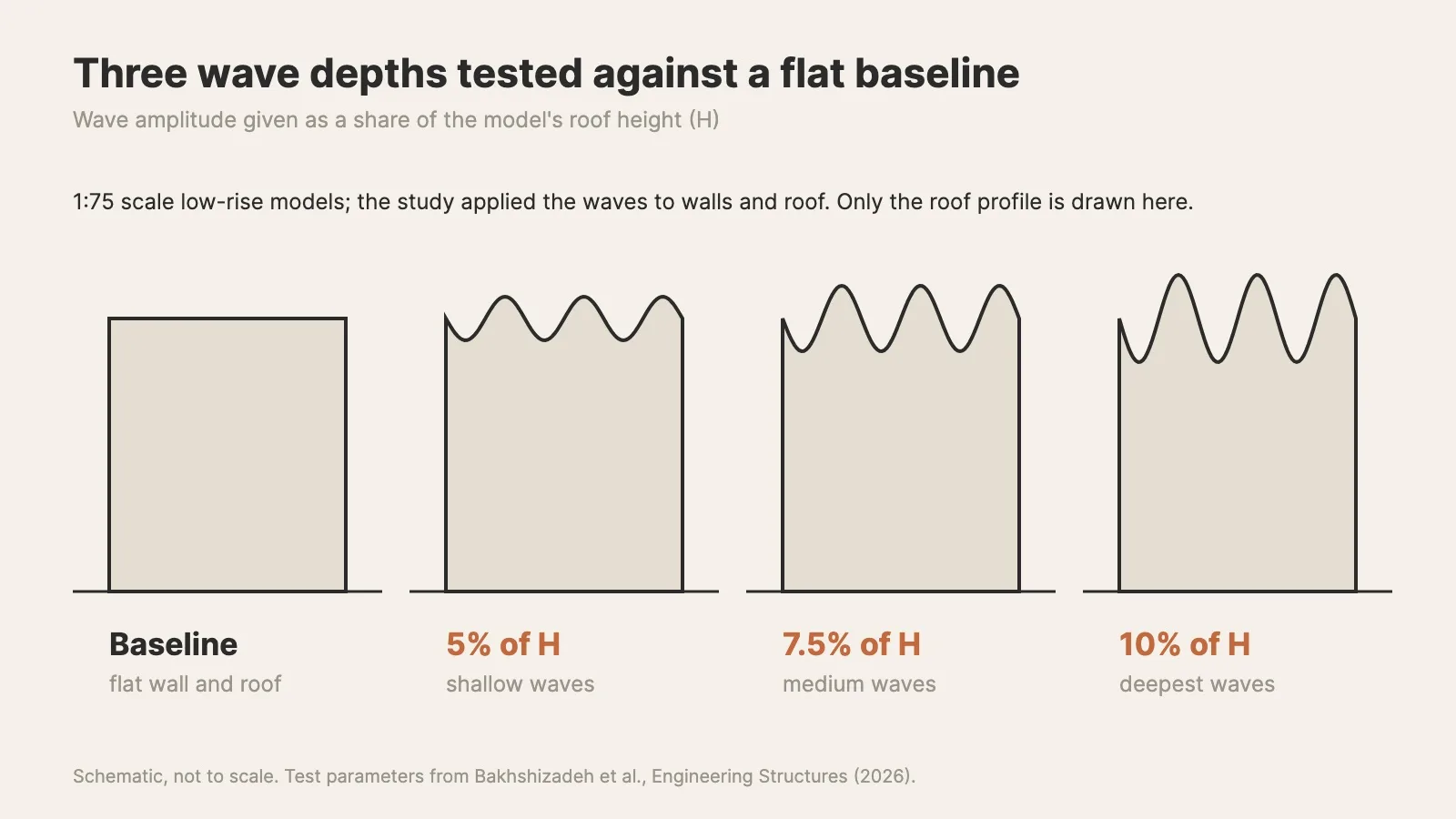
The team 3D printed eight models of a low-rise building at 1:75 scale and ran 56 separate tests in the university’s atmospheric boundary layer wind tunnel. Next to a flat baseline, they applied sinusoidal waves to the walls and roof at three depths, equal to 5, 7.5 and 10 percent of the roof height, with the wave frequency held constant, and recorded the pressures across the surfaces as the wind direction changed.
Why corners and edges matter
On a conventional box, wind separates at sharp roof edges and corners and rolls up into strong, organised vortices, including cone-shaped ones when it arrives at an angle. They produce the intense suction that usually governs the design of cladding and roofing. In the tests, sufficiently deep corrugations broke up those coherent vortices and damped local pressure swings, although the effect depended strongly on wave depth and wind direction. The deepest waves did best; the university likens the air to a stone skipping from crest to crest instead of settling into one suction zone along the edge.
What it could mean for design
Usual ways to tame wind loads on low buildings include parapets, rounded corners and sloped walls, or simply heavier and stronger construction, which can be expensive or hard to add to existing buildings. The researchers see envelope shape as another tool. “Changing a building’s shape can significantly reduce the intensity of wind forces it has to withstand,” Fernández-Cabán said in the university’s announcement. The paper also points to large scale 3D printing as a way to build curved envelopes and suggests the depth of a wavy wall can hold storage, furniture or services to win back floor space.
The results come from scale models in a tunnel, not full-size buildings in a hurricane. The group is now studying the airflow around the envelopes in more detail and plans computational fluid dynamics work to refine the wave patterns and try geometries that were not tested.








Leave a comment