


Table of Contents Show
Shapes in architecture determine how a building stands, how it channels light, and how people feel inside it. Every rectangle, triangle, circle, and curve carries structural meaning and psychological weight, making shape selection one of the earliest and most consequential decisions in the design process.
From the rigid grid of a glass office tower to the flowing shell of a concert hall, shapes in architecture sit at the intersection of engineering, art, and human perception. This guide breaks down the major geometric and organic shape categories, explains their structural behavior, and connects each to real buildings you can visit or study today.
What Are Geometric Shapes in Architecture?
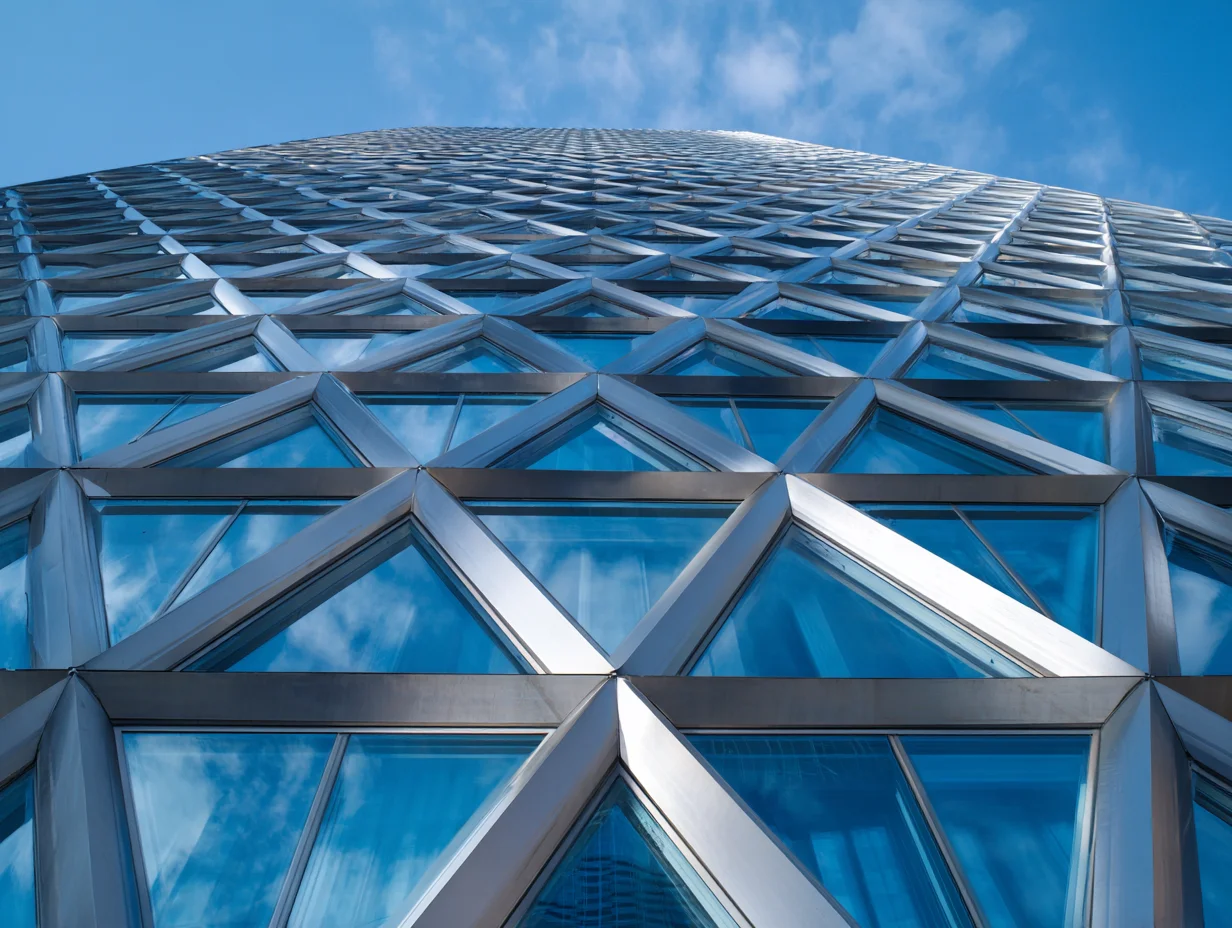
Geometric shapes in architecture are forms defined by mathematical rules: straight edges, fixed angles, measurable radii. Rectangles, triangles, circles, squares, and hexagons all fall into this category. Their predictability makes them easier to calculate structurally, simpler to construct with standard building materials, and more efficient to furnish and occupy. A rectangular floor plan, for example, allows modular furniture placement, straightforward HVAC zoning, and repetitive framing that reduces labor costs.
But ease of construction is only part of the story. Geometric shapes also communicate ideas. A courthouse built from heavy stone rectangles signals permanence and authority. A triangular roof truss signals structural honesty. A circular rotunda signals gathering and equality, with no seat closer to the center than any other. Architects choose geometric forms not just for how they perform but for what they say.
💡 Pro Tip
When developing a concept model, start by testing your primary shape at three different scales: the overall massing, the floor plan, and the window openings. A triangle that works as a roof profile may create unusable floor area if applied to the plan without adjustment. Experienced designers resolve this tension early, before structural engineering begins.
Rectangles and Squares: The Foundation of Building Design
Rectangles dominate architecture for practical reasons. Research by Steadman (2014) confirmed earlier findings by Bemis and Burchard showing that rectangular plans account for roughly 98% of residential housing layouts. Right angles simplify structural connections, wall framing, and interior partitioning. They also make buildings easier to extend, subdivide, and renovate over time.
Squares offer the most compact ratio of perimeter to area among rectangles, which reduces exterior wall material for a given floor area. Historically, squares carried symbolic meaning: stability, equality, and earthly order. The evolution of architectural styles shows how the square has persisted from ancient Roman atria to Mies van der Rohe’s grid-based modernism.
That dominance comes with trade-offs. Rectangular massing can feel monotonous when repeated across an entire streetscape, and corner conditions in rectangular buildings often create dark, underused spaces. Many contemporary firms break the grid subtly by rotating modules, chamfering corners, or stacking offset rectangles to add visual rhythm without abandoning the efficiency of orthogonal geometry.
Triangles in Architectural Design
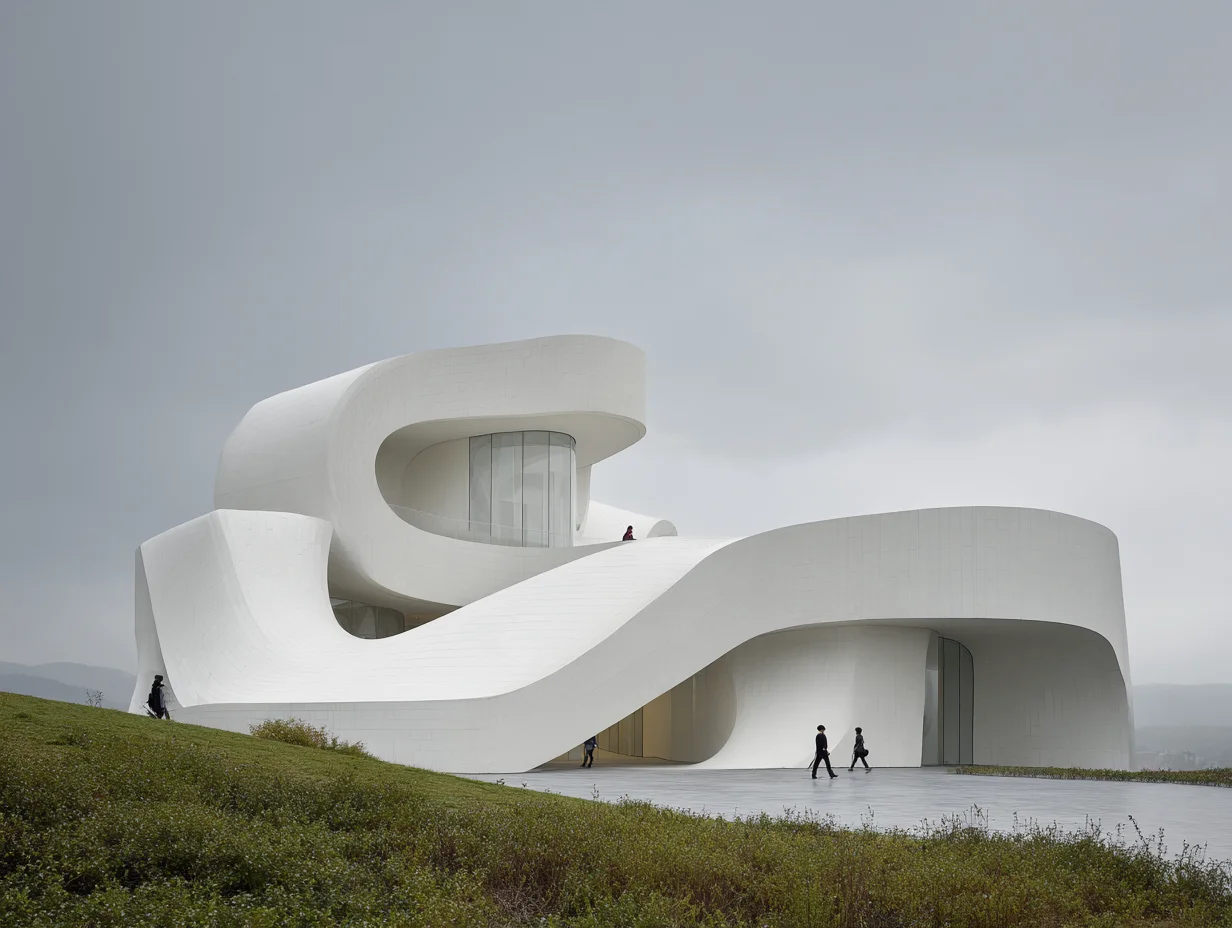
The triangle is the only polygon that cannot be deformed under pressure without breaking a side. Press on one corner of a rectangle, and it collapses into a parallelogram. Press on a triangle, and it holds. This rigidity makes triangles essential to structural systems: roof trusses, geodesic domes, space frames, and braced frames all rely on triangulation to resist lateral loads.
A-frame houses are perhaps the most visible residential application. The steeply pitched walls double as the roof, shedding snow load efficiently and creating a dramatic interior volume from minimal materials. On a larger scale, Norman Foster’s 30 St Mary Axe (“The Gherkin”) in London uses a diagrid structural system, essentially a lattice of triangles wrapped around a curved form, to reduce wind load by 40% compared to a conventional rectangular tower of similar height.
Triangles also appear in plan form. I.M. Pei’s East Building of the National Gallery of Art in Washington, D.C. occupies a trapezoidal site that Pei resolved by splitting the building into two interlocking triangles, a sharp isosceles for gallery space and a smaller right triangle for offices and study rooms.
🎓 Expert Insight
“Architecture should speak of its time and place, but yearn for timelessness.” — Frank Gehry
Gehry’s observation applies directly to shape choices. The triangle has remained structurally relevant for thousands of years precisely because its geometry is timeless, yet each era finds new ways to express it, from Egyptian pyramids to contemporary diagrid towers.
Circles and Curves in Building Design
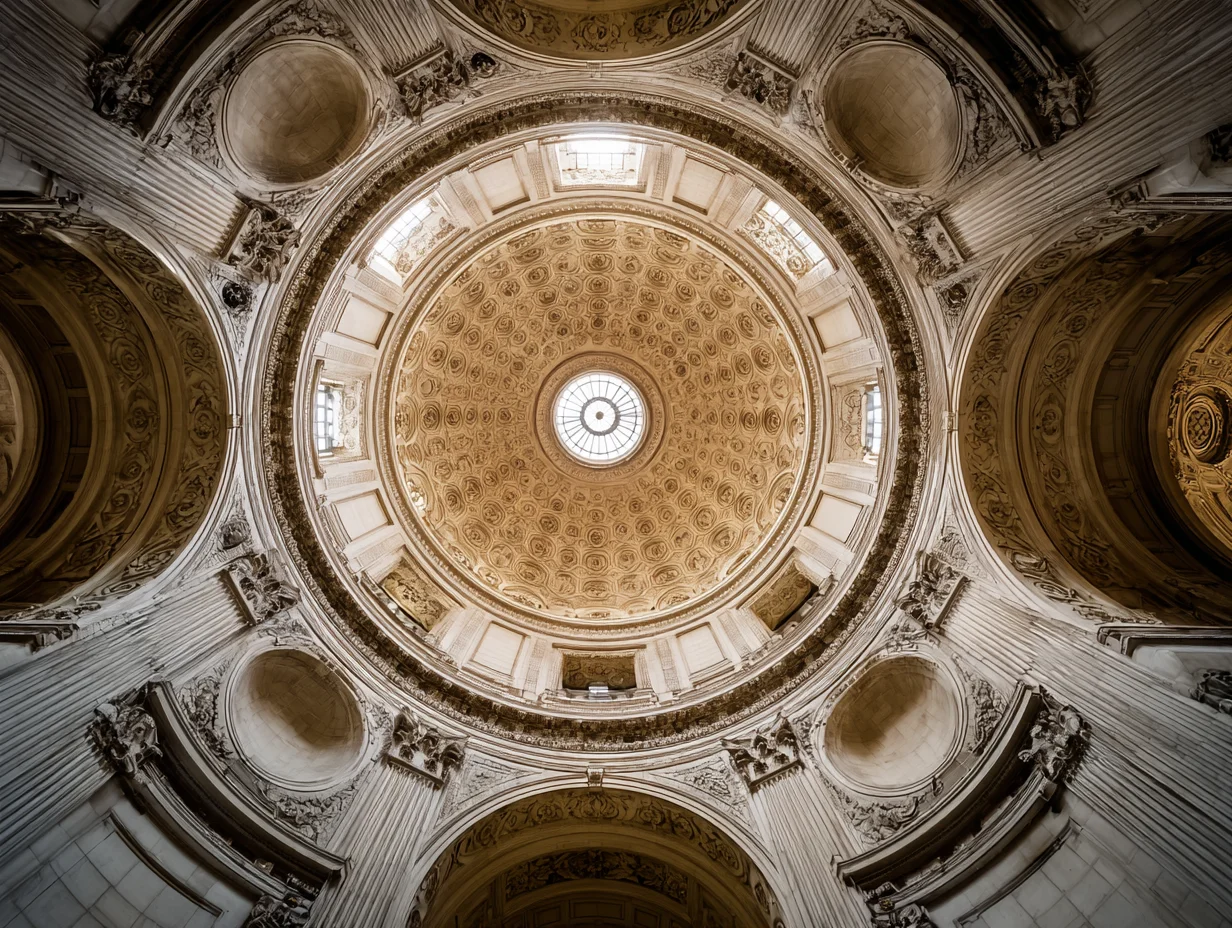
A circle distributes stress evenly along its arc rather than concentrating it at corners, which is why cylindrical water tanks, grain silos, and pressure vessels are round. In architecture, circles appear as domes, rotundas, circular floor plans, and arched openings. The Pantheon in Rome, completed around 125 AD, remains the largest unreinforced concrete dome in the world, with a 43.3-meter internal diameter. Its circular oculus at the top acts as both a light source and a compression ring that stabilizes the dome.
Circular plans are rarer in everyday construction because curved walls are harder and more expensive to build than straight ones, and furniture designed for rectangular rooms fits poorly against curved surfaces. Still, the shape excels in specific programs. Concert halls, legislative chambers, and religious buildings often use circular or semicircular plans because the form creates equal sightlines and acoustics for all occupants. The golden ratio in architectural aesthetics frequently intersects with circular proportions, particularly in dome and window design.
Arches, half-circles turned on their side, redirect vertical gravity loads into horizontal thrust at the supports. Gothic pointed arches refined this further by directing more force downward and less outward, allowing thinner walls and larger windows, a structural innovation that shaped an entire era of cathedral building.
How Do Organic Shapes Differ from Geometric Forms?

Organic shapes in architecture lack the straight edges and fixed angles of geometric forms. They curve, branch, taper, and flow in patterns that recall natural objects: shells, bones, river valleys, tree canopies. Where a rectangle communicates order and control, an organic shape communicates movement and adaptation.
Frank Lloyd Wright pioneered organic architecture as a philosophy, not just a style. His Fallingwater (1939) uses rectilinear concrete slabs, but the building’s relationship to its site, cantilevered over a waterfall, with stone walls rising from the rock, makes the whole composition feel grown rather than placed. The comparison between organic and parametric design clarifies that organic architecture is about contextual integration, not simply curved surfaces.
Later architects pushed organic shapes further. Eero Saarinen’s TWA Flight Center (1962) at JFK Airport used thin-shell concrete vaults to create a bird-like form that expressed flight without being literal. Jørn Utzon’s Sydney Opera House (1973) used precast concrete shells derived from sections of a single sphere, solving both the aesthetic ambition and the construction geometry simultaneously.
🏗️ Real-World Example
Heydar Aliyev Center (Baku, 2012): Designed by Zaha Hadid Architects, this 57,500 m² cultural center uses a continuous folding surface with no visible corners or sharp transitions between wall, roof, and ground. The structure required a space-frame system of steel trusses and a glass-fiber reinforced concrete (GFRC) and polyester (GRP) cladding system to achieve its fluid geometry.
Types of Shapes in Architecture: A Comparison
Understanding how different shapes behave structurally, spatially, and emotionally helps designers make informed choices early in a project. The following table summarizes the key properties of the most common architectural shapes.
Comparison of Common Architectural Shapes
| Shape | Structural Behavior | Common Uses | Psychological Effect |
|---|---|---|---|
| Rectangle/Square | Efficient load paths, easy to frame and partition | Offices, housing, retail, schools | Order, stability, formality |
| Triangle | Rigid under load, cannot deform without breaking | Trusses, A-frames, diagrids, geodesic domes | Strength, dynamism, tension |
| Circle/Dome | Distributes stress evenly, minimal surface area for volume | Rotundas, concert halls, sports arenas, domes | Unity, equality, infinity |
| Arch | Redirects vertical load into lateral thrust at supports | Bridges, doorways, cathedral naves, viaducts | Grandeur, passage, transition |
| Organic/Freeform | Complex stress paths, often requires advanced engineering | Museums, cultural centers, airports, pavilions | Movement, nature, fluidity |
| Hexagon | Tessellates without gaps, good load distribution | Pavilions, modular housing, facade panels | Efficiency, nature (honeycomb), innovation |
Shapes in Architectural Design: From Concept to Construction
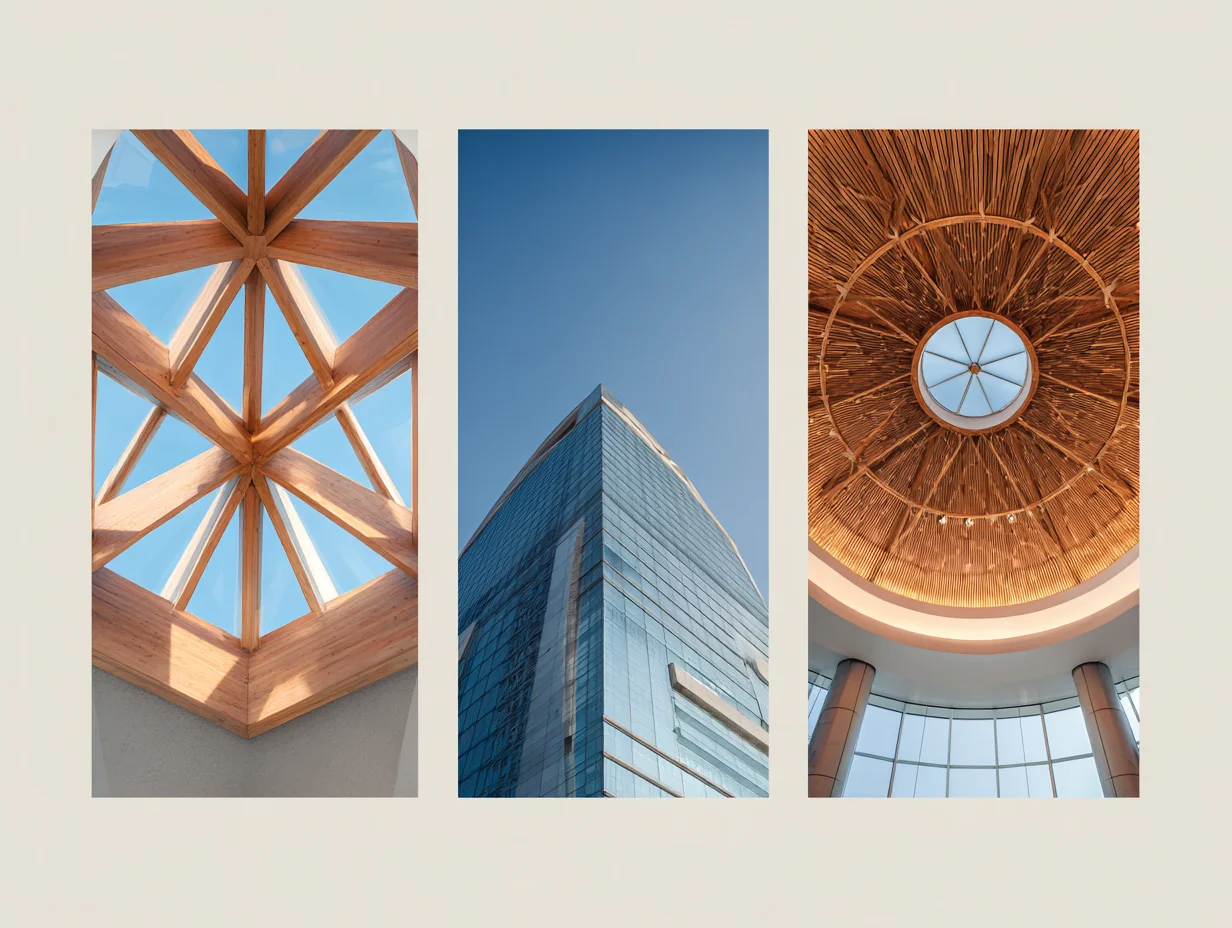
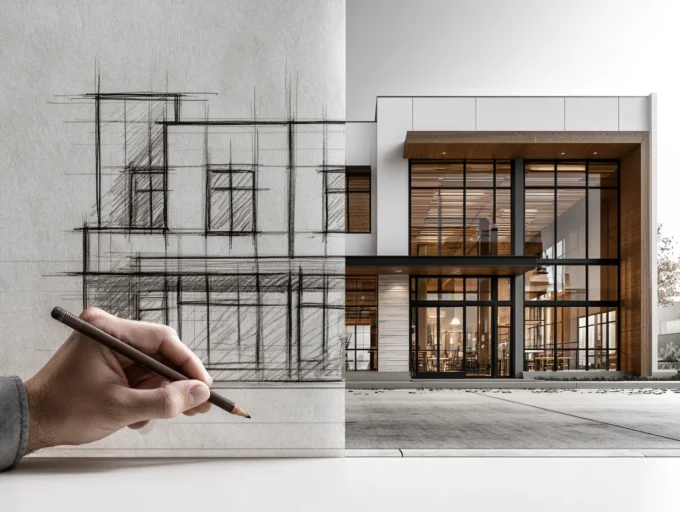
A shape on paper behaves differently from a shape in three dimensions. Architects work through this translation constantly. A circular plan becomes a cylinder when extruded, a dome when rotated, or a cone when tapered. A triangle becomes a prism, a pyramid, or a tetrahedron. Each three-dimensional expression changes the structural requirements, the interior spatial quality, and the exterior appearance.
Form finding in architecture formalizes this process. Frei Otto’s soap-film experiments and Antoni Gaudí’s hanging chain models both used physical forces to discover optimal three-dimensional shapes. Today, parametric software like Grasshopper for Rhino lets designers run hundreds of iterations, adjusting variables like span, material thickness, and load conditions to generate shapes that satisfy multiple performance criteria at once.
The shift from hand-drawn to computational design has expanded the range of buildable shapes dramatically. Surfaces that would have been impossible to document with 2D drawings, such as the double-curved cladding panels on Gehry’s Guggenheim Bilbao, became feasible once CATIA software could produce precise manufacturing data for every unique panel.
💡 Pro Tip
If you are working with curved or freeform shapes, build a physical model early, even a rough cardboard or foam one. Digital models can hide constructability problems that become obvious the moment you try to fold, bend, or join materials by hand. Many firms that specialize in complex geometry still prototype key junctions at 1:1 scale before finalizing shop drawings.
Why Do Certain Shapes Dominate Specific Building Types?
Program drives shape more than style does. Hospitals use rectangular corridors because gurneys need straight paths and standardized room sizes. Airport terminals stretch into linear or branching forms to accommodate sequential processing (check-in, security, gates). Sports stadiums wrap seating around an oval or circular field to maximize sightlines. Religious buildings often use vertical shapes, spires, minarets, and domes, to direct attention upward.
Climate also shapes buildings literally. Steeply pitched roofs shed snow in cold regions. Low, courtyard-centered plans maximize shade and ventilation in hot climates. Wind-prone coastal areas favor aerodynamic profiles. The biomimicry approach to architectural design takes this further, studying how natural organisms solve structural and environmental problems through shape alone.
Budget plays a role too. Curved and freeform shapes cost more to engineer, fabricate, and clad than orthogonal ones. The premium varies widely depending on material and construction method, but as a rough benchmark, a complex curved facade can cost two to four times more per square meter than a flat curtain wall system. That cost gap is shrinking as CNC fabrication and robotic construction become more accessible, but it still influences which shapes get built outside of high-profile cultural projects.
⚠️ Common Mistake to Avoid
Students and early-career designers often choose shapes for visual impact alone, without testing them against the project’s functional requirements. A dramatic curved atrium looks striking in a rendering, but if the program calls for flexible, subdividable floor plates, a curvilinear plan may waste 15-20% of the gross floor area. Always test your shape against the space planning requirements before committing to the massing.
Video: Geometry and Architecture Explained
This video from the Stewart Hicks channel examines how geometric principles translate into architectural form, covering the relationship between abstract shapes and built structures through historical and contemporary examples.
Geometric Forms in Modern and Contemporary Architecture
Modernist architects stripped buildings to their geometric essentials. Le Corbusier’s Villa Savoie (1931) is a white rectangular box lifted on pilotis, with a rooftop garden framed by curved windscreens. The shape communicates the “Five Points of Architecture” directly: free plan, free facade, ribbon windows, pilotis, and roof garden, all made legible through simple geometry.
Later modernists like Tadao Ando refined this further, using smooth concrete surfaces and precise geometric volumes to create spaces where light becomes the primary material. Ando’s Church of the Light (1989) is essentially a concrete box with a cruciform slit cut into one wall. The shape is severe, but the light pouring through the cross transforms the interior into something deeply emotional.
Contemporary architecture has moved beyond the single-shape-per-building approach. Firms like BIG (Bjarke Ingels Group) and OMA (Rem Koolhaas) combine, stack, twist, and subtract basic geometric shapes to create buildings that respond to multiple site conditions simultaneously. BIG’s VIA 57 West in New York (2016) is a courtyard building crossed with a skyscraper, forming a tetrahedron-like shape that provides both a sheltered garden and Hudson River views. The geometry isn’t decorative; it solves two competing programmatic requirements at once.
The Role of Shapes in Structural Systems
Every structural system has a preferred geometry. Post-and-beam construction favors rectangles. Cable-stayed bridges use triangulation between mast, cable, and deck. Shell structures work best as doubly curved surfaces, saddle shapes or domes, because curvature in two directions provides stiffness without added material thickness.
Buckminster Fuller’s geodesic domes are a clear case study. By subdividing a sphere into triangulated panels, Fuller created enclosures that cover large spans with minimal material weight. The Biosphere in Montreal (1967), originally the U.S. Pavilion at Expo 67, spans 76 meters with a steel-tube framework that weighs a fraction of what a conventional structure of similar volume would require.
Parametric architecture principles have expanded the range of structurally viable shapes by linking form directly to force analysis. Software now generates shapes where material is placed only where stress demands it, removing unnecessary mass and producing organic-looking forms that are, paradoxically, highly rational from an engineering standpoint.
📌 Did You Know?
The Great Pyramid of Giza (c. 2560 BC) has a base perimeter of 921 meters and a height of 146.6 meters. The ratio of the perimeter to twice the height is approximately 3.14, which is remarkably close to pi. Whether this was intentional or a byproduct of the construction method using a measuring wheel remains debated among historians and mathematicians.
Final Thoughts
✅ Key Takeaways
- Rectangles dominate building design because they simplify construction, furnishing, and spatial planning, but their overuse can produce monotonous environments.
- Triangles provide unmatched structural rigidity and appear in trusses, diagrids, geodesic domes, and A-frame roofs across every building scale.
- Circles and domes distribute stress evenly, making them ideal for large-span enclosures, but curved construction costs significantly more than orthogonal systems.
- Organic and freeform shapes in architecture have become more buildable thanks to parametric design tools and CNC fabrication, though they still carry a cost premium.
- Shape selection should respond to program, structure, climate, and budget, not just visual preference. Testing shapes against functional requirements early prevents costly redesigns later.
Shapes in architecture are never purely aesthetic or purely structural. A rectangle is a statement about efficiency and order. A curve is a statement about movement and adaptability. The best buildings use shapes with full awareness of what they communicate, what they cost, and how they perform. Whether you are designing a single-family house or a cultural landmark, the shapes you choose will define how people experience the space long after the drawings are filed away.
For a deeper look at how proportion and geometry work together, see our guide on how architects use the golden ratio in design. If you are interested in the specific architects who have pushed geometric boundaries, our article on Zaha Hadid’s architectural legacy covers her approach to fluid, non-linear geometry in detail.








Leave a comment