



Table of Contents Show
Value engineering in construction projects is a structured team review that improves the ratio of function to cost. A multidisciplinary group defines what each part of the project has to do, then tests different ways of doing it. The goal is better value for the money spent, not a smaller budget achieved by removing scope.
The term gets used loosely on site. Owners say it when they mean “make it cheaper”, contractors say it when they mean substitution, and architects often hear it as a warning that the finishes are about to disappear. The method behind the phrase is far more specific than that, and it has a published standard, a defined sequence of phases, and in the United States a legal mandate on large publicly funded work.
What Is Value Engineering?

Value engineering is a function based method for improving a project. Instead of asking what a wall costs, the team asks what the wall does, then asks whether there is another way to do that job for less money, or a better way to do it for the same money. Value is treated as a ratio: the performance of the required functions divided by the resources needed to deliver them. That ratio can improve by lowering cost, by raising performance, or by both.
The method came out of a shortage. During the Second World War, General Electric could not obtain the materials and components its production lines needed, so Lawrence Miles and Harry Erlicher looked for substitutes. They noticed that the replacements often cost less, performed better, or both, and turned an accident of necessity into a repeatable process they called value analysis. Miles set out the functional approach at GE in December 1947 and published Techniques of Value Analysis and Engineering in 1961, which is why he is still credited as the originator of value engineering. Construction borrowed the method from manufacturing decades later.
Today the practice sits under a published standard maintained by SAVE International, the professional body that certifies value practitioners. The standard uses “value methodology” as the umbrella term, with value analysis, value engineering and value management treated as interchangeable names for the same process.
Value Engineering Is Not Cost Cutting
This is where most site level arguments start. A cost cut removes something: a green roof becomes a membrane roof, stone becomes render, three lifts become two. A value study asks a different question first, which is what function that element performs and whether the function is basic or secondary. Only after the functions are mapped does the team look for alternatives, and an alternative that damages a required function is not a valid outcome of the study.
The federal guidance is unusually blunt about this. In its 2024 case study on value engineering practice, the Federal Highway Administration states that value engineering is neither a design review nor a way of reducing project cost by sacrificing quality, reliability or performance. Some accepted recommendations in that study added cost, because they improved the result.
⚠️ Common Mistake to Avoid
Calling a post bid descoping exercise “value engineering” is the most common misuse of the term in building work. If nobody has performed function analysis, the exercise does not meet the SAVE International standard for a value study, whatever the meeting is called in the minutes. The practical test is simple: ask whether the team has written down the functions of the element under review as verb and noun pairs, such as “support load” or “control glare”. If that step is missing, what is happening is price reduction, and it should be described that way in correspondence so the design record stays accurate.
The distinction matters for liability as much as for design quality. When an owner records a decision as value engineering, the implication is that performance was tested and preserved. If performance was never tested, the architect’s role in evaluating pricing against scope is what stands between a substitution and a defect claim later.
The Six Phase Value Engineering Process

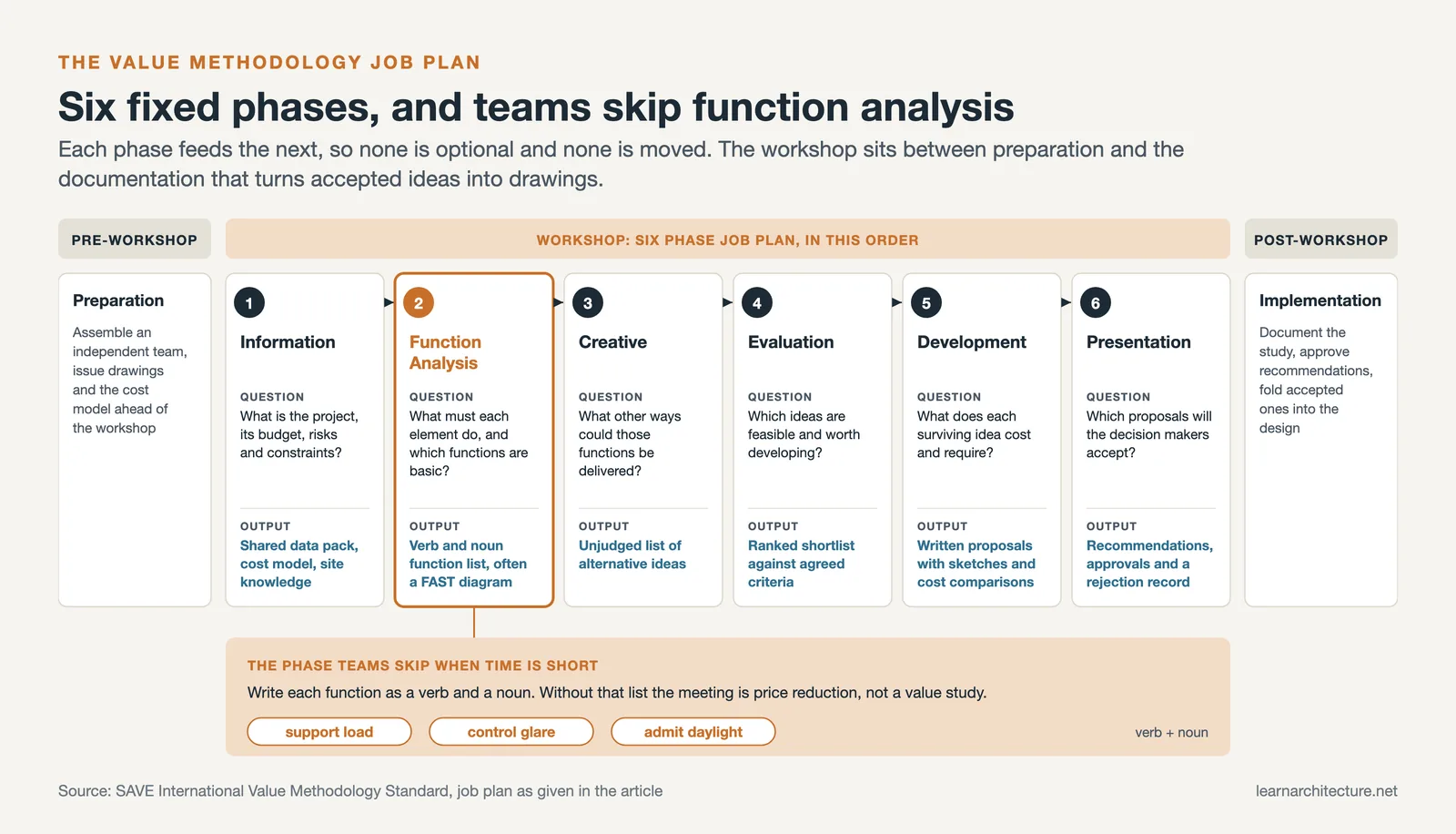
The SAVE International Value Methodology Standard organises a value study into three stages: pre-workshop preparation, the workshop itself, and post-workshop documentation and implementation. The workshop follows a six phase job plan, performed in order. The phases are not optional and they are not shuffled, because each one feeds the next.
The Value Methodology Job Plan at a Glance
The table below sets out what happens in each phase and what the team should have on paper when it ends.
| Phase | Question the team answers | Output |
|---|---|---|
| Information | What is the project, its budget, risks and constraints? | Shared data pack, cost model, site knowledge |
| Function Analysis | What must each element do, and which functions are basic? | Verb and noun function list, often a FAST diagram |
| Creative | What other ways could those functions be delivered? | Unjudged list of alternative ideas |
| Evaluation | Which ideas are feasible and worth developing? | Ranked shortlist against agreed criteria |
| Development | What does each surviving idea cost and require? | Written proposals with sketches and cost comparisons |
| Presentation | Which proposals will the decision makers accept? | Recommendations, approvals and a rejection record |
Function analysis is the phase that separates a value study from a cost meeting, and it is also the phase teams skip when time is short. Writing “support load” or “admit daylight” against an element forces the group to argue about purpose before it argues about product, which usually changes the shortlist. The habit of tracking cost per key metric from the start of design makes that argument much easier to win, because the team can see which functions are absorbing the budget.
When Should a Value Engineering Study Happen?
As early as the design is legible and as late as changes are still cheap, which in practice means somewhere between the end of concept design and the middle of design development. Public agencies have converged on that window from both directions. Virginia’s Department of Transportation aims to hold reviews at around 30 percent of the planning stage, late enough to see a complete plan but early enough for a recommendation to matter. Florida’s Department of Transportation usually runs design phase studies at 60 percent plans, so accepted changes can be drawn without disturbing the programme.
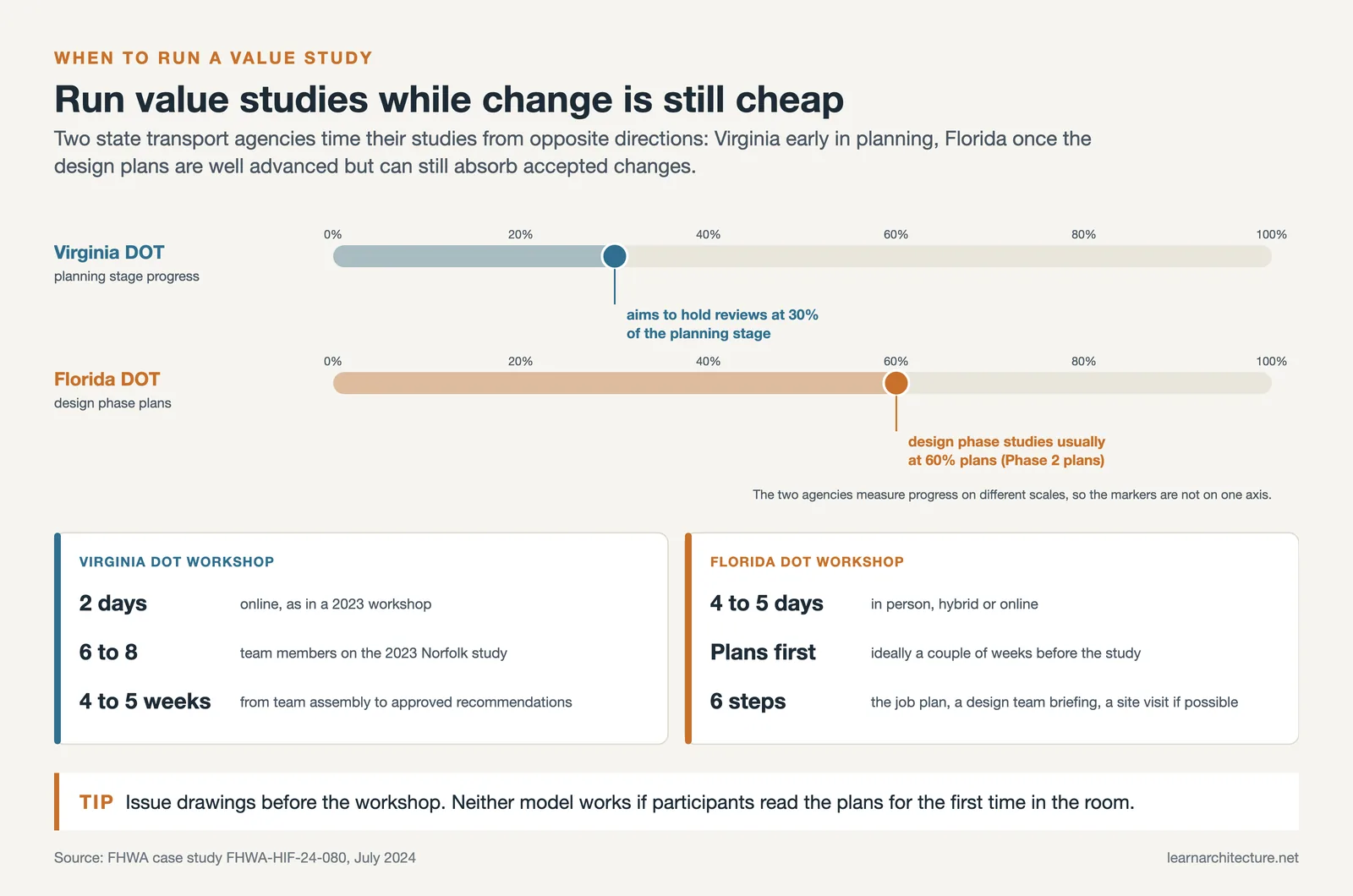
The workshop itself is short. Virginia usually holds the workshop online, and its 2023 Norfolk study used a six to eight member team meeting over two days, and the whole cycle from team assembly to approved recommendations takes four to five weeks. Florida runs four to five day workshops, in person, hybrid or online, with plans issued to the team a couple of weeks in advance. Neither model works if the participants read the drawings for the first time in the room.
Timing is also the reason a study late in a project produces disappointing numbers. Once a foundation design is fixed and long lead items are ordered, most of the remaining money is committed even though very little of it has been spent. A study run at that point can only trim, which is the version of the exercise that gave the phrase its bad reputation. An earlier architecture feasibility study and a live cost model, maintained with one of the construction cost estimating tools now available to small teams, give a value study something useful to work with.
Where Value Engineering Is Required by Law
On federally funded highway work in the United States, value engineering is not a matter of taste. Title 23 CFR Part 627 requires every state department of transportation to run a value engineering programme, sets the project thresholds that trigger a study, and requires annual reporting of results to the Federal Highway Administration. Design build projects have been excluded from the requirement since 2014, on the argument that the delivery method already puts the builder inside the design process.
🔢 Quick Numbers
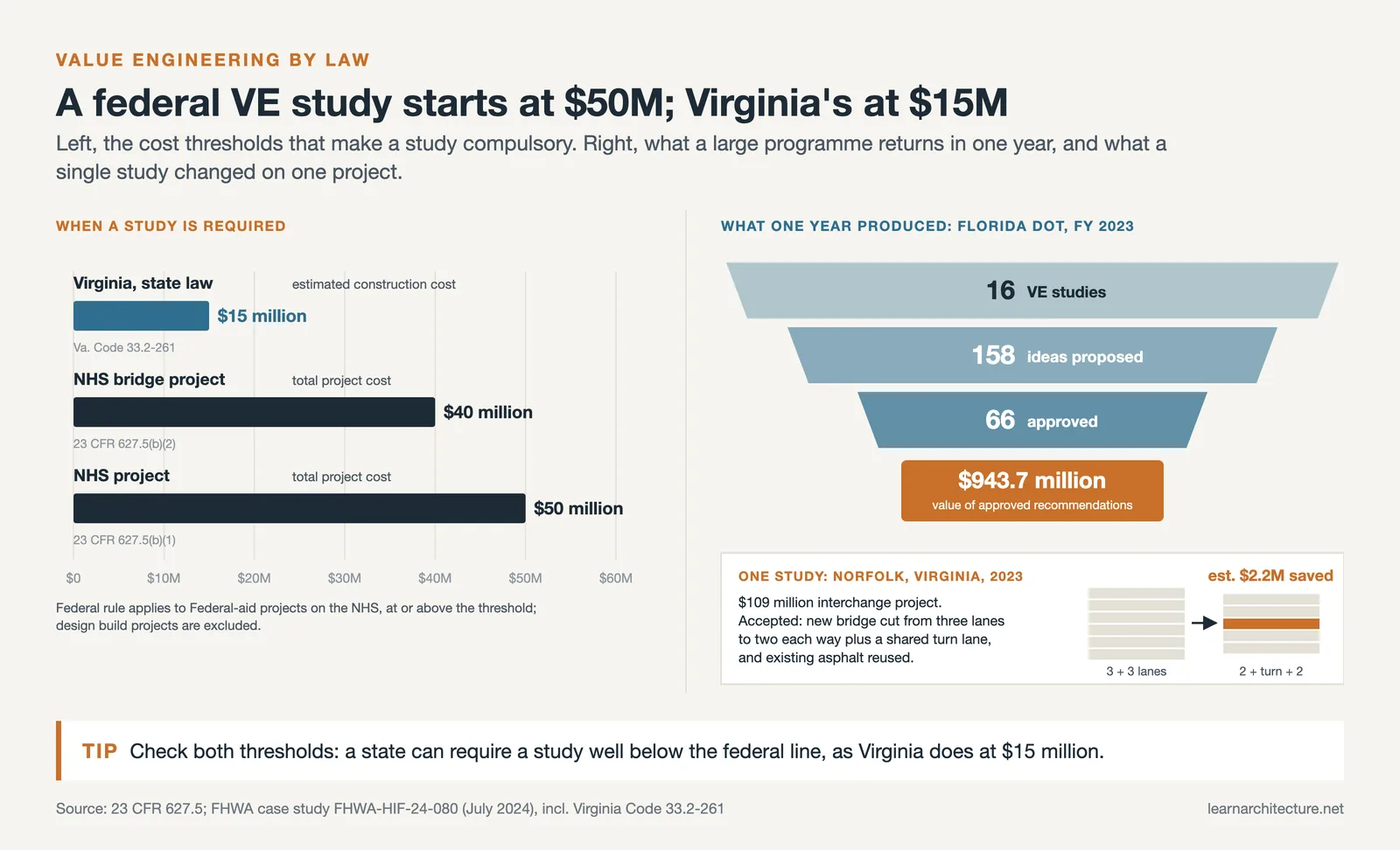
- Studies are required on National Highway System projects with an estimated total cost of $50 million or more and NHS bridge projects of $40 million or more (23 CFR 627.5)
- Florida DOT ran 16 value engineering studies in FY 2023, producing 158 proposed and 66 approved recommendations worth $943.7 million (FHWA case study FHWA-HIF-24-080, July 2024)
- Virginia DOT reported $3.99 million in total savings from seven studies in FY 2022, a reminder that programme scale drives the headline figure (same source)
- Virginia applies a lower state threshold of $15 million in estimated construction cost under Virginia Code Section 33.2-261
Two mechanisms sit inside these programmes and they are often confused. A value engineering study is a pre-award review of the design by a team not involved in producing it. A value engineering change proposal, or VECP, is submitted by the contractor after award, and the net saving is shared between the agency and the contractor under the contract terms. Building sector clients borrow the VECP idea more often than they realise, usually without the sharing mechanism that makes contractors bother to look.
Outside the public sector the driver is contractual rather than statutory. Owners write value management into consultant appointments, and a growing number of construction management scopes now include facilitating the workshop as a named service.
How to Protect the Design in a Value Study

Walk in with the functions already written down. If the design team supplies the function list, the conversation starts on design terms rather than on a spreadsheet of unit rates, and the elements carrying real performance load become visible before anyone proposes deleting them. Bring the reasoning behind the expensive decisions too, since the outside team does not know why the span is what it is.
Ask for life cycle cost, not first cost, on anything involving the envelope, the structure or the plant. A cheaper cladding build up that raises heating demand for sixty years is a saving on one line and a loss on the balance sheet, and the federal definition of the exercise explicitly includes overall life cycle cost among the things a team must weigh. Structural optimisation is where the argument is easiest to win with numbers, and the Shanghai Tower’s wind tunnel driven form is the textbook case, since the shape cut structural steel by roughly a quarter.
🏗️ Real-World Example
Air Terminal Interchange, Norfolk, Virginia (2023): on a $109 million interchange serving Naval Station Norfolk, a VDOT value team of six to eight specialists met online over two days in April 2023. They questioned whether traffic counts justified a three lane bridge in each direction, having noticed that the flow was heavily directional, toward the base in the morning and away from it in the afternoon. The bridge was reduced to two lanes plus a shared turn lane, and existing asphalt was reused. The two accepted recommendations were valued at $2.2 million.
Finally, keep the rejection record. Recommendations that were considered and turned down, with the reason, are as useful as the accepted ones when the same idea resurfaces eight months later under budget pressure. Agencies formalise this step with a signed recommendation approval form, and there is no reason a private project cannot do the same in a one page memo.
Where to Go From Here
Bottom Line: value engineering in construction projects is a function driven method with a published standard behind it, and its results depend almost entirely on when it is run and whether function analysis actually happens. Run early, with the design team supplying the functions and a live cost model in the room, it protects the project. Run after bidding as a hunt for line items to delete, it is simply cost cutting wearing a better name.
Cost figures and savings data cited here come from published agency reports and vary by region, project type and procurement route. Statutory thresholds and value engineering requirements differ between jurisdictions, so confirm the rules that apply to your project with the relevant authority.
Frequently Asked Questions
Who takes part in a value engineering workshop?
A multidisciplinary team that was not involved in producing the design, usually led by a certified facilitator. Agency teams pull in roadway design, structures, environmental, utilities, right of way and construction staff, while building projects typically involve the architect, structural and services engineers, a cost consultant and the contractor if one is appointed. The independence of the reviewers is the point of the exercise.
How much does a value engineering study cost?
It is normally priced as a facilitated workshop plus preparation and reporting, so the cost tracks the team size and the number of days rather than the project value. Public agency studies run from two days to a working week, with several weeks of preparation and documentation around them. The relevant comparison is not the fee itself but the share of project cost still open to change at the moment the study happens.
Can value engineering happen during construction?
Yes, through a value engineering change proposal submitted by the contractor after award. The contractor identifies a change that delivers the same or better result for less money, the agency evaluates it, and the net saving is shared under the contract. This route depends on a sharing clause being written into the contract in the first place.
Is value engineering the same as value management?
The SAVE International standard treats value engineering, value analysis and value management as names for the same underlying methodology. In UK and European practice, value management is often used for the earlier strategic work on project objectives, with value engineering reserved for studies on a developed design. The phases and the reliance on function analysis are the same in both cases.













Leave a comment