


Table of Contents Show
Parametric design uses rules and adjustable parameters that the architect controls directly, so changing one input updates the whole model at once. Generative design goes further by letting software explore many solutions against goals you set. The core difference is authorship: parametric design keeps you driving, while generative design proposes options for you to judge.
If you have ever asked what is parametric design and where generative design fits, you are looking at two related but separate methods. Both run on algorithms, yet they hand control to the designer in very different ways. This focused guide breaks down each method, lines them up side by side, and shows when architects reach for one over the other.
What Is Parametric Design?
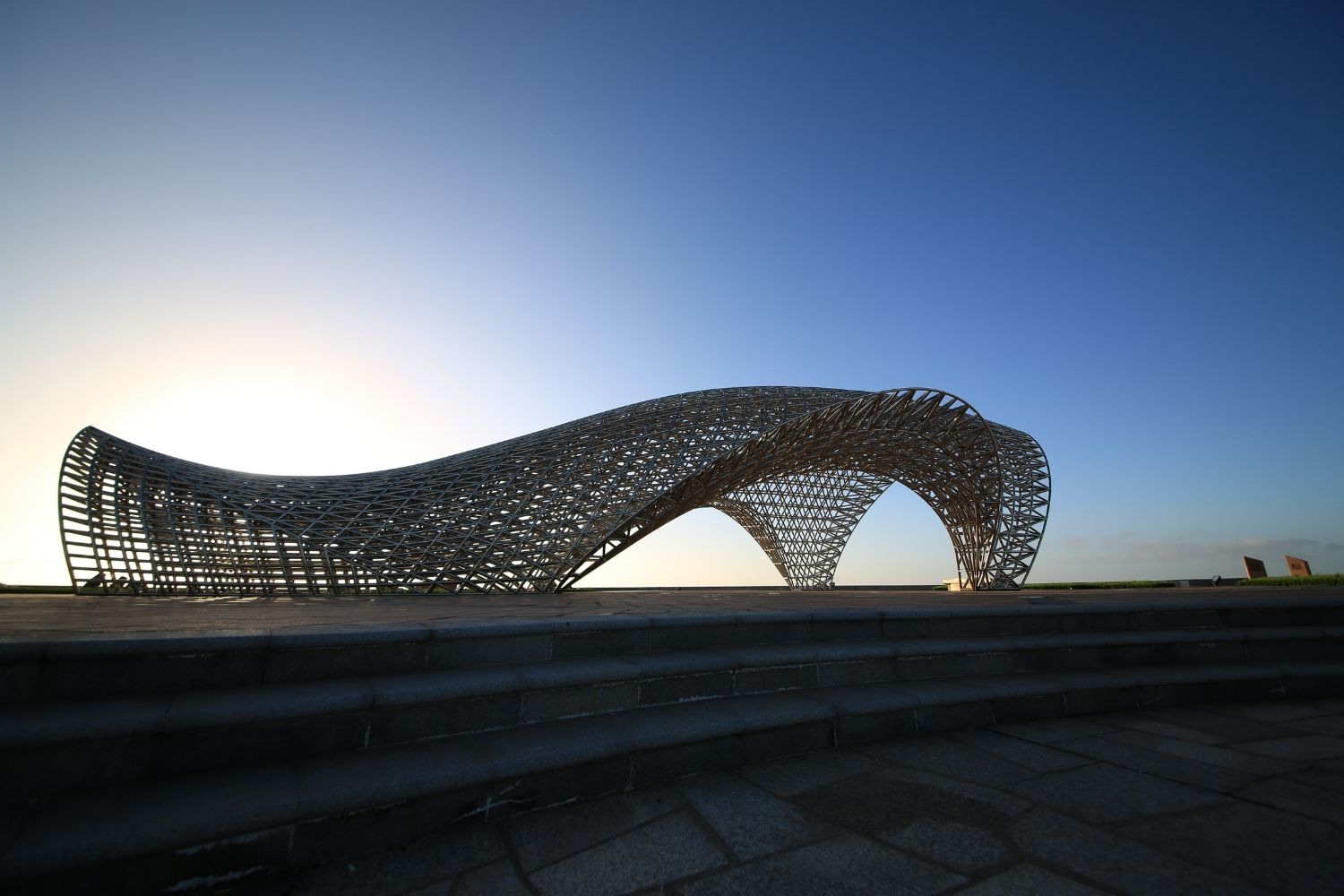
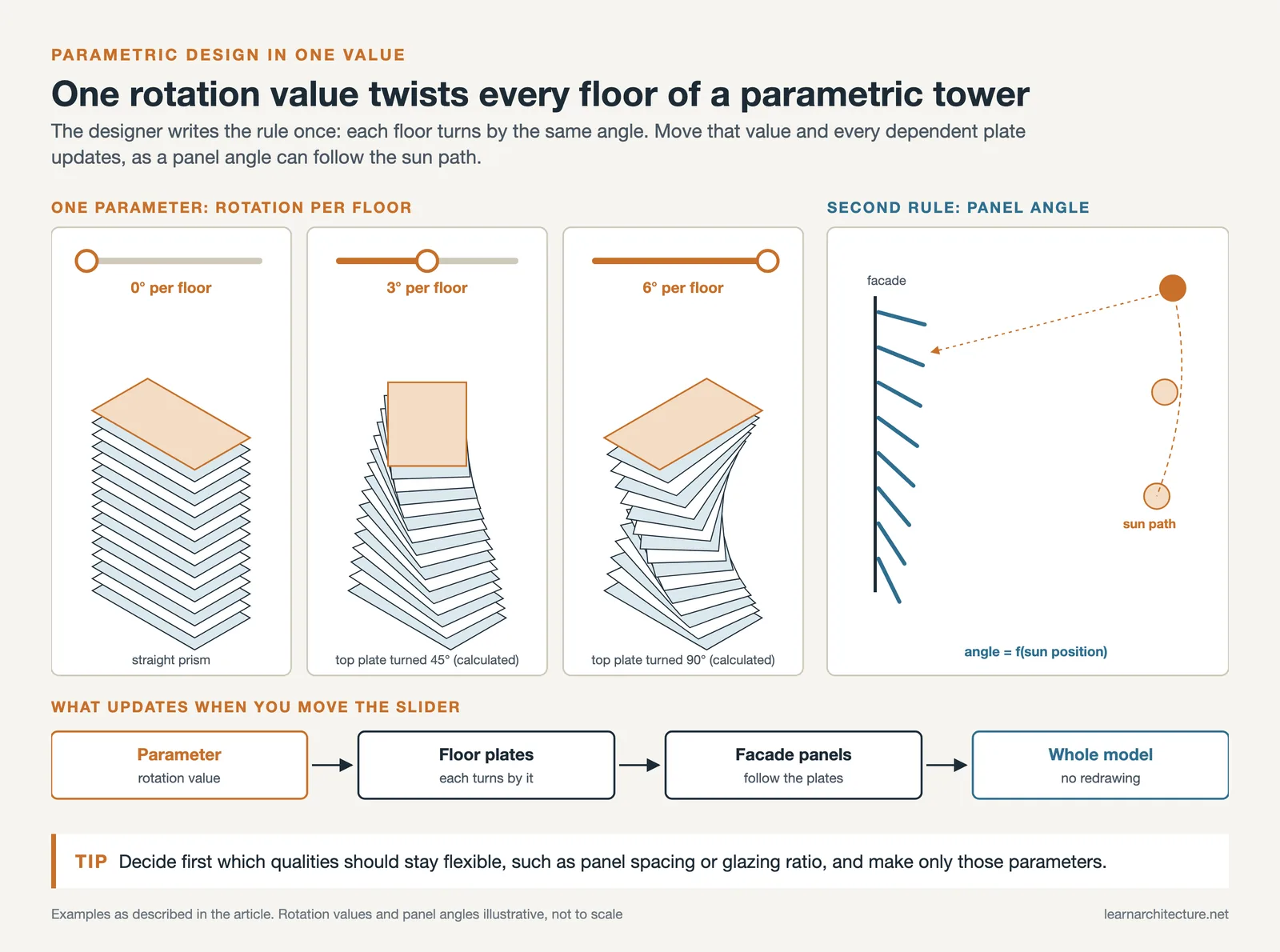
Parametric design is a method where geometry is built from a set of rules and variable inputs called parameters, rather than from fixed lines drawn by hand. Instead of placing a static curve, you define the relationship that produces it, such as a facade panel whose angle depends on the sun path. Adjust the parameter and every dependent element updates automatically across the model.
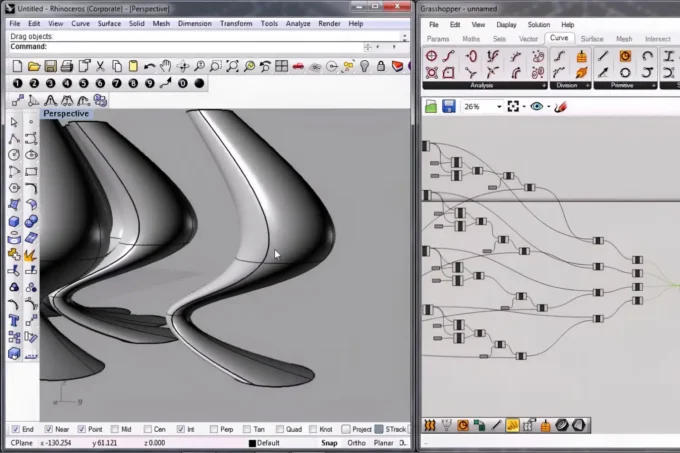
This is the heart of parametric design architecture: the building becomes a living system of relationships. A tower could have a footprint linked to a structural grid, with floor plates that twist according to one rotation value. Change that value and the form responds without you redrawing a thing. Most architects build these relationships visually using Grasshopper, the visual programming editor developed by McNeel for Rhino, where components are wired together on a canvas.
How Does Parametric Design Work in Practice?
A parametric architectural design workflow starts by deciding which qualities should be flexible. Panel spacing, glazing ratio, beam depth, and roof curvature can all become parameters. The designer keeps full authorship over the logic, so the result reflects intentional decisions rather than random output. For a deeper look at the underlying ideas, the key principles of parametric architecture cover algorithm-driven form, modeling, and responsive adaptation in detail, and our breakdown of the best parametric design software for architects compares the main platforms.
📌 Did You Know?
Parametric thinking predates computers. According to the documented history of parametric design, German architect Frei Otto used soap-film models and hanging weighted strings to find optimal shapes for tensile structures, including the Munich Olympic Stadium. Antoni Gaudi used the same physical, rule-based method decades earlier for catenary arches.
What Is Generative Design?
Generative design is a method where you define goals and constraints first, then let an algorithm produce and test many candidate solutions on its own. You might tell the system to minimize structural mass while keeping daylight above a target and respecting site setbacks. The software then runs through generations of options, scoring each against those objective functions and surfacing the strongest performers.
The shift here is real. With a parametric model you build the rules and steer the form. With generative design you frame the problem and review what the machine returns, often dozens or hundreds of layouts you would never have sketched. This sits within the wider field of computational design in architecture, and tools such as Autodesk’s generative design software automate the search across a single cloud solve. Our piece on how generative design learns from nature shows how evolutionary logic drives these results.
How Does Generative Design Differ From Automation?
Generative design is not the same as a script that repeats a fixed task. A macro automates a step you already know. A generative engine explores a solution space you have not mapped, returning answers you did not anticipate. The value lies in that exploration, since the system can weigh competing goals, such as cost against daylight, and report the trade-offs rather than forcing a single result. Architects keep the final call, deciding which performance numbers actually matter for the brief and the client.
💡 Pro Tip
When setting up a generative study, spend most of your effort defining the objective functions and constraints before generating anything. A common pattern on real projects is rushing to outputs with vague goals, which floods you with options that all miss the point. Sharp constraints produce a short list worth reviewing.
Parametric Design vs Generative Design: The Core Difference
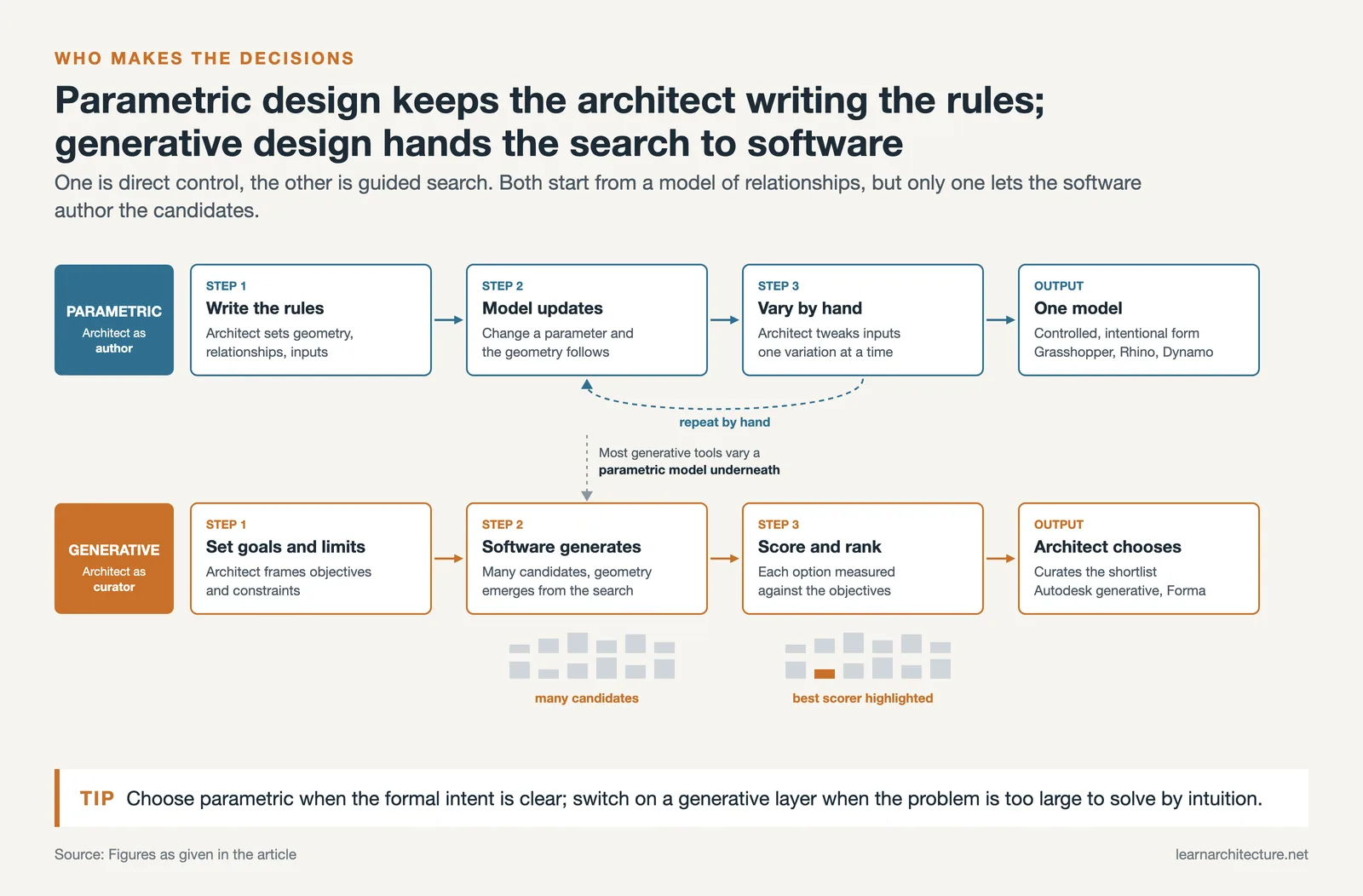
The cleanest way to separate the two is to ask who makes the decisions. In a parametric model, the architect authors every relationship and the software executes them faithfully. In generative design, the architect sets the brief and the software authors the candidates. One is direct control, the other is guided search. They also overlap, since most generative tools rely on a parametric model underneath to describe the geometry they vary.
🎓 Expert Insight
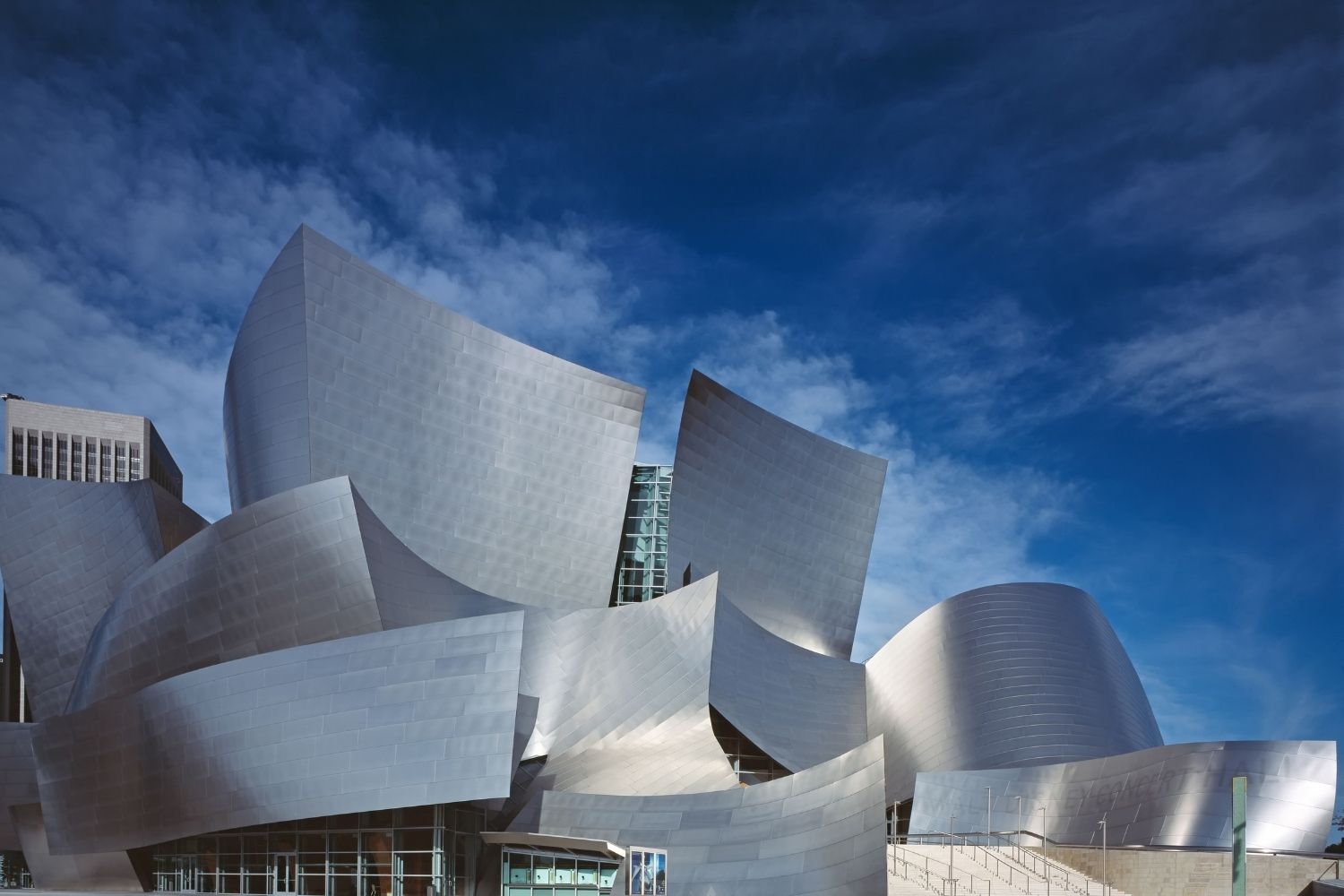
“Parametricism is the great new style after modernism.”, Patrik Schumacher, Zaha Hadid Architects
Schumacher’s Parametricism Manifesto framed rule-based design as a full architectural language, not just a tool. That ambition helps explain why parametric methods became the foundation generative workflows now build on.
Comparison of Parametric Design vs Generative Design
The table below summarizes how the two methods differ across the points that matter most when you choose an approach.
| Aspect | Parametric Design | Generative Design |
|---|---|---|
| Who drives the form | Architect sets rules and adjusts inputs | Software explores options against set goals |
| Starting point | Defined geometry and relationships | Constraints and objectives, geometry emerges |
| Outcomes produced | One model, variations changed by hand | Many candidates generated automatically |
| Best suited to | Controlled form-finding, facades, complex but intentional geometry | Layout optimization, structural efficiency, option exploration |
| Typical tools | Grasshopper, Rhino, Dynamo | Autodesk generative design, Forma, solver-based engines |
| Designer’s role | Direct author of the logic | Curator who frames goals and judges results |
Which Approach Should Architects Use?

Reach for parametric design when you have a clear formal intent and want precise control over how it adapts. Twisting towers, panelized facades, gridshells, and any geometry where the relationship between elements carries the design idea all favor a parametric model. The method rewards architects who want to keep their hands on the wheel while still moving fast through variations.
Generative design earns its place when the problem is hard to solve by intuition alone. Packing the most usable floor area into an awkward site, finding the lightest truss that meets a span, or testing hundreds of unit mixes against daylight and cost are tasks where letting the machine search pays off. Many studios combine both, using a parametric model to describe the building and a generative layer to optimize specific parts of it.
🏗️ Real-World Example
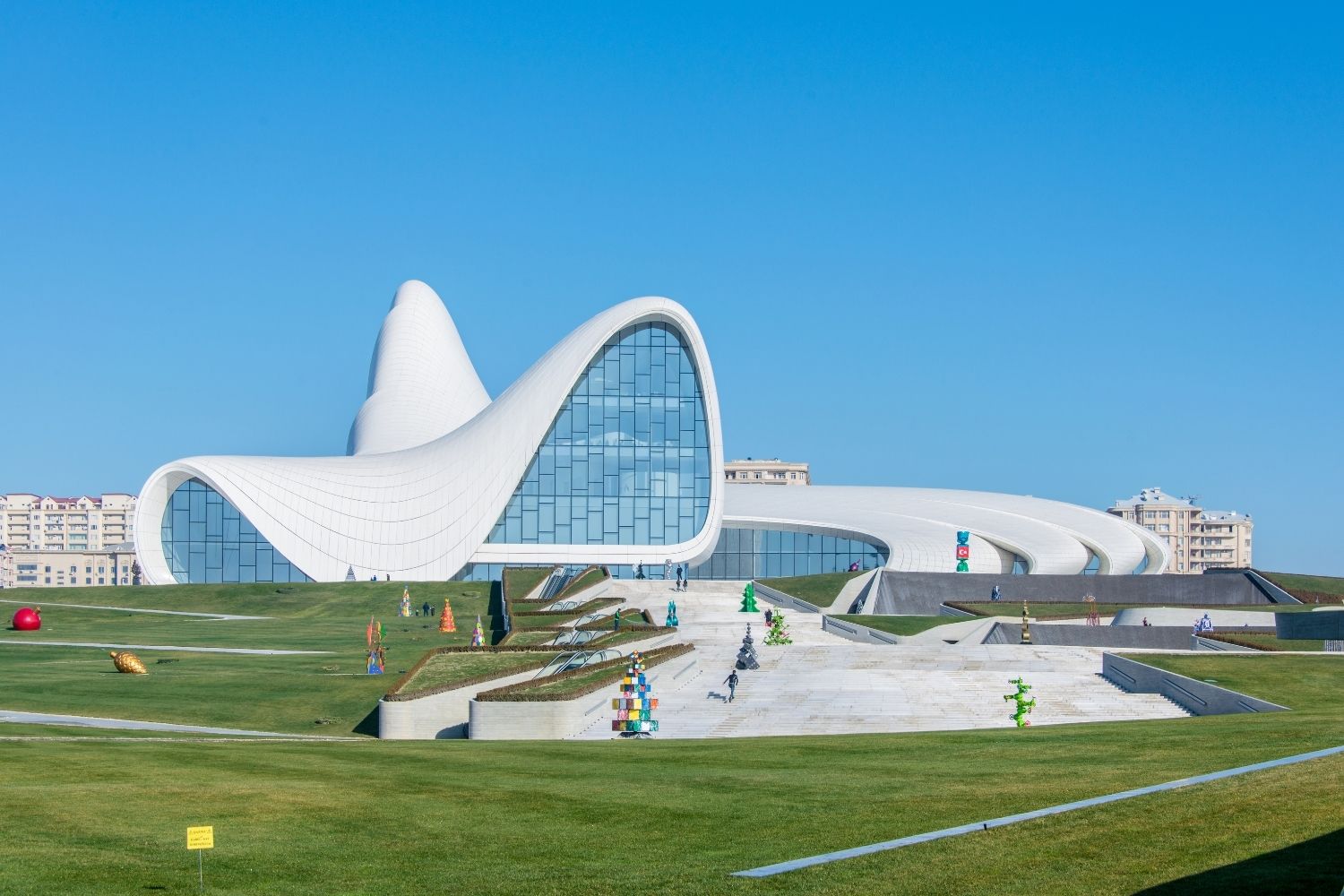
Heydar Aliyev Center (Baku, 2012): Zaha Hadid Architects used parametric methods to control the flowing, continuous surface that wraps the building into a single gesture. The relationships between thousands of cladding panels were driven by the geometry itself, so the skin reads as one fluid form rather than separate parts.
Skill level matters too. Parametric work has a steep but well-charted learning path, supported by years of tutorials and plugins. If you are starting out, our guide to Grasshopper and Rhino for architects is a solid entry point, and the practitioners profiled in architects who excel in parametric design show how far the method can go. For broader inspiration, the constantly updated parametric design coverage on ArchDaily tracks new built work.
Generative design asks for a different mindset. You spend less time modeling and more time framing problems precisely, then reading results with a critical eye. The architect stays essential, because the software has no view on culture, context, or how a space should feel. It returns performance, and you supply judgment.
Cost and time also shape the choice. A parametric model can be reused across a project once the logic is set, which pays back the upfront effort on facades and repeating systems. Generative studies tend to run on specific, well defined problems rather than the whole building, so studios often fold them into a hybrid workflow, building the design parametrically and aiming generative searches at the parts where measurable performance decides the outcome.
So what is a parametric design choice versus a generative one in plain terms? Parametric design is the better fit when the form is the idea and you want to author it. Generative design wins when performance against measurable goals is the idea and you want options you would not reach by hand. Most ambitious projects end up using a blend of the two.
Working through these methods places computational tools in a longer story. The most interesting projects are rarely about choosing parametric or generative in isolation, and more about knowing which decisions you want to keep for yourself and which ones you are happy to let an algorithm test on your behalf.











Leave a comment