


Table of Contents Show
Starting an architecture firm involves securing your professional license, choosing a legal entity, writing a business plan, budgeting for startup costs, and building a client pipeline. Each step requires specific decisions that affect your firm’s long-term viability, and skipping any one of them can create expensive problems later.
Opening your own practice is one of the most rewarding moves you can make as a licensed architect, but it demands more than design talent. You need a clear plan for the business side: finances, contracts, insurance, marketing, and operations. The architects who succeed as firm owners are the ones who treat their practice like a business from day one. This guide breaks down the process into concrete steps so you can move from employee to principal with confidence. If you are still weighing whether architecture offers the right financial path for you, our breakdown of architect earning potential and salary trends is a good starting point.
Confirm Your Licensing and Legal Structure

Before anything else, verify that your architecture license is active and valid in every jurisdiction where you plan to practice. In the United States, all 55 jurisdictions require you to pass the Architect Registration Examination (ARE) and complete the Architectural Experience Program (AXP) through NCARB. If you hold an NCARB Certificate, you can apply for reciprocal licensure in additional states more quickly. Some states also require a supplemental exam or extra continuing education, so check the NCARB Licensing Requirements Tool for your specific jurisdiction.
What Legal Structure Should You Choose?
Your choice of business entity affects taxes, personal liability, and how you bring on partners later. Most new architecture firms register as a Professional Limited Liability Company (PLLC) or a Professional Corporation (PC), because these structures shield your personal assets from business debts while satisfying state board requirements that mandate architect ownership. A sole proprietorship is the simplest option, but it offers no liability protection. If you plan to bring in a partner within the first few years, forming a PLLC from the start saves you the cost and paperwork of restructuring later.
You will also need professional liability insurance (errors and omissions coverage), general liability insurance, and, depending on your state, workers’ compensation once you hire employees. Consult an attorney and an accountant who understand architecture practice regulations in your state.
💡 Pro Tip
Register your firm name and check trademark availability before printing business cards or launching a website. Many architects skip this step only to discover another firm already uses a similar name in their state, forcing a costly rebrand after they have already built early recognition.
Write a Business Plan for Your Architecture Practice
A solid architecture firm business plan does not need to be a 50-page document, but it does need to answer a few critical questions: Who are your ideal clients? What project types will you focus on? How will you price your services? And how much revenue do you need to cover expenses in your first 12 months?

Start with a one-page executive summary that defines your firm’s focus. Are you pursuing custom residential work, small commercial fit-outs, or renovation projects? Narrowing your niche early helps you market more effectively and compete against larger firms that spread themselves thin. The AIA’s guide to financial principles for starting a firm outlines ten foundational concepts every new firm owner should understand before signing a lease or hiring staff.
Your plan should include a pricing model (hourly, fixed fee, or percentage of construction cost), a 12-month cash flow projection, and a target utilization rate. Most profitable small firms aim for a billable utilization rate of 60% to 65% of total working hours. The rest goes to marketing, administration, and business development. For a deeper look at income strategies, see our article on making money as an architect.
🔢 Quick Numbers
- 75% of U.S. architecture firms have fewer than 10 employees (AIA Small Firm Exchange, 2024 Annual Report)
- Small firms (under $250K annual billings) projected a 7% revenue decline in 2025 (AIA Architecture Billings Index, October 2025)
- Staff architect compensation at small firms grew an average of 4.4% annually from 2023 to 2025 (AIA Small Firm Compensation Report, 2025)
Estimate Your Architecture Firm Startup Costs

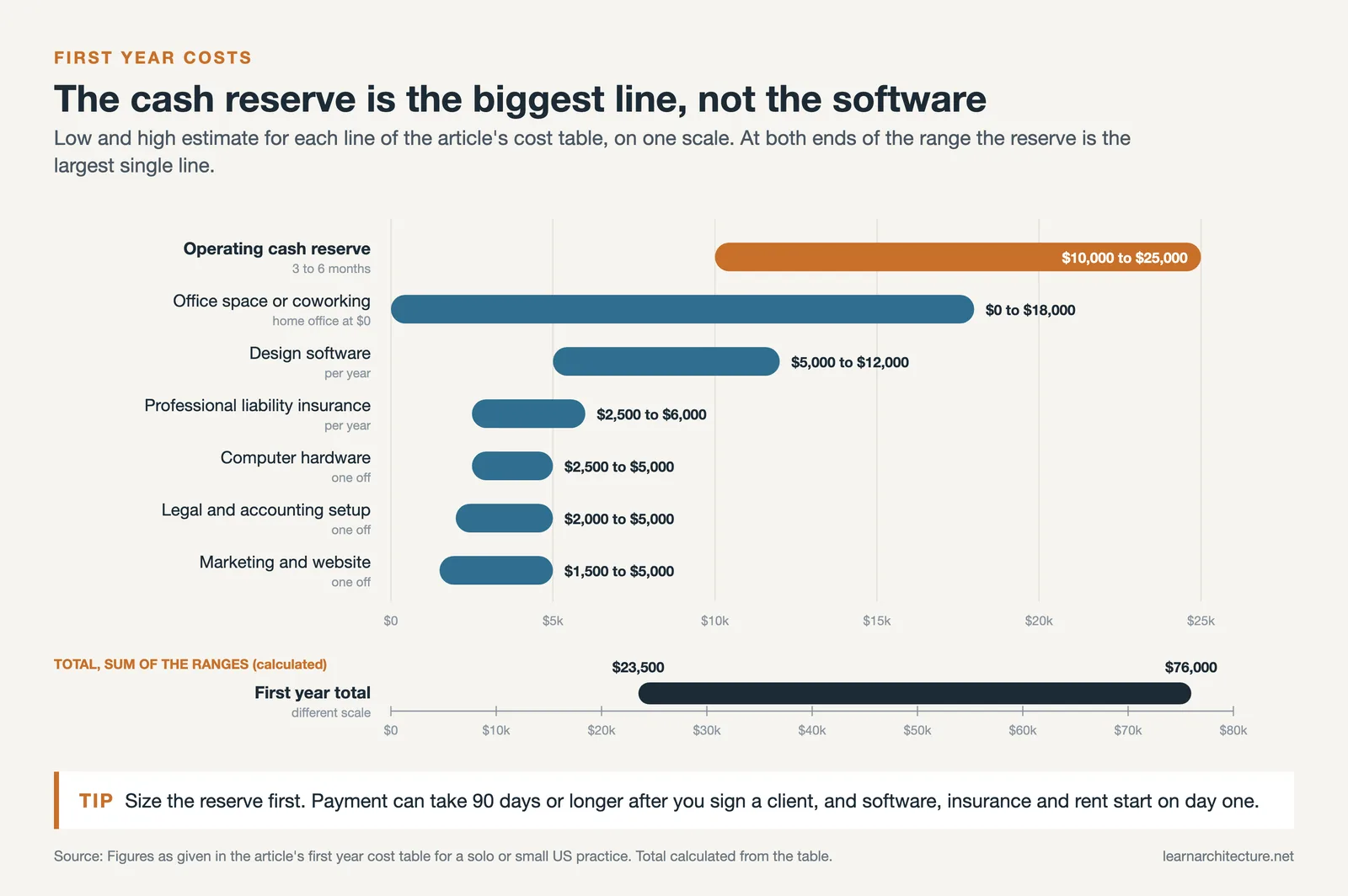
One of the biggest mistakes new firm owners make is underestimating how much cash they need before their first project fee arrives. The gap between signing a client and receiving payment can stretch to 90 days or longer, and you will be spending money from day one on software subscriptions, insurance premiums, and marketing.
Typical Startup Cost Breakdown
The following table shows approximate first-year costs for a solo or small architecture practice in the United States:
| Category | Estimated Range | Notes |
|---|---|---|
| Design Software (Revit, AutoCAD, Adobe) | $5,000 to $12,000/yr | Subscription-based; discounts for startups |
| Computer Hardware | $2,500 to $5,000 | Workstation, monitor, peripherals |
| Professional Liability Insurance | $2,500 to $6,000/yr | Varies by coverage limit and state |
| Office Space or Coworking | $0 to $18,000/yr | Home office at $0; coworking from $200/mo |
| Legal and Accounting Setup | $2,000 to $5,000 | Entity formation, contracts, tax setup |
| Marketing and Website | $1,500 to $5,000 | Portfolio site, branding, initial outreach |
| Operating Cash Reserve (3 to 6 months) | $10,000 to $25,000 | Covers bills before revenue flows in |
A realistic total for starting an architecture practice as a solo practitioner falls between roughly $23,500 and $76,000, depending on location, whether you rent office space, and which software licenses you carry. According to AIA Firm Survey data, firms with 2 to 4 employees report median annual expenses near $350,000, so building a reserve of three to six months of operating capital is a smart buffer against slow payment cycles.
⚠️ Common Mistake to Avoid
Many new firm owners price their services too low to “win” early projects, then struggle to raise rates later without losing clients. Set your fees based on your actual costs, desired salary, and overhead from the start. Underbidding damages both your cash flow and the market perception of your work.
Set Up Your Office and Technology
You do not need a corner office with a reception desk to launch a credible firm. Many successful practices start from a home office or a shared coworking space with a dedicated meeting room for client presentations. What matters more is your technology stack. At minimum, you will need a BIM-capable workstation running Revit or ArchiCAD, a project management tool like Monograph or Asana, and accounting software such as QuickBooks or Xero.
Cloud storage is non-negotiable. Services like Dropbox Business or Google Workspace keep your files accessible and backed up, and they make collaboration easier once you bring on contractors or employees. Invest in a second monitor, a quality plotter or large-format printing account, and a reliable video conferencing setup for remote client meetings. If you are still weighing which design software fits your workflow, our ArchiCAD vs SketchUp comparison covers the key differences.
Build Your Brand and Win Your First Clients
Your portfolio is your most powerful sales tool. Before you officially launch, spend time assembling a clean, focused portfolio website that highlights your strongest projects. If your previous work was done under a former employer, be transparent about your role on each project and get permission before publishing images. Our architecture portfolio guide walks through how to select, organize, and present projects for maximum impact.
Starting an architecture firm also means becoming your own marketer. Set up a Google Business Profile, create a LinkedIn company page, and begin sharing project updates and design thinking on social media. Personal referrals drive the majority of new business for small firms, so tell every colleague, former client, contractor, and real estate professional in your network that you have opened your own practice. Attend local AIA chapter events and join committees where you can meet potential clients and collaborators. For a more detailed breakdown of marketing tactics, read our guide on marketing strategies for architects.
Your first one or two projects may come from personal connections rather than cold outreach. Treat those projects as case studies: document the process, photograph the finished work, and ask for testimonials. Early wins build momentum faster than any advertising spend. If you are considering taking on freelance projects alongside your firm, our article on becoming a freelance architect covers how to structure that transition.
Cost figures referenced above are approximate and vary by region, material supplier, and project scope. Always verify current licensing fees and insurance rates with your state board and insurance provider.
Frequently Asked Questions

How much does it cost to start an architecture firm?
A solo architecture practice can launch for roughly $23,500 to $76,000, depending on your location and whether you rent office space. The biggest line items are design software subscriptions, professional liability insurance, and an operating cash reserve to cover the first few months before client payments arrive.
Do I need a license to open an architecture firm?
Yes. Every U.S. state and territory requires at least one principal of the firm to hold a valid architecture license. You must pass the ARE, complete the AXP experience program, and meet any additional requirements set by your state licensing board.
What is the best legal structure for a new architecture firm?
Most new firms choose a Professional Limited Liability Company (PLLC) because it limits personal liability while satisfying state rules that require architect ownership. A sole proprietorship is simpler to set up but leaves your personal assets exposed if the firm faces a lawsuit.
How do I find my first clients as a new firm owner?
Personal referrals are the primary source of early projects for most small firms. Inform your entire professional network, attend AIA chapter events, partner with local contractors and developers, and build a strong portfolio website. Consistent outreach and visible project work bring in leads over time.
How long does it take for a new architecture firm to become profitable?
Most small architecture practices need 12 to 24 months to reach consistent profitability. The timeline depends on your overhead, pricing strategy, and how quickly you build a steady project pipeline. Keeping fixed costs low in the first year gives you more room to grow without financial pressure.
Where to Go From Here
Your Next Step: Draft a one-page business plan this week that defines your target client, your first three project types, and a 12-month expense projection. That single page will force you to make the key decisions that turn the idea of starting an architecture firm into a real, funded plan you can act on.













Leave a comment