


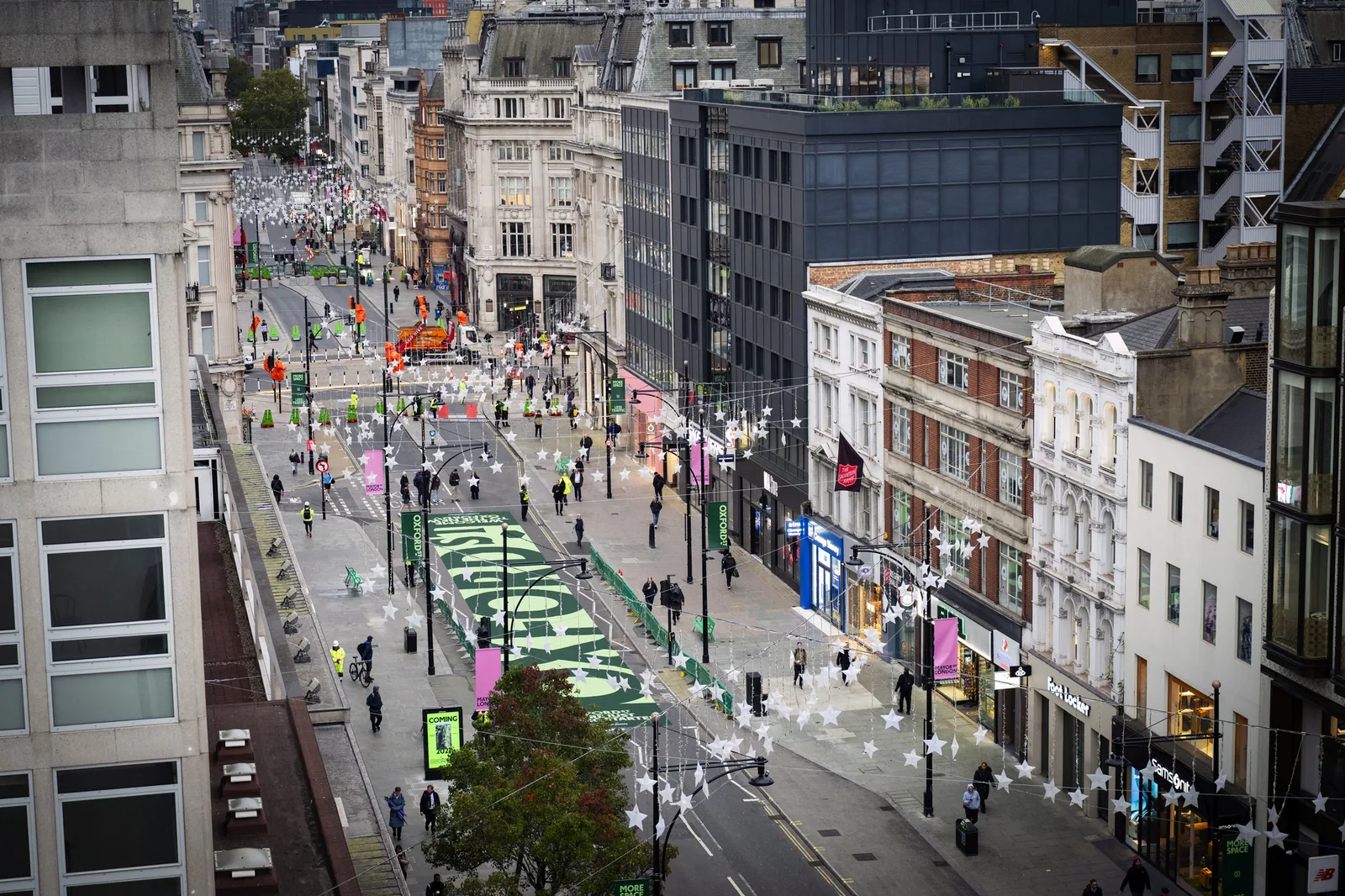
Almost a kilometre of London’s Oxford Street closed to traffic on Monday 26 October, marking the first phase of the Oxford Street pedestrianisation that Mayor Sadiq Khan first proposed in 2016. Between Orchard Street and Great Portland Street the road is now off limits to private vehicles, buses, taxis and private hire cars, and also to cycles, scooters and pedicabs. The changes made so far are meant to be temporary, so that the first months can work as a live test of how people actually use the space.
The idea has a long record of false starts. As ArchDaily recalls, the original plan aimed for completion in 2020 but was blocked in 2018 after two consultations. It was revived in 2024 and received final approval in February 2026. City Hall points to a consultation held between February and May 2025, with 6,642 responses, in which almost seven in ten respondents supported the Mayor’s proposals. In January 2026 the Mayor set up the Oxford Street Development Corporation (OSDC) to lead the regeneration; ArchDaily notes it can take planning powers over from Westminster City Council.
Who is designing the Oxford Street pedestrianisation
The first section is being designed by East, a landscape and urban design practice based in East London, with Gehl, Publica and J&L Gibbons. ArchDaily also lists sustainability consultant Etude and transport consultant NRP in the team. Alongside them, Hawkins\Brown leads a framework covering the entire length between Marble Arch and Tottenham Court Road, supported by ASPECT Studios, Urban Movement, Authentic Futures and Michael Grubb Studios, according to the Mayor’s office. Traffic changes elsewhere on the street would first go to consultation.
East director Julian Lewis said the transitional stage lets the public test the street, so that permanent designs for the car-free sections can be developed “in ways that are informed through use.” Darryl Chen, partner and urban design lead at Hawkins\Brown, described the closure as “the start of a programme of transformation” for the street and the wider West End.
A street furnished for testing
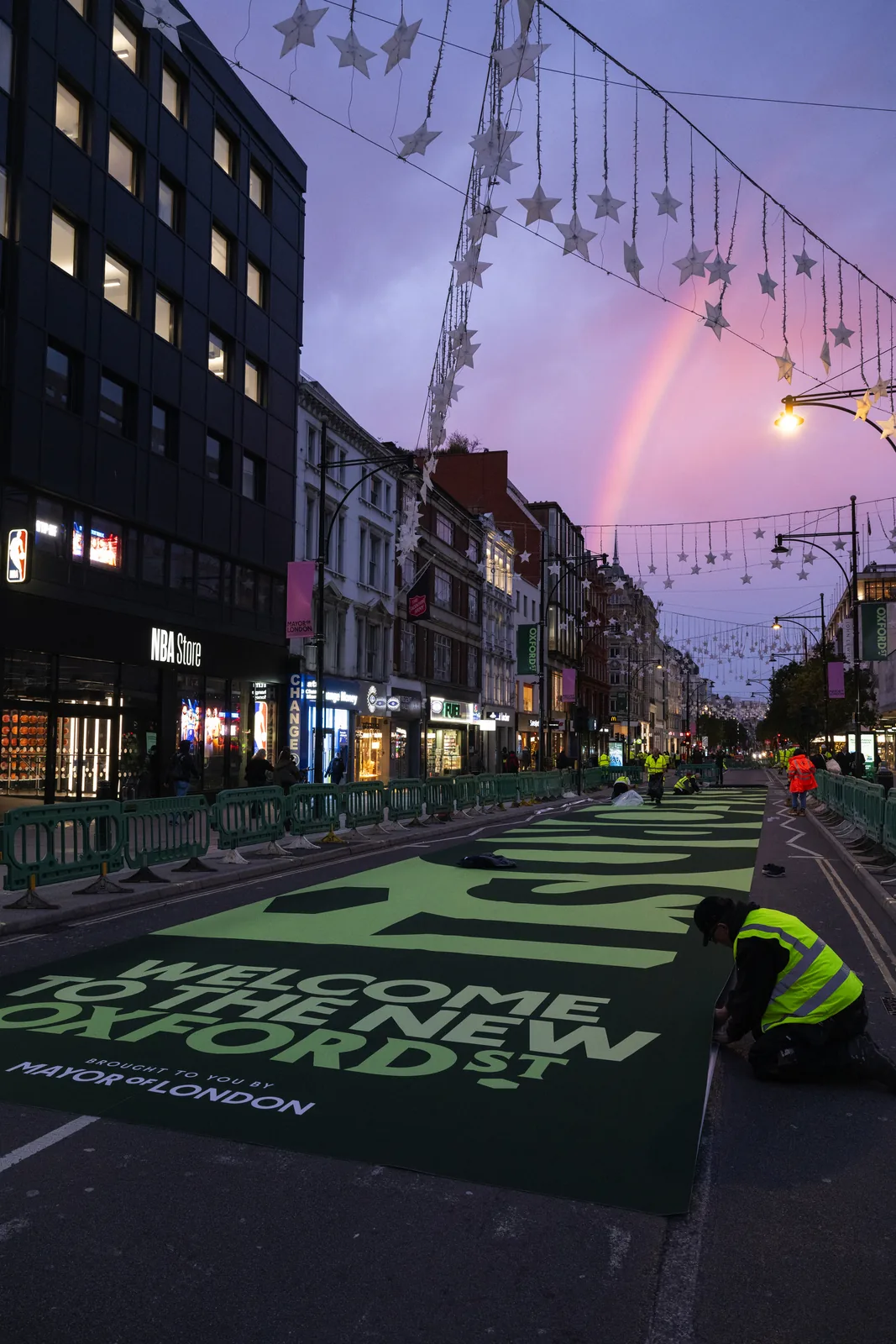
The early works remove road markings and add seating, planting and signage. ArchDaily describes timber and steel benches placed at intervals where they do not get in the way of people walking, timber seats and tables at stopping points marked by different paving textures, and textured stone surfacing to guide movement, with larger pavers at the north to south crossings. Trees will grow in large pots until they can be lowered into the ground for good. Sensors built into the furniture will record how many people pass and how long they stay, and that data will be combined with feedback from residents, businesses, accessibility groups and others to shape the permanent scheme.
By the end of spring 2027, City Hall expects more than 50 new trees, more than 100 seats and dining tables, new lighting, clearer signage and two public squares, which ArchDaily locates near Holles Street and Duke Street. Construction of the permanent design for this stretch is due to start later in 2027 and finish in 2028.
Buses, deliveries and access
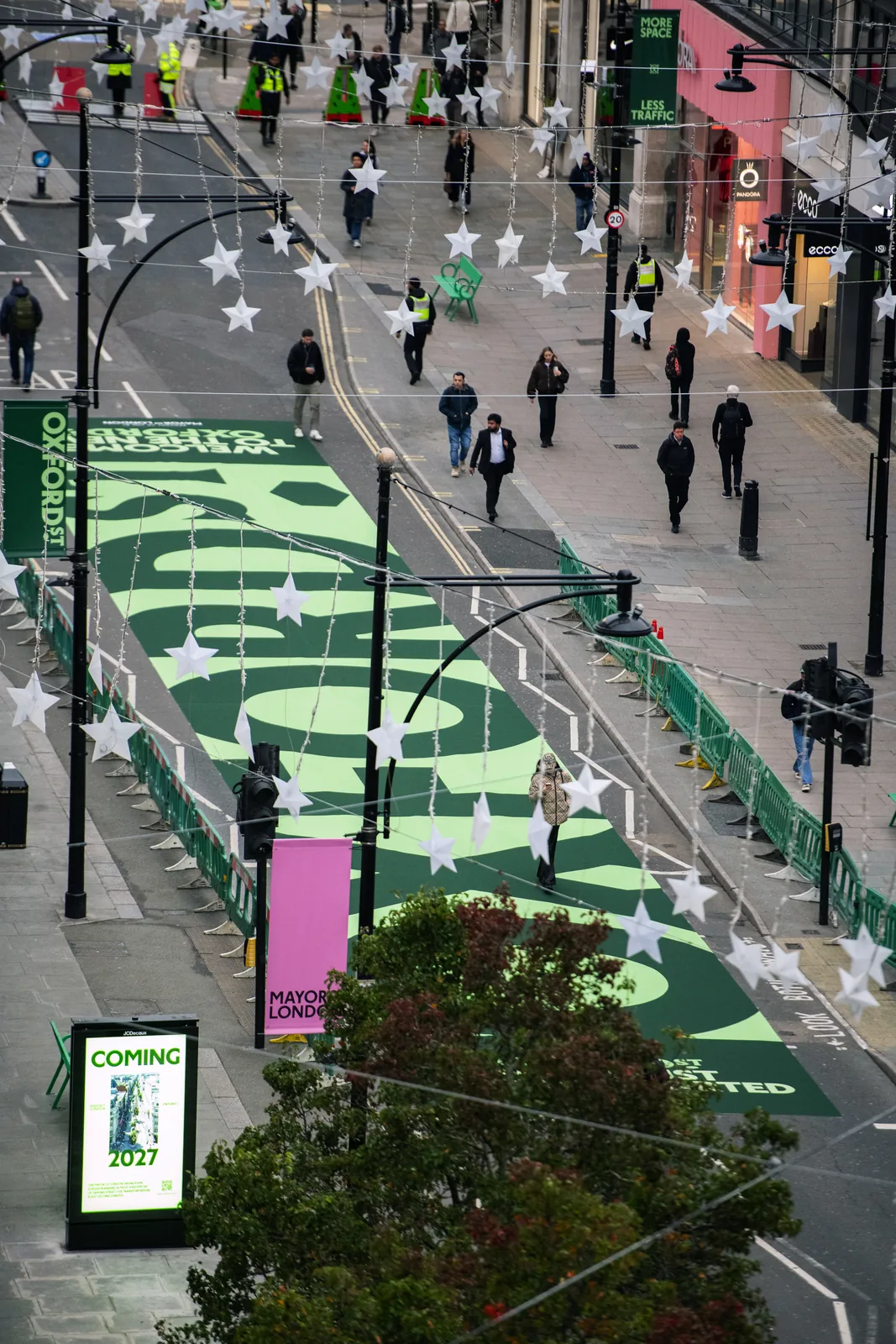
Buses and other vehicles now run on nearby roads, and new stops on Wigmore Street, Cavendish Place and Henrietta Place sit roughly 200 metres from the closed section. Emergency services keep access at all times, deliveries are allowed between midnight and 7am, and cross streets such as Duke Street, New Bond Street and Regent Street stay open. Transport for London maintains the street, while Westminster City Council keeps cleaning it.
Accessibility is a stated priority. Guide Dogs said the change could make the street more inclusive for the roughly 214,000 people in London who live with sight loss, and DisOrdinary, which has worked with the design teams on disabled people’s experience of the street, said it hoped the project could become an example of adapting places “not originally designed with Disabled people in mind.” Khan called the opening “a truly momentous occasion for the capital.”
The stakes are commercial as well as spatial. According to City Hall, spending on Oxford Street runs to around £3.1bn a year, and the Mayor wants the project to put it back alongside destinations such as La Rambla, the Champs-Élysées and Times Square.





Leave a comment