


Table of Contents Show
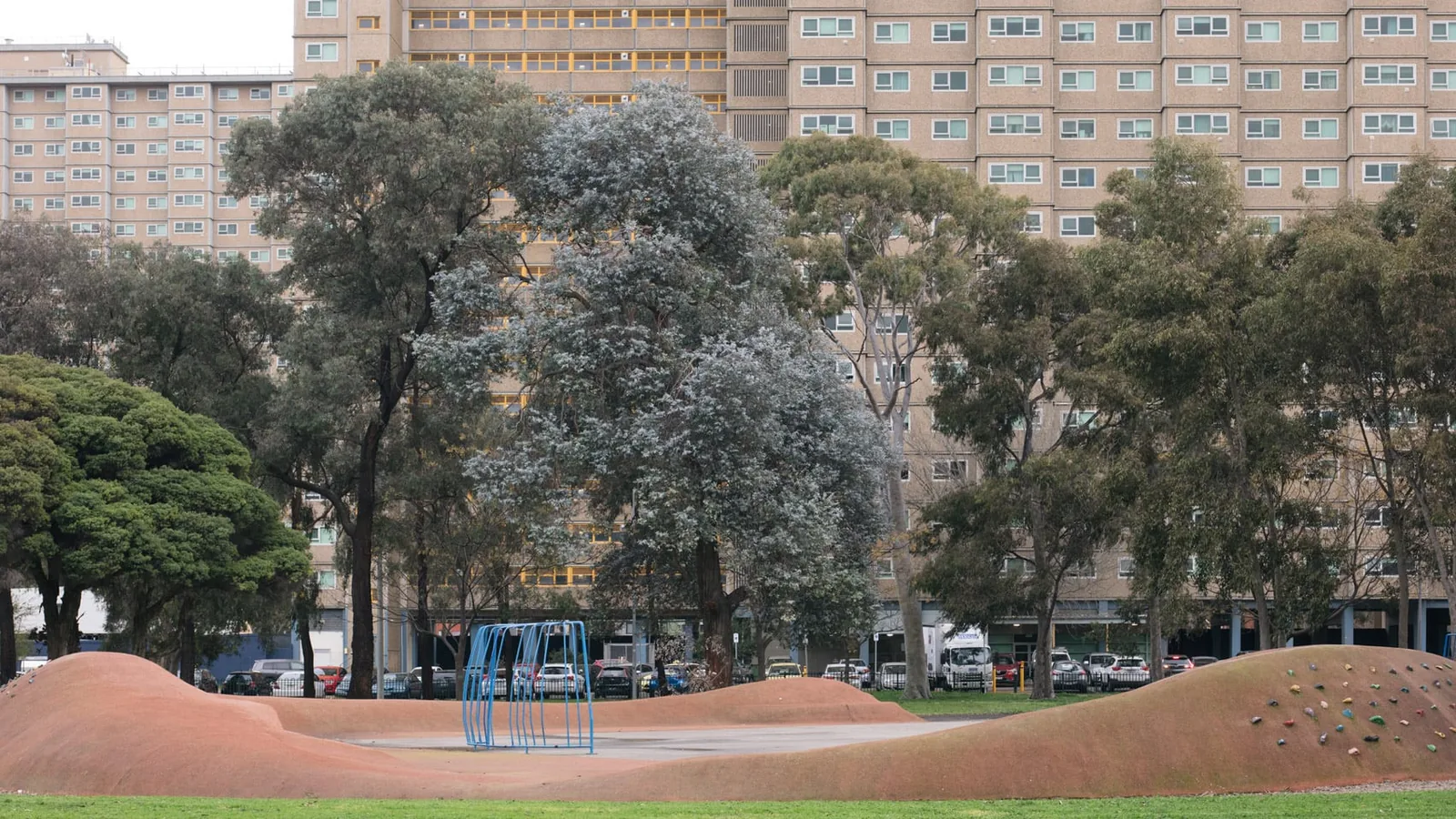
Architect Simon Robinson, director of the Melbourne research and design practice Office, has spent years pressing Victoria’s state government to study retrofitting rather than demolishing the Melbourne public housing towers it plans to tear down. In an interview with Dezeen, Robinson said the government holds feasibility studies on refurbishing the condemned estates but has not published them, despite requests from the Victorian Legislative Council. “We thought that was pretty odd that you wouldn’t do a refurbishment study on these estates,” he said.
 Houzee Awards 2027 Opens Entries Across 202 Residential Design Nominations
 Nearly Two Years After the Eaton Fire, Altadena Rebuilding Has Reached Only 179 of 6,746 Destroyed Homes
 Pliera BIM Platform Pairs a Browser-Based Modeller With AI-Generated Parametric Objects to Challenge Revit
 Aurora 275: Crosslam Builds What It Calls Brazil’s Tallest Hybrid Timber Building in São Paulo
The towers sit inside Homes Victoria’s High-Rise Redevelopment Program, a policy the state’s Labor government set in motion in 2023 under which every one of Melbourne’s 44 public housing towers, plus numerous smaller blocks, is slated for clearance and rebuilding over the next quarter century, with a 2051 target. State officials defend the timetable by pointing to the age of the stock, much of it put up across the 1960s and early 1970s, and to running costs they call unsustainable, while promising that the rebuilt sites will hold three times as many homes. Residents facing relocation say they were barely consulted, the policy has drawn scrutiny from a United Nations housing rapporteur, a legal challenge is still working through the courts, and the program has turned into a live issue in this month’s state election.
Retain Repair Reinvest: a cheaper fix for Melbourne public housing
Office has worked pro bono with residents on feasibility studies for three estates, developing an approach it calls Retain Repair Reinvest, which keeps the existing buildings and renovates them for comfort and energy efficiency rather than relocating residents and starting again. “So we took it upon ourselves to start to do these feasibility studies, along with public housing residents,” Robinson said, adding that the practice is not arguing every block is worth saving: “We’re also not saying that all of them should be refurbished, perhaps some are beyond repair.”
At Flemington Estate, once home to about 1,500 people before the clearance program began, the practice’s plan keeps all 720 existing dwellings in place and inserts 577 further infill homes alongside them, plus new facades, private balconies, underground parking and a communal green space. By Office’s reckoning the scheme comes in roughly $300 million cheaper than flattening the site and starting over, largely because nobody needs rehousing while the work is under way, a line item Robinson said officials have “consistently excluded and never disclosed.” Swapping in double glazing, rooftop solar and water-saving fittings, the practice calculates, would also leave the finished buildings with 55% less embodied and operational warming impact than a full rebuild.

One estate taken off the demolition list
The practice can point to one concrete result. Ascot Vale Estate, the first case study it released, was quietly dropped from Homes Victoria’s published demolition list, and a cluster of 57 three-storey brick blocks there that the architect Best Overend, an early and vocal champion of public housing, designed in 1947, has since been refurbished.
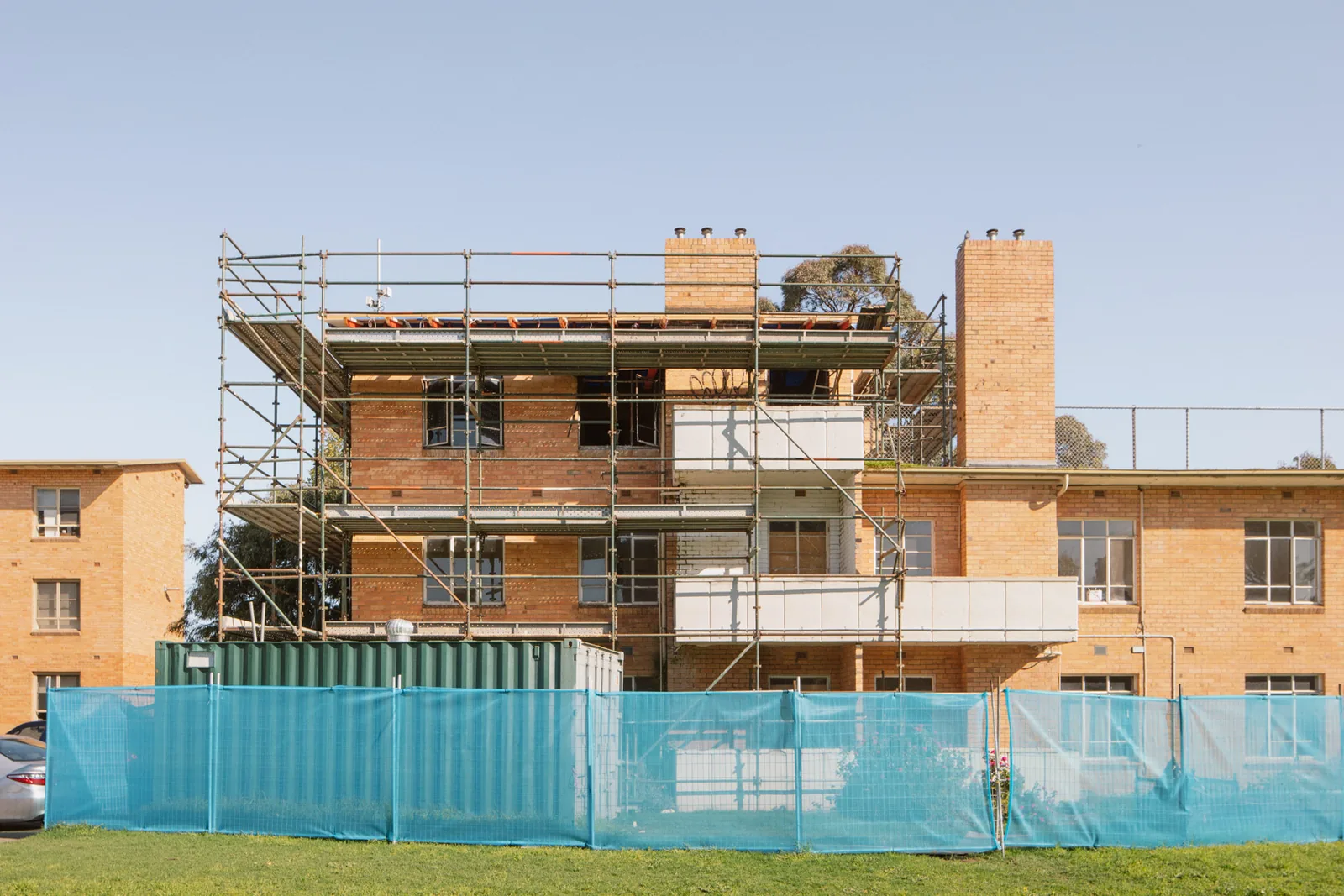
Barak Beacon Estate was not spared
Barak Beacon Estate, the second case study, had no such reprieve: the estate has already come down, and its replacement is on track to be finished before the year is out.
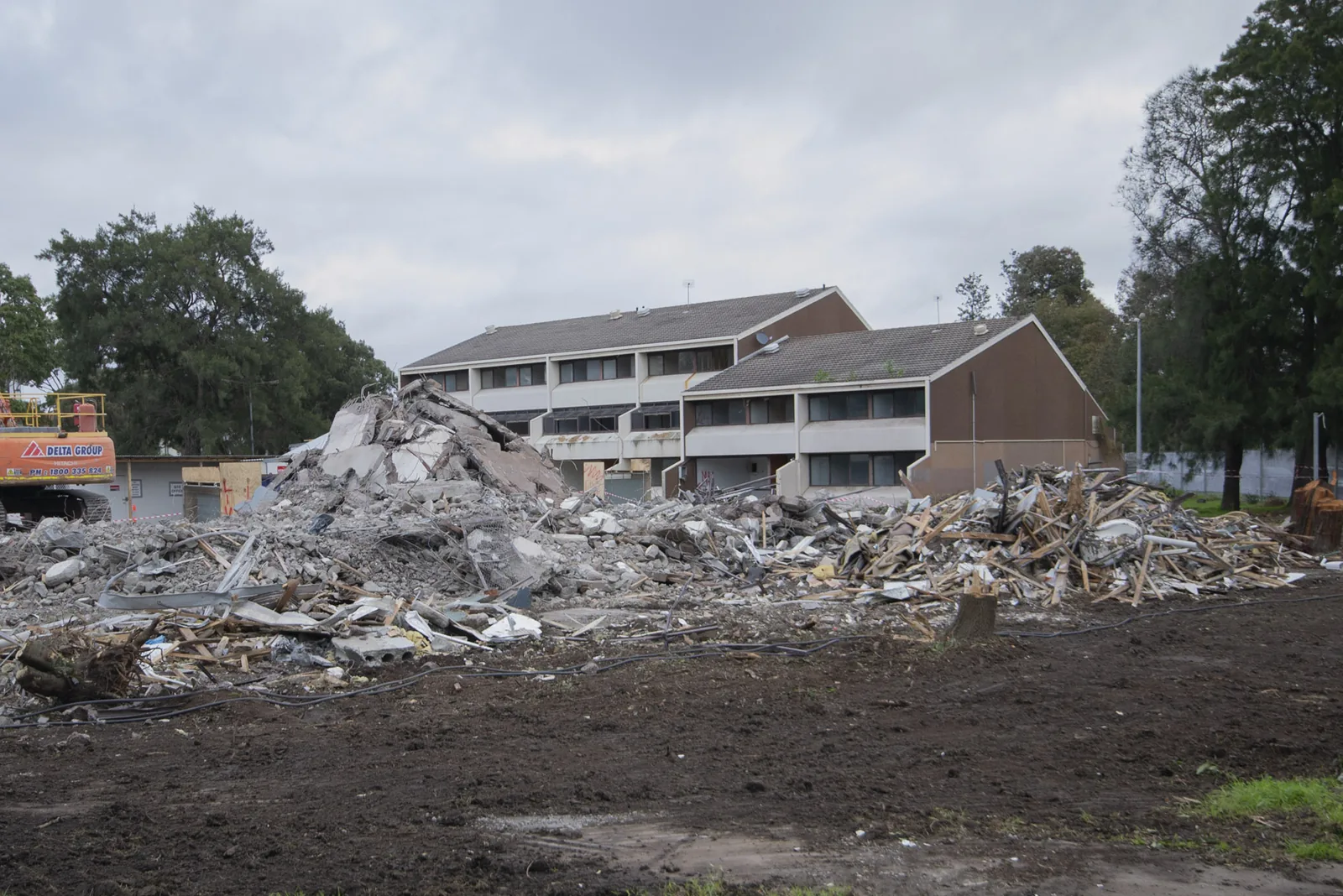
Flemington Estate’s fate awaits a court ruling
Flemington’s outcome is still open. Around 32 households are left across its four towers, a complex that accounts for about a tenth of all high-rise public housing in Victoria, with residents’ lawyers at Inner Melbourne Community Legal having taken their case all the way to Australia’s apex court after two lower courts sided with the demolition plan; judges heard the matter last month and a ruling is awaited. For now an injunction blocks Homes Victoria from serving any more eviction notices, the Liberal opposition says it would put the whole redevelopment program on hold if elected this month, and state politicians were already debating Office’s retrofit case back in November 2023.
Robinson also argues that the housing replacing the towers will not be public housing at all, but “community housing” built by private developers and let at a mix of below-market and market rents, with less secure tenancies than before. “The government is now calling everything social housing, because they don’t want the public to know that it’s no longer public housing,” he said. Victoria’s social housing stock, at 3% of all dwellings, already sits below the national average of 4.2% and the OECD average of 7%, while more than 60,000 people are on the waitlist. Dezeen put Robinson’s claims to the Victorian government, which said it could not respond before the election.
















Leave a comment