


Insta360 has switched on a spatial capture feature for owners of its X6, X5 and X4 Air 360° cameras, letting anyone turn a short walkthrough video into an explorable 3D scene without any editing or modeling skills. The tool is already live in several markets, including France, and is scheduled to reach the United States on September 28, according to a hands-on test published by 3DVF writer Benoît Rogez.
The idea, as 3DVF sums it up, is to turn videos into 3D scenes without requiring any technical skills. Users hold the camera, walk through a space, and the footage is uploaded so the company’s servers can reconstruct it into a navigable environment that can be shared like a link to a video game level.
How Insta360’s spatial capture works
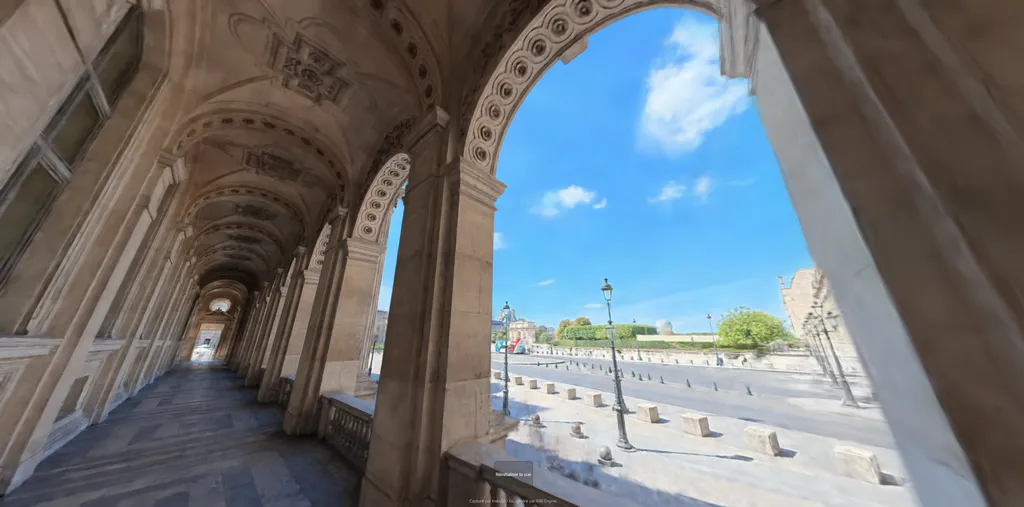
The underlying technique is Gaussian splatting, a rendering method that has advanced quickly over the last few years. Rather than building a traditional 3D mesh, the software represents a scene as a cloud of colored “splats”, which Rogez compares to a three-dimensional form of pointillism. That approach is what allows the system to reproduce tricky effects like reflections and transparency that conventional 3D scanning often struggles with.
Capture is meant to be quick and forgiving. Insta360 recommends scanning spaces under 100 square meters, ideally a well-lit indoor room, while walking about 30 percent slower than normal and doubling back over areas that need more detail. Recording tops out at two minutes, and footage must be shot in 8K at 30 frames per second; the selfie stick that ships with the camera is recommended, held roughly 50 centimeters from the body at chest height. Crowded scenes are best avoided, since although the software filters out pedestrians and vehicles, too much movement can degrade the reconstruction.
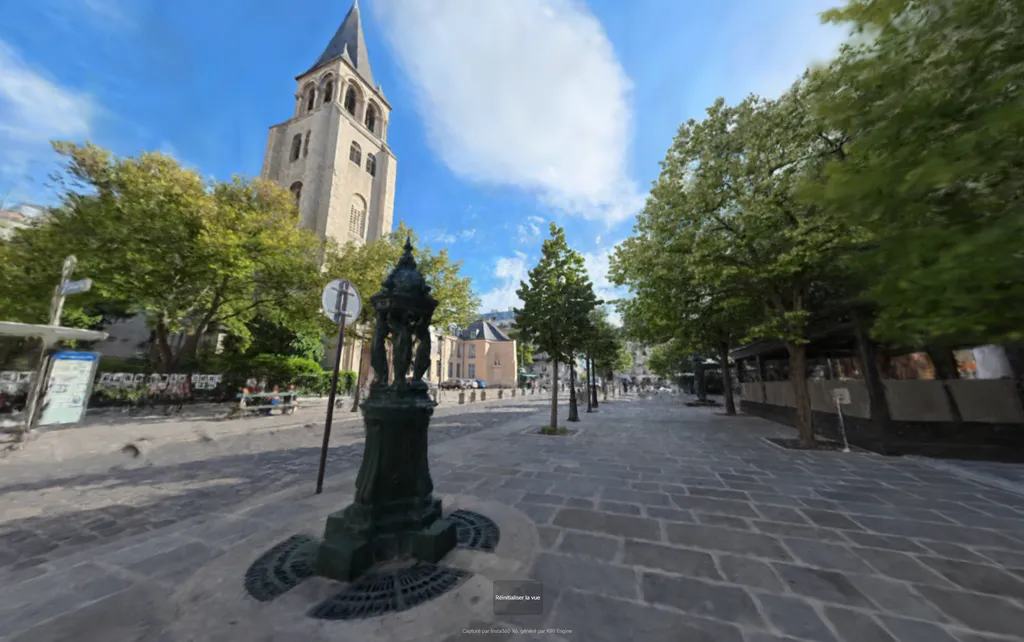
Once uploaded, processing happens in the cloud. During 3DVF’s tests it typically took around 40 minutes, fast enough that a scene captured at the Louvre or in a Paris park was ready to view by the time the reporter had gotten home on the metro.
3DVF’s Insta360 X6 test results around Paris
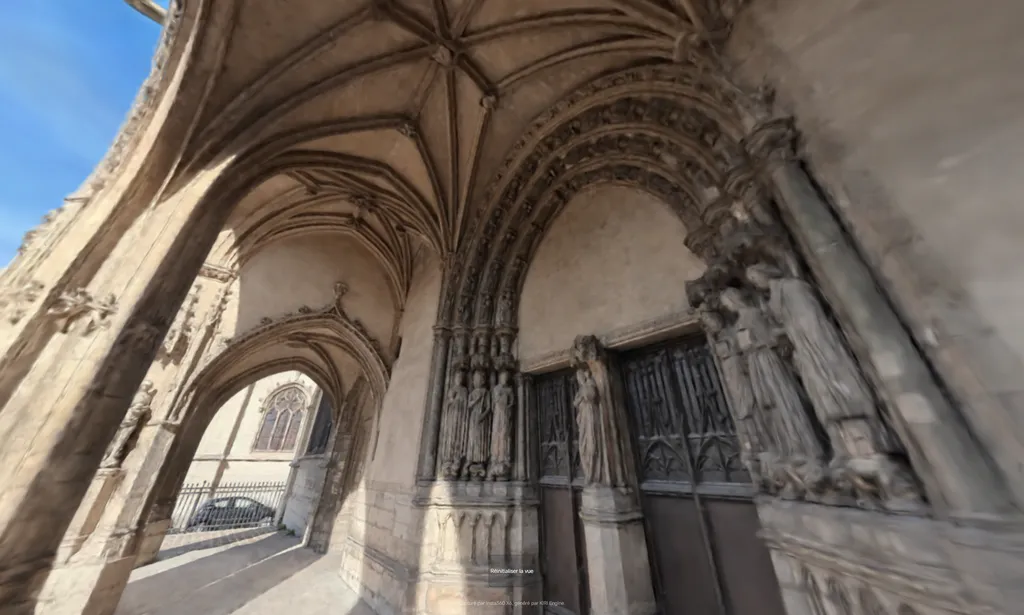
Using an X6 and an X5 supplied by Insta360, though the article was not sponsored, Rogez captured a range of locations. A pass in front of a Paris church produced sharper detail near the entrance, where more time was spent filming. A greenhouse interior came through recognizably, though a separately processed, GPU-rendered version made overnight was far more detailed. A covered walkway at the Louvre generated a clean overview scene suitable for location scouting.
Not everything reconstructed cleanly. In one Paris street scene shot with the X5, railings and plants held up well but a staircase did not: attempting to climb it in the finished scene simply passes through the steps. A person who stood mostly still during filming turned up as a ghostly presence in the reconstruction, while moving cars were successfully edited out. Inside a Louvre gallery of small sculptures, reflective glass and a glossy floor produced hazy artifacts described as “floaters.”
The clearest failure came when 3DVF deliberately broke the rules, scanning the reflective Olympic balloon and flame in the Jardin des Tuileries. Rushing to circle the metallic sculpture within the two-minute limit, surrounded by tourists and shooting over bare, featureless ground, the attempt produced what Rogez called an unusable jumble of splats, a result he says underlines why Insta360’s shooting guidelines exist.
Pricing and current limitations
Insta360 is offering the feature with a light-touch pricing model. Each user gets four free captures per month, after which users draw on an in-app credit system, and “each scene will cost no more than €1/$1,” less with credit packs or promotions.
3DVF flagged several constraints beyond the occasional artifact. The two-minute recording cap rules out digitizing anything larger than a room or a single monument, so users need to be selective about what they scan. Footage shot in Dolby Vision or iLog on the X6 is not yet supported, which the outlet notes is a missed opportunity for high-contrast interiors such as stained-glass churches. Processing speed is also prioritized over maximum fidelity, and Insta360 warns that the fast turnaround times seen in testing are not guaranteed if server demand rises. There is currently no way to embed a finished scene on an outside website the way one might embed a YouTube video. Rogez concludes that Insta360 has built the tool primarily as a consumer sharing feature, a way of preserving what he calls a three-dimensional memory of a place, rather than a professional scanning solution.
The feature’s wider rollout continues with its planned US launch on September 28.











Leave a comment