


Nearly two decades after George Lucas first set out to build a museum for the art of storytelling, the doors are about to open. The Lucas Museum of Narrative Art will debut on September 22 in Los Angeles, capping a project that took eight years to build and far longer to plan, after earlier attempts to locate it in San Francisco and Chicago collapsed.
Speaking to reporters at a press preview, Lucas reflected on the difficulty of getting the museum built at all. “I’m used to doing the impossible,” he said, “but this one almost broke my will.”
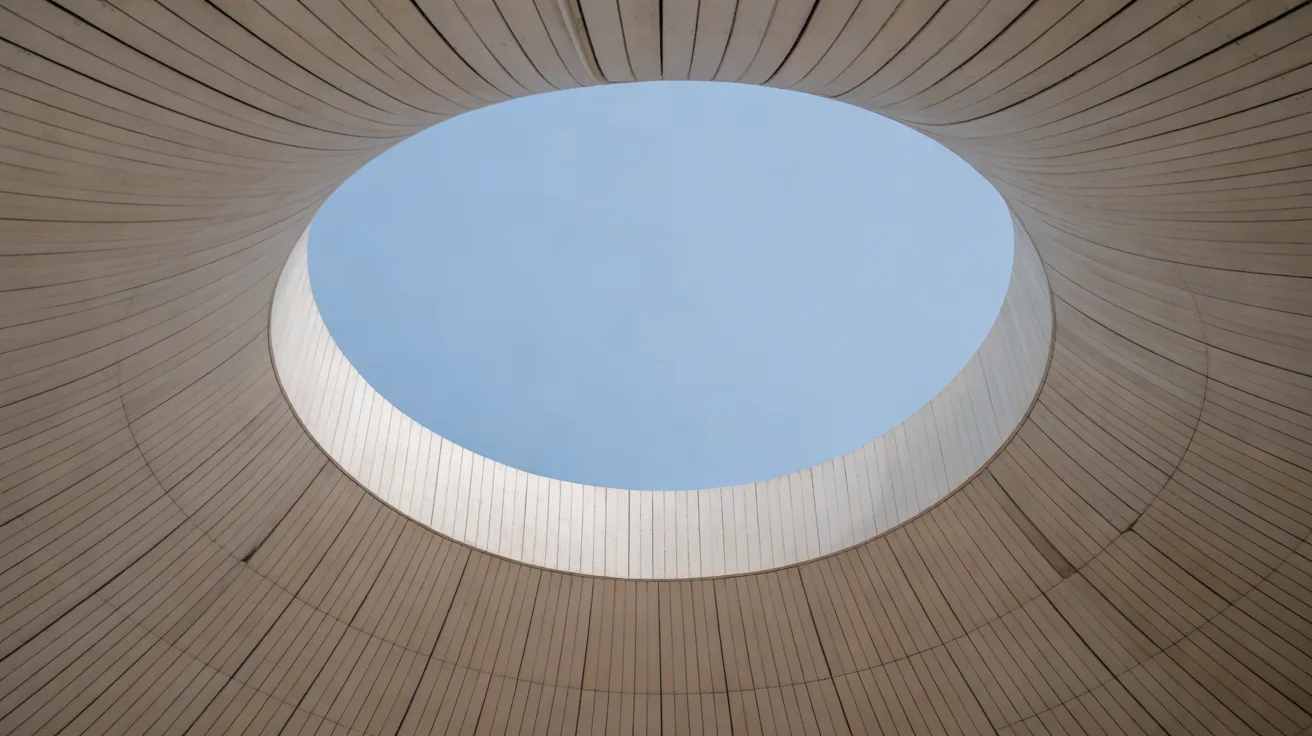
The building rises beside the University of Southern California, Lucas’s alma mater, with a curved, saucer-like form that architect Ma Yansong says was shaped less by science fiction than by natural references. He has pointed to tree canopies and cloud formations as his inspiration, though the resemblance to a spacecraft is hard to miss. A central plaza connecting the museum’s two wings includes an oculus that Yansong said lets visitors “see the sky and the universe.”
A Home for Storytelling in All Media
Across 100,000 square feet of gallery space, the museum brings together an unusually wide range of visual storytelling, spanning comics, illustration, photography, sculpture, murals and painting. Works by Norman Rockwell, Diego Rivera, Judy Baca and Banksy sit alongside costumes from film and drawings from comic strips such as Asterix and Garfield.
For Mellody Hobson, Lucas’s wife and co-founder of the museum, cinema’s popularity made Los Angeles the natural site for the project. “The largest, most popular form of narrative art is cinema,” she said. “So what better space for it to be than the home of storytelling?” She added that narrative art “depicts the myths that anchor us, the stories that we believe in.”
Senior curator Ryan Linkof described the museum’s guiding idea as recognition of imagery that is often overlooked. “Visual storytelling is the art that surrounds us,” he said, citing newspaper photographs, book covers, advertisements and street art as examples of forms rarely treated as fine art despite their constant presence in daily life.
From Cave Paintings to Comic Strips
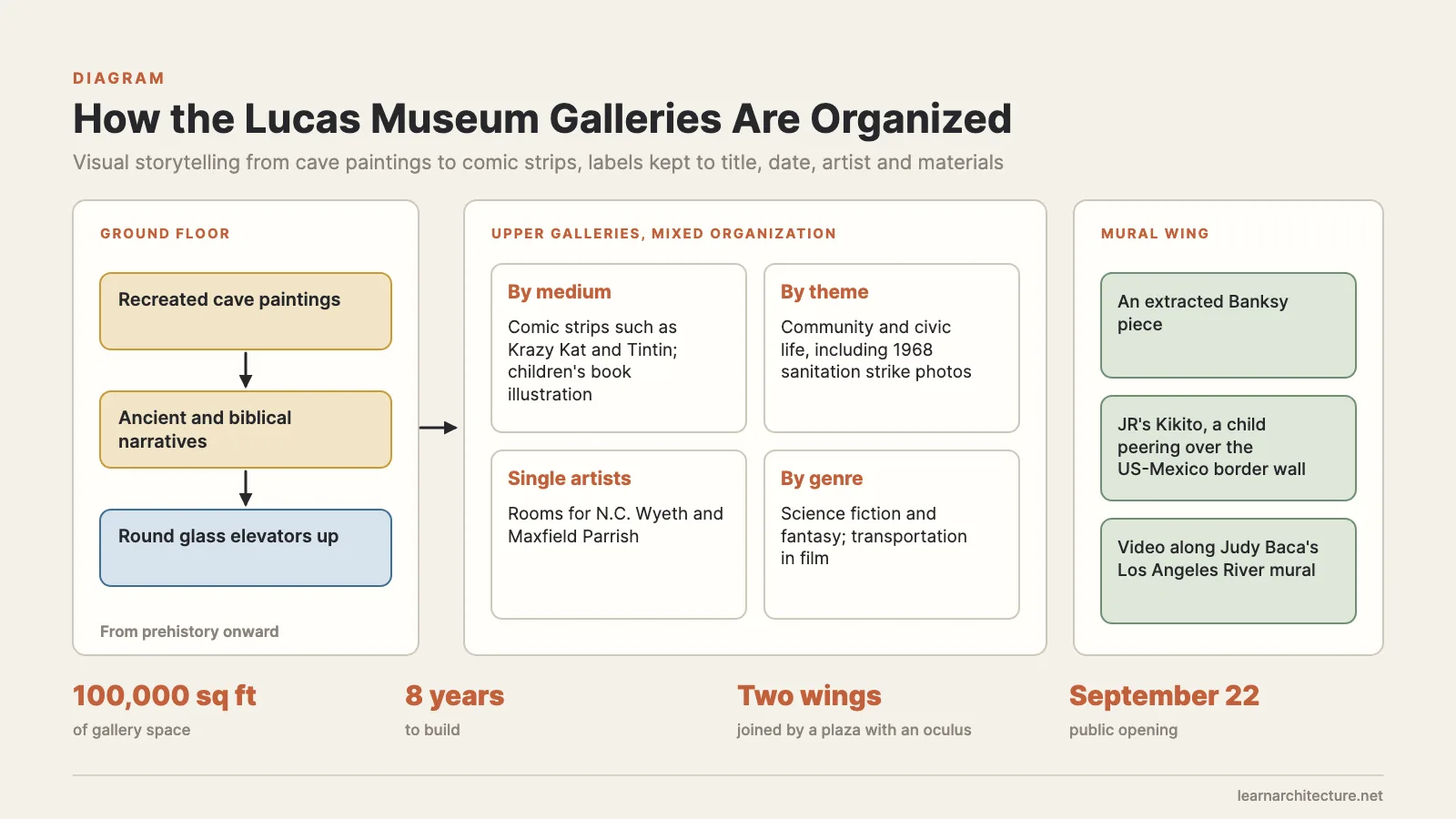
The museum’s ground floor traces visual storytelling from prehistory onward, opening with an immersive recreation of cave paintings before moving through depictions of ancient and biblical narratives. Visitors then reach the core collection, drawn largely from the 20th and 21st centuries, by way of round glass elevators.
Upstairs, the galleries are organized inconsistently by medium, theme and individual artist. Comic strips including Krazy Kat and The Adventures of Tintin fill one room; children’s book illustrations from Where the Wild Things Are fill another. Thematic galleries address subjects such as community and civic life, featuring photography from a 1968 sanitation workers’ strike alongside a recent Shepard Fairey and Ernesto Yerena Montejano piece addressing immigration enforcement. Other rooms are devoted to single artists, including N.C. Wyeth and Maxfield Parrish, or to genres such as science fiction and fantasy. A gallery on transportation in film offers vehicle models and costumes for those seeking a connection to Lucas’s own filmography, alongside what organizers describe as further subtle references scattered throughout the building.
The mural collection occupies its own wing, including an extracted Banksy piece and JR’s Kikito, a large-scale image of a child peering over the US-Mexico border wall. A video installation traces the full length of Judy Baca’s mural depicting the region’s history along the Los Angeles River.
Minimal Labels, Maximum Interpretation
Rather than lengthy wall text, each work carries only a small plaque with title, date, artist and materials. Linkof said this was intentional, meant to avoid an experience that is “heavily mediated,” telling visitors “where to look, how to look, what to think, how to understand and interpret something.” Instead, he said, “we’re encouraging people to have their own individual encounters with works of art and take away what they feel like speaks to them.” Visitors curious for more context can scan artworks with a phone for a brief description.
Museum CEO Tracey Bates argued that many of the artists on display have long been denied the institutional recognition given to fine artists working in more traditional forms. “Rockwell in his day was not considered an artist, more an advertising illustrator,” she said, “but actually, the process, the level of depth in those images, he is one of our greatest storytellers.” Bates said Lucas describes the collection simply as the People’s Art, adding: “This museum is its home.”
The Lucas Museum of Narrative Art opens to the public on September 22.
The Lucas Museum joins a long line of buildings where the architecture is part of the argument rather than a container for it. See our selection of famous museums that redefined architecture for how earlier examples handled the same problem.










Leave a comment