


Table of Contents Show
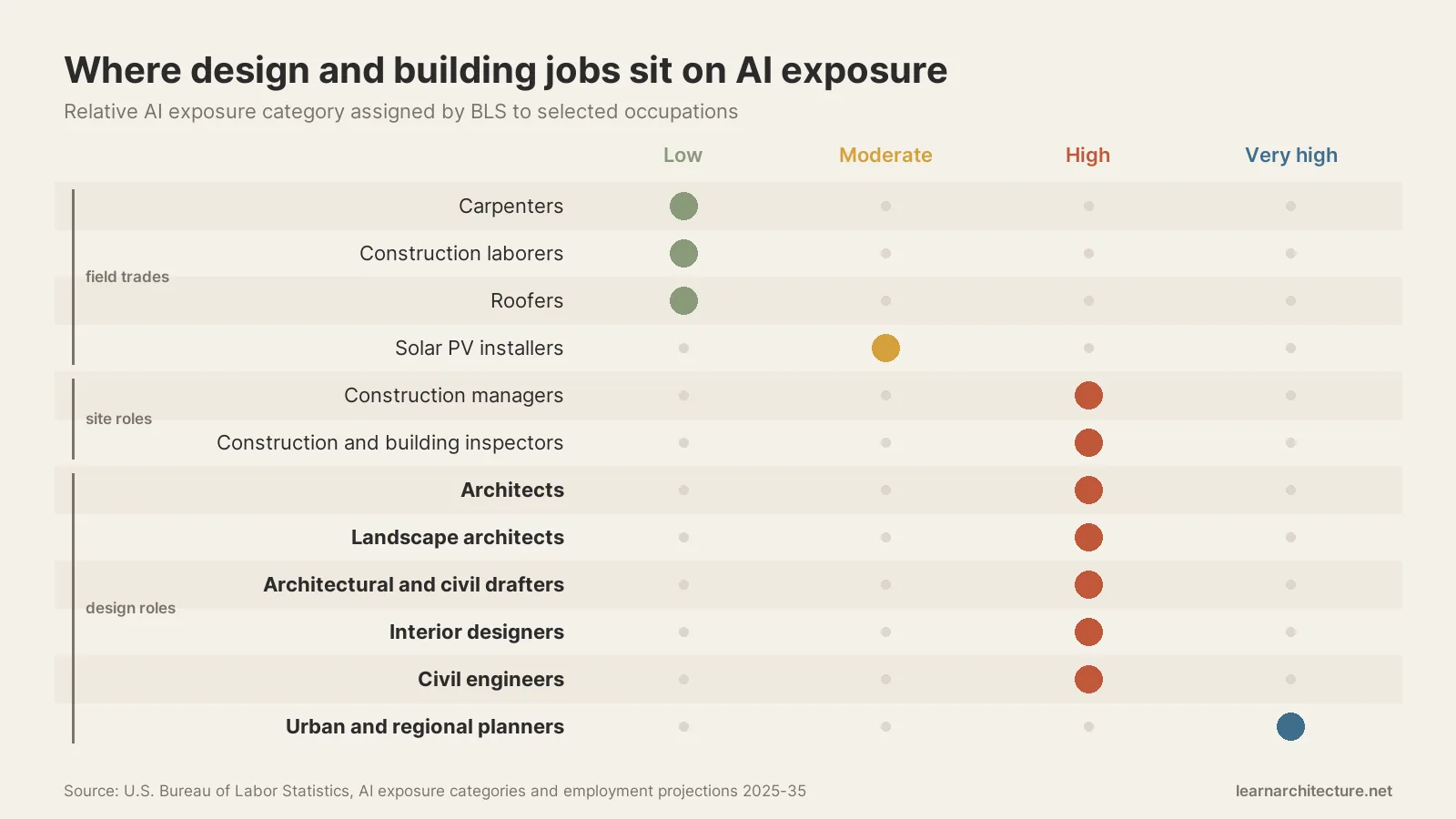
Most jobs on a building site are only lightly exposed to current AI tools, but the design professions that work alongside them are not. According to the National Association of Home Builders (NAHB), which analysed U.S. Bureau of Labor Statistics (BLS) figures, 45 of the 47 construction occupations it selected, about 96%, carry “low” or “moderate” relative AI exposure. In the same BLS table, architects, landscape architects, interior designers, civil engineers and architectural and civil drafters are all rated “high”, and urban and regional planners “very high”.
 Autodesk CEO Says AI Won’t Replace Architects but Suggests Firms Hire Fewer and Budget for Technology
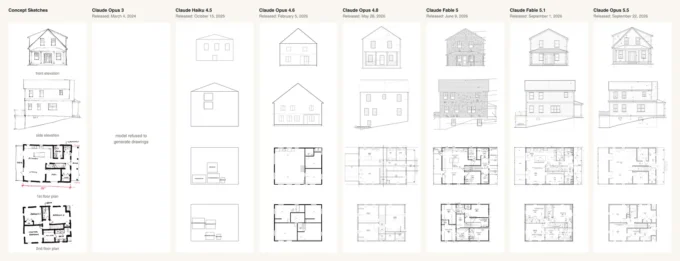
 An Architect Tested 13 AI Models on a House Drawing Set and Found a Sudden Leap
 BDP and Galliford Try Fail to Have Aberdeen Hotel Cladding Claim Dismissed
 Scott Brownrigg’s Pre-Tax Profit Rises to £4.4m as UK Fee Income Grows 37%
The NAHB analysis, published on its Eye on Housing blog by Jing Fu, NAHB’s senior director of forecasting and analysis, focuses on construction and trades occupations plus construction managers. It states that it does not cover adjacent occupations such as architects, engineers and cost estimators, so the figures for design roles below come directly from the BLS table it is based on.
How BLS measures AI exposure
The BLS published its AI exposure categories as a supplement to its 2025-35 employment projections. It combined five outside sources. Three are theoretical measures of how well AI capabilities match the work an occupation involves, from Felten, Raj and Seamans, from Eloundou and colleagues and from Eisfeldt and colleagues. The other two are based on observed use: Anthropic’s measure built from Claude conversations and API traffic, and Microsoft’s measure built from Copilot data.
Each occupation receives a percentile rank in every source, and BLS then clusters the occupations into four groups: low, moderate, high and very high. The 831 detailed occupations in the table are split almost evenly between the four. BLS stresses that the category is relative, and that it is not a forecast of job losses, wages, productivity or adoption. The theoretical sources also reflect AI capabilities available no later than mid-2023.
AI exposure on the building site
Only two of the 47 construction occupations are rated high: construction managers and construction and building inspectors. NAHB links this to how much of those jobs is scheduling, paperwork, compliance checks, reporting, planning and communication. The low group includes carpenters, construction laborers, roofers and operating engineers, whose work rests on hands-on execution, site conditions that change from day to day, safety calls and the handling of materials and equipment.
That pattern matches how builders say they use the technology. In NAHB’s Housing Market Index special questions, builders said they use AI mainly for information-heavy work: marketing and advertising, planning projects and designing them.

Exposure is not a growth forecast
The BLS projections show how weakly exposure tracks employment. Construction managers are projected to grow 9.1% between 2025 and 2035, while employment of construction and building inspectors is projected to stay flat. Solar photovoltaic installers, rated moderate, are the fastest-growing occupation in NAHB’s group at 36.5%.
For architects, the table projects employment rising from 124,600 in 2025 to 129,900 in 2035, a gain of 4.3%, with a median annual wage of $99,280 in 2025. Landscape architects are projected to grow 4.4%, architectural and civil drafters 5.2% and interior designers 2.7%, all from the high exposure group.

What a high rating means for architecture practices
A high rating places an occupation above most others on the combined theoretical and observed-use measures, meaning more of its tasks overlap with what AI tools can assist with or complete. It does not say how many architects firms will need, a question that has divided industry leaders, as we reported when Autodesk chief executive Andrew Anagnost suggested firms might hire five or seven people instead of ten.
NAHB expects AI to augment existing construction work first: quicker estimating and planning, managing documents, tracking progress, analysing safety and supporting decisions. Changes in the field are likely to arrive more slowly, as robotics, computer vision and equipment with built-in AI reach job sites.













Leave a comment