



Table of Contents Show
The best interior design books teach the principles behind good rooms, not just pretty pictures of them. A strong reading list mixes color theory, spatial planning, styling technique and design history, so you understand why a space works before you decorate it. The titles below cover both fundamentals for beginners and deeper references that working designers return to for years.
Whether you are starting an interior design course, furnishing your first apartment, or building a professional library, reading widely shortens the learning curve. Books give you a vocabulary for proportion, light and material that visual inspiration alone cannot. This guide groups recommended interior design books by what they actually teach, so you can choose the right starting point for your goals.
Why Read Interior Design Books at All?
Reading interior design books builds the theoretical foundation that social media and showroom visits skip over. Books explain the reasoning behind balance, scale and color relationships, giving you transferable principles you can apply to any room rather than copying a single trend. For interior design beginners, that grounding turns guesswork into confident decisions.
There is also a practical career angle. Most accredited programs and professional bodies expect designers to know the canon of design theory, color science and the history of the field. Reading the standard texts means you share a language with educators, clients and collaborators. If you are still mapping out the broader discipline, our overview of popular interior design concepts pairs well with the books listed here.
📌 Did You Know?
Josef Albers developed the color exercises behind Interaction of Color over roughly forty years of teaching, first at the Bauhaus, then at Black Mountain College, and finally at Yale University. The book was first published by Yale University Press in 1963 as a limited silkscreen edition with 150 color plates.
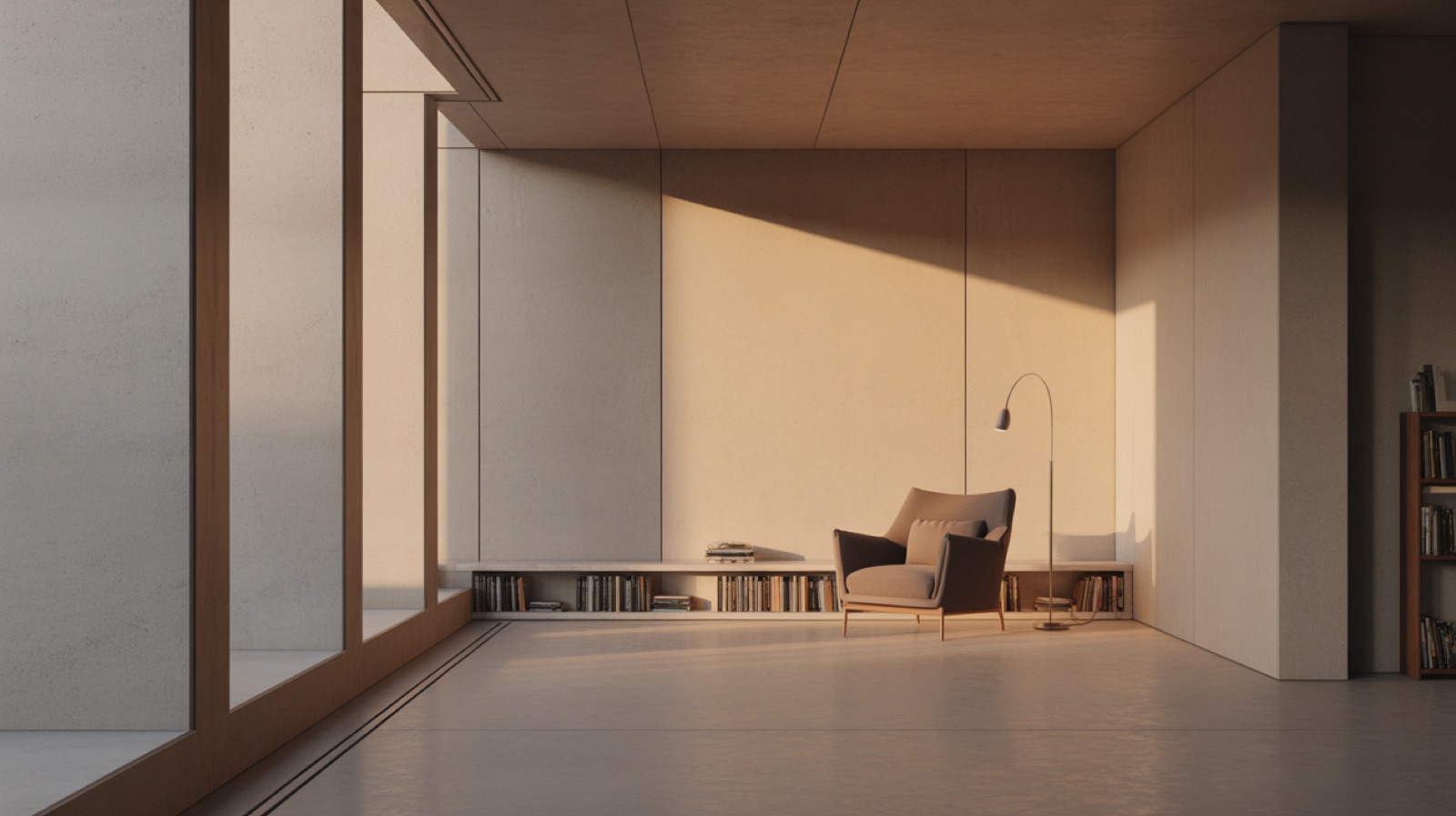
Best Interior Design Books for Color Theory
Color is the single most powerful and most misused tool in a room, which is why color sits at the top of nearly every serious reading list. These design theory books move past matching swatches and into how colors behave next to one another, under different light, and across a whole scheme.
Interaction of Color by Josef Albers
This is the foundational color text for designers of every kind. Albers shows, through paired studies, that a single color looks different depending on what surrounds it, which is exactly the problem you face when a paint chip behaves differently on the wall. It is a workbook as much as a reading book, and the lessons apply directly to interior palettes, where the same paint can read warm in a north-facing room and cold in a south-facing one. Working through even a handful of its studies changes how you choose accent colors, undertones and the balance between a dominant hue and its supporting tones. The Yale University Press history of the book traces how Albers built these exercises in the classroom.
The Colour Scheme Bible and Choosing Colours
Where Albers teaches perception, these titles teach application. The Colour Scheme Bible walks through how color shapes mood and the perceived size of a space, and how to assemble harmonious schemes for real rooms. Choosing Colours by Kevin McCloud is a practical companion for picking palettes that hold together across walls, textiles and furniture. Read alongside our guide to popular interior design styles, they help you match a palette to the look you are after.
⚠️ Common Mistake to Avoid
Many beginners treat a color book as a catalog of finished schemes to copy. The greater value is in the principles. Read for how undertone, light and adjacency change a color, then test your own samples on the actual wall at different times of day before committing to gallons of paint.

Best Interior Design Books for Theory and Fundamentals
Before styling comes structure. These books cover the bones of a space: how to plan, proportion and organize a room so that it functions as well as it looks. They are the design theory books most often assigned in foundation courses.
101 Things I Learned in Architecture School by Matthew Frederick
Short, illustrated and quietly brilliant, this book distills the principles taught across a full design education into single-page lessons on line, proportion, the design process and presentation. Published by MIT Press, it crosses easily between architecture and interiors and is one of the most accessible entry points for interior design beginners. The MIT Press listing describes its lesson-by-lesson format.
Form and Structure in Interior Architecture
By Graeme Brooker and Sally Stone, this text focuses on how to arrange rooms for circulation, function and flow. It is more technical than a styling book and rewards readers who want to understand spatial planning, the discipline that separates a decorated room from a designed one. If you want to go further into the spatial side, our piece on interior architecture concepts extends these ideas.
💡 Pro Tip
Read fundamentals and styling books in that order, not the reverse. Working designers often recommend grounding yourself in proportion and spatial planning first, because once you understand why a layout works you can style almost any palette onto it. Jumping straight to styling tends to produce rooms that photograph well but feel awkward to live in.

Best Interior Design Books for Styling and Practice
Once the fundamentals are in place, styling books teach the finishing layer: arranging objects, layering textures and making a space feel collected rather than staged. This is where the books for interior designers get tactile and immediately useful.
Styled by Emily Henderson
Subtitled Secrets for Arranging Rooms, from Tabletops to Bookshelves, this is the go-to practical guide for vignettes, shelf styling and pulling a room together. Henderson breaks styling into repeatable formulas for grouping objects in odd numbers, varying height, and mixing textures, which makes it ideal for anyone who feels stuck once the furniture is in place. Because the advice is concrete rather than abstract, you can apply a single chapter to a coffee table or a mantel the same afternoon you read it. It is a strong bridge between theory and the everyday decisions that finish a space.
Pattern Play by Rebecca Atwood
Written by a textile designer, Pattern Play tackles the part of styling that intimidates most people: combining patterns without chaos. Atwood explains scale, color and rhythm in mixing prints, which is invaluable for textiles, wallpaper and soft furnishings. It complements the furniture and decor decisions covered in our guide to furniture and decor in interior aesthetics.
⚖️ Pros & Cons at a Glance
✔️ Pros of styling-led books: immediately actionable, visually rich, fast confidence boost, easy to apply at home.
✖️ Cons: lighter on underlying theory, can date with trends, less useful for technical or commercial work without a fundamentals base.
Best Interior Design Books for History and Context
Knowing where a style comes from makes you a far more deliberate designer. History books explain why mid-century modern feels the way it does, how the Bauhaus reshaped the link between function and form, and what made movements like Art Deco or minimalism take hold. This context keeps your interior design reading from becoming a series of disconnected trends.
The Story of Design and Survey Histories
Broad survey histories trace decorative arts and interiors from early craft traditions through industrialization to contemporary practice. They are dense, but they reward slow reading because they reveal the recurring logic behind ornament, proportion and material across centuries. For students, a single strong survey often replaces a shelf of narrower titles and anchors everything else you read.
Movement-Focused Monographs
Once a survey gives you the map, monographs on specific movements or designers fill in the detail. A focused book on the Bauhaus, Scandinavian modernism or a single influential designer teaches you how a coherent visual language is built and sustained. The collection notes published by the Metropolitan Museum of Art, which holds Albers’s work, are a reliable, free way to study primary sources behind these movements.
🔢 Quick Numbers
- Interaction of Color was first published in 1963 as a limited silkscreen edition with 150 color plates (Yale University Press).
- Albers refined its exercises across roughly four decades of teaching at three schools: the Bauhaus, Black Mountain College and Yale (Yale University Press).
- 101 Things I Learned in Architecture School presents its lessons in a 101-item, single-page format (MIT Press).
How Should Beginners Build a Reading List?
Beginners should start with one fundamentals book, one color book and one styling book, then add history and specialism later. This three-book base covers structure, palette and finish, which are the three things every room needs. Reading one title from each group prevents the common trap of collecting ten styling books and never learning why a layout works.
A sensible starting trio is 101 Things I Learned in Architecture School for fundamentals, Interaction of Color for palette, and Styled for finishing. From there, branch toward whatever you want to specialize in, whether that is residential, commercial or sustainable design. Professional bodies such as the American Society of Interior Designers also publish resources and standards worth following as you grow into the field.
Frequently Asked Questions
What is the best interior design book for absolute beginners?
For absolute beginners, 101 Things I Learned in Architecture School by Matthew Frederick is the most approachable starting point. Its single-page, illustrated lessons cover the core principles of design without dense theory, making it easy to read in short sittings while still building a real foundation.
Do I need to read color theory books to be an interior designer?
Yes, color theory is essential. Color drives the mood, perceived size and cohesion of every room, and a text like Interaction of Color teaches how colors actually behave together rather than how they look in isolation. Skipping it leaves you guessing at one of design’s most influential variables.
Are interior design books still useful with so much online content?
Books remain valuable because they teach durable principles, while most online content shows trends. A well-chosen book explains the reasoning you can apply to any project, whereas a feed of inspiration images rarely tells you why a room succeeds. The two work best together, with books as the foundation.
How many interior design books should I own?
Quality matters more than quantity. A focused shelf of five to eight well-chosen titles spanning fundamentals, color, styling and history will serve you better than dozens of trend-led volumes. Add specialist books only as your interests and projects narrow.
Start with three titles, one each for structure, color and styling, and read them with a notebook beside you. The goal is not to finish a stack of books but to absorb principles you can apply the next time you stand in an empty room. Build the shelf slowly, and let each project tell you which book to read next.













Leave a comment