


Table of Contents Show
Researchers in Switzerland have shown how to make large building components from hemp rope and fungus with neither moulds nor synthetic resin. In a July paper in the journal Architectural Intelligence, they describe braided mycelium composites: a robot winds thick hemp rope into a braided scaffold, and living mycelium then grows through it and binds the points where the ropes cross. To show the process works at architectural size, the group made a panel of 2 by 1 metres.
The authors are Tiziano Derme, Alim Battal, Nicolas Boscoboinik and Benjamin Dillenburger of the Institute of Technology in Architecture at ETH Zurich, and Francis W. M. R. Schwarze of Empa in St. Gallen. The work is part of a mycelium research stream at ETH’s Digital Building Technologies group.
Why mycelium composites need a new production method
Mycelium, the thread-like network of a fungus, can colonise straw, sawdust or hemp and glue it into light, compostable boards, already sold for insulation and sound absorption. These are normally formed in rigid moulds in batches, which, the paper says, restricts custom shapes and continuous reinforcement. Mycelium alone is also weak in tension. In the braided system the rope is not a temporary support. It stays in place as the main reinforcement and load path, while the fungus takes over the job a resin would normally do at the junctions.
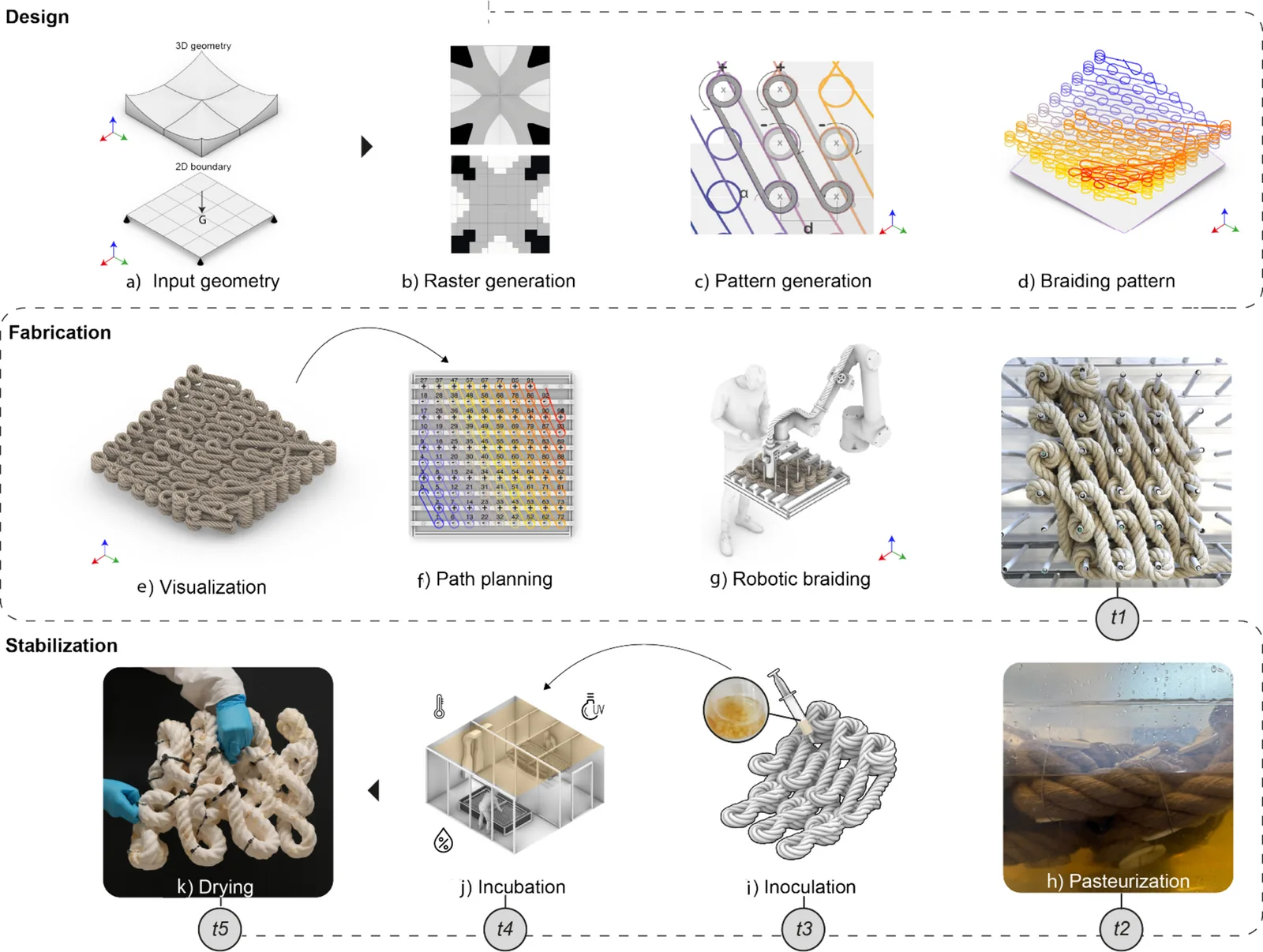
From a raster image to a robot path
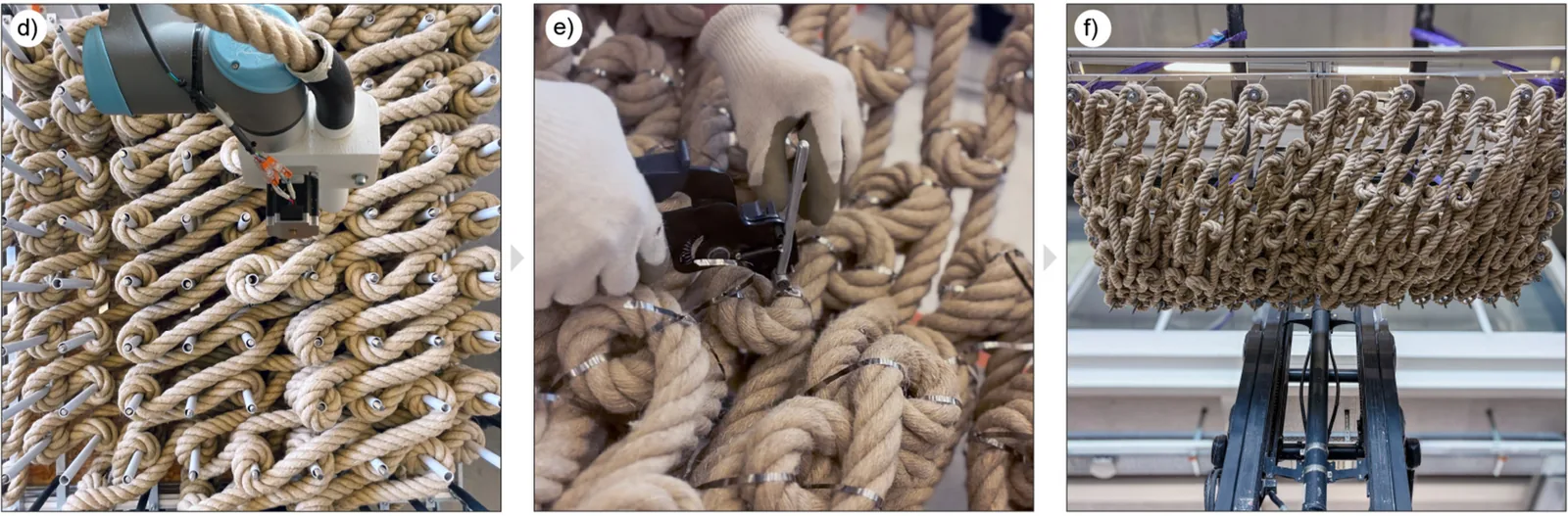
Design starts with a raster field: grey values on a grid set the number of rope layers, density and porosity of each zone, and the grid is matched to the rope diameter so that every pattern can be built. The braid sequence is then converted into targets for a six-axis robot arm, which feeds rope around a modular frame of pins and makes half-round detours around anchors to avoid collisions. Because hemp twists and drags in unpredictable ways, a person works next to the robot and presses the loops into place to keep them on the planned path.
Weeks of growth in a clean room
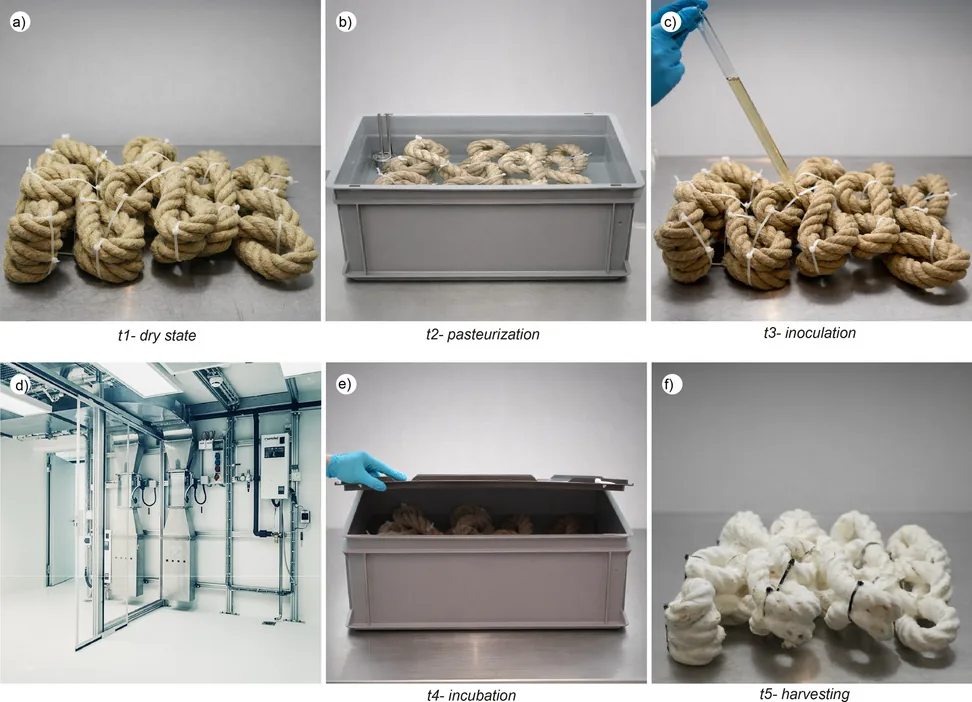
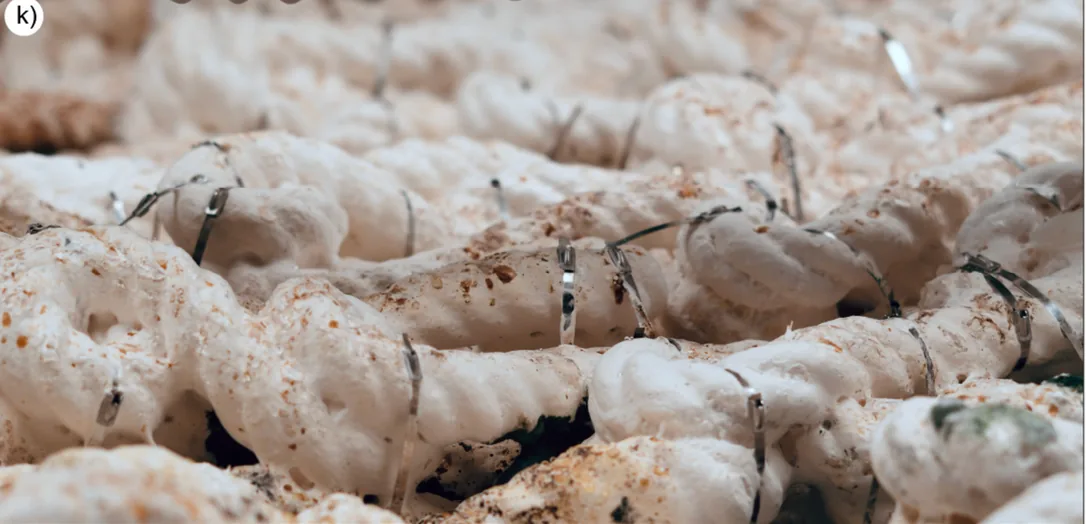
After braiding, the scaffold is pasteurised in hot water at 60 to 80°C and given a short UV-C treatment to keep competing moulds out. It is injected with a liquid fungal culture and incubated in a controlled clean room at around 26°C and 70% relative humidity, then air-dried until its weight stops changing. Drying stops the fungus and stiffens the network. The paper puts the whole consolidation stage at 30 to 45 days.
For the demonstrator, the robot laid 165 metres of hemp rope 28 mm thick; the dry scaffold weighed 83 kg. Laying rope took roughly 28 minutes per square metre in ideal conditions, not counting pauses. The robot completed 368 of 402 planned turns on its own, a rate of 91.5%, with operators handling the rest. Soaked and inoculated, the panel reached 138 kg, then dried down to 58 kg, 30.1% lighter than the dry scaffold. The average deviation from the digital model grew from 13.4 mm to 15.7 mm between braiding and the end of drying.
What the tests show
Single ropes colonised for 60 days by two fungi were tested in three-point bending. Trametes pubescens gave an effective flexural modulus of about 26 MPa and Ganoderma lucidum about 19 MPa, a gap the researchers did not find statistically significant. No rope snapped; the mycelium skin was crushed and cracked step by step under the load, which the team reads as a composite governed by its junctions. Sound absorption was modest, reaching only 0.10 to 0.17 at 1.6 kHz in impedance tube tests, which places this configuration below moulded mycelium acoustic panels.
Limits before buildings
The authors list the open questions themselves: growth takes weeks, the panel warps as it swings between wet and dry states, sample sizes were small, and creep, connections and long-term serviceability still need testing. At architectural scale, they argue, the bottleneck is no longer the robot but keeping the geometry steady while the fungus grows and dries.








Leave a comment