



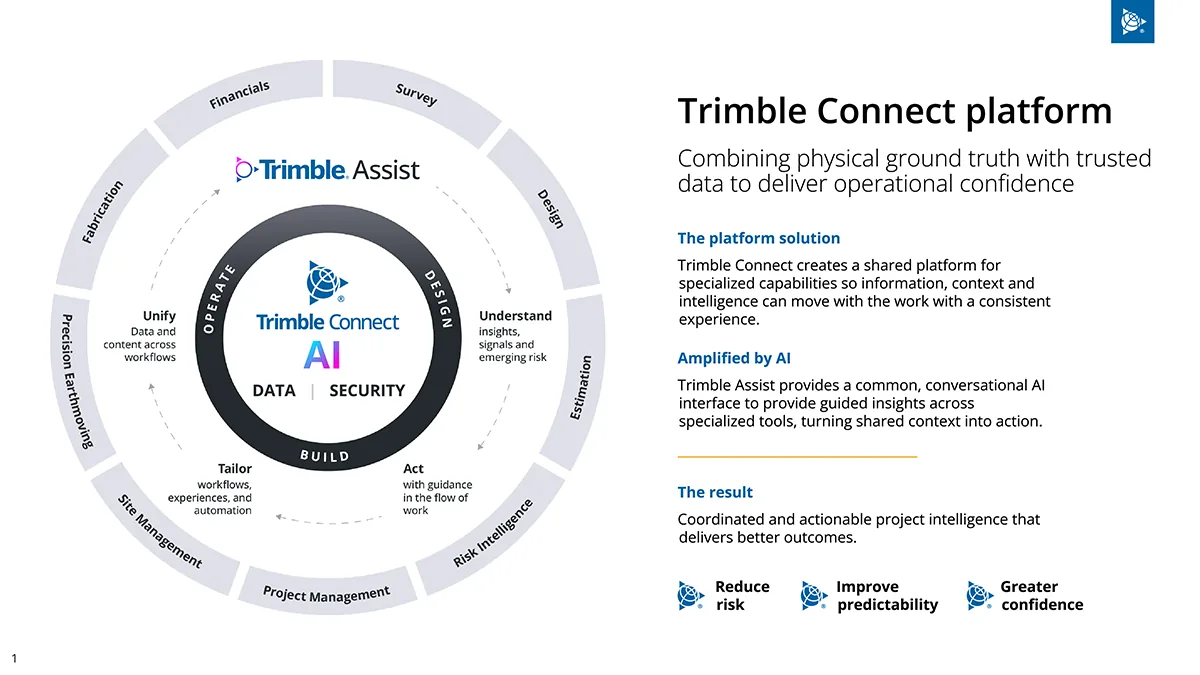
Trimble used its Dimensions user conference in Las Vegas on 9 November to launch a set of AI features for Trimble Connect, its construction data platform. The centrepiece for firms that want to shape their own tools is Trimble Agent Studio, which Trimble says lets customers turn standard procedures and the knowledge of their most experienced staff into custom AI agents and skills. It sits alongside Trimble Assist, a chat interface for working with agents across Trimble’s products. As with most launch material, the benefits described are the company’s claims.
 Blender 5.3 Adds Native Gaussian Splats, Opening a New Route From Site Scans to Architectural Visualisation
 Dynamo 4.3 Lets Architects Review Every Python Edit Autodesk Assistant Makes Before Accepting It
 Revit 2027.3 and 2027.4 Let Autodesk Assistant Build Dynamo Graphs and Bring Forma Daylight Analysis Into the Model
 Chaos Builds Veras Into Enscape 4.22 and Adds Image-Based Asset Tools
What Trimble Agent Studio and Trimble Assist do
In the release, Trimble presents Assist as a common conversational layer built into Connect, and Agent Studio as the place where teams and developers build, configure, orchestrate and govern their own agents. In a post on Trimble’s newsroom, chief executive Rob Painter calls Agent Studio a no-code builder for deploying specialised agents that reason across project data. Trimble frames the purpose as training and guiding a newer generation of workers as experienced people retire.
“In construction, risk can enter a project at five major points: physical, informational, contractual, commercial and knowledge. Connection is how we help customers manage that risk,” Painter said in the release.
Ten capabilities, six available today
Trimble lists ten AI capabilities across design, build and operate. Of most interest to architects is Generative Design, which produces design options while referencing live as-built point clouds streamed from Connect; it is still in Trimble Labs, an early programme for customer feedback. One-Click AI Indoor Classification sorts raw scan points into floors, walls, pipes and temporary structures, and 360 Reality Capture turns sitewalk videos into point clouds aligned to project drawings. Automated Structural Modeling turns prompts and spatial data into constructible steel models.
On site and in the back office, AI Punch Walk records voice-driven inspections and pins items to drawings, AI Procurement and Invoice Matching flags billing mismatches, and Trimble Connect Scheduling links the master programme to live jobsite data. Six of the ten are available now: Automated Structural Modeling, Indoor Classification, 360 Reality Capture, Punch Walk, Procurement and Invoice Matching, and Scheduling. AI Diagnostics for Field Hardware is limited to select customers, and Design File Verification and Change Order Automation are in development.
Scale, governance and what is not stated
Trimble says Connect has more than 55 million cumulative users who have worked on more than 35 million projects, with over 400 integrations. Painter adds that more than one million people use it each month. On governance, Trimble says all AI agents and models currently available in Connect carry standardised safety labels covering safety, security design and data provenance, aligned with the EU AI Act, ISO 42001 and its own AI principles.
The release gives no prices, and no dates for the features still in development. Painter’s post says more capabilities will arrive in phases throughout 2027 and mentions a usage-tracked consumption model called Trimble Credits, without figures. Architects working with Trimble-based contractors may meet these tools through shared models and scans before buying anything themselves.















Leave a comment