


The National Council of Architectural Registration Boards has set out new assessment methods for Pathways to Practice, its ongoing effort to rework how candidates become licensed architects in the United States. A blog post on 16 November, written by NCARB staffer Carson Bear, walks through how the organisation’s 16-competency framework will soon let candidates mix education, experience and examination in new combinations, under one fixed rule: a college degree will not be mandatory for any single competency.
 RhinoAI and Claude Code: McNeel Opens Rhino 9 to AI Agents at Rhino World 2026
 AI Data Brokers Are Offering Architects Six Figures for Old CAD Files, Raising Questions of Ownership
 Trimble Agent Studio Lets Construction Teams Turn In-House Know-How Into Custom AI Agents
 Blender 5.3 Adds Native Gaussian Splats, Opening a New Route From Site Scans to Architectural Visualisation
NCARB has been building toward this for a few years now, pitching the change as a way to widen entry into the profession while holding the same bar for competence. Candidates still have to show mastery of all 16 competencies, spread across design and documentation, construction administration, and practice and project management work; what is changing is how many different ways each one can be proven.

Education opens up with pre-approved courses
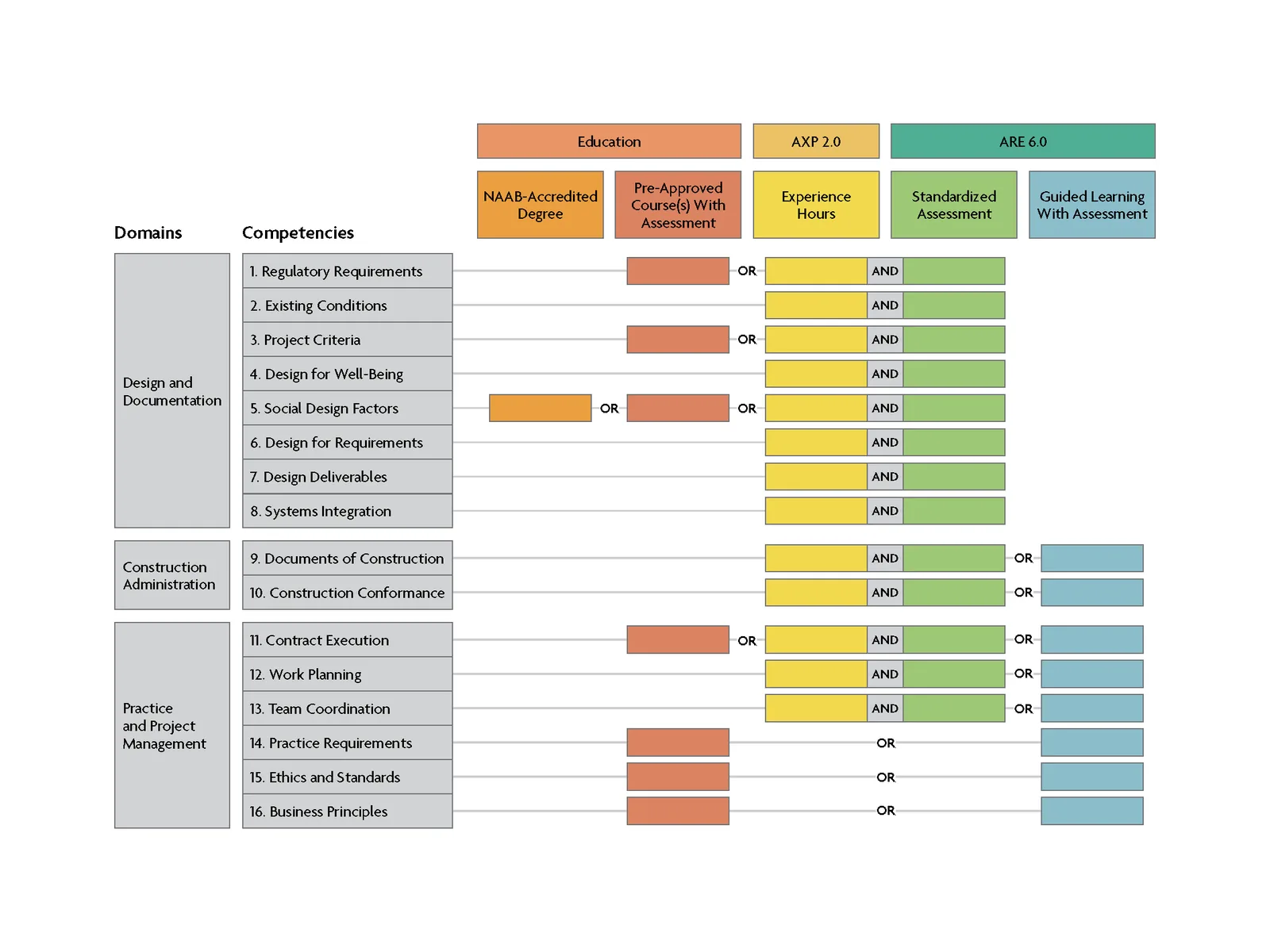
Right now, finishing a NAAB-accredited degree (one certified by the National Architectural Accrediting Board) earns credit toward just a single competency, social design factors, and NCARB says talks with NAAB are under way on whether that list can grow. The larger shift is a new pre-approved-courses track: any college or university, whether or not its architecture programme is accredited, can submit a course along with how it tests students, for NCARB to measure against the competency standard. Passing such a course and its assessment banks credit toward licensure before graduation. NCARB puts the current reach of this option at seven competencies. No competency, though, will ever hinge on holding a degree, leaving candidates who skip higher education a full set of alternate assessments to work through instead.
Supervised hours shrink into AXP 2.0, testing turns into ARE 6.0
What candidates know as the Architectural Experience Program is being rebuilt as AXP 2.0, trimmed down to the hours NCARB judges genuinely need supervised, hands-on learning, with the total hour count reset to match how firms actually operate today. The organisation also wants to credit relevant coursework toward that experience requirement, reasoning that classroom learning and time on the job can reinforce each other. Five competencies will need logged experience under the redesign, eight more can draw on it optionally, and anywhere experience counts, a matching standardised check will sit alongside it.
A fresh name covers the licensing exam as well, moving from today’s version to what NCARB calls its next-generation test, kept at testing centres or via remote proctoring. Two formats will be on offer: conventional timed assessments resembling current exam sections, mandatory for five competencies and optional for eight, plus an untried guided-learning route that mixes short practice check-ins with one closing assessment, open for eight competencies. Each piece targets a single competency instead of a wide subject area, and NCARB expects shorter, cheaper individual sessions even though total cost and time to licensure should stay roughly level.

A gradual rollout for Pathways to Practice, with time left for current candidates
None of this switches on soon. NCARB’s own schedule points to a start no sooner than the 2028 to 2029 turn, once it has issued fresh guidance covering the revised experience programme, the next-generation exam and updated education rules sometime in 2028. Anyone licensing under today’s rules keeps roughly four more years to finish that way, the two systems are meant to run side by side for about two years once the newer one opens, and NCARB puts retirement of the current methods no earlier than 2030 or 2031.
NCARB’s published matrix maps out how those routes split by competency group. Design-heavy and documentation competencies mostly pair logged hours with a standardised check, whereas several competencies under practice and project management, contract execution and business principles among them, lean toward the course-based or guided-learning routes instead, a sign that NCARB sees those particular skills as better taught than examined cold. None of it takes effect yet, and the organisation says fuller guidance, covering how much experience each education level still needs and how current candidates eventually cross over, should surface by late 2027.


















Leave a comment