



Construction has begun on all four jails meant to replace New York City’s Rikers Island complex, following a recent groundbreaking on the Manhattan site in Chinatown. The city’s Department of Design and Construction is overseeing new detention facilities in Queens, Brooklyn, the Bronx and Manhattan under the Borough-Based Jail Program, which launched in 2017. The program was originally tied to an August 2027 deadline for shutting Rikers, a target the city now acknowledges it will miss.
The Brooklyn facility, at 275 Atlantic Avenue in Boerum Hill, is furthest along and is expected to open in 2029. The other three are expected to be completed in the early 2030s, past the original closure date for Rikers.
Design of the borough-based jails

Architecture firm HOK is behind both the Brooklyn jail and the Manhattan facility. The Bronx project, rising on the former grounds of Lincoln Hospital, is being designed by a team including CetraRuddy, Lumen Architects and Urbahn Architects, while STV and Michael Graves are behind the Queens facility, the only one of the four with dedicated housing for women and gender expansive people.
Design documents describe cells fitted with a single bed, a desk, a stool, a toilet and horizontally barred windows rather than the solid bars associated with older jails. In Manhattan, HOK is building in circadian lighting systems tied to daylight cycles, moving away from the constant overhead fluorescents typical of existing facilities; some cells also give occupants control over a reading light. Brooklyn’s design leans on terracotta and fixed sun fins to match the surrounding streetscape, with outdoor sections of each cell enclosed in security mesh so residents get daily access to open air.
HOK’s Ken Drucker argues the firm has an obligation to take on this kind of work rather than avoid it. “We think it’s our responsibility as architects to help solve some serious social problems, and we don’t shy away from them,” he told Dezeen. His colleague Jeff Goodale, the firm’s director of civic and justice work, framed the intent behind the layouts in similar terms: “This design strategy is really meant to be something that the people can thrive in, and it’s not just a place where they always feel like they’re on the defence all the time.”

Not everyone in the profession agrees jails should be designed at all. In 2020 the AIA’s New York chapter called on architecture firms to step back from prison and detention work altogether, a stance that puts firms like HOK at odds with parts of their own industry.
Borough-Based Jail Program: Costs, Delays and Community Pushback
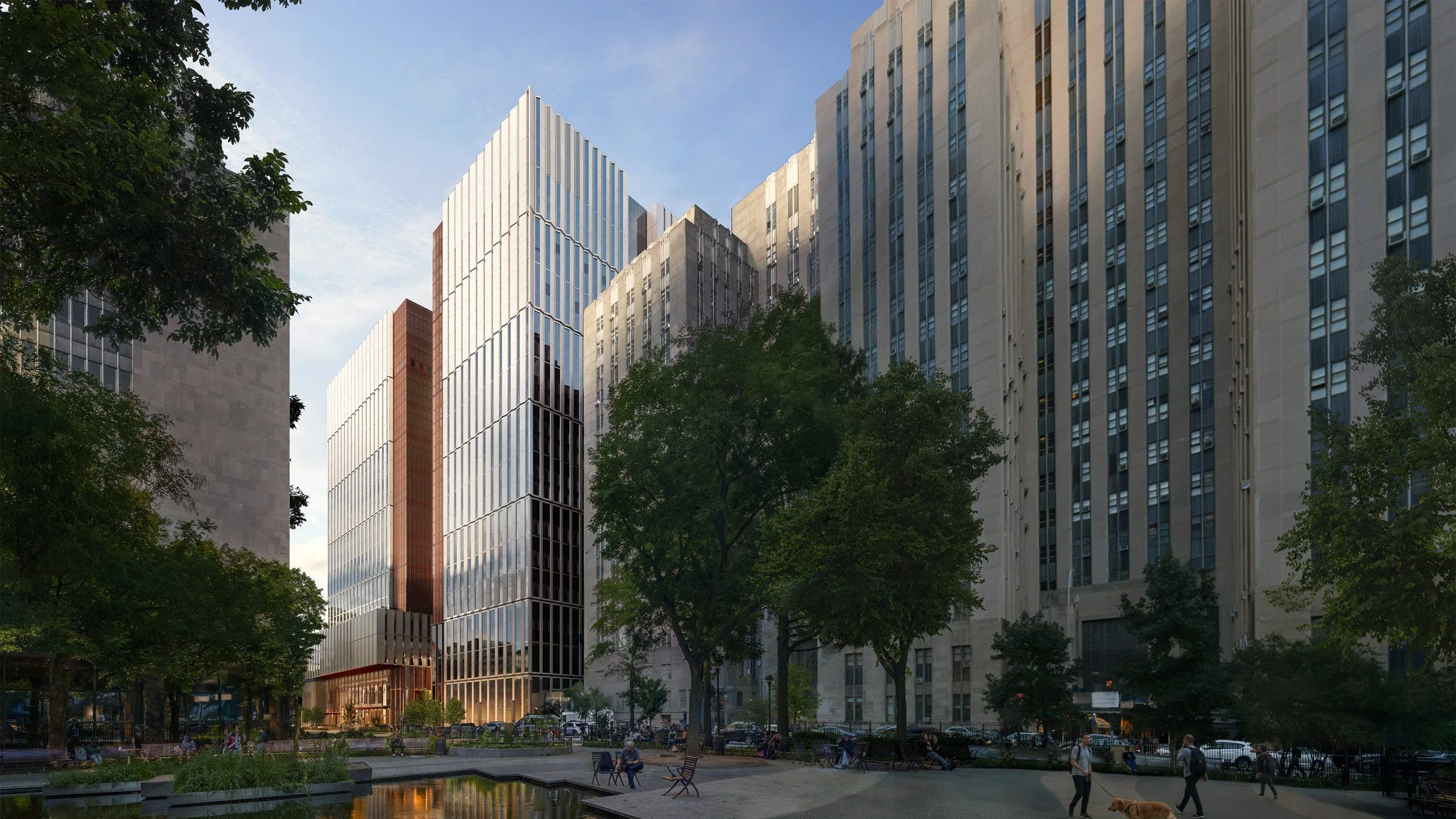
Mayor Zohran Mamdani has described Rikers as “one of the deepest failures of our city government” and framed the programme as replacing a system built around neglect with one centred on rehabilitation.
That reasoning has not quieted local resistance. Residents near several of the sites, including in Chinatown and around the Bronx location, have staged rallies against the projects over the past few years, and design details for the Queens facility, including accessibility updates, are still being finalized in community meetings.
With contracts registered and demolition finished at every site, the program’s next visible milestones are structural: excavation and structural work continue at the remaining sites ahead of years of construction still to come.
Justice buildings are among the hardest briefs in civic architecture, and whether to take them at all divides the profession. For how civic work is commissioned and judged, see our guide to the specialisms within practice and the questions raised in designing public space.
















Leave a comment