



Table of Contents Show
RIBA Part 1, Part 2 and Part 3 are the three qualification stages that make up architectural education in the UK. Part 1 is an undergraduate degree, Part 2 is a master’s level qualification, and Part 3 is a professional practice examination taken after at least 24 months of recorded work experience. Passing all three makes you eligible to register with the Architects Registration Board.
The three part system has shaped how architects qualify in Britain for more than fifty years, and it is now being rewritten. Students starting today need to understand both how the current route works and what the Architects Registration Board (ARB) is replacing it with between 2027 and 2028. This breakdown covers each stage, the experience rules that trip up most candidates, the registration process at the end, and the transition dates that decide which framework applies to you.
What Are RIBA Part 1, 2 and 3?
They are three separate qualifications, not three years of one course. The term “Part” belongs to the Royal Institute of British Architects, which validates courses at each of the three levels. ARB, the statutory regulator created under the Architects Act 1997, runs a parallel system: it accredits qualifications and maintains the Register of Architects. Most UK courses are recognised by both bodies at the same time, which is why students talk about a single qualification when two organisations are actually involved.
The distinction matters at the end of the process. Only ARB registration gives you the legal right to call yourself an architect in the UK. RIBA Chartered Membership is a separate, voluntary step that gives you the postnominals and access to the institute’s services. You can hold one without the other. If you are weighing up the length of the commitment before you apply anywhere, the realistic timeline for becoming an architect sets out how the years actually stack up.
The Three Stages at a Glance
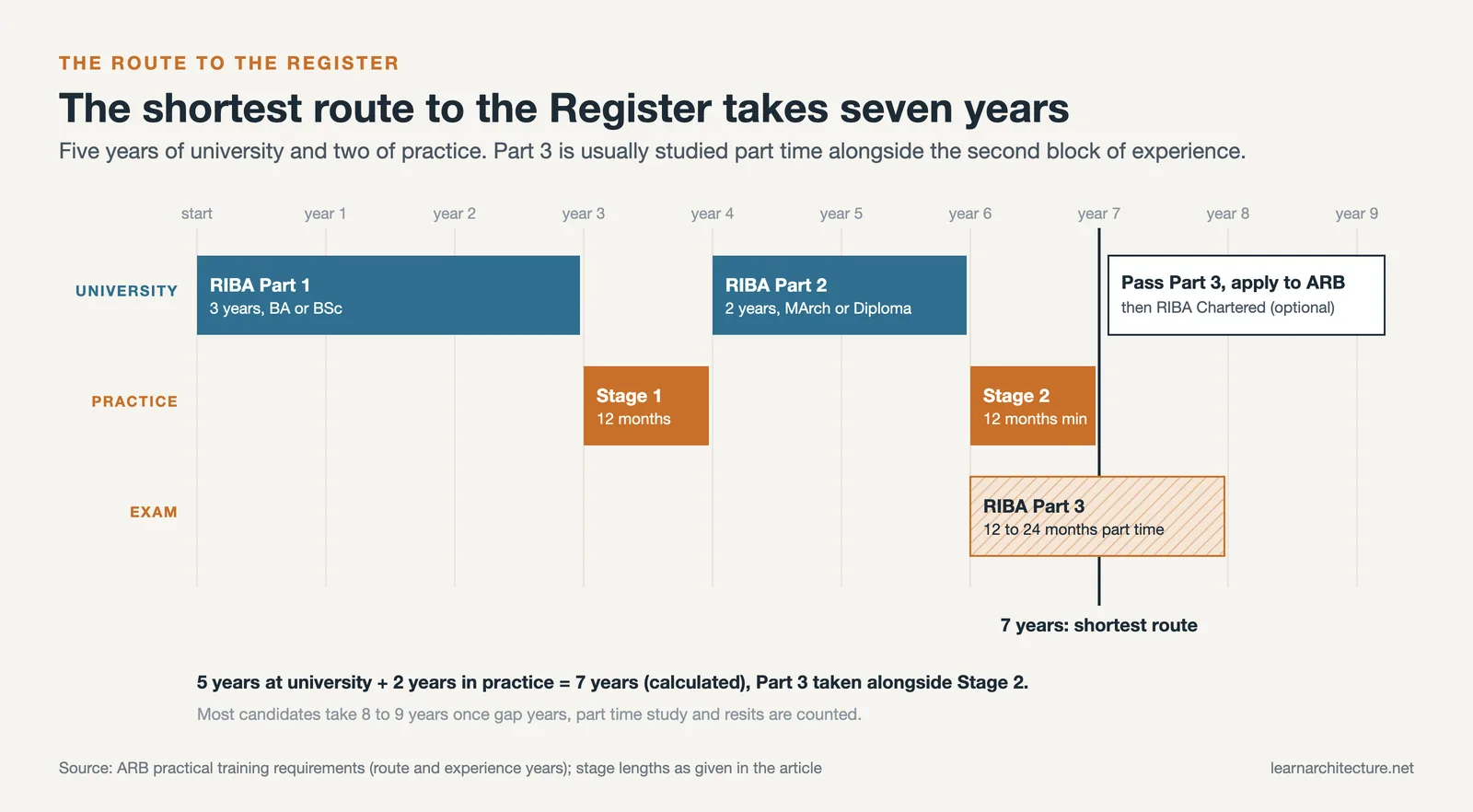
The table below summarises the standard UK route, including the two periods of practical experience that sit between the academic stages.
| Stage | Level | Typical length | What it leads to |
|---|---|---|---|
| RIBA Part 1 | Undergraduate (BA or BSc) | 3 years full time | Entry to Part 2 courses, architectural assistant roles |
| Stage 1 experience | Practice based | 12 months (the “year out”) | Recorded PEDR sheets counting toward the 24 month total |
| RIBA Part 2 | Master’s level (MArch or Diploma) | 2 years full time | Eligibility for Part 3 courses |
| Stage 2 experience | Practice based | 12 months minimum | Completion of the practical training requirement |
| RIBA Part 3 | Professional practice exam | 12 to 24 months part time | ARB registration and RIBA Chartered Membership |
Add it up and the shortest realistic path runs to seven years: five in university and two in practice, followed by a final examination. Very few people complete it in exactly that time, and there is no penalty for taking longer.
RIBA Part 1: The Undergraduate Stage

Part 1 is a three year honours degree in architecture, usually a BA or BSc, delivered through design studio with supporting modules in history, theory, technology, environmental design and professional studies. Studio work dominates the timetable and the assessment. You leave with a portfolio, which becomes the currency for both job applications and Part 2 admissions.
A Part 1 degree on its own is not a licence to do anything, and it does not commit you to the rest of the route. Plenty of graduates move into visualisation, interior design, construction, development or design research and never return. If you are still choosing where to apply, the guide to the top architecture schools worldwide covers how to read a programme beyond its ranking position, and the beginner’s starter guide to learning architecture is a useful primer before first year begins.
The Year Out: Stage 1 Practical Experience
After Part 1, most students spend a year working in practice as an architectural assistant. This is the first block of the 24 months of practical experience that Part 3 will eventually require, and it has to be recorded on the RIBA’s Professional Experience and Development Record (PEDR), signed off by both an employment mentor and a professional studies adviser.
💡 Pro Tip
Fill in your PEDR sheets while the work is still fresh, not at the end of the placement. Candidates who reconstruct a year of experience from memory tend to write vague entries that fail to evidence the criteria, and chasing a former mentor for a signature two years later is the single most common administrative delay at Part 3 enrolment.
RIBA Part 2 Explained: Master’s Level Study

Part 2 is a two year qualification at master’s level, most often an MArch, though some schools award a Diploma in Architecture. Projects get longer, briefs get less prescriptive, and the emphasis shifts toward independent research, thesis level design and technical resolution. Many programmes ask for a year of practice experience before entry, which is one reason the year out has become standard rather than optional.
Full time study is not the only option. The RIBA runs its own school through RIBA Studio, offering a Certificate at Part 1 level and a Diploma at Part 2 level for people who stay in employment throughout. The Level 7 architect apprenticeship covers Part 2 and Part 3 together while the apprentice works and earns, with tuition costs met through the apprenticeship levy. These routes take longer in calendar years but remove most of the tuition debt, and ARB’s reforms were written partly to make more of them possible. Where cost is the deciding factor, the breakdown of AA School tuition fees shows how wide the gap between providers can be at Part 1 and Part 2 level.
RIBA Part 3 Guide: The Final Professional Practice Exam
Part 3 is not a taught degree. It is an examination in professional practice, assessing whether you can act as an architect in the UK: contract administration, procurement, professional conduct, statutory duties, insurance, fees and practice management. Assessment usually combines a written case study drawn from a live project, a career appraisal, your professional experience record, written papers or coursework, and an oral examination in front of two examiners.
Providers structure it differently. The Bartlett at UCL, for example, delivers its Part 3 examination in professional practice around four units covering practice, projects, professionalism and portfolio, taught part time alongside full time employment. The RIBA runs its own Advanced Diploma in Professional Practice in Architecture from Chester and London, with cohorts also delivered in Hong Kong and the UAE. Course length runs from around twelve months to two years depending on the provider and your study pattern.
The Practical Experience Rule Most Candidates Get Wrong
The requirement is a minimum of 24 months of recorded experience under the direct supervision of a professional in the construction industry, of which at least 12 months must be worked in the UK, the wider EEA, Switzerland, the Channel Islands or the Isle of Man under the direct supervision of an architect. What matters as much as the total is when the months were worked.
⚠️ Common Mistake to Avoid
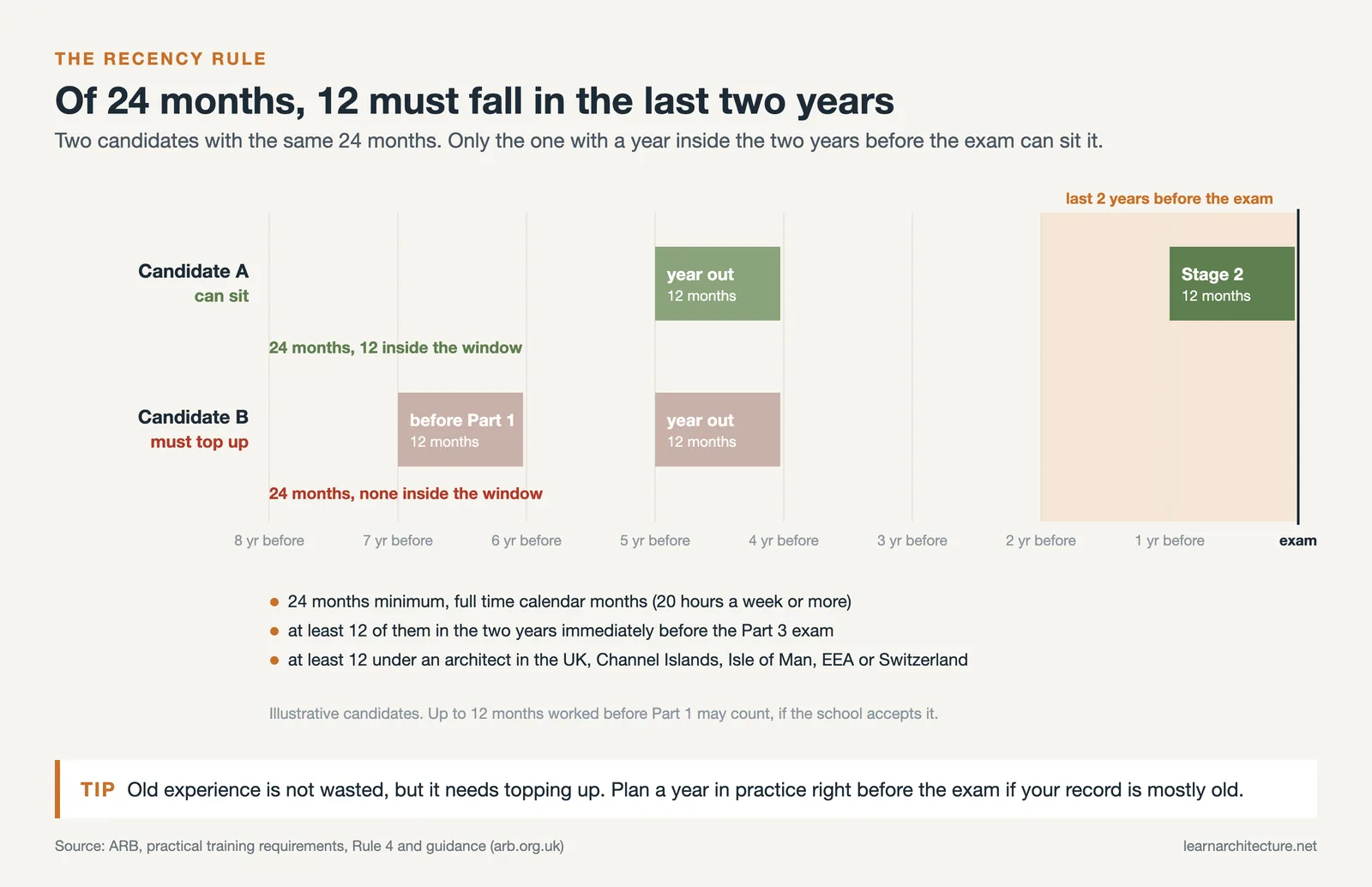
Many candidates assume all 24 months have to be earned after Part 2. They do not. The ARB and RIBA rule states that at least 12 of the 24 months must fall within the two years immediately before you sit the Part 3 exam, which means up to 12 months of earlier experience, including up to 12 months of work done before you started Part 1 if your school accepts it, can count toward the total. The trap runs the other way: experience gathered years ago and never topped up will not satisfy the recency test.
ARB sets out the detail, including how overseas placements and self employment are treated, in its practical training requirements. Discuss anything unusual with your professional studies adviser before you commit to a placement rather than after.
How Do You Register With ARB and Become a Chartered Architect?

Passing Part 3 does not put you on the Register automatically. You apply to ARB, submit evidence of your Part 1, Part 2 and Part 3 qualifications, and pay an application fee plus the annual registration fee, which is charged pro rata depending on the month you apply. ARB set the registration fee for 2026 at £225 at its October 2025 Board meeting, with a £40 application fee for anyone joining within two years of passing Part 3. Applying within two years of passing Part 3 is significantly cheaper than applying later, because a longer gap triggers a higher application fee, currently £124, and past a certain point additional scrutiny of your continued competence. The published ARB fee tables set out every category. For scale, 38,726 architects renewed their registration for 2026, broadly level with the previous year, according to ARB figures reported by the Architects’ Journal in January 2026.
Once your name appears on the Register you can legally use the title architect. Chartered Membership of the RIBA is a separate application, with its own subscription, and it is what allows you to use the letters RIBA after your name. The two run in parallel for the rest of your career, alongside ARB’s statutory CPD scheme and the Architects Code of Conduct and Practice that took effect in September 2025. Architects qualifying in the United States follow a different path entirely, mapped out in our guide to getting licensed through NCARB and the ARE.
What Changes Under the ARB’s New Framework?
ARB is dismantling the three part structure. Its Tomorrow’s Architects reforms replace Parts 1, 2 and 3 with two accreditation points: a set of Academic Outcomes, achieved through a master’s level or equivalent qualification, and a set of Practice Outcomes, achieved through a qualification based on professional experience. Both are built on five competency areas covering professionalism and ethics, design, research and evaluation, contextual and architectural knowledge, and management, practice and leadership.
📌 Did You Know?
The push to scrap the three part structure came largely from inside the system. In the education survey ARB published in June 2022, 65% of respondents agreed that the structure of Parts 1, 2 and 3 needed to change, and among architecture students that figure reached 94%. Eighty per cent also backed the move from rules based criteria to an outcomes based model.
The full proposals, the transition timetable and the reasoning behind them sit on ARB’s Tomorrow’s Architects pages.
Transition Dates That Affect Current Students
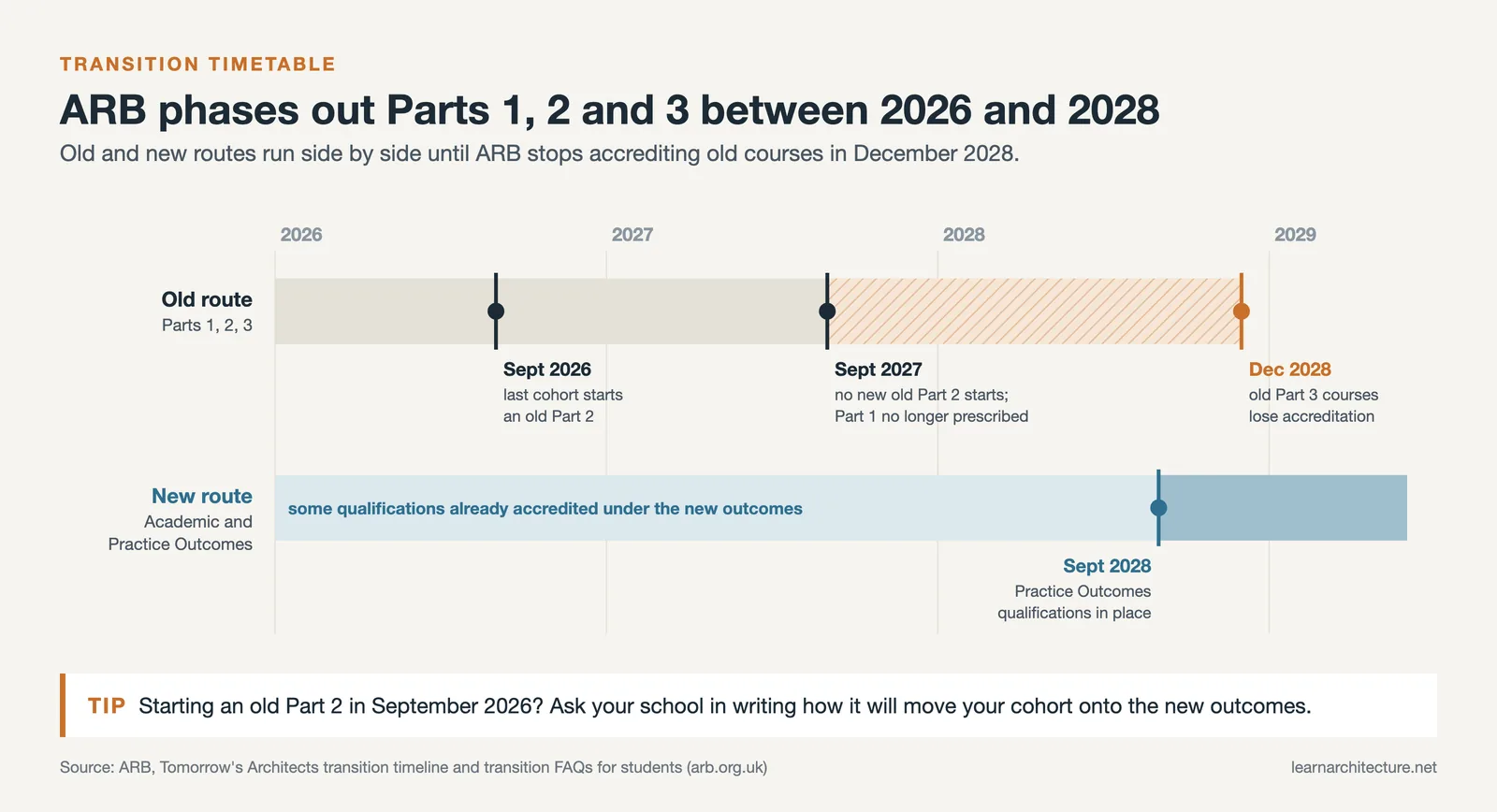
| Date | What happens |
|---|---|
| September 2026 | Final cohort begins an existing Part 2 qualification |
| September 2027 | No new students can start an old Part 2, and Part 1 is no longer prescribed by ARB |
| September 2028 | New qualifications assessing the Practice Outcomes are in place |
| December 2028 | Old Part 3 courses cease to be accredited for registration purposes |
The reforms are already producing courses. ARB’s 2025 annual report records the approval of the first three master’s level qualifications under the new framework, and the regulator accredited new qualifications from two more universities in May 2026. If you are midway through the old route, ARB will continue to accredit existing qualifications until 31 December 2028, so a student who began a Part 2 in 2026 can finish it and take an old style Part 3 within that window.
One point causes needless panic. The RIBA has confirmed it will keep validating programmes at Part 1, Part 2 and Part 3 and will keep running its own RIBA Studio and Part 3 qualifications, so the vocabulary is not disappearing even where ARB stops using it. The institute’s position on the reforms is set out on its changes to studying architecture pages, and the current route is summarised on the main RIBA guide to becoming an architect.
If You Qualified Outside the UK

Holders of overseas qualifications have their degrees assessed by ARB for equivalence to Parts 1 and 2. Where they fall short, the Prescribed Examination provides a route to demonstrate equivalent competence, charged per part. A UK Part 3 is still required in almost all cases, which is why the Bartlett, the RIBA and other providers accept candidates who have never held a UK Part 1 or Part 2 certificate.
Mutual recognition agreements shorten the process for some. ARB has agreements covering Australia and New Zealand, the United States and, since 2025, Canada, plus a registration route for holders of Swiss qualifications. The Prescribed Examination itself is being replaced during the transition, so anyone planning to use it should check the current position before paying for anything. Budgeting for the whole journey is its own exercise, and the breakdown of what becoming an architect actually costs is worth reading before you commit.
Fee levels, transition dates and registration rules change regularly. Figures here reflect ARB and RIBA published information at the time of writing, and you should confirm current requirements directly with the relevant body before making decisions.
Where to Go From Here
The practical question for anyone starting now is which framework they will finish under, not which one they start in. Check whether a course you are applying to has been accredited against the new competency outcomes, ask the school directly how it plans to move existing students across, and keep your experience record current from the first week of your first placement. Those habits protect you regardless of which set of rules is in force when you reach the final exam. For a wider view of what the career looks like on the other side, our honest assessment of architecture as a career covers pay, workload and long term outlook.
Your Next Step: Before you accept a place on a course or an offer in practice, ask the school or your professional studies adviser one question in writing: which ARB accreditation does this qualification currently hold, and what is the plan for moving existing students onto the new competency outcomes. The answer tells you more about your route to registration than any prospectus will.
Frequently Asked Questions
How long does it take to qualify as an architect in the UK?
Seven years is the shortest standard route: three years at Part 1, two years at Part 2 and two years of practical experience, with Part 3 usually studied alongside the final period of work. Most people take eight or nine years once gap years, part time study and repeated modules are factored in.
Can you take RIBA Part 2 without Part 1?
Not on the traditional route, since Part 2 admissions require a Part 1 or an assessed equivalent. Under ARB’s new framework an accredited undergraduate architecture degree stops being a requirement, which opens master’s level entry to people with other degrees or relevant professional experience.
Is RIBA Part 3 the same as ARB registration?
No. Part 3 is the examination; registration is the administrative step that follows it. You apply to ARB with evidence of all three qualifications and pay the application and registration fees, and only once your name is on the Register can you legally call yourself an architect in the UK.
Will RIBA Part 1, 2 and 3 disappear after 2028?
ARB will stop accrediting old style qualifications after 31 December 2028 and will regulate through Academic and Practice Outcomes instead. The RIBA has said it will continue validating programmes at Parts 1, 2 and 3 as a route to Chartered Membership, so the terms will still be used in job adverts and course titles.
Do you have to join the RIBA to work as an architect?
No. Chartered Membership is optional and costs an annual subscription. Registration with ARB is the mandatory one, because the Architects Act 1997 protects the title rather than the membership.












Leave a comment